

Milestones: Now by Maxwell
Maxwell made an album about commitment with another man’s instruments and another woman’s famous song. It still sounds like his.
The number-one R&B single of 1999 was “Fortunate.” Maxwell didn’t write a single word, but R. Kelly did and produced it for the Life soundtrack. It arguably gave him the most signature song of his career. Debatably bigger than his first two albums. Through the late ‘90s, Maxwell had built himself into one of the genre’s fiercest, most talented artists. By writing and produced with his production crew, insisting on his arrangements. He began writing songs in his room and became a regular at the New York club circuit within a few years, performing his original compositions at small clubs around the city. He signed with Columbia Records in 1994.
His debut album, Maxwell’s Urban Hang Suite, was recorded in 1996 and was largely inspired by a short-lived romance. It featured comparisons to Marvin Gaye’s early work for his use of an expansive approach, an obsessive love interest, and a seven-minute-long single. His first album had slow starts on the charts, but then “Ascension (Don’t Ever Wonder)” gained massive popularity on R&B radio playlists, helping the album to go platinum. Maxwell was grouped in with D’Angelo, Erykah Badu, and Lauryn Hill as part of the neo-soul movement, although his music was more constrained in its outlook than any of his contemporaries. He had little to say about politics and Black identity, and he wanted to focus on a topic that was close to his heart, and one that made many fans swoon or grumble.
The sophomore album, Embrya, arrived in 1998. While Urban Hang Suite had a polarizing critical reception, with praise for its concentrated approach, Embrya was criticized for meandering and being self-indulgent. Maxwell seemed to be striving for a more introspective and ethereal sound than critics wanted, and the market was not ready for it. Then “Fortunate” was released as a single, an oft-haunting, broadly conventional R. Kelly ballad. It appeared to be the opposite of his previous work, and it became Maxwell’s biggest career hit. The industry told him what the market wanted, and he delivered.
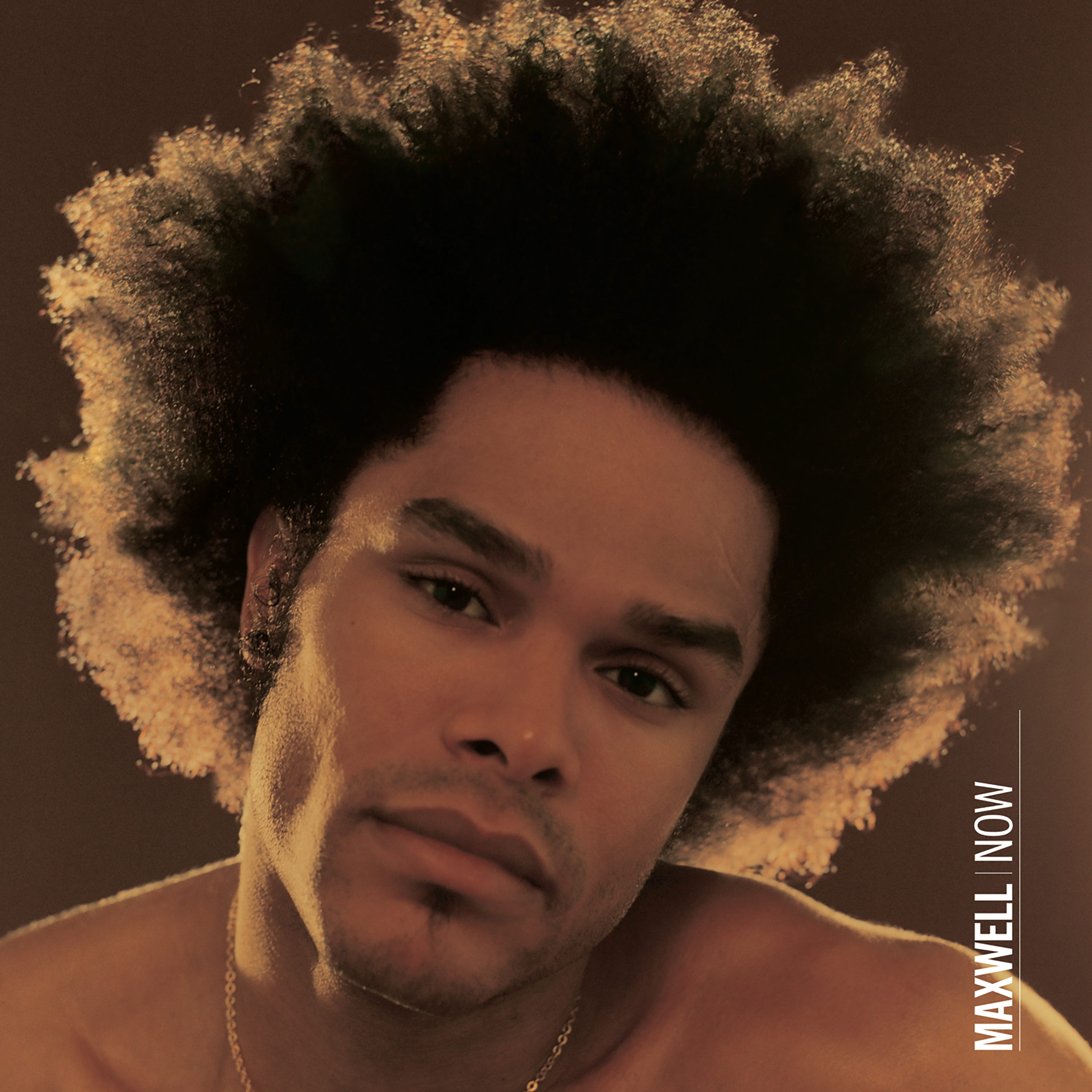
Now was released four years later. He produced the album under his alias Musze, but the most prominent name attached to this album is Stuart Matthewman. The Sade and Sweetback keyboardist and producer appears on each of the 12 tracks as a co-producer and co-writer. Matthewman can be heard on all the album’s musical instruments, including guitar, keyboards, bass, saxophone, banjo, autoharp, clarinet, and Mellotron. His unmistakable style has a significant impact on Now since his Sade productions are deeply felt, patient, and expansive. They allow the listener to get absorbed in the music. His expertise in gentle ballads appears to influence Maxwell’s singing, if only to a small extent. Now is a collaborative effort that only sounds like it was created by a single artist.
This is really the album of declarations from the singer; Maxwell seems to have used a lot of this record just to let his true intentions be known, without much playacting, the prime example being the number one hit “Lifetime,” a 15-week R&B/Hip-Hop Songs chart winner that nabbed a Grammy nomination. He’s telling you that he wants this person for keeps and will not wait. No flirting, no deferring of the commitment. The song reiterates how much he means what he says, with his falsetto reaching new, ever more serious heights each time, as if seeking the absolute most honest tone for a permanent promise. “Get to Know Ya” is the lead single from this collection and is a bit more subtle, a man laying his desire on the line without expecting too much in return, and “NoOne” tells you its premise outright with the title, of sorts. He’s chosen; there’s nothing to contest.
When it comes to a one-night encounter, and he’s owning it, this is the point where he lets go on “Temporary Nite.” This is the loosest Maxwell has sounded on the whole album. After this is “Symptom Unknown,” where Maxwell is declaring a state of confusion in him. He is having an emotion in him that he cannot understand, and instead of making a judgment out of it, he lets Matthewman’s guitar fill the space left for a possible diagnosis.
Kate Bush wrote the song “This Woman’s Work” in 1989 for the movie She’s Having a Baby. It was a man’s perspective about his lover having a medical emergency and his devastation for his part in it—all the things he should have said to her and could not say. Maxwell’s version is a slower arrangement stripped to the bones of the melody, his upper register, and a few chords. It was one of his best songs, not written by him, and it haunts this album’s best track. This is no slight against Maxwell, for he does a typically exquisite job of distilling the song to its essence, but it is a sign of things to come.
The drum stool on this album is marked by Michael Bland, Prince’s drummer for the mid-90s. Wah Wah Watson, whose wah-wah guitar made magic in Marvin Gaye’s I Want You and Herbie Hancock’s Head Hunters, is also on board. Hod David, who co-wrote several tracks, plays guitars, keyboards, bass, and programmed drums. The sessions for the album were held at The Hit Factory and Sear Sound in New York, Sarm West in London, The Village Recorder in Los Angeles, and Chung King in Manhattan. And not just any musicians—they are people with rich histories, lending the recordings a certain sensibility that makes ‘70s R&B and jazz-funk feel a lot less like a stretch. It is, in fact, Maxwell’s R&B and jazz-funk.
The relationship is breaking up on “Silently,” but no one is saying. Maxwell doesn’t make it all weep and moan but simply tells it like it is. It is dissolving quietly without notice, with no fussing and fighting, no saying anything at all. It is the saddest song on the album, and it’s one of Maxwell’s saddest, most inward-looking choruses. “Changed” takes a different approach, as Maxwell tries to make heads or tails of a relationship that clearly can no longer be the same. It has changed somehow between him and the girl, and he is trying to determine whether it is just for a while or permanently.
On this album’s most underresolved track (“Symptom Unknown”), Matthewman’s guitar meanders beautifully around the changes to the tune that never quite arrive. When an artist has sung his heart out on much of Now, proclaiming his feelings most recently on “Lifetime” with enough passion to make it a top 40 hit for 15 weeks, this is a song where the doubt wins out. Matthewman, drawing upon his experience with the patience of playing with Sade, when a guitar phrase could carry a whole four minutes, gives Maxwell enough room to describe the symptoms without looking for any remedy for it. While a man who could commit to someone on “Lifetime” for 15 weeks at number one couldn’t commit to explaining what is going on inside him on “Symptom Unknown” for even four minutes. He left the confusion standing and, thereafter, didn’t create any other albums for eight years.
Great (★★★★☆)