

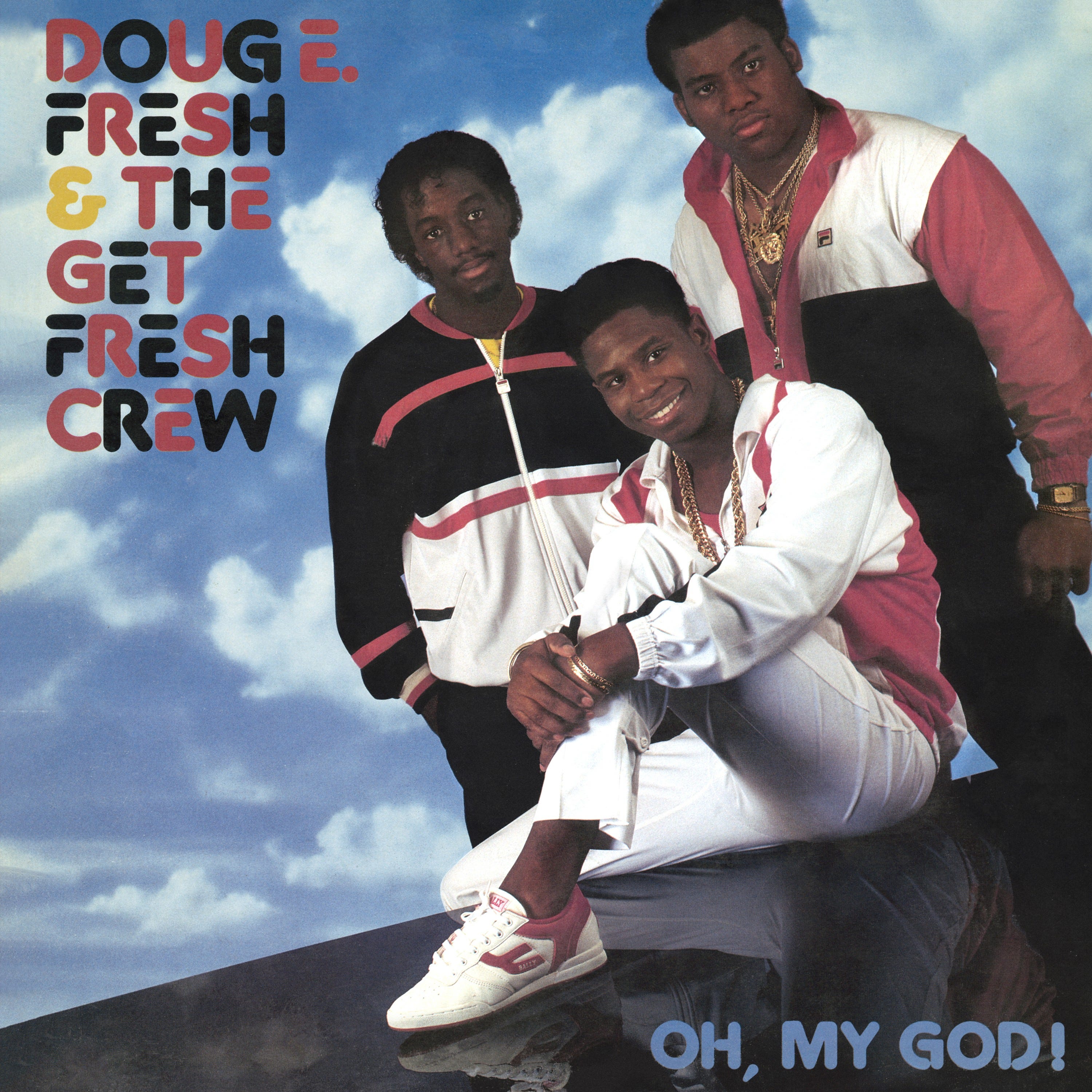
Douglas E. Davis cups his hands around a microphone stand in Manhattan, just after dawn in February 1986. There’s no instrument in the room. Davis puts his mouth around the mic and starts popping a kick drum with his throat. His snare drum is attached to his bottom lip. The hi-hat is a dry, percussive hiss between his teeth. Those who have heard this magic trick don’t believe their eyes; those who haven’t suspect they’re being lied to. He goes by Doug E. Fresh, and has been moonlighting in Harlem talent shows since junior high school. The summer before this session he cut a pair of singles with a friend from high school named Ricky Walters. Those singles spread through neighborhoods faster than either of them expected, and redefined what a rap song could possibly sound like. He has been called the original human beatbox by people who couldn’t correctly tell you how he got that nickname to begin with. Onstage it doesn’t matter. What matters is the room that sits around while he makes a kick drum with his throat.
The Caribbean breezes through every recording session Doug ever steps in front of. His parents immigrated him from Bridgetown, Barbados, to Harlem when he was too young to talk back. So the dancehall toasting his parents played at family parties in Bridgetown got stuffed into the way Doug used his voice ten years later, and then into the way he attacked a microphone another decade after that. He sounds like reggae doesn’t exist any time he steps outside of New York’s clipped meter, like on “Lovin’ Ev’ry Minute of It” and on “She Was the Type of Girl” where his consonants get softer than most Black New Yorkers’, and his rhymes cling to beats long after they’re needed to. He never replaced that island music in his ears with his adopted city’s.
When Doug walked into a Brooklyn studio that February, Mister Fantastica wasn’t with him. Doug and MC Ricky D wrote the hook to “The Show” together at Ricky’s kitchen table back in late 1985, along with “La-Di-Da-Di,” which followed soon after. Between them they cornered Harlem’s sound for the winter of ‘85 and spring of ‘86 with singles that blew up so quickly and extensively that by the time summer records began landing in stores New York hadn’t sounded like this in years. Soon after Ricky’s second single dropped them uneasy partners split up, quietly at first but then decisively. Ricky wouldn’t rap on another record for years, only to pop up on Def Jam a few years later under a name borrowed from his childhood nickname in Harlem. So complete was this gesture of self-reinvention that two years later half of hip-hop’s listeners would swear Ricky Rubin made himself up. Doug hadn’t stopped dreaming about making his first album since his first talent show back in junior high; now the debut LP he’d planned on making with MC Ricky D that spring would be a solo effort. How well he could do it by himself was what everyone flocking to buy rap albums that summer wondered when dropping five dollars at their local record store.
Programmer Chill Will built the drums and performed all of the cuts. Barry Bee, self-described as the Cut Professor, scratched records. Dennis Bell and Ollie Cotton worked the board. Doug leaves rapping for forty-two seconds on “Leave It Up to the Cut Professor” and steps back while Chill Will crafts a beat so empty-handed you can almost see right through it, and Barry Bee scratches over it. “Chill Will Cuttin’ It Up” is forty seconds of vocals-less testament to Chill Will working a beat for no reason other than to show he could. Doug disappears off his debut album for those four minutes and lets his DJ’s and programmers take turns stealing the spotlight. He spent that summer calling the Get Fresh Crew a band in nearly every interview, and Get Fresh Crew Come Clean proves it.
For one minute and a half on “Nuthin’” Doug tells the listener the streets offered him nothing. By the song’s second verse he’s sold that nothing and is now rapping about it on wax. Barry Bee scratches a sample underneath him while Chill Will drops one of his dreamscape drums so bare there’s not much besides silence underneath him. Doug kicks a beat so cleverly woven into the production you’d swear he was on the outro and complements Chill Will’s programming by harmonizing his voice with his mouth percussion. Doug spends the chorus telling a fabricated story about how his girlfriend turned him onto bodegas and every other rapper in 1986 is rapping about the same things on that same block. Doug digs his pockets for the fifth verse and counts his money to the song’s end, only half of him doing it. The other half is working beats.
The remix of “The Show” clocks in over eight minutes, every single one of which is Doug apologizing for taking something he made with somebody else. They dragged the Cold Crush Brothers’ “Oh my God!” tag clear to the front of the mix. They stuffed beatbox interludes into Slick Rick-shaped holes. Doug raps Ricky’s verses, and there’s nothin’ you can say about the two of them sharing a song that isn’t true about them sharing a life. Doug E. Fresh was an amazing beatboxer, and he was never going to tell stories the way Ricky could. He’s both celebrating and mourning over that eight-minute stretch. Winning and grieving at once, holding a hit single by its corners while the man it belonged to half walks out the door of his life.
On “She Was the Type of Girl,” Doug attempts storytelling from the school Ricky taught himself in. He sketches you a woman brick by brick: what she’s wearing, how she carries herself when she walks, the sound her feet make on pavement, what she says when she opens her mouth, the moment Doug realizes she’s got no interest in him. The Caribbean comes through hardest on this song. His accent curls around syllables in a way other Brooklyn rap from the year curls around syllables doesn’t. The consonants soften as they do in dancehall. The rhyme schemes are stubborn enough to let a syllable hang until the beat forces them to clip it. Doug was not Slick Rick and will never be stylistically centrifugal enough to reach him, but here he is spinning off of him nonetheless with his own accent and his own ear.
Doug recorded a song called “Abortion” and delivered his rhymes from the perspective of a young man trying to convince a woman not to terminate her pregnancy. It’s the perspective any stern-raised-twenty-year-old churchgoer from Harlem would offer on the subject in 1986, and he gives you that perspective straight up without wink or smirk, snide lyricism that would later become attached to any rapper who dared approach this topic like it was anyone’s business but his own. You can agree with him or not—what’s wild is how rare it was for him to say anything at all. We hadn’t yet reached the era of so-called conscious rap arriving as its own marketable subset, but even then most rappers wouldn’t touch the topic at a dinner party much less record themselves discussing it for Vinyl Anthems in front of an A&R man.
Bernard Wright, then a fusion keyboardist just springboarded from cutting ’Nard for GRP records, walked into a Brooklyn studio sometime that spring and recorded his contributions to a hip-hop album whose lead singer made percussion sounds using his mouth. Jimmy Owens, a working jazz trombonist, did essentially the same thing on a later track. Album producers Dennis Bell and Ollie Cotton were likewise building a career out of not knowing what a rap producer’s role in the music industry was at the exact second they were defining it. Hip-hop had become professionalized enough that real musicians were being invited into the studio to play on songs, DJs were being given their own interstitial moments to shine, and Doug’s beatboxing was being mixed as if it were a horn solo of one. Kids Smiling watched three different studios birth it into the world: A&R Studios, Planet Sound and Rawlston Recording in Brooklyn. All three studios had three different acoustics, which is part of why the album sounds unlike anything that had come before.
Even now, this has never received a proper compact disc release. Reality Records went belly up, Fantasy Records was sold to new owners who couldn’t squeeze a profit out of what Doug’s catalog wasn’t already turning, and the masters were moved to a location unknown from which they have not since been returned. You can find LL Cool J, Run-DMC, and the Beastie Boys behind Cam’ron albums on Spotify. You can pick up a half-dozen versions of Rakim’s Paid in Full if you’re really shopping for one. Doug’s debut album—a top twenty entry on the R&B charts when it was released—has never earned a silver pressing, and has never been made available to stream on any major service in its original tracklisting. Whose career gets kept on life support is another story for another time, and one that hasn’t particularly mattered because the quality of the art in question has never been brought into the discussion.
Doug blesses his heart into “All the Way to Heaven.” The song details ascension, being good at your chosen craft, heaven-as-a-churchgoing-twenty-year-old-from-Harlem conceptualized as somewhere you earn and somewhere you stay when you get there. The beatbox underneath him is the same beatbox he was doing for empty junior high auditoriums and Harlem crowds who had no idea what was happening twenty years prior to the single’s release date. At one point his voice cracks slightly on an elongated note, a thing that professional engineers in Brooklyn knew how to fix had they wanted to leave it on the track. He’s twenty, but the thirteen-year-old kid he was, who played with Cubase on his parents’ living room floor, is doing somersaults in his throat the whole song. “I do this for the people,” he says halfway through the verse, tucked between two showcases of his percussive talent. “And I do this ’cause I love it.”
Solid (★★★½☆)