

Milestones: Reasonable Doubt by JAŸ-Z
The drug dealer’s debut built a billion-dollar empire. Thirty years later, nothing else in his catalog sounds this hungry or this scared.
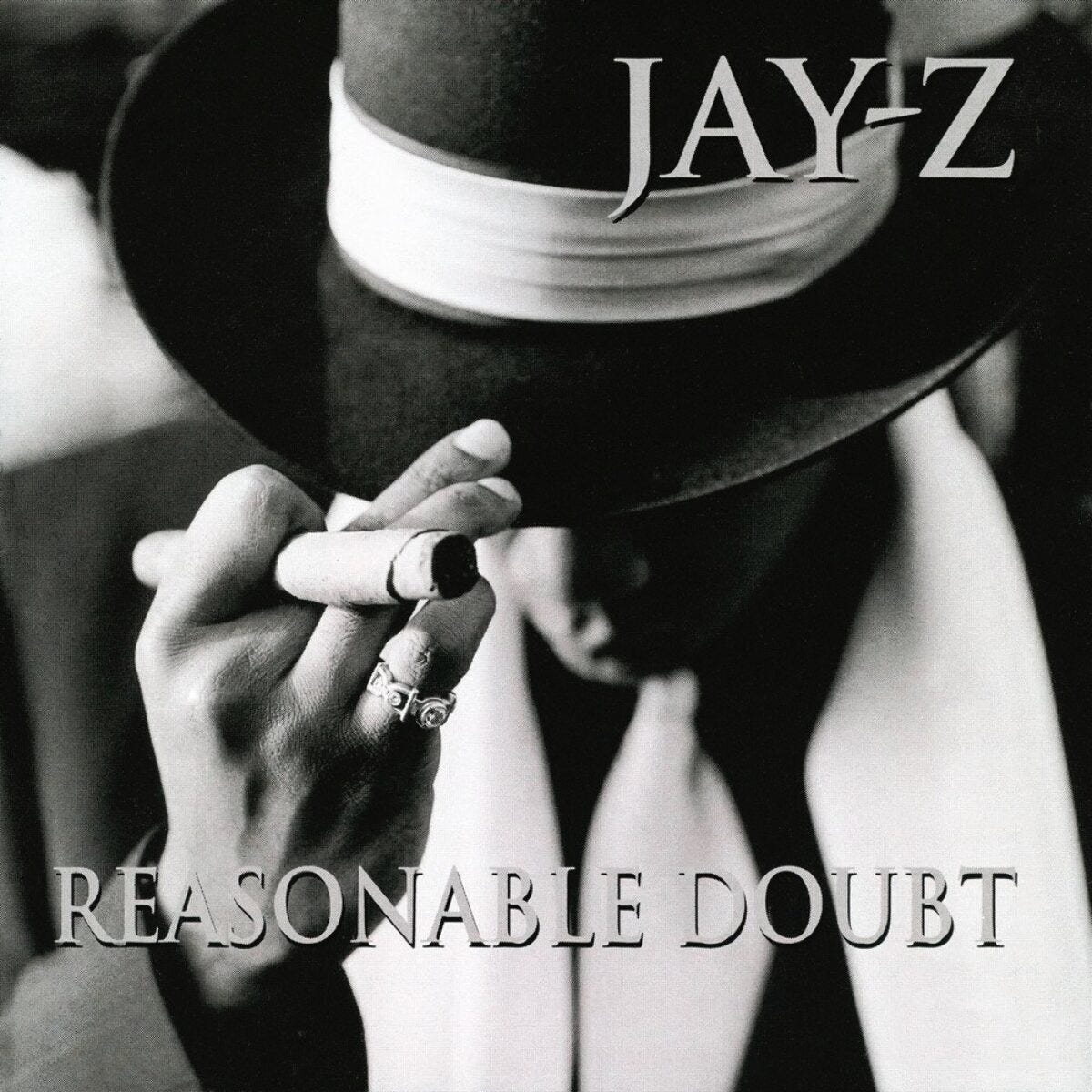
Three guys from Brooklyn put their drug money together and bought the cheapest office they could find on Street John, in one of the dreariest blocks of lower Manhattan. For some reason, they named the company after John D. Rockefeller, which was kinda funny. They were dealing in wrinkled fives and tens coming out of a pocket of the cargo pants. The one dealing the handshakes was Damon Dash; the one keeping quiet was Kareem Burke; the rapper was Shawn Corey Carter, selling burned CDs and tapes from the trunk of a white Lexus at college campuses that nobody ever heard of.
Everyone dismissed Shawn from every major record label in New York at that point. Atlantic declined. Columbia declined. “I went to every single record label and they were like, ‘This guy is terrible,’” he told MTV years later. Payday Records were apparently owing Shawn some money for a few singles in a botched deal—Shawn asked to pull the money out, created Roc-A-Fella, and gave some to Dash and Burke. Reasonable Doubt then came out in the summer of 1996—JAŸ-Z was 26, started rapping at 15, toured with Big Daddy Kane, and had absolutely no reason to think that the music industry wanted anything whatsoever to do with him.
The chip-on-his-shoulder album talks about selling crack the way a man who’s done it for ten years and hates it, but knows how, might talk about it—with flow but a barely concealed exhaustion. On “D’Evils,” none of his friends speak to each other anymore ’cause everybody’s trying to win. A mate’s baby mother gets kidnapped; he lays it out straight: never prayed to God. He prayed to Gotti. Premier chops an Allen Toussaint gospel sample with a voice from Snoop’s Murder Was the Case and inverts gospel against itself. “Can I Live” starts quickly with a piece of spoken word: “We hustle out of a sense of hopelessness. One sorta a desperation. Through that desperation, we become addicted. One sorta a like the fiends we accustomed to servin’.” Irv Gotti built a beat out of Isaac Hayes’ “Look of Love,” and it’s gorgeous. Jay tells you he is 26 and is wondering if he might see 27. He relates it flat, the way you would when you have just seen a bank statement that left things hanging in the negative.
A lot of New York rap in 1996 sampled hard records. Reasonable Doubt went digging through your parents’ vinyl collection instead. Lonnie Liston Smith, The Stylistics, Bohannon, Eddie Henderson, Earl Klugh and Hubert Laws, The Whole Darn Family. Soul and jazz and quiet storm, all repurposed until they sound like borrowed time in an expensive room. Ski flipped Lonnie Liston Smith’s piano into a mournful bed for “Dead Presidents II” and spliced a Nas vocal from “The World Is Yours (Tip Mix)” underneath it, a move that would become its own soap opera years later when Jay and Nas went to war. “Politics as Usual” takes The Stylistics’ “Hurry Up This Way Again,” which is a love song, and Jay raps over it about paranoia, moving product between cities, and trusting nobody. Clark Kent and Ski both made beats for that track. Ski’s won. The sessions ran on competitive energy. The music on this album is unhurried, smoky, upholstered, but the lyrics keep telling you somebody might die at any moment.
For “Friend or Foe,” you only hear one side of the conversation. Jay is in a hotel room telling a kid pushing his turf, “yo, get lost,” in polite tones, as befits someone who already knows what happens if you try to put him off. Then Premier chops Brother to Brother’s “Hey What’s That You Say” into something that could be a lift in a building you shouldn’t be in, and the track lives off that—quiet menace in a suit. On “Coming of Age,” he has a slightly more polite conversation. Memoirs from a young kid trying to rise up (Memphis Bleek plays his part), so Jay takes Bleek out, watches him buy sneakers and re-ups, warns him about loyalty, a Clark Kent sample off Eddie Henderson’s “Inside You” adding a softness that neither relies on much of course. The kid needs someone to look up to and so Jay is glad to oblige.
On Reasonable Doubt, Jay talks about money and who got hurt in getting it, and “Regrets” is where he counts the damage. Peter Panic uses a sunny Earl Klugh and Hubert Laws sample that makes it worse. You are getting awful news in an expensive room. One verse goes to a woman whose lifestyle burned through, one to his mother, and one to the ghost of the dead friend who is asking Jay to let a beef go. Jay lets it go. That is the one mercy on the entire record. Jay ain’t apologizing for nothing else.
The sessions were taken by Dexter Thibou, the engineer from D&D. He remembered that Jay never once lost his cool and always kept it classy, even when things went tits up. Mary J. Blige came late one night to lay her vocals for “Can’t Knock the Hustle” and decided she didn’t want to sing there with all them people. He waited. His man Knobby had built the beat from Scarface dialogue and Meli’sa Morgan two years earlier back at his mother’s place, and Mary’s hook now gave them the record they could play at a dinner party as well as a dice game. Commercially, however, it was “Ain’t No Nigga” that went harder. Big Jaz decided to flip The Whole Darn Family’s “Seven Minutes of Funk” and the Four Tops and built a bounce that Foxy Brown (Fox Boogie was her name) would ride the whole way to her own career, and she was back at Jay’s ass rhyming what she expected from her man. And even kinda beat him on his album at his own game.
The collaborative “Brooklyn’s Finest” has Jay and The Notorious B.I.G. trade barriage of bars back and forth. Neither wrote down a word, but they both learned the other did not either over the course of recording through the two studios, D&D and Giant. Spanning the course of two months, the pair created two Brooklyn rappers who love and respect one another, trying to out-talk the other one into the ground. Biggie, the more famous, wanted to cement his position, and much of the young Jay’s performance on that song is aimed at dethroning him and proving he belonged in the air Biggie breathed. “22 Two’s,” a pure technical exercise over a Tribe Called Quest sample and delivered as a gig at Mad Wednesdays, goes somewhere entirely different—twenty-two variations of the title over an A Tribe Called Quest interpolation in a swaggering exhibition of talent about no other subject than himself. Biggie sounds like a man born winning. Jay, for all his swagger, sounds like a young man who’s had to teach himself how, and it is there on this wonderful, iconic debut for all to hear.
D&D started at around 6 in the evening, with the sessions running 6-8 hours. Dash paid engineers with cash out of his pocket and rarely lacked it. Thibou said Jay was “so pristine about his shit” that every detail had to be right: beats, punchlines, pronunciation, placement of the last line. Roc-A-Fella would always pay in cash for all the jackets, boats, cars, and studios you saw in the videos, always on an overdraft. Then looking broke, they paid more than they had. Reasonable Doubt débuted at #23 on the Billboard Hot 200 list, staying there for eighteen weeks before being certified platinum in February 2002; nearly six years after it was released. It possibly sold only 420,000 before the end of ’96. Jay’s eighteenth album, Vol. 2… Hard Knock Life, two years later was his first #1, and Jay calls Reasonable Doubt “the joint it took my whole life to make.” No sentiment. He would have been crafting each of its bars since he was hanging out with Jaz-O during his early teenage days.
Masterpiece (★★★★★)