

Milestones: Return of 4eva by Big K.R.I.T.
The Mississippi rapper and producer’s magnum opus of a mixtape is Southern rap’s warmest, most self-assured free album of 2011.
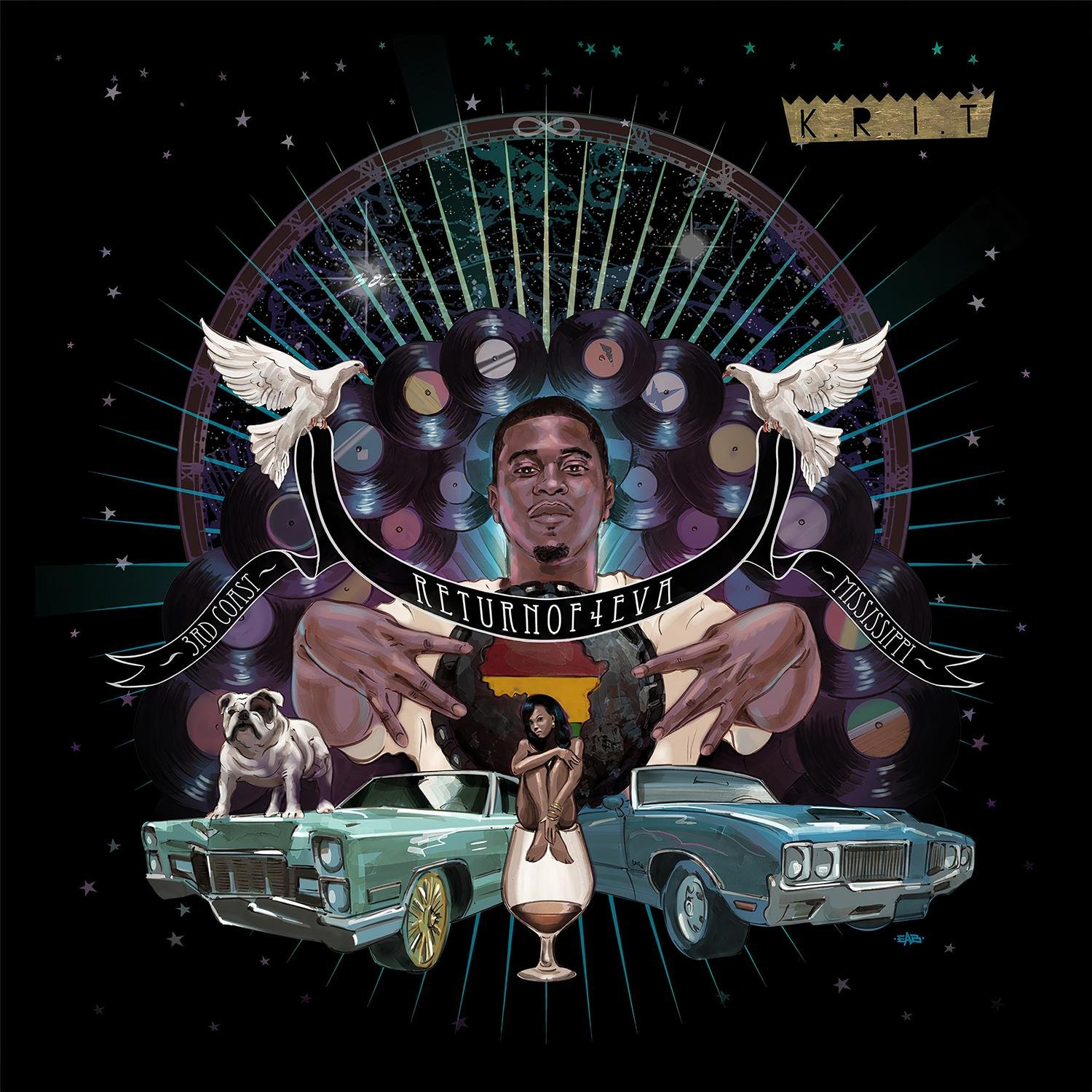
Southern rap had drifted into a strange cul-de-sac. Lex Luger’s industrial 808 patterns were eating the mainstream alive. Waka Flocka Flame’s Flockaveli had steamrolled the prior fall, and every major-label A&R in Atlanta wanted that same blunt-force percussion on every single. The soul and funk that once fed Southern hip-hop, the stuff that Organized Noize and DJ Paul and Pimp C had poured into records for two decades, had mostly evaporated from commercial radio. It survived in pockets, among older heads and regional loyalists, but a 24-year-old kid from Meridian, Mississippi, wasn’t supposed to be carrying that tradition forward. Big K.R.I.T., born Justin Scott, had other plans. He’d dropped K.R.I.T. Wuz Here the previous May, a self-produced mixtape that earned him a Def Jam deal and an XXL Freshman cover alongside Kendrick Lamar and Mac Miller. Return of 4Eva, released for free, was his follow-through. Twenty-one tracks he wrote, produced, and sang on by himself, out of a town most rap fans couldn’t locate on a map.
K.R.I.T. learned to make music on a PlayStation, using MTV Music Generator because he couldn’t afford to buy production from anyone else. That scrappy origin persists throughout Return of 4Eva, where every drum pattern and horn stab and bass tone belongs to him. He samples old soul and funk records, chops them into new shapes, and buries them under subwoofer-punishing low end, but the final product never sounds like collage work. The tracks carry a uniform humidity, thick and slow-moving, the kind of music that sounds right with the windows down in August heat. “R4 Theme Song” (arguably his best song ever) runs a hard-hitting beat, a Softones sample, and an interpolation of OutKast’s “Ms. Jackson.” “Rotation” locks into a late-afternoon drift with a looping organ sample and 808 kick that hits somewhere behind your sternum. He clearly absorbed Pimp C’s belief that the producer and the rapper should answer to each other, and he skips the middleman entirely by being both. The advantage of a single creative brain steering everything is cohesion. The risk is insularity, and K.R.I.T. sometimes tips toward the second.
But the strongest songs on Return of 4Eva justify the one-man-band approach because K.R.I.T.’s writing and his instrumentals are telling the same story. “Dreamin’” is the clearest example. He raps about scribbling rhymes on his baseball glove during practice, about his father dismissing music as a career, about the years of working without recognition. The instrumental underneath, distorted vocal samples and chill psychedelic guitar, sets a tone of restless optimism, like driving toward something you can’t see yet. “Rise and Shine” opens with the line “the latest I could be was on time” and spends three minutes on the stubborn daily grind of a person who refuses to waste a morning. “American Rapstar” goes after the industry itself. K.R.I.T. recounts an A&R telling him you can judge a song’s worth within fifteen seconds, and he spends the rest of the track dismantling that logic, arguing that his music requires the full three minutes and forty seconds to register.
The mixtape’s second half moves into harder territory. “Another Naive Individual Glorifying Greed and Encouraging Racism” spells out its acronym on purpose, and the song delivers on the provocation. K.R.I.T. raps about systemic poverty, the pressure on successful Black men to perform generosity while their communities starve, the contradiction between material aspiration and collective survival. “Tap dance if you want him to/Coulda fed the hungry, but he bought them jewels,” he writes, implicating both the rapper and the audience watching him. “Lions and Lambs” shifts to broader racial terrain with a heavy organ-driven track that feels borrowed from a Delta church service, and K.R.I.T. drops his voice into a lower, more deliberate cadence, letting each bar land with extra weight. “Free My Soul” pushes further, asking God to intervene in the confusion of young Black life in the Deep South. He’s talking about his block, his family, the people he sees at the gas station. When he addresses racism, he does it with the specificity of someone who grew up in a town of 40,000 people where the consequences were visible and local.
The guests on Return of 4Eva benefit from K.R.I.T.’s beats in ways their own recent records hadn’t managed. David Banner, a fellow Mississippian whose commercial peak had passed by 2011, comes alive on “Sookie Now,” riding a funky, strutting groove that gives him room to flex regional pride without the bombast of his mid-2000s singles. Chamillionaire, three years removed from any major release, delivers his best guest verse in ages on “Time Machine,” where he finds space to shout out the people of Japan in the wake of the 2011 tsunami, the kind of tangential, in-the-moment detail that dates the tape in a good way, making it feel alive and responsive to the world outside the booth. The “Country Shit” remix closes the project with Ludacris and Bun B trading verses, and K.R.I.T.’s beat, a heavy, trunk-rattling crawl, suits Bun B’s gruff Houston baritone perfectly. K.R.I.T. handles these collaborations like a bandleader distributing solos. He gives each rapper a track calibrated for their strengths, and the results uniformly surpass what any of those artists were putting out on their own that year.
The peaks on Return of 4Eva hit hard enough to make the valleys worth crossing. “The Vent” is the emotional center, a five-minute confessional about losing friends to petty beef, watching relationships deteriorate under the stress of ambition, and questioning whether the radio will ever play the music he grew up loving. “The radio won’t play the shit I used to love,” he admits midway through, then catches himself: “or maybe I’m just growing up.” That kind of small, honest pivot—disappointment flipping into self-awareness in real time—is K.R.I.T. at his sharpest. “My Sub” pounds with ridiculous low end, a love song to the subwoofer in his trunk, and K.R.I.T. delivers it with the affectionate goofiness of somebody who truly does spend his weekends testing speaker systems in parking lots. “King’s Blues” strips the instrumentation to bare-knuckle piano and lets K.R.I.T. croon about weariness and persistence over something that could have been cut in a juke joint.
None of these songs are trying to be anything other than what they are. Reflections from a young man in Mississippi who taught himself to rap and make beats in his bedroom, who drives a car with the bass turned up too loud, who worries about his grandmother and argues with God and feels slighted by an industry that doesn’t know where his hometown is. In a year when Southern rap was being defined by everything loud and stripped-down, Return of 4Eva argued quietly that the region’s richest tradition was still the one with soul music running underneath it. For a free tape from a kid nobody in New York had met, that argument carried real weight.
Masterpiece (★★★★★)