

Milestones: Section.80 by Kendrick Lamar
A 23-year-old with a co-sign from Dr. Dre made an album about his generation’s addictions. Fifteen years later, the first week’s 5,000 copies look like a rounding error against the culture it rewired.
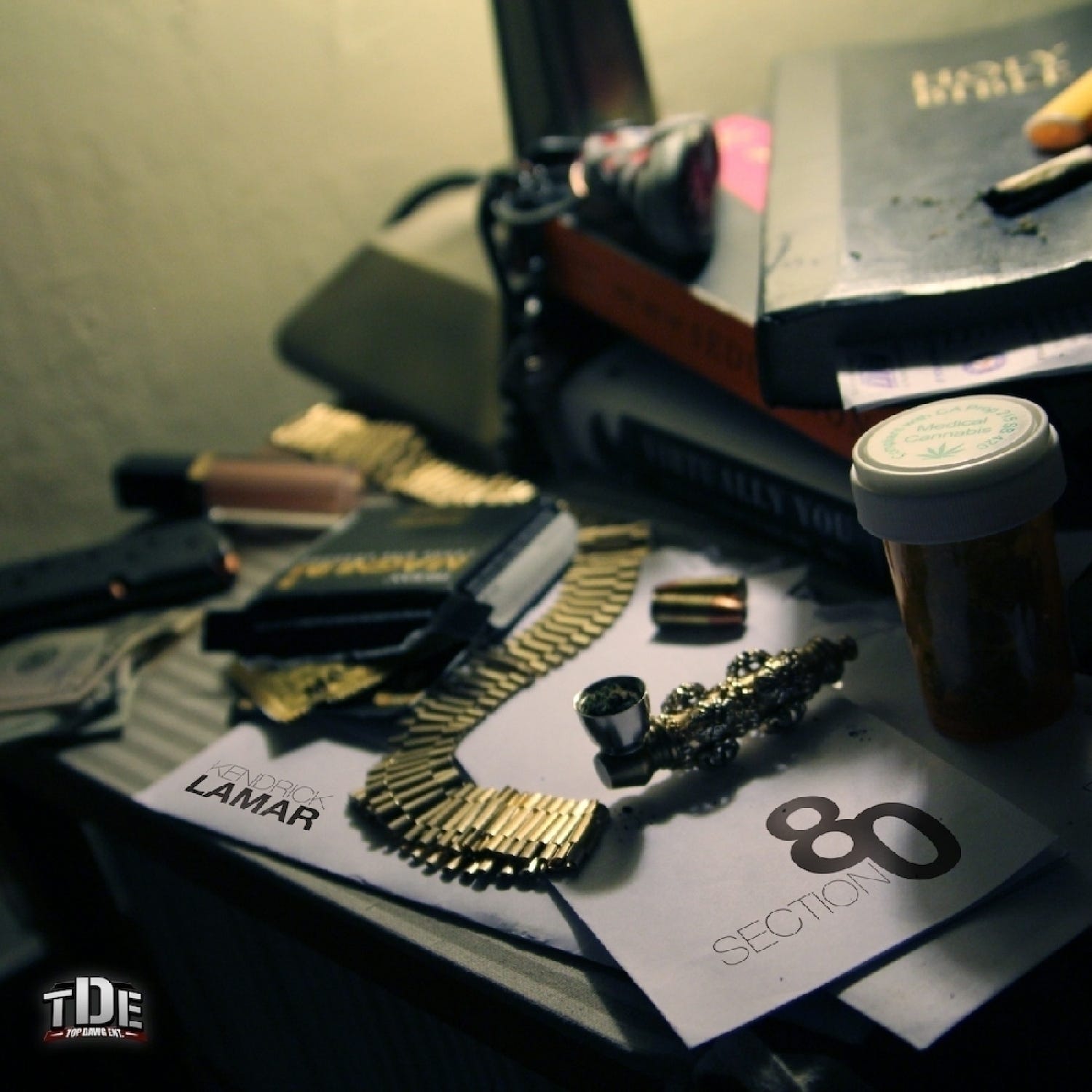
A friend of his got twenty-five to life, and that was enough. The kid who’d been running around rapping as K. Dot and still acting as the hype man for the TDE tour. Now he moved back into Top Dawg Studios in Carson, a town twenty minutes from Compton he’d been recording in since he was sixteen; the house crew called it “the House of Pain.” He was writing raps on his mom’s kitchen table and in a bus between shows. Dr. Dre was already circling him. He was already in the background. But Kendrick Lamar Duckworth didn’t want a Dre beat on that. He told Complex he didn’t want people repping a single song for “two or three crazy ass Dre beats.” So he handed every track to the Digi + Phonics players, to Sounwave and THC and Tae Beast and Willie B, and even got Tommy Black and a J. Cole beat to do a close.
The title is supposed to tell you what it’s about if you read it properly. Section 8 housing and the 80’s. The generation who were born during the crack epidemic, who would be prescribed Adderall and Xanax by the time they were fifteen, who were raised on the long tail of Reagan’s War on Drugs and left with no mythology of progress behind them. That’s who Kendrick is talking to here, and that’s who he’s talking about, and he’s one of them. The parenthetical tags stitched into the disc for good measure: couples up songs by gender. “(Her Vice)” and “(His Vice)”; “(Her Evils)” and “(His Evils)”; “(Her Pain)” and “(His Pain).” Same pain, different sex, two tracks side by side so you can’t listen to one without thinking about the other.
On “A.D.H.D,” a 23-year-old describes getting high and going to parties and being carefree, his own word for it, and then the song keeps going, and the carefree behavior stops sounding carefree. The drugs are for not paying attention, and he says so. “You know why we crack babies? ‘Cause we born in the 80s.” He’s doing exactly what he’s about to spend the rest of the tracklist questioning, and he knows it, and he doesn’t play that he’s above it. That’s the innovation he’s at the party too, getting high with everybody else. A year before “Swimming Pools (Drank)” asked that question with a catchy hook, this was the first draft.
Two girls get cheated on, leave, and end up bouncing off each other out of epic frustration. Men flub them so thoroughly that they’re fully done with the whole category. On “Tammy’s Song,” Kendrick is narrating it from outside the door, never offering a judgment. The “Keisha’s Song,” meanwhile, has a hook sung by Ashtrobot about wanting to be cheated on in order to feel alive, and Keisha, a prostitute, searches for comfort and control and finds neither, and eventually she‘s dead. These are named characters, not composites or archetypes: women with specific bad nights, specific results. Kendrick knew the art of constructing a person, three verses and nothing more, and leaving her story living or dying on its own. He already practiced that work on good kid, m.A.A.d city, where the characters’ single narrative link served, more than the separation of a rap collection would, as simple an anchor as a chapter break. But here, the separation in itself is the narrative. Keisha does not know Tammy; Tammy does not know Keisha. They’re just occupying the same album.
Nor would the crack epidemic have gotten underway if, as “Ronald Reagan Era” states without remorse, government policy hadn’t pioneered the drugs that came to demolish the communities that brought forth the Section.80 generation. Uncredited, RZA's vocal work (or so it sounds) is layered through DJ Fricktion in London (working simultaneously with RZA) and right where it needs to be; questioning the same social project with which Wu-Tang had already engaged themselves a decade prior from the other coast with a younger vocal delivery on top. Its “(His Evils)” tag is equivalent to Tammy’s. Her evils were thus; his are systems.
Willie B and Sounwave built the beat for “Rigamortus” out of a jazz loop, and Kendrick sped-rapped over it, speed-bagging the track into a feel of weightlessness, a single long breath, a challenge to himself. He kept the false start (“Alright, here we go, third take”) at the beginning and misspelled “rigor mortis” in the title, always considering whether to put a word like that in, and then deciding on it, as part of a movement from a rapper evidently wanting the flex to look effortless and casual while showing you through the improvement. The whole thing is about killing everyone else he gets so quick you can barely recognize the words, and it’s kind of awesome. Listen to it now, though, after To Pimp a Butterfly has turned up and out, after Terrace Martin, who produced “Ab-Soul’s Outro” on this same LP, is now one of Kendrick’s main collaborators, and the jazz thing exactly none of it sounds like coincidence. It already was architecture.
Kendrick gave Tommy Black a sample (by We Are KING) while he was in the studio with Dre. Black stayed up all night and flipped it into the beat for “Chapter Six.” That’s how most of the record was made: he selected his own samples, handed them down to people who he had known since he was a teenager, let them flip it overnight, pulled what sounded raw back. He told Complex he wanted it to be “as organic as possible,” and organic, it turned out, was a collection of unfinished songs, which sat for weeks until a gap of inspiration for returning to that song opened up.
One of his best deep cuts, “Kush and Corinthians (His Pain),” a track that combines the biblical with hippie drug to address Keisha’s pain: “I’m humble, I’m loud/I’m righteous, I’m a killer.” BJ the Chicago Kid sings the portion: “Have you ever known a saint that was taking a sinner’s advice? Well it’s probably you, am I right?” That is just Section.80 stacked into one lyric, and he’s waiting for you to take the bait by simply pointing at the problem and saying nothing.
And then there is “Blow My High,” where for some reason all the conceptual weight completely drains out of the room, and the whole thing is just a 23-year-old listing things that irritate him. Name drops, minor inconveniences, genuine frustrations. Maybe the most truthful track here because it isn’t really attempting to argue anything, just attempting to put you in a certain state of mind: I was having a good day, and then you showed up. Sold 5,000 copies in its first week on iTunes alone, no CD pressing (it did have limited vinyl pressing), no radio push, no label campaign. Debuted at #113 on the Billboard 200. By February 2014 it passed 130,000. The RIAA certified it platinum in January of this year. Nobody actually tried to get it in front of anyone. It just kept getting passed from hand to hand, year after year, long after everyone else knew what it was.
Great (★★★★☆)