

Milestones: Stretchin’ Out in Bootsy's Rubber Band by Bootsy’s Rubber Band
The album where P-Funk’s wildest bassist stopped playing behind other people’s concepts and discovered he had his own.
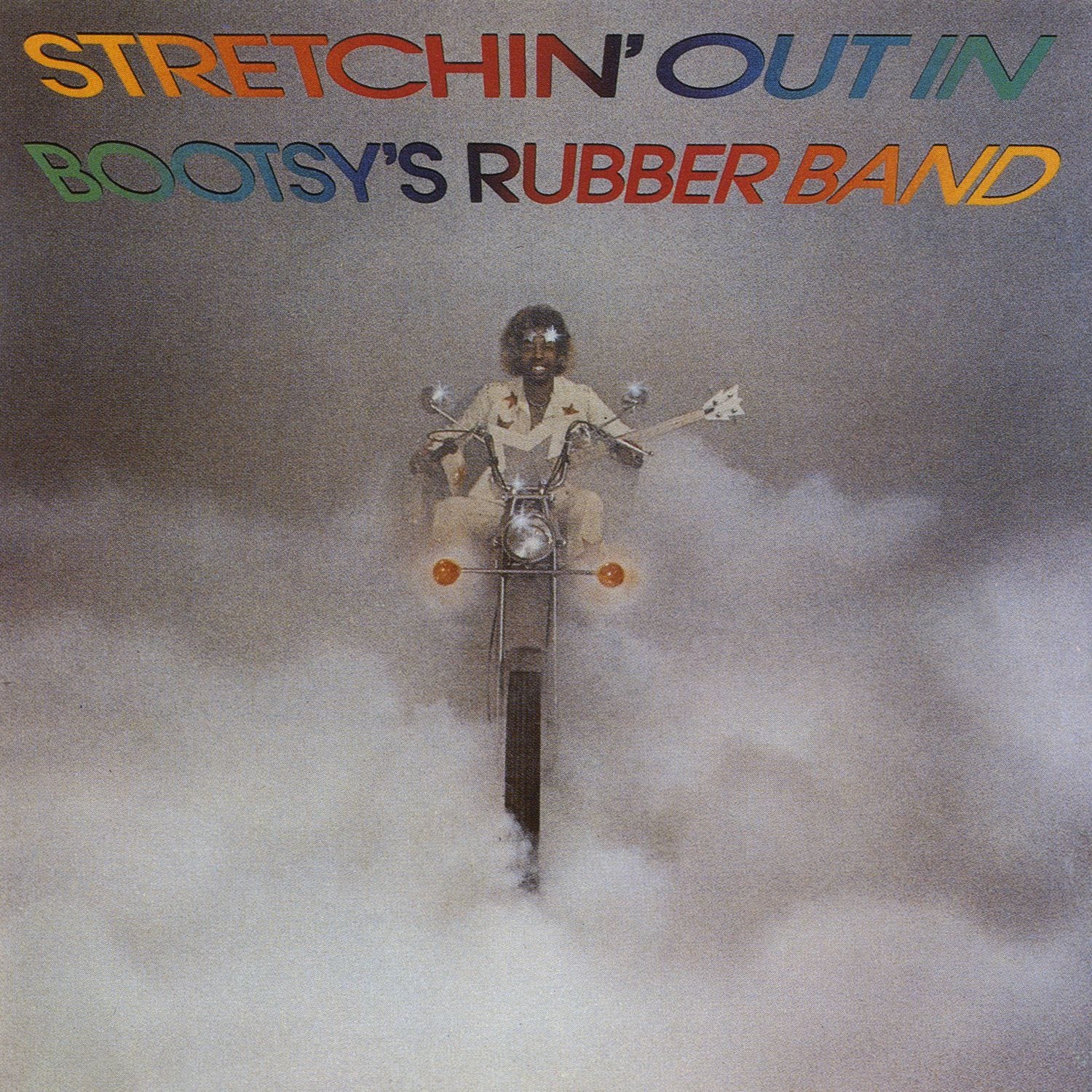
At the height of his powers, George Clinton had Parliament’s Mothership Connection and Funkadelic’s Let’s Take It to the Stage records being cut in the same week from the same rotating cast of musicians who slept in the studio and played until someone told them to stop. Within this chaos, a Cincinnati native who had cut his teeth backing James Brown onstage as a teenager and who had joined Clinton’s orbit four years earlier received an unprecedented leeway for a sideman in someone else’s enterprise: a chance to record his own band, his own compositions, to test whether the fastest and broadest comic timing in the room could carry a microphone through a mix without the assistance of the Mothership or the Maggot Brain. The answer to that question is etched into the grooves of the LP, but it was a long time in coming.
Brown had been giving Collins the same lesson—before he had joined Brown’s band—telling him to “give me the one.” Collins was eighteen, “Throwin’ guitar licks all over the place,” as he described it in Bass Player, “tryin’ to do Jimi Hendrix in ‘Sex Machine’ and ‘Super Bad.’ ” Brown just wanted the downbeat. Collins remembered in Bass Player that the bandleader would lavish praise on his band in the dressing room after an especially poor concert and criticize them most heavily after a show they thought was their best, and that it was months before he realized the dynamic. “I just absorbed what he said and used it in a positive way,” he said. That discipline is the sound of Collins’ Stretchin’ Out. On every track, the bassist abandons himself to the most florid melodic excursions before pulling up short, right before the pocket, to keep the groove from drifting away.
Collins and his older brother Phelps “Catfish” Collins had spent eleven months in Brown’s employ before they both quit, exhausted by the regimen. They returned to Cincinnati, where they formed the House Guests and cut two self-produced singles before a Parliament singer named Mallia Franklin connected them with George Clinton. By 1972, they were Funkadelic. Collins did rhythm and bass on America Eats Its Young, Cosmic Slop, and Standing on the Verge of Getting Ready to Get Down. Clinton recognized the same potential in Collins that Brown had, and he pursued the bassist with the same intensity. “You’re a star already,” Clinton told him, according to his autobiography, Funkadelic.org, “So you can’t just be in the Funkadelic! So you can’t just be in the Funkadelic!” Collins was not altogether opposed to the idea. “I wasn’t down with that because I’d never wanted to be a frontman,” he told Guitar World. “I didn’t want to be responsible.” Clinton persisted, and Warner Bros. finally got a piece of Collins’ band.
Bootsy Collins’ Stretchin’ Out in Bootsy’s Rubber Band begins where the title leaves off, in a single night, unsummarized and with no context given other than the implication that it is representative of many. It opens on the title song, which follows the title’s injunction to bend and snap back while Collins and his bandmates shout about the funk as if they’ve just discovered it in the parking lot. It segues into “Psychoticbumpschool,” which builds on that energy—“psychotic” is the word they used to describe their on-stage persona of Casper, a P-Funk conceptual entity embodying the spirit of the band that has variously switched between holy ghost and funky ghost depending on the temperature. Both tracks are essentially anthems, with Collins’ band—a stripped-down version of Parliament’s astonishing array of instrumentalists—blasting its way through the mix. There are seven or eight people playing at once on these tracks, but nobody ever loses the beat.
From there, “Another Point of View” slows things down to a simmer and lets Fred Wesley and Maceo Parker trade fours and fives while Collins keeps the pulse steady with his bass. The audience is thinner; the lights are lower. Then it opens up into “I’d Rather Be With You,” which finds Collins emoting about the love he could rather be with instead of any of the other things the funk band typically spends its time with. The song is simple and almost arrogant in its simplicity, its four- or five-note ostinato never varying from the pattern. It is demonstrably the most straight love song the P-Funk organization had ever recorded - and, as it turns out, the most emotionally available. Childish Gambino sampled it extensively forty years later for his own “Redbone,” but when asked about the influence of Parliament-Funkadelic on the track in general, he singled out this particular album for having “a real feel of love in it. It’s not really a Parliament-Funkadelic thing,” he told Rolling Stone. “It’s like a Bootsy album.”
Love is a recurring theme in Stretchin’ Out—“Love Vibes” features Leslyn Bailey leading the charge, and it makes room for a more reciprocal passion than is typical for P-Funk, where the desire is often one-sided and easily fulfilled. On this track, the production is lighter, the horns mostly gone, the rhythm section and Bailey’s vocals filling the space. “Physical Love” makes its point most explicitly. The title says it all, but it takes its time getting to the point, dragging itself along by the heaviness of its bass. Eddie Hazel, uncredited—he’s listed only in the writing credits—works his guitar low in the mix, and it’s an odd choice of instrument for a guitarist who not five years earlier had done one of the most influential guitar solos in psychedelic history on Maggot Brain. Hazel is not playing lead on this track; he is supporting the rhythm, creating a sound that is at once more spacious and more insistent than the funk band usually gets. Listening to this record, one gets the distinct impression that Hazel has been assigned a particular emotional task on this record.
The final track finds Collins and the band describing the process of retiring for the night, the post-concert ritual of retiring the instruments and going to sleep with the two of them in the bed. Hazel picks guitar again, uncredited, and his tone is so low it could almost be a keyboard. The album that began life as a bass line that beckoned listeners to a dance floor ends with that bass barely able to say goodbye before the quietest possible fade-out. No manifestos; no Mother Ships. Not even a concept album, really—just a night that stretched out too long and a man who did not want to be a frontman telling it like it was.
The men who make music with Collins are worth noting, if only because this is a concept album about an end-of-night ritual that could just as easily have been a disaster. Most of the great Parliament-Funkadelic instrumentalists were in their twenties when they cut Stretchin’ Out—Bernie Worrell, who could make a Moog synthesizer sound like a full orchestra, manned the keyboards. Maceo Parker and Fred Wesley led the horn section, joined by Rick Gardner on trumpet; Michael and Randy Brecker were both on hand, courtesy of Arista Records. Catfish Collins played guitar, as did Gary Shider and Michael Hampton—Frankie “Kash” Waddy played drums. These are the kinds of musicians who had been drilled into tight rhythm and punishing grooves by Brown’s near-tyrannical fines and were then unleashed in Clinton’s Detroit to have as much fun as they damn well pleased. That combination of discipline under pressure is what makes every track on this album simultaneously so groovy and so tightly held together. When the rhythm section locks into James Brown time, the keyboards and horns go off, and Collins’ bass dances between the pockets and the abandon.
A related question that haunts the rubber band sessions of 1976 is what, if anything, did Bootsy Collins and his band bring to the table that Parliament and Funkadelic did not. They were all working in the same studio, same year, with many of the same musicians and a shared producer. The answer lies in the love songs. Parliament was George Clinton’s concept band, his vehicle for theatrical productions and the Mothership, the costumes, the Starchild and Sir Nose D’Voidoffunk. Funkadelic was his rock band, more hard-edged and less constrained by a single costume, but it was still more ideas than men for most of its early years, peaking with Eddie Hazel’s tortured guitar cries on Maggot Brain. The Rubber Band was something else entirely—it was Bootsy’s dating album, his love album, the sexy one. The other two bands could be overwhelming, their sound dense with ideas and color. The Rubber Band’s music opened up space; it slowed the beats down and focused them on the bass, with Collins’ voice as its rhythmic center. Clinton’s bands were all about extravagance and spectacle, but Collins’ own band was all about two people in the room.
When he talked to radio host Frankie Crocker in 1980 about his earliest days in the music business, George Clinton declared that he knew he’d “made it” when Bootsy made it. “When he made it, that’s when I felt secure,” he said. It was not the success the record enjoyed on the charts that convinced Clinton; it was the knowledge that the young man who had joined Parliament as a teenager could go out and make a record on his own, with his own band, sell it to the public, and make money doing it. Stretchin’ Out in Bootsy’s Rubber Band did not need the mothership, and it barely needed a concept beyond an evening’s worth of music. Collins had long been trying to learn the one thing James Brown never taught him: how to play so gently that the silence between the notes became music as well. On his first album, he learned it.
Great (★★★★☆)