

Milestones: The 2 Live Crew Is What We Are by The 2 Live Crew
The first Southern rap debut to cross the gold line did it through the back of a promoter’s car, one Black-owned record store at a time. A clerk in Florida was charged with a crime for selling it.
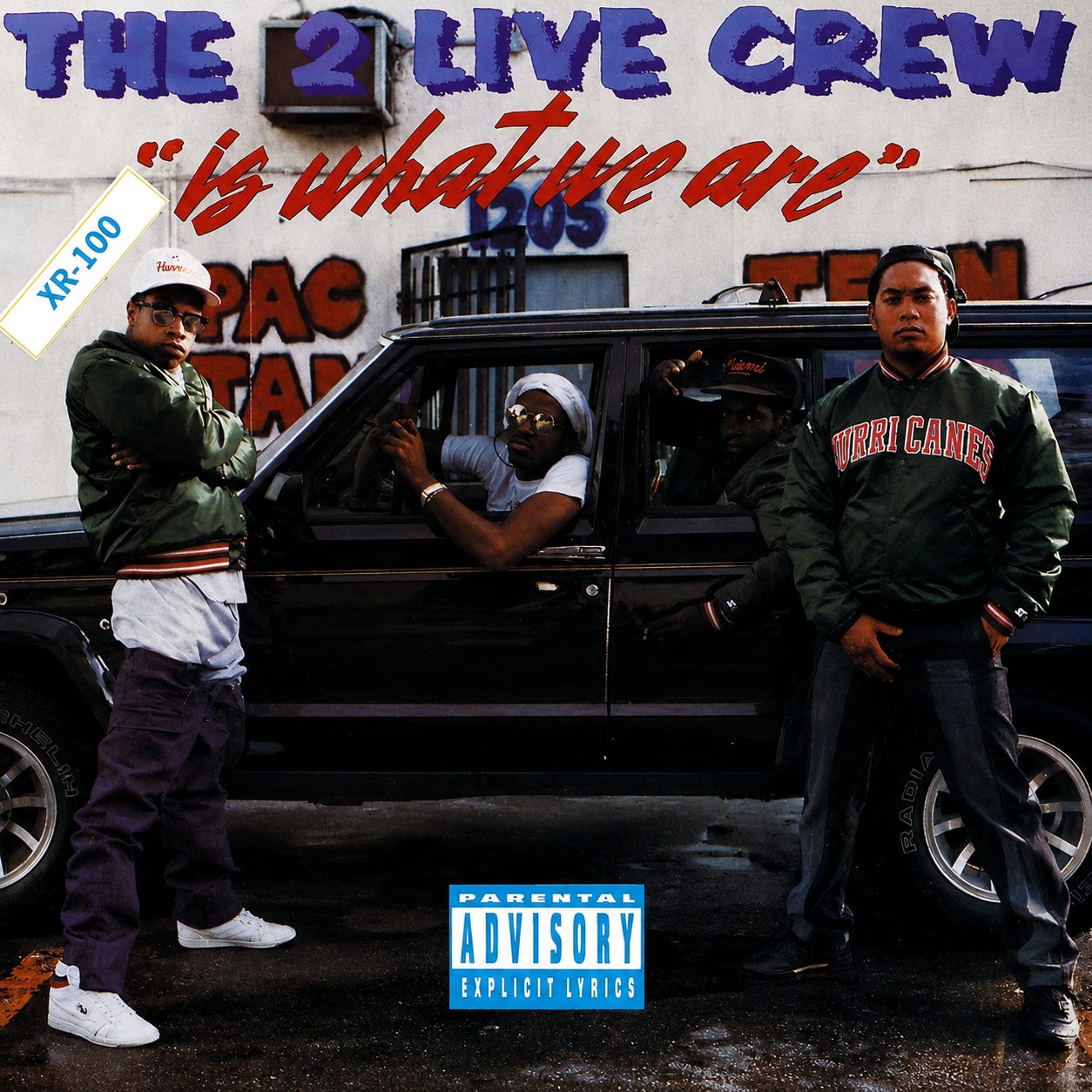
In the summer of 1986, a Miami promoter named Luther Campbell was loading boxes of his label’s first full-length into the trunk of his car, driving them out to independent record stores in Callaway, up through the Florida panhandle, and over the Tennessee border into east Texas, convincing each owner to display the LP on the counter instead of the back wall. Def Jam and Profile weren’t returning his calls, MTV would not show the video, and no major distributor was interested in a rap LP with a Miami return address. He’d formed Luke Skyywalker Records so he could put his music on pressing plates and on shelves without permission from anyone who’d tell him no. The full-length was eight tracks of booming 808 snares and a Rochester DJ’s crates of electro, made by four men of whom only three rapped, and none had lived in Miami for more than a year when it came out.
Wong Won, a Trinidadian-born Brooklyn native who performed under the moniker Fresh Kid Ice, had spent the winter stationed at March Air Force Base with another enlistee, David “Mr. Mixx” Hobbs, and a childhood friend, Yuri Vielot, who rapped as Amazing Vee. The three had cut a single in 1985 called “Revelation,” which made its way into a mix show in Miami, where Campbell, also a DJ by trade and the man who’d booked Pac Jam Teen Disco at the Liberty City recreation center, saw it and sent money down to Rochester to get them on a plane. He got Mr. Mixx out of the service, hired an upstate New Yorker named Mark Ross (Brother Marquis) to replace Vielot on the touring and recording circuit, and inserted himself as a hype man and executive producer on the LP, which he helped press and distribute out of his own pocket. The future of Miami rap had assembled itself around the man who’d booked Pac Jam, and his production team for the 2 Live Crew’s debut was built across four separate zip codes, only one of which was in Florida.
The strongest argument for Hobbs as the secret sauce of this album is buried in the middle of its B-side, because he can be heard behind the decks on “Apache” and “Planet Rock,” conducting a medley of T La Rock’s “It’s Yours,” and Spoonie Gee’s “Spoonin’ Rap,” and Hashim’s “Al-Naafiysh,” with a Doug E Fresh beatbox break in the middle and a closing “Hold It Now, Hit It” by the Beastie Boys. A DJ with a particular obsession with what was coming out of Def Jam in 1986 (and most everything else that didn’t come out of the L.A. electro scene) would have crates full of this same music, and what Hobbs puts together for the 2 Live Crew’s outtakes resembles a syllabus. It points west and south, to Bambaataa’s electro, the Egyptian Lover’s “Egypt, Egypt,” Hashim’s post-punk workouts, the entire lineage of 808-powered Miami bass that would flower in the next five years - all the things that powered the local sound, as opposed to the more familiar Bronx-bred boom bap that Marley Marl was laying down in Power Play.
That reputation is something else that gets built into this record. Hobbs gets a vocal production credit on the first cut, “Cut It Up,” because it’s the hip-hop custom to let the man behind the mixing board sing on the track. Fresh Kid Ice and Brother Marquis spend the next three minutes bragging about the very thing they’ve just done on “Check It Out Y’all” and “2 Live Is What We Are (Word),” trading couplets of deadpan lyrical thuggishness for the national audience that this single would soon acquire. But it’s Hobbs again who cuts, Hobbs who sequences, Hobbs who produces every drum track on this record with his hands. The beats all sound like they’re built on especially elastic 808s, with a bottom-heavy sub-bass that rattles car stereos to their cores and a lineage stretching back to Bambaataa rather than the tight little snares of the East Coast scene. The same rhythmic pulse would come to define Miami bass, right down to the present day.
What do you call the music that makes the pulse, the kid from Rochester who cuts this record for a crew of teens from the Liberty City teen center who cut their teeth at Pac Jam? Something made by assembly rather than birth, perhaps, which is as Miami a sound as anything that’s come since. The man who pressed these records was also already selling them, mostly in Black-owned independent stores, up and down the eastern corridor, because no major distributor had drawn up a map to that particular retail terrain yet, and Campbell drew one himself, putting in long drives with a trunk full of product. This debut went gold in that network of stores, in the same way that an R&B single might have gone gold on the chitlin’ circuit, from one handshake to the next. Meanwhile, Jive and Columbia Records were still laughing at the idea of a Southern rap scene when Campbell’s first pressing sold out.
A clerk at Starship Records & Tapes in Callaway, Florida, was arrested in 1987 for selling The 2 Live Crew Is What We Are to a 14-year-old girl, and later acquitted at the county courthouse, having not left a single line of precedent for any obscenity trial that came before or since. The 2 Live Crew’s national legal battles began and ended in Florida but stretched, in fits and starts, for the next 15 years. In 1990, the year the 2 Live Crew’s As Nasty As They Wanna Be was released, a federal judge in Broward County became the first judge in America to rule an entire album legally obscene (this ruling was eventually overturned on appeal).
Three years later, the U.S. Supreme Court ruled in Campbell v. Acuff-Rose Music, Inc. that the 2 Live Crew’s parody of “Oh, Pretty Woman” was a fair use of Roy Orbison’s original, a decision that still helps shape legal interpretations of parody to this day. The legal history of 2 Live Crew is longer and more complicated than almost any band’s, and it begins, as all of this does, in a record store.
The first Southern rap LP to go gold did it all without major label support, on a label owned by a man who would eventually lose a trademark lawsuit against his own fictional character, with a production crew that had assembled itself across three states and only one of which had ever lived in Miami before the album came out. Fresh Kid Ice would die in 2017, a few years after suffering a stroke that put him on dialysis. Luther Campbell filed for bankruptcy in 1995 and lost his Luke Records catalog to his creditors. Brother Marquis and Mr. Mixx are both alive and well, and making music to this day. The 2 Live Crew’s later material, recorded in the wake of these legal and financial bills, lacks the same charge, because the long fights had drained them of something vital. Before there was a third coast to rap from, there was a Rochester DJ named David Hobbs cutting 808s in a Miami studio, and a promoter in Liberty City walking up to every store with a trunk full of product and telling them to put it on the counter.
Masterpiece (★★★★★)