

Milestones: The Clones of Dr. Funkenstein by Parliament
Less than a year after the Mothership landed, George Clinton cloned himself an army, and Parliament’s fifth album turned funk’s silliest premise into its most durable creation myth.
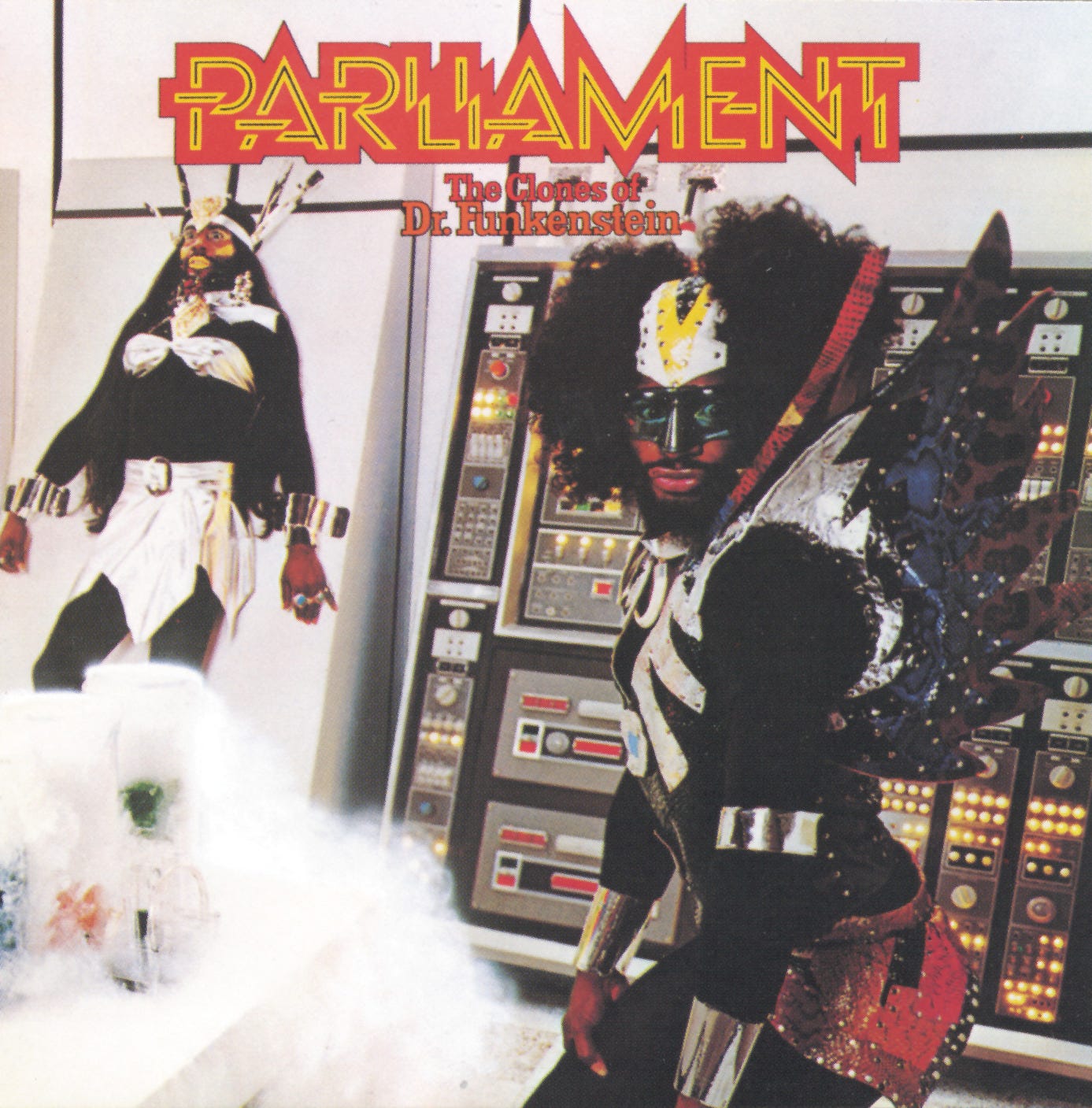
On October 26, 1976, on the Municipal Auditorium stage in New Orleans, a spaceship landed but in the wrong place and at the wrong time. The P-Funk Earth Tour followed its script, and the script ordered the spaceship, which cost $500,000 and was created by Broadway experts Jules Fisher and Peter Larkin, to land at the beginning of the show. George Clinton understood the situation and noted it already on that night. “That was the climax,” he recalled in an Andscape feature. “As great as the band was, there was nothing we could do to top that spaceship landing.” On the next night, the ship landed just in time to become the most famous prop on a musical stage, according to the Smithsonian. The audience arriving at the concert knew the name “Mothership Connection” thanks to the album whose track “Give Up the Funk (Tear the Roof off the Sucker)” became a gold record in the same October month. The Clones of Dr. Funkenstein was the name of the record, its sequel, and the record which Clinton used to explain whom the spaceship belonged to and why one ship could not contain enough funk for an entire planet. The explanation sounds like a fairy tale.
Featuring Clinton solo on the microphone and telling the bedtime story over Bernie Worrell’s keys, “Prelude” sets the tone right away.
“Funk upon a time
In the days of the Funkapus
The concept of specially-designed Afronauts
Capable of funkatizing galaxies
Was first laid on man-child
But was later repossessed
And placed among the secrets of the pyramids.”
He ends his tale with “And funk is its own reward,” then “May I frighten you?”, the most scary thing being the party. Listening to the monologue slow enough, the joke transforms into history. Funk is stolen from its owners and stored with “kings and pharaohs” among “secrets of the pyramids”, and now it has been left to wait in “terrestrial projects” for the owner who will awake it. Terrestrial projects. Clinton was raised in Plainfield, New Jersey, where he used to style hair in a barbershop surrounded by doo-wop singers, and he knew exactly which projects he was talking about. The whole P-Funk mythology relies on this double meaning of the word: a stolen heritage presented as a Saturday matinee.
Then the doctor enters the stage and turns out to be the most non-threatening mad scientist in movies. Clinton sings the title song in low tones and introduces himself as “Dr. Funkenstein, king of the funk,” “the biggest pill of swift lippin’, ego trippin’ and body snatchin’.” The clones respond like a congregation singing “We love to funk you, Funkenstein, your funk is the best”, and their lord answers the praise with the lines a serious villain cannot stand: “Kiss me on my ego.” The comedy develops into the parody of science: he calls himself “preoccupied and dedicated to the preservation of the motion of hips,” and promises to make you feel such atoms moving so fast they will enlarge your molecules, while someone in the crowd yells to funk him “in the proton.” Mary Shelley’s doctor was chased out of town with torches. But the other doctor gains a fan club, and that fan club is going to write the rest of the album.
Clinton gives the anthem to the creations and those creatures sing it in unison. “Children of Production” begins with a trick of timing: the band plays a sixteenth note before the downbeat and leaves it empty, so the groove enters the room before its own feet. Under it, the clones introduce themselves: “We are children of production/Produced in conjunction/With the urgency of our Dr. Funkenstein.” The clones call themselves “deeper than abortion, deeper than the notion/That the world was flat when it was round”, a “biological time bomb/Exploding in a timezone”. In 1976, three years after Roe v Wade and in the middle of the decade when society was discussing the limits of scientific achievements, the choir of happy and created children declaring they were deeper than abortion was a truly shocking thing to feature on a disco record. Clinton even invites the dissenters to the album. “Gamin’ on Ya!” is full of voices mocking Funkenstein as a fool who pretends to know everything, and the mockery becomes a part of the mythology, so the mythology does not become too precious.
None of it would be funny if not for the band, and this band is loaded with talent to the max. Fred Wesley and Maceo Parker had walked out of James Brown’s band carrying the most disciplined horns in American music, and Wesley was the author of the arrangements for “Dr. Funkenstein,” “Children of Production,” “Getten’ to Know You,” and “Do That Stuff.” Worrell, a Plainfield genius whose talent Clinton had heard about long before meeting him – the kid who was said to compose a symphony before junior high, was arranging horns in every other track except “Dr. Funkenstein,” “Gamin’ on Ya!,” “Everything Is on the One,” “I’ve Been Watching You (Move Your Sexy Body),” and “Funkin’ for Fun.” The two schools met head-on in “Everything Is on the One,” which repeats the rule Brown enforced with money and puts it to the rhyme of a playground chant: “Everything is on the one today y’all, now hit it/Everything is on the one today y’all, and don’t forget it.” Bootsy Collins, another Brown disciple, co-wrote almost all tracks of the record with Clinton and Worrell, one more drill team member who went to live among the stars.
Tenderness comes unexpectedly. Garry Shider takes the lead on “Getten’ to Know You” and sings the courtship without wearing the lab coat, and Glenn Goins carries “I’ve Been Watching You (Move Your Sexy Body)” with a gospel-trained voice from the same Plainfield scene, turning the flirt into a long jam of a track which is longer than any doctor’s monologue. Goins is the lead singer of “Funkin’ for Fun” too, roaring on top of it, and his singing becomes the evidence that the clones were not the joke, but the story told in different voices.
Rap will spend the next two decades proving how effectively the doctor cloned people. Nice & Smooth built their “Funky for You” hook from Worrell’s squiggling synthesizer riff opening “Do That Stuff”. Organized Noize took inspiration from “Children of Production,” creating the sung hook for OutKast’s “Southernplayalisticadillacmuzik”, which means that the clones’ own anthem helped to introduce Big Boi and André 3000 to the world. And the entire era of G-funk, Dre, Snoop, and everything else which followed The Chronic, operated on P-Funk as cars operate on fuel. Clinton had written the loophole into his own story: a clone, according to him, is a mission performed as intended, funk reproducing “in the image of the chosen one,” and every producer looping a Worrell line is the child of production by the terms of the album’s logic.
Fifty years later, the ship itself stands in a museum, a restored Mothership parked in the Smithsonian’s National Museum of African American History and Culture, lights out, waiting for the downbeat that will never come again. The album is still alive. And the filmed concert from Houston in 1976 captures the moment this record was made for. Goins, two years from his death from Hodgkin’s lymphoma, stands at the edge of the stage singing “Swing down, sweet chariot/Stop, and let me ride”, then asks the stadium directly, “Do you wanna fly, Houston? Do y’all wanna fly?” Twenty thousand people yell the answer to a man summoning a spaceship to the roof of the stadium as if he is summoning the glory to the church.
Standout (★★★★½)