

Milestones: The House Is Burning by Isaiah Rashad
TDE’s first Southern signee returns from five years inside addiction with the bounciest album of his career. He swears it is his saddest yet, and he is not lying.
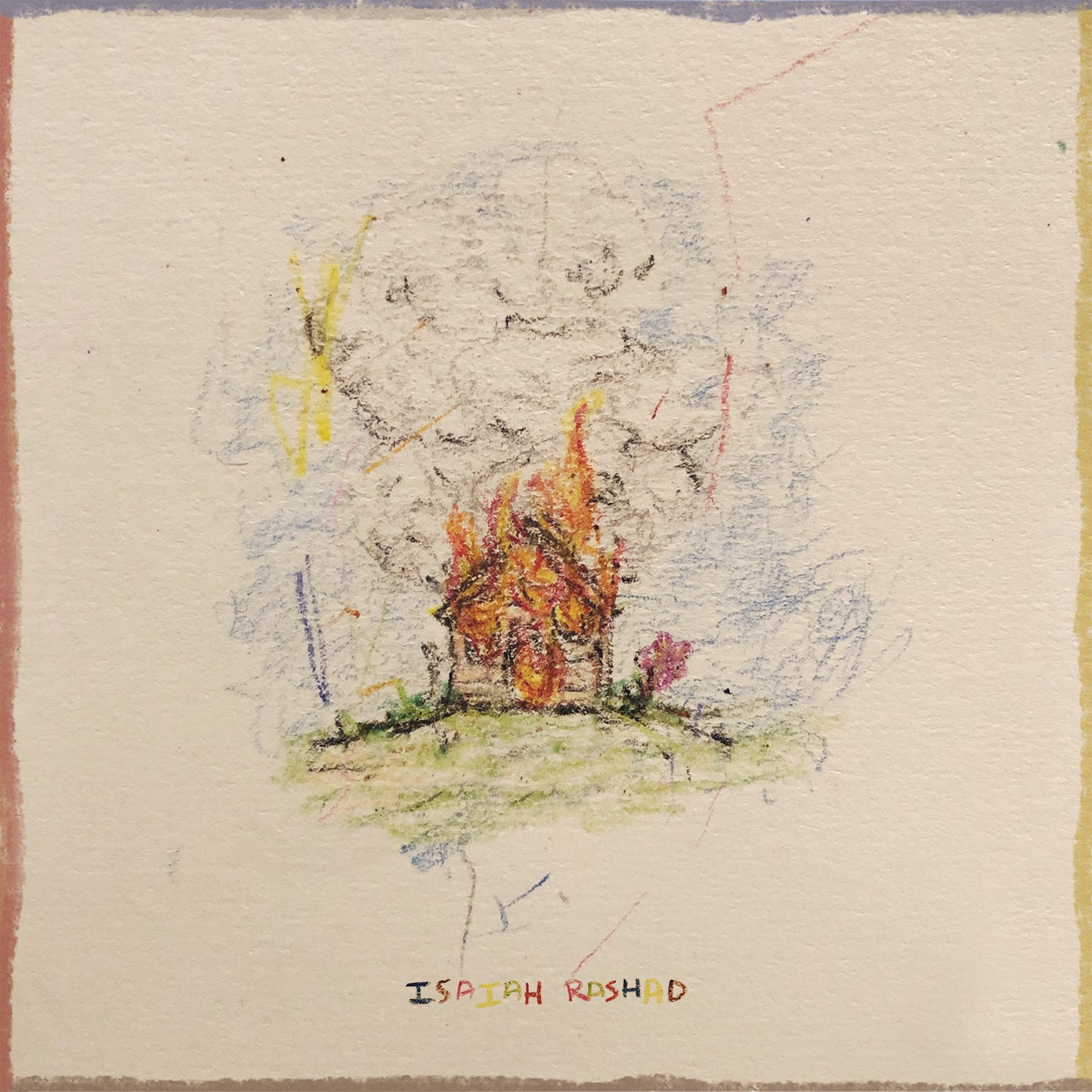
Calvin Donaldson Elementary School in Chattanooga exists under the grey skies of early June 2021. The rapper who is standing in its hallway, the place where he spent his first and second grades, is already thirty years old, has not released any albums in the past five years, and is preparing the next release in a couple of weeks. Isaiah Rashad says to Rolling Stone: “It feels refreshing to be here.” His second album, The House Is Burning, is the explanation he decided to provide to the question that has been raised in the headlines recently: where have you been?
His father left when Isaiah was three years old, and his mother, a hairdresser, raised him. His stepfamily belonged to Five Percent Nation, and some days he went to the mosque with them—something that is not usually written in the biographies of Chattanooga rappers. He even considered becoming a preacher, but after receiving a copy of ATLiens and realizing what kind of rapper OutKast was, the preacher idea fell flat. Being old enough to speak in front of a crowd of people, he already called himself Zay Taylor.
Dave Free listened to his early tracks and brought them to Top Dawg’s office. Anthony Tiffith signed him in March 2013 and told everyone about it only in September. In fact, this piece of news contained a small but important footnote. This was the first Southern rapper that Top Dawg Entertainment signed. Cilvia Demo appeared four months after the signing and performed a business that made this kid the XXL Freshman. Two years later, The Sun’s Tirade reached the Top 20 and got some reviews that put the target on a young rapper’s back. But Isaiah remained silent.
Five years of silence between The Sun’s Tirade and The House Is Burning became the best-documented blackout period in the company’s history. And it is hard for everybody who enjoyed his first albums not to think about how close Isaiah was to leaving music forever. While he was working on Tirade, he took Xanax and alcohol and continued using them afterward. Moreover, he said that he almost got dropped from the label three times. And back at home, in Chattanooga, he was unable to self-start and motivate himself for several months. He might never make another album again. Fortunately, we are not listening to this version of events.
Most of the version we’re hearing was constructed entirely within the confines of North Hollywood studio belonging to Kenny Beats, whose neon sign reads “Don’t overthink shit” and whose mission had been to solve a simple yet critical issue for the last couple of months—teaching Isaiah how to rap without whatever in his system. Isaiah learned how to freestyle, watching Alicia Keys and Young Thug doing it, leaving his mouth uncontrolled until the brain could have its say in the matter. Previously, this guy’s writing process had been a phone in his hand, but now he started to nail single-pass takes, and Isaiah explained it to The FADER as the harder confidence test than being sober in the booth. Kenny was less delicate in the same piece, describing him as somebody who always managed to hide in plain sight.
Start off with the opener, and you’ll find yourself entering on Isaiah during prayer, exhaling on his enemies and god in the same breath while the beat behind him stays too warm to go well with it. “I heard they got new gods outside in this bitch,” he says to nobody in particular on “Darkseid,” and his words could be taken as both a complaint and an exhalation. Lil Uzi Vert appears on “From the Garden” in the loose form, sounding as if he just walked into the booth to hang out, and he and Isaiah spend their three minutes telling each other about where they come from without even bothering to make a moral out of it.
Duke Deuce has long been Isaiah’s wished-for cousin, and “Lay Wit Ya” is the song that finally makes him appear on the track along with Isaiah over the beat recognizable to anybody familiar with the Three 6 Mafia catalog. There is a certain stretch within the second verse, where Isaiah hands over the booth and allows Duke to take care of it by himself; you can hear him grin while he does it. “RIP Young” is the dedication to Young Dolph, which was not made by anyone else on TDE, and the names mentioned by Isaiah in the verse belong to people from his own town before they became somebody to the rest of us. Smino shows up on “Claymore,” reminding Isaiah he is the explosive in his own metaphor, and continues to walk past it.
There are some bars on “Headshots (4r da Locals)” where Isaiah aims his gun towards everybody else and turns it back to himself at once, daring the Chattanooga locals to notice the difference. Amindi provides the vocals on “All Herb,” and Isaiah tells the listener openly that weed is the substance that keeps him alive throughout the song without trying to make it noble. He shifts moods within one bar, and a single line about wishing to be left alone changes the floor underneath the part of the song you were nodding to twenty seconds ago.
Praying is almost exactly like what Isaiah is doing on “Hey Mista,” talking to some older god dude who is also maybe nobody at all. The voice you use to do that is the one you save for when you ask a stranger something you can’t say to the people that know you. At the table with Isaiah on “True Story” are Jay Rock and Jay Worthy, two other rappers, without any of the embellishments turned on; all three of them agree to leave the character stuff behind and say what happened to them. Jay Rock comes in past due to have something explained to him, and Jay Worthy rolls in mid-sentence, as if the tape started rolling right in the middle of his sentence.
The verse that introduced Doechii to everybody else comes on “Wat U Sed,” where she shows up basically ready to go three years ahead of the rest of the room, taking her one small verse and making the minute pay her a full album’s worth. Cops shooting people lurk behind “Don’t Shoot,” which is maybe the closest Isaiah gets to having a protest song without using the words. Kenny Beats produced “Score,” where Isaiah gets paired up with SZA and 6LACK; what should have been a big single turns out to be more like an after-hours joint, where all the people in the room have gotten tired of chasing the same thing and are not entirely sure what it is.
Isaiah’s old crew TheHouse, which he co-founded with other guys in Chattanooga years before TDE caught him and signed him, has their first proper appearance on the record on “Chad.” His old partner in crime, YGTUT, comes through as the cousin that never left, the verse telling the story of how he has seen Isaiah get to where he is at every point along the way and kept track of it all. The song is named after a guy who serves as a double for everybody that did not leave with him, staying behind in Chattanooga while he went to get famous and got sick and came back. “9-3 Freestyle” follows without much structure at all, just Isaiah doing the freestyle thing Kenny taught him with the seat belt off. And the title track is the only place on the LP where Isaiah admits that he is watching the house burn down around him, but even that admission is second-hand, as the words come from a fire that used to belong to him. He sees himself out of there on “HB2U,” a quiet kitchen note of a birthday song that he told Rolling Stone is the song he cared about most on the record, an embarrassed thank-you for surviving parts of the last five years that he was unsure he would survive.
Towards the end of the Fader piece, the journalist asks Isaiah what The House Is Burning means to him, and he tells the truth. “I was dead, and now I am alive,” he says, and then waits a beat before he adds, “I guess.” Those two words carry the sound of somebody who knows from experience what it feels like to be wrong about themselves. They also carry the sound of him sitting in the hallway at Calvin Donaldson Elementary at thirty, on a gray Tuesday in June, three weeks before the release of a record he may not have been sure he was going to be able to make, telling a journalist it felt good to be home.
Great (★★★★☆)