My Presence Is a Present and My Gift Is Rapping
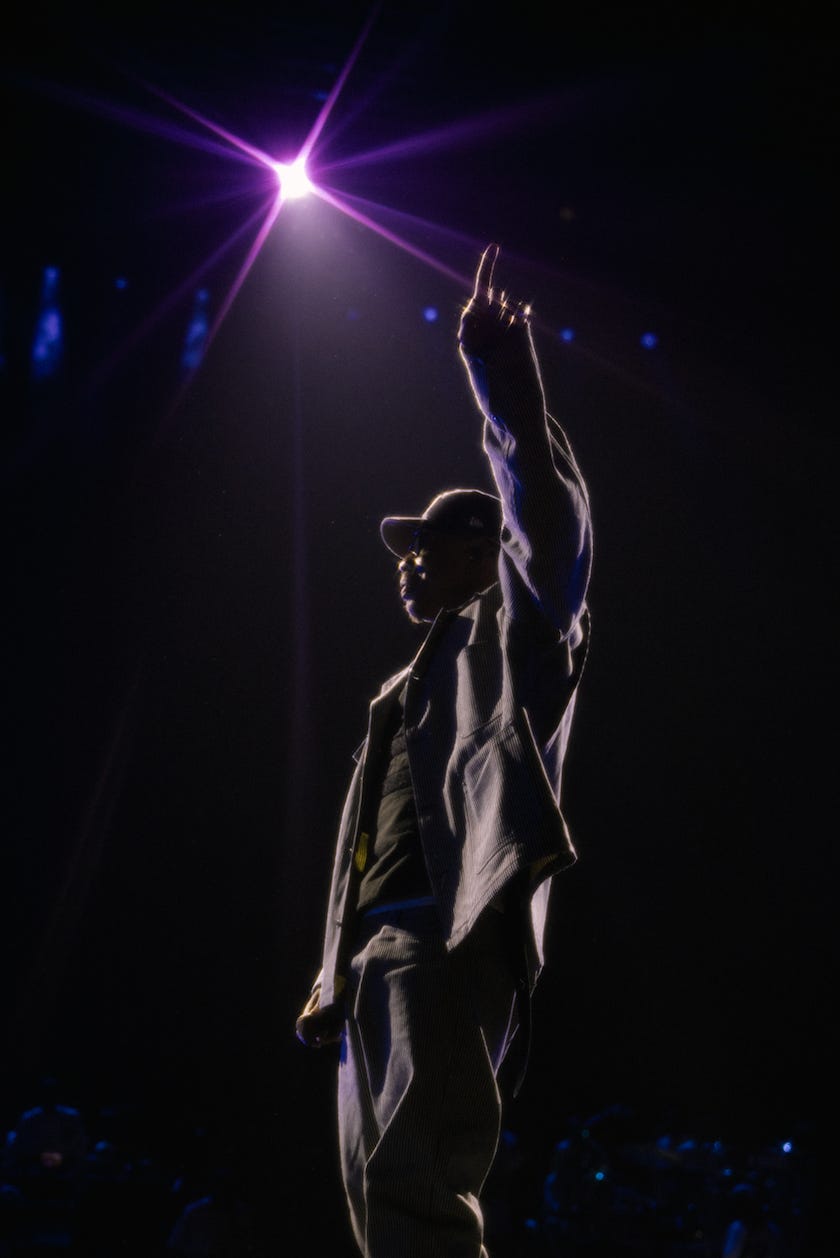
Three nights at Yankee Stadium sold out, the third added for the overflow, and Saturday’s 45,832 broke an attendance record set 24 hours earlier by the man himself.
The vacant store space of the old Crown Diner at 161st Street and Gerard Avenue remained so for six years until the start of July, when a pop-up shop opened up selling thirtieth-anniversary merchandise for the album Reasonable Doubt by a Marcy Houses hustler whom no label wanted to sign at the time. Now known as JAŸ-Z, who booked Yankee Stadium for three nights in July to celebrate it, and sold out the first two nights. 44,916 at the first show became the biggest paid attendance in the history of Yankee Stadium for a concert and 45,832 in the second night broke the record from the previous night, and from the stage, JAŸ-Z drew a personal line: “the album that did 43,000 in its first week now put 45,000 in the seats”—and another night with more than 45,000 in attendance was yet to come.
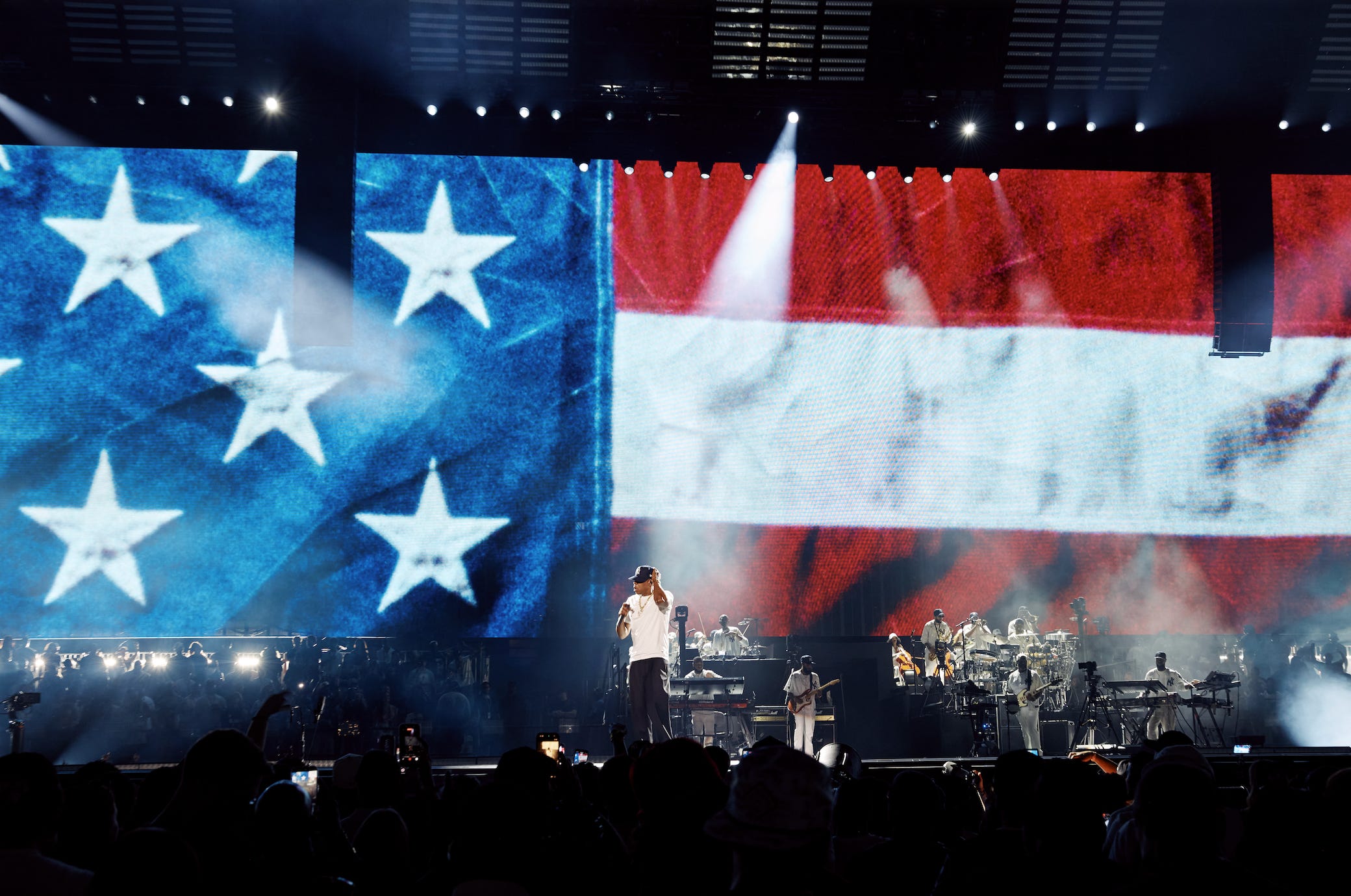
The Friday night started with the release of the album Reasonable Doubt. Beyoncé took the stage to sing her part on “Can’t Knock the Hustle”—originally performed by Mary J. Blige, and Blue Ivy Carter sat at a piano for “Feelin’ It”. Nas took the stage for his song “Dead Presidents,” the track that includes his sample voice, and continued playing the songs of the album that were “science fiction” in 2001, like “The World Is Yours”, “N.Y. State of Mind” and “Where I’m From.” Memphis Bleek did “Coming of Age.” Jaz-O, the first mentor, did “Bring It On,” and Alicia Keys sang “Empire State of Mind” to close the main set. The Blueprint celebrated its twenty-fifth anniversary with the appearance of Slick Rick, Pharrell and Eminem, who performed two tracks: “Renegade” and then “Lose Yourself” over “Takeover” beat—at Yankee Stadium in the Bronx, the site of the original insult.
The freestyle took place immediately after “Politics As Usual” with the use of Frank Ocean’s “Made in America” hook. JAŸ-Z stopped the show to mention his critics in it. “They say I sold out, yeah, I did sell out/Three nights, I sold Yankee Stadium the hell out.” Then, “Ex-drug dealer you might not like the packaging, but my presence is a present.” And finally, “I don’t listen to Twitter activists, they type, and I laugh at them/It’s really no comparison.” The description claims that the freestyle was milder than the one performed at Roots Picnic earlier this year that had actual names mentioned in it. The Yankee Stadium freestyle, on the contrary, was targeted against the stans and critics for the whole spring, accusing the anniversary of being a cash grab.
I have no problem with a man answering his own record. Rappers have always litigated in verse, and it is exactly the case when a fifty-six-year-old man performed it from the stage that he filled three times. The first bar is the piece of writing that truly deserves attention; it turns a moral issue into a figure, and 45,000 people cheering back is the proof of it. The third bar, however, becomes rather weak in writing. “Twitter activists” is the real phenomenon: the discourse economy where posting replaces doing. A man who spent the last seven years in state houses definitely has a point in this matter. However, using the term in the context of this controversy sweeps up a lot of people who are far beyond “typing.”
This is exactly the point that is ignored by JAŸ-Z in his freestyle. The anniversary itself included a special edition of Reasonable Doubt on vinyl to be sold through Target, the company that experienced serious backlash because of the rollback of its diversity, equity and inclusion initiatives. This was exactly the point where a boycott appeared, one of the few means available for an ordinary customer. The boycott mechanism is the register where the line is not to be crossed: an unglamorous work that has been conducted by the Montgomery for 381 days. For a Black fan keeping the discipline, the thirtieth anniversary of the great independence album came with a choice: to cross the line or to be absent from the celebration. None of the options is tempting, and some of the people who were “laughed” from the stage kept the boycott the same weekend.
However, the complaint sounds stranger the closer it becomes related to the rest of the anniversary’s promotion. There was no problem with the Amazon tie-ins. The criticism that was typed on phones made by Apple, posted on platforms of Meta and Google that have reached deep into labor conditions, data extraction and public policies in comparison with one retailer’s HR retreat sounds like a rounding error. None of it absolves the vinyl: this is the reality of consumer politics where people boycott what they can leave, and nobody can leave the phone. The Target is a real and narrow lever. The vinyl variant walked in the midst of it in the wrong year.
Kaepernick is the older controversy, and the freestyle touched upon it. In 2016, Colin Kaepernick kneeled during the national anthem protesting police killings and has not played a down in the NFL ever since that season ended. The early position of JAŸ-Z on this matter was clear: he wore custom Kaepernick jersey performing on Saturday Night Live in 2017, turned down the Super Bowl halftime show offer and mentioned this fact on wax, on “Apeshit”: “I said no to the Super Bowl: You need me, I don’t need you/Every night we in the end zone, tell the NFL we in stadiums too.” The video of that song aired when Kaepernick’s collusion grievance was still active, and JAŸ-Z and Beyoncé posed in front of the Mona Lisa with the message to the league.
Then the situation changed twice in six months. In February 2019, Kaepernick and Eric Reid settled their collusion case against the league confidentially and in August, Roc Nation announced a partnership with the NFL as its live music entertainment strategist, consulting on the halftime show and steering the league’s Inspire Change social-justice platform, with Robert Kraft acting as the broker. Standing next to the commissioner that ordered the blackballing, JAŸ-Z said, “I think we’re past kneeling. I think it’s time for action.” His more comprehensive account, given afterwards, ran, “No one is saying [Colin Kaepernick] hasn’t been done wrong. He was done wrong. I would understand if it was three months ago. But it was three years ago, and someone needs to say, ‘What do we do now—because people are still dying?’” The room that he said this phrase in shaped the perception of it, and “past kneeling” sounded like an epitaph to the man who was unemployed for kneeling.
The most vocal opponents came from the inside. Eric Reid, who knelt beside Kaepernick and settled along with him, called the deal “asinine.” Kenny Stills said that JAŸ-Z “didn’t seem very informed.” Nessa Diab, Kaepernick’s partner, criticized the deal publicly. Jemele Hill wrote that the partnership provided the league with “guilt-free access to Black audiences, culture, entertainers and influencers”. The man was not part of the deal, and according to the sources at the time of the news, the two men did not speak about it. None of these people were the Twitter activists. One of them filed the collusion grievance.
The publicly visible money is divided in half. The NFL made a $100 million promise to Inspire Change over the course of ten years, earmarking it for education and economic advancement, police-community relations and criminal justice reform, and this promise is genuine and checked. As well as the gap that critics continue to point out seven years in, with no publicly verifiable outcome and unclear grant partnerships. In November 2019, the league arranged a workout for Kaepernick, and the sources credited JAŸ-Z and Roc Nation with bringing the parties together. No team signed him. The public record of this matter ends there: nine-figure promise on one hand and quarterback who never played again on the other, and all the rest is kept in private.
One more privately kept fact appeared in the record of Friday night. The Kaepernick bars appeared in the freestyle immediately after “Politics As Usual” naming the song, “You pickin’ and choosin’ the politickin’ as usual/They digging deep for narratives, it’s embarrassing/They running outta characters, had to bring back up Kaep again”, and went even further: “Buddy took a check, I ain’t even mad at him/But along with that check you have to sign a non disparagement/I’m the one they can’t control.” CBS lead NFL insider Jonathan Jones reported the claim as JAŸ-Z saying that Kaepernick signed the non-disparagement clause in the 2019 settlement. The settlement is confidential, and its terms have never been disclosed: a man who was not a part of the agreement characterized its contents in front of 45,000 people. Sources that have direct knowledge of the deal told TMZ that the non-disparagement clause was not included in it, pointing to Kaepernick’s posts mentioning the number of teams that denied him employment. The quarterback did not give any comments regarding the freestyle. The fact written in the privately kept paper is now challenged in public with the publication of the denial.
The “no comparison” part of the bar has its own paper trail. JAŸ-Z co-founded REFORM Alliance with Meek Mill and Michael Rubin, and the organization continues to conduct probation and parole reform in multiple states, the statute-by-statute process that shortens the terms of supervision. JAŸ-Z financed Meek Mill through the probation case that became the national scandal, as well as 21 Savage’s immigration case. He executive produced Time: The Kalief Browder Story (about a sixteen-year-old boy who spent three years on Rikers Island without a trial), Rest in Power (Trayvon Martin) and Free Meek. Roc Nation finances lawyers in the police-misconduct and wrongful prosecution cases that do not get the headline coverage. Against the quote-tweet, the post is indeed the no comparison; he is right about that, and the people who reduce the record of the post-2019 JAŸ-Z to the handshake with Goodell are arguing with a cartoon.
None of it, however, explains the $100 million. Freestyle cannot address Reid, who was there and on the field at the time, and rhyme cannot dispute Hill’s structural read, which was never about JAŸ-Z’s intentions, and always about what the league purchased. Seven years of Inspire Change without publicly verified books does not dispute it either.
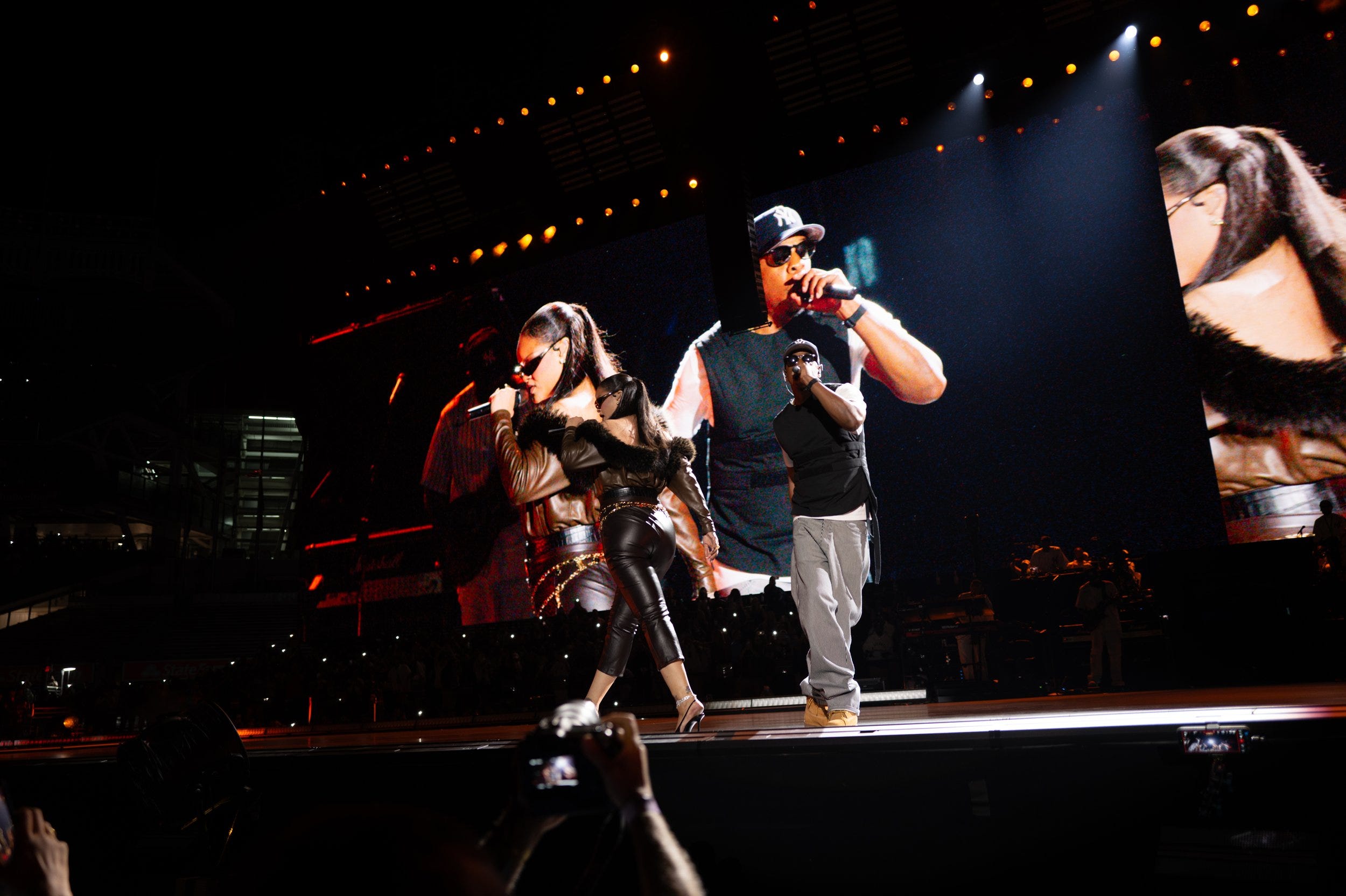
Sunday was supposed to be the final celebration. The additional performance, added as “Extra Innings” after selling out the first two nights, was scheduled for 8 p.m., and more than 45,000 people held tickets. According to the police source and the joint statement issued by the Yankees, Roc Nation and Live Nation, the hundreds of people without tickets who moved in groups tried to push past the ticketholders at multiple fan entrances, shoving past checkpoints and, in some cases, breaching security completely. The stadium gates were closed. The stadium was placed in complete lockout; nobody was allowed in, nobody was allowed out, and it stayed this way while the re-entry took place from around 10 p.m. until late midnight through slow and thorough screening at every entrance. JAŸ-Z took the stage at the beginning of midnight, four and a half hours late, performed the set until 3 in the morning with Rihanna (“Run This Town,” “Bitch Betta Have My Money”), Usher (“Heart of the City,” “Throwback”), Jeezy (“Seen It All,” “Go Crazy Remix”), Swizz Beatz (“Money, Cash, Hoes” through “On to the Next One”), the Clipse (“Grindin’”) and Beyoncé (“Drunk in Love”) among others, and apologized for the delay on stage. The FDNY claimed that it had difficulties to reach the people needing medical help through the crowds outside, and six people were hurt and all expected to recover. There were no arrests reported.
The bill for this performance has its names on it. Rosalynn Glover flew from Atlanta, watched Gate 2 and then Gate 4 being stormed by the crowds, claimed that some people entered the stadium without passing the checkpoint and that the staff at Gate 4 were laughing at ticketholders who were still waiting in line. Another concertgoer reported that his friends who paid $3,000 for the floor seats never got into the stadium. Videos circulated of A$AP Rocky, Charlamagne Tha God and Fabolous being on the wrong side of the doors. The joint statement thanked the NYPD and stadium security for “putting the welfare of attendees above all other considerations”, and the separately reported line of the night made it more precise, “We didn’t want people to get trampled.” Fair enough and true, and the decision was correct after the gates broke. The gates breaking, however, is the accusation. The baseball franchise, record label and the largest concert promoter in the world organized the performance, setting an attendance record twice in 48 hours, and then could not hold the checkpoint against people who never bought the ticket, while the people who did stay outside in the heat eating the flight, hotel and floor seats.
The people who rushed those gates deserve their share in the blame without the sociology usually associated with it on the internet. They were not identified, no motive is available, but the necessity to mention it is not needed to say the obvious: that is, that they climbed over paying fans to get the free seats at the celebration of the man whose entire myth says that he paid for everything himself. Nobody gets to blame them on his behalf, and nobody gets to remove them from the narrative either. All the rest at those gates followed the rules and waited four hours in the heat.
The man asked in the end to be judged by the present and not the packaging. Friday night showed a much better argument than freestyle, with Blue Ivy at the piano, Nas playing in the Bronx outfield on “N.Y. State of Mind,” the attendance record set and broken in 24 hours. Sunday night showed the opposite argument without anyone typing a word, with the gates closed, laughing staff behind them, and thousands of people waiting outside for the present that they paid for in full (with the music direction provided with the help of Adam Blackstone and others, who deserve their flowers as well). The pop-up at the old Crown Diner space was built to be removed, and when it happens, 161st and Gerard will return to the dark windows that the neighborhood saw for six years, near the ballpark that set the three largest concert attendance records in its history.