

Needing the Opinion of Celebrities of the State and the World
People attack artists like Beyoncé for speaking up yet demand that she “read the room.” They want cultural commentary without accountability for the chaos they chase.
Somewhere along the way, a significant portion of the American public decided that musicians and actors should do their politics for them. The arrangement was never formalized, but the terms became clear through repetition. Famous people were supposed to “use their platform.” They were supposed to “speak up.” They were supposed to donate, endorse, post, appear. The public would supply the moral direction. The celebrity would supply the risk.
This worked well enough when the famous person said something the crowd already believed. Applause, retweets, a sense that the culture was moving in the right direction. But the arrangement contained a trap. The same people who demanded that celebrities speak up also reserved the right to determine whether the speech was adequate, timely, appropriately worded, and free of any personal benefit. The celebrity was supposed to be a vessel, not a person. When the vessel cracked—said something imperfect, wore something questionable, donated to the wrong place or at the wrong moment—the crowd turned. The betrayal felt personal because the investment had been personal. These people had outsourced their courage to a pop star. When the pop star turned out to be a flawed human being with a team that makes mistakes, the disappointment curdled into rage.
The loop became self-sustaining. Demand that celebrities speak. Punish them when they do. Demand that they try again. The punishment varied depending on who the celebrity was, what they looked like, and how much latitude the crowd had decided to grant them in advance. Some artists got infinite chances. Others got none. The criteria shifted constantly, but the underlying expectation remained fixed: famous people owed their audiences a kind of moral labor that the audiences themselves were unwilling to perform.
This is how pop culture became, for millions of people, the outer boundary of political engagement. Following the right accounts felt like organizing. Sharing the right posts felt like action. Knowing which celebrities had said the right things felt like being informed. The parasocial relationship expanded to include civic responsibility. And when the country kept getting worse despite all the correct celebrity endorsements, the response was not to question the model but to blame the celebrities for failing to execute it properly.
The request was never really “say something.” The request was “say something so I don’t have to.” The request was “take the position so I can feel represented without exposure.” The request was “be my politics, absorb the backlash, and never make a mistake that forces me to reconsider whether this was ever a reasonable expectation.”
In 1963, Malcolm X sat for an interview at UC Berkeley and said something that people still share on social media when they want to sound politically literate: “Show me in the white community where a comedian is a white leader. Show me in the white community where a singer is a white leader, or a dancer, or a trumpet player is a white leader. These aren’t leaders. These are puppets and clowns that have been set up over the Black community by the white community.”
Sixty-three years later, the same people who post that quote will turn around and demand that Beyoncé issue a statement about whatever crisis is trending, and the latest trend is over some new merchandise telling her to “read the room” during the extraordinary times we’re in (more on that later). You would think she already announced the third and last act of the Renaissance series. They will share Malcolm’s words about the absurdity of treating entertainers as political representatives, then spend the rest of the week monitoring which artists have spoken up and which have stayed silent. The contradiction never registers. They have absorbed the language of the critique without absorbing the critique itself. Malcolm was talking about the specific manipulation of Black celebrity by white power structures, but the broader point stands: if you would not accept a trumpet player as your congressman, why are you treating a pop star as your conscience?
“That’s bothering me lately
Why is this pressure all on me?
Why this negativity?
If something’s wrong, blame it on me
B-E-Y-O-N-C-?
Shut up
No one said to open your mouth.” — Destiny’s Child on “Dot.”
This is not a defense of Beyoncé (or any artist), nor am I part of the Hive. She has publicists and lawyers and billions of dollars and does not require my advocacy. She’ll be fine. The person who might benefit from a minute of reflection is you, the one toggling between “why won’t celebrities speak up” and “she needs to stay in her lane,” sometimes within the same scroll session.
A particular kind of person insists they don’t care about Beyoncé at all, that she’s overrated, that they’ve moved on. And yet this same person has detailed opinions about the timing of her political endorsements, the phrasing of her foundation announcements, the optics of her wardrobe choices, and whether her charitable contributions clear some invisible threshold. The person who claims indifference also wants her to say the right thing, at the right moment, in the right outfit, with the right amount of humility and the right amount of fire, and then be quiet until they need her again. The contradiction tells you everything.
Let’s be concrete. On October 25, 2024, Beyoncé appeared at Kamala Harris’s Houston rally at Shell Energy Stadium. Over a million people requested tickets. She spoke about being a mother and caring about reproductive freedom. She introduced the candidate. She did not perform. She took the stage, made her case, left. The online response was swift and fractured: some praised her, some said it wasn’t enough, some complained she should have sung, some complained she would have made it about herself if she had. The complaint shifted shape to fit whatever grievance someone brought with them. A woman appeared in public to endorse a candidate. That act became a referendum on her entire career and moral standing. This is the cost of the proxy system people have built: the celebrity becomes the screen on which you project your own confusion about civic participation.
In January 2025, after the Eaton Fire destroyed thousands of structures in Altadena and Pasadena, BeyGOOD pledged $2.5 million for direct cash assistance to displaced homeowners and renters. The fund kept distributing after the initial announcement. By April, it had exceeded $3 million in direct grants to over 200 families, plus thousands of donated household items. Tony Robbins kicked in another million. Receipts exist. Naomi Mauvais, a fire survivor, received a $20,000 grant and described it as the first real support her family had gotten since the flames. The timeline’s response was predictable: where was this money before, why Altadena specifically, why not more, why announce it publicly, why not do it quietly. You can watch in real time as “rich people should give their money away” becomes “not like that.”
Compare the temperature. Taylor Swift endorsed Harris in September nearly two years ago. She got criticism from the right—Trump posted “I HATE TAYLOR SWIFT” on Truth Social—and some performative hand-wringing from pundits who asked whether celebrities should weigh in at all. Her poll numbers shifted among Republicans. What she did not get, to anywhere near the same degree, was the granular scrutiny of motive, timing, authenticity, and moral standing that Beyoncé draws every time she moves. Swift posted on Instagram. Beyoncé flew to Houston, stood on a stage, and spoke into a microphone in front of tens of thousands of people. One of these actions drew more sustained hostility.
Or take the Cowboy Carter saga. The album debuted at number one on Billboard’s Top Country Albums chart. “Texas Hold ‘Em” hit number one on the Hot Country Songs chart. Beyoncé became the first Black woman to accomplish both. The Country Music Association Awards shut her out entirely, zero nominations. Post Malone, who released his first country project the same year and recorded it with a roster of Nashville heavyweights, received four nominations. Malone did the circuit, collaborated with the approved names, kissed the ring. Beyoncé did not move to Nashville and buy drinks at honky-tonks. The standard changed depending on who was being measured. Amanda Martinez, a researcher at the University of North Carolina who studies anti-Blackness in country music, put it plainly: there’s a “real culture of deference where you’re supposed to bow down to the gatekeepers.” The album wasn’t countried in the approved way. The punishment arrived fast.
The Buffalo Soldiers shirt incident from June last year is the kind of thing people seize on when they want to feel righteous. Beyoncé wore a shirt during a Juneteenth concert in Paris featuring imagery of the Buffalo Soldiers, the historic Black U.S. Army units formed after the Civil War. On the back was a quote describing their opponents as “the enemies of peace, order and settlement: warring Indians, bandits, cattle thieves, murderous gunmen, bootleggers, trespassers, and Mexican revolutionaries.” The quote came from a historical text. It encircled Indigenous people and Mexican revolutionaries as antagonists to American expansion, which is accurate to the period’s language and grotesque in its colonial assumptions. Indigenous influencers and scholars objected. They were correct to object. The language was indefensible, and whether Beyoncé or her team vetted that text remains unclear.
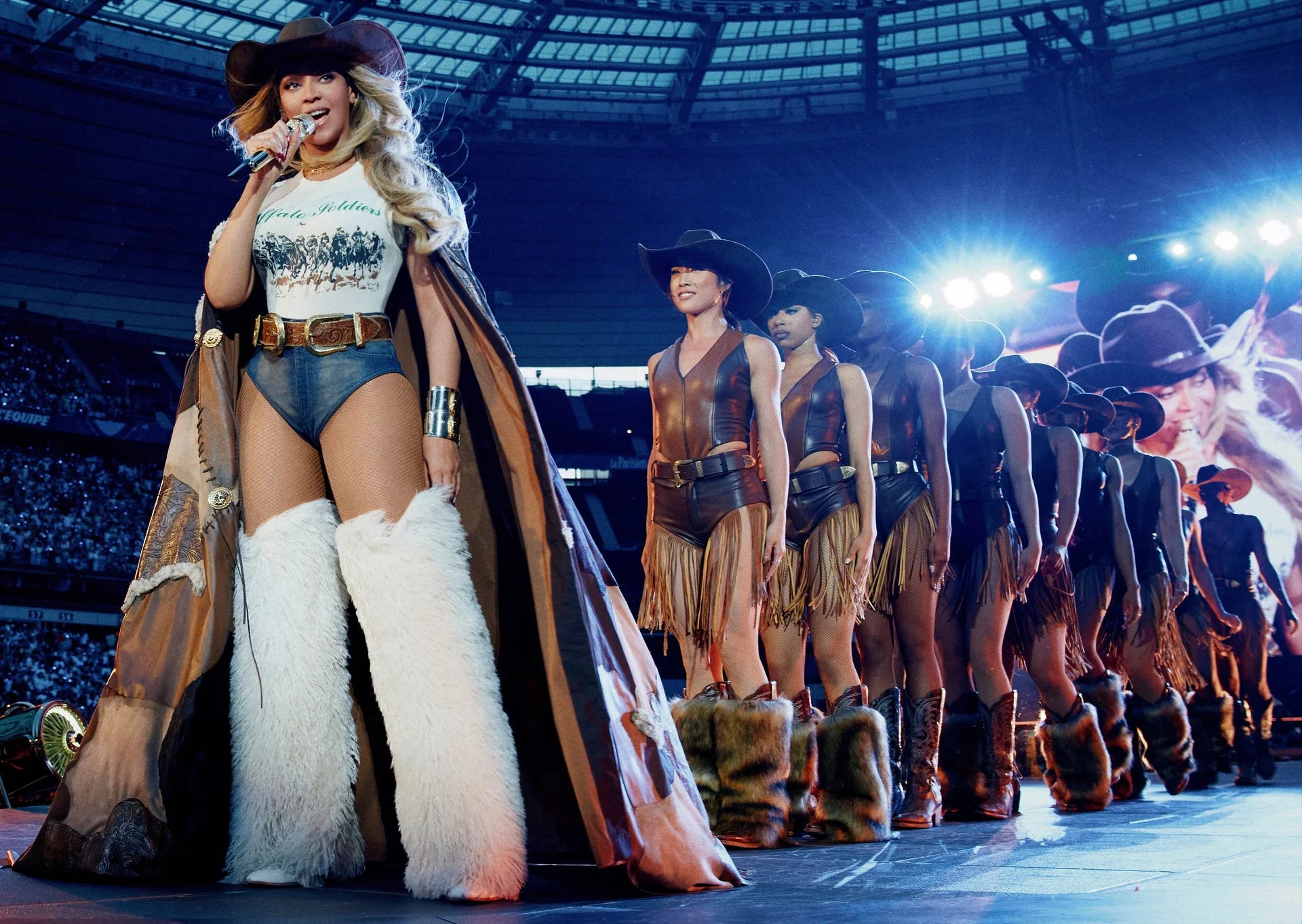
The same critics demanding historical awareness from a pop star often traffic in their own half-read screenshotted history lessons. The impulse to hold Beyoncé accountable is not wrong. The impulse to hold her accountable while excusing your own sloppy engagement with the same historical record is convenient. If you want artists to know the difference between honoring Black soldiers and endorsing the violence they were ordered to commit, you should probably know that too. Most people retweeting outrage could not locate the Eaton Fire on a map or name one of the homeowners who received direct assistance. The performance of moral rigor only goes one direction.
Pop culture has become, for a significant chunk of the population, the perimeter of political engagement. Celebrity endorsements feel like activism. Celebrity donations feel like policy. Demanding that a famous person “say something” substitutes for the labor of organizing or donating or showing up yourself. Then, when the famous person says something, the evaluation begins: wrong tone, wrong venue, wrong shirt, not soon enough, not loudly enough, not with sufficient purity. The celebrity is supposed to absorb the risk of public positioning so you don’t have to. When they absorb it imperfectly, you discard them and wait for the next vessel.
Meanwhile, ICE is conducting militarized raids across the country. Journalists are being arrested for documenting it. Don Lemon and Georgia Fort, an independent Minnesota reporter, were taken into federal custody this week for covering a protest at a St. Paul church. Attorney General Pam Bondi ordered the arrests personally. Fort recorded a video as agents arrived at her door, saying she was being arrested for being a member of the press. The Justice Department has refused to open civil rights investigations into ICE officers who killed two people in Minnesota. Federal prosecutors in that state are threatening mass resignation over the department’s conduct. This is happening now. Voting did not stop it. Asking Beyoncé and other artists to say something will not stop it.
The country is not going to be saved by Beyoncé’s Instagram posts or foundation pledges. It will not be damned by her wardrobe mistakes. She is a musician and businesswoman with influence, money, and occasionally bad merchandise. She is not your congressperson or your pastor or your movement leader. If you need civic courage, build civic courage. If you need community defense funds, start one. If you need accountability, start with the mirror. The opinion of celebrities is not a substitute for the work. It’s not even the beginning of the work. Stop asking musicians to be your conscience and then acting shocked when they show up as imperfect people instead of licensed spokespeople. The disappointment you feel is the disappointment of a system you built.
Editor’s Note: Read this piece from Ebanē Marquice that already discussed this similar talking point months prior.

 | A guest post by
|
this was a good read social media enables millions of people to outsource their activism and political consciousness and community responsibility to celebrities and then they get act like they’re on the frontlines when a celebrity messes up. the vitriol for Beyoncé is specifically rooted in anti Blckness and misogynoir — she’s been giving back where she feels needed since the 90s because her mother taught her the value of tithing at a young age. her charitable actions are unselfish and rooted in her spiritual relationship and people still find the need to dog on her. the Buffalo Bill “controversy” was ridiculous. the whole point of Cowboy Carter was to highlight Black American history in country music and country culture; Beyoncé shone light on a dark part of Black Texan history in that we have been used as unwitting, manipulated agents of the government just like in WWII and Vietnam and Iraq. when we get caught up on moral correctness and how celebrities should model it for us, we lose the ability to understand the nuance of history and how white supremacy has centuries of intercultural, interracial conflict.
The obsession and need some people have for entertainers/celebrities to be political avatars is a nasty piece of celebrity worship. For those entertainers that do speak out on social/political issues, cool. Good for them. I won't offer them endless praise for doing so. They're exceptions to the rule. There are very real activists and organizers on the ground who put in real liberation work everyday without the benefit of millions of admirers giving them superficial pats on the back. They're not rich, they're not famous. They have far more to lose (and often do) by putting themselves out there everyday doing work, all for the love of the people and the desire to see oppressed people free. I could care less what a celebrity has to say (or doesn't say) about politics. What did Malcolm say? What did Huey, Ella, Martin, Garvey, Walter Rodney or Fannie Lou say? What do countless activists, organizers and scholars have to say? Why aren't people tapped into them? Why aren't we seeking their expertise/perspective? The question should always be: "Am I studying, reading and in community with people serious about liberation and developing a concrete analysis of our current situation?". The only thing a celebrity/entertainer can do for me is to entertain me with their unique artistic gifts. If by chance some political messaging is in that, then cool (obviously there is a long history of incredible protest/political art/music), but if not, then that's cool too. No matter how much we enjoy the entertainment an entertainer provides, looking for them to be mouthpieces for our preferred politic is the ultimate stan glaze.