

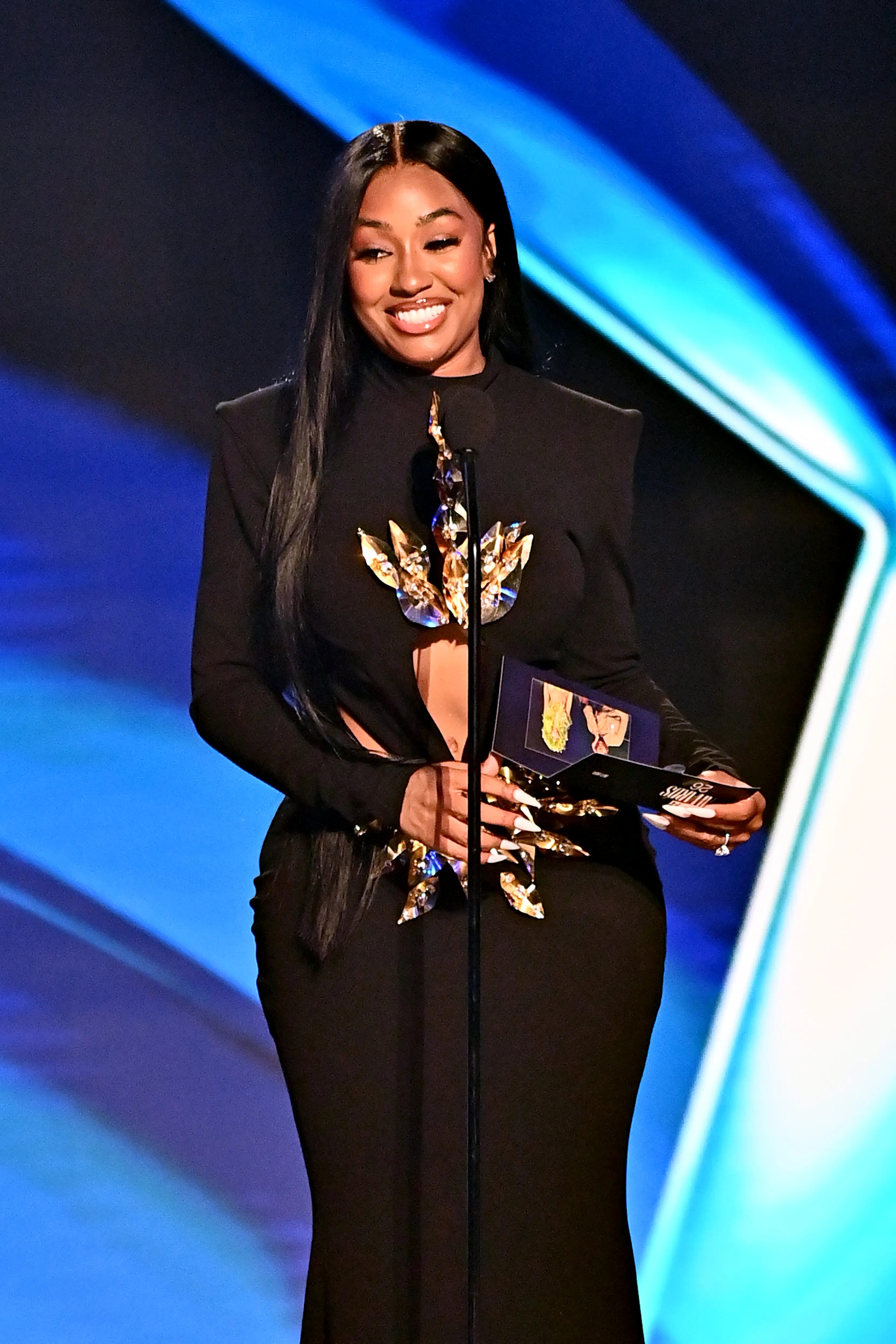
The strip club in the “Spend Dat” video is fictional, a place where bottle service doesn’t come with a bill at the end of the night, where the floor is all dancers and no bouncer at the door, where NeNe Leakes and Trina and Trick Daddy and Ball Greezy are summoned by the cash. It is a realm where money floats and never ends, and Caresha Brownlee, known as Yung Miami to the millions who have spent the summer with her, is the creative director of a concept she saves, her face, for the center of the piece, printed on a hundred-dollar bill in the place of Benjamin Franklin.
What she wants everyone who hears the song to do with all that money is spend it, and where it came from is the joke and the boast and the provocation. The hook names names and gives orders, a scammer and a booster both getting one shout and one command before the item is flipped, the Goyard bag on a boosting run already unzipped, its tags gone before it can cool. Boosting is shoplifting as an industry, scamming is fraud as an art form, the song names both and cleanses neither. J. White Did It has the curl of a guitar figure and the sigh of a piano in the pocket, a bounce light enough for a rooftop at noon, and Yung Miami has the sneer and the skip of a playground chant, her nasal, clipped delivery easy enough that it accompanied brunch all June, the booster’s manifestos riding on top.
India.Arie heard the same song everyone else did and took a different lesson. When someone asked her to boycott (meaning someone else sparked the conversation and not her), she declined the suggestion, and clarified that while she had not told people to stop playing the song, she did think that a track “accepted so widely” was “a sign of where we are as a culture,” and that was, she added, “just facts.” People could do what they wanted. She would do what she wanted. In a Substack post responding to the comment in full, she clarified her stance on the comment and the song, as another in a long series of thoughts on music as “pure frequency,” on lyricism as a means to get inside of people’s subconscious mind, on her own careful curation of what she listened to, as she curated what she ate. She would not, however, say the words to the title out loud.

Take it with a pinch of salt, and you won’t be wrong, either. Songs teach. A hook drilled into the skull enough times becomes a habit, and a habit, unavoidably, turns into a thought before it becomes a requirement, and children know the words to things long before they understand what they’re asking of you. Parents have feared exactly this since records began, and they have not always been wrong. Her reading of it is complicated by the provocation of the premise, the implication that she hears a broke public in that hook, a public that has fallen for scamming, and she blames the fall, but the arrow could just as easily be pointed the other way. No one wrote this to ruin a content crowd, but it found one, and it played them the one story it knew.
It was money, and no song is responsible for that (nor we co-sign scamming); the recession had hollowed these pockets long before Yung Miami told them to spend, and the record only put voices to the feeling. To be broke in the summer of 2026 is not to be in a state, but to have a ledger with your name at the top, with jobs vanishing in slow, unremarkable increments and rents devouring paychecks in cities all over the country, with the formerly well-rounded suddenly underwater on a down payment. Songs about overcoming this specific set of circumstances didn’t appear from nowhere, they didn’t materialize with some kind of secret knowledge of the times, they bloomed where the ground had opened up, and the depression had its own movies, with penthouse parties and champagne tastings in every lobby, the 2008 wipeout set rap up to have a decade of trap houses converted to storefronts and cornerboys rebranded as founders, and when the straight road stops paying everyone, the crooked one stops looking like a moral failing and starts looking like a lifeline, and “Spend Dat” is a song about lifelines.
None of which is new, either, from Yung Miami or from the long history of music. Cardi B put out “WAP” during the pandemic, and the conservatives had a meltdown, not only among the residents of the state but also among a congressional candidate, and rock and roll had its own moment of reckoning half a century earlier, then gangsta rap took over, all of which have been greeted by the same sense that youth is wasted on the young. Underneath it all, there is a certain amount of panic, not likely to be acted on, which is easy to overlook given the wailing about murder committed in the name of love. Those who really engage in murder are far less likely to engage in the same kind of self-purification, and a prison guard would be free to enjoy Pusha T’s verses about bricklaying while his commanding officer listened to “Ha” and agreed in principle to teach a seminar on the finer points of the university at nine in the morning. It is the provocation that matters, as does the ability to crawl inside the skin of someone who would have committed the crimes described in the song, and that has been the case since the parents first bought their children records that made it clear that sex was far more important than death.
Notice who gets to be lectured to, who gets to be an artist, a street philosopher, a chronicler of his corner of the world, and who gets to be the subject of lectures. A man who built his reputation on lies, women, and guns is praised as an icon, while a woman who counts the hundreds of men who tried to scam her and calls them out is a problem. No presidential commission was ever formed to determine what was happening to the moral fabric of the country while JAŸ-Z spent his career rapping about selling crack to his neighborhood or while an entire generation of males decided that dealing was a perfectly sensible idea. Women get asked to stop doing what they’ve been doing, and men get asked to do the same, but the reasons why are far more interesting, as an insight into why they behave as they do, with far less remorse. It might not be a detail, then, when it comes to this discussion, to point out that it isn’t a detail at all.
The men arrived to her defense and turned the defense into defense. Trick Daddy went on social media berating the women criticizing the song that they were old and raggedy and jealous, and dismissed a singer’s larger argument about how music affects children by reducing it to one about bodies, while Free and Dee-1 pushed back (Trick told her, “You ain’t shaped like her. You shaped like me”). Then came Uncle Luke, who built 2 Live Crew out of the filthiest shit the genre had to offer and ended up in federal court in 1990 fighting for the right to continue selling “Me So Horny,” now saying that India.Arie’s criticism was “Black on Black crime” and brushing off all the Afrocentric types forever seeking art carved in their own exact image. The man who went toe-to-toe with the United States government over the right to say as dirty as he wanted now stands sentinel over a Black woman for saying a dirty record gave her pause.

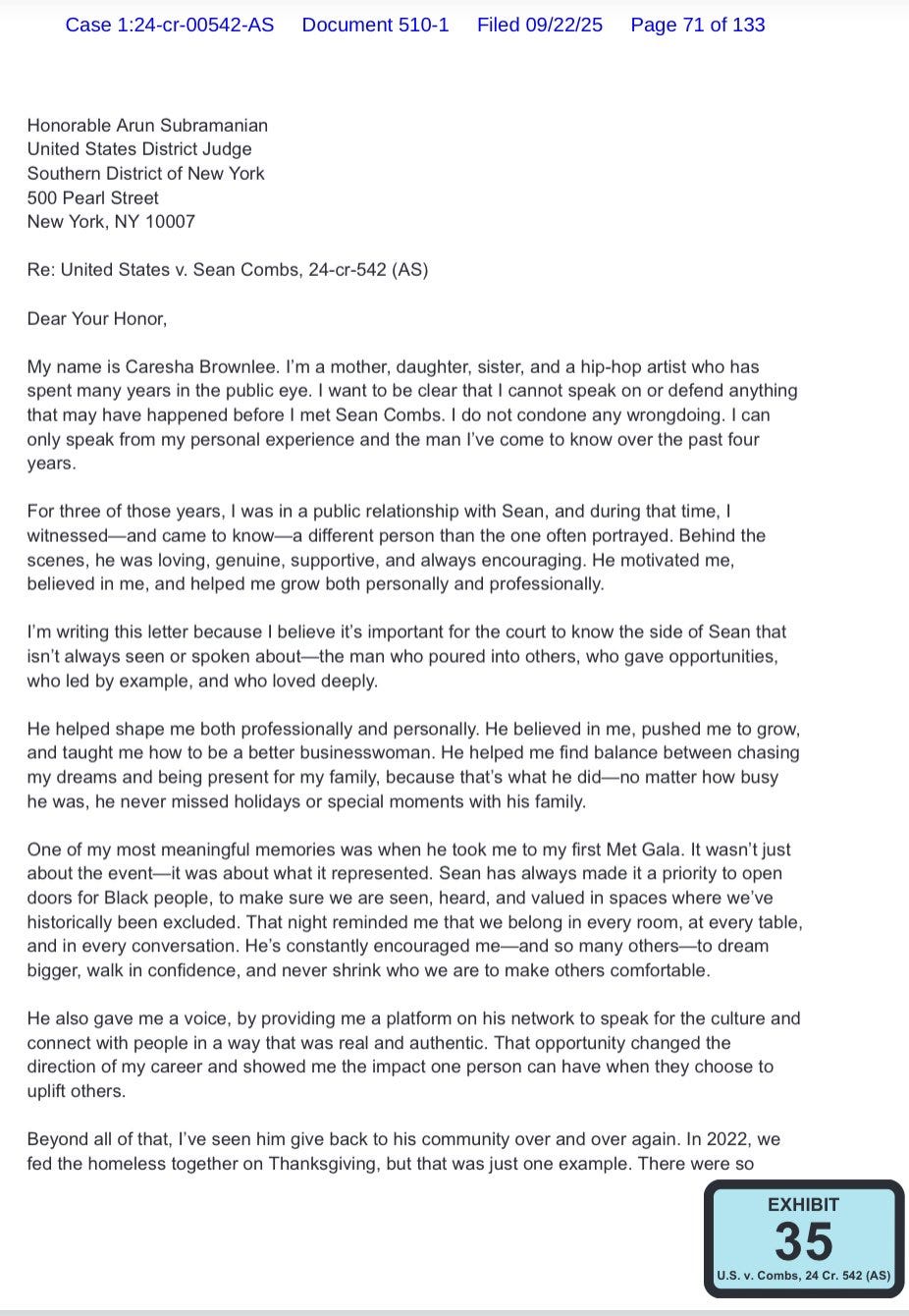
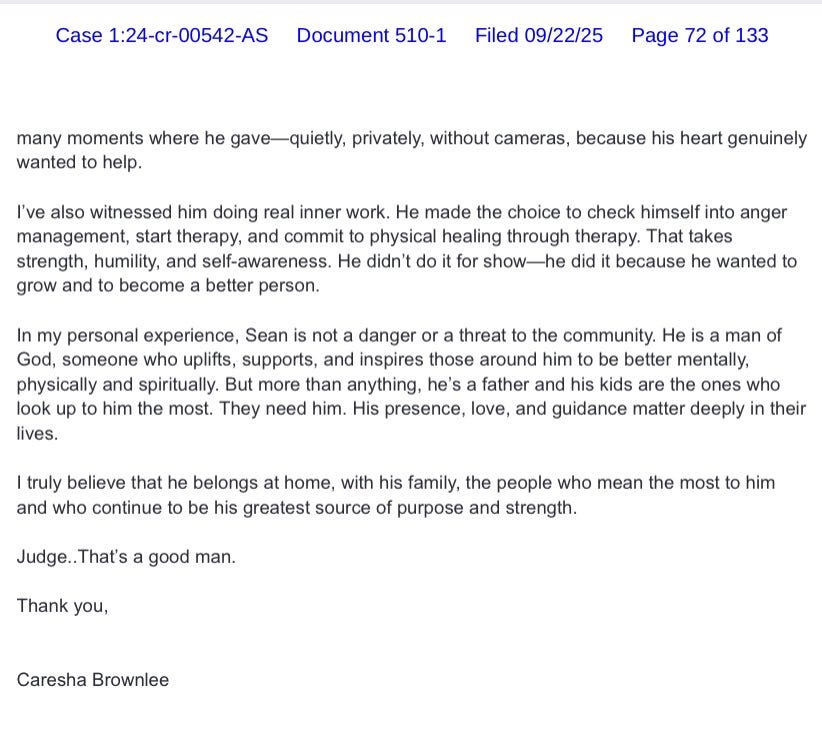
Months before “Spend Dat,” Caresha penned a letter to the federal judge who was about to sentence Sean Combs, begging him for leniency and describing the mogul as a “good man” who was “not a danger or a threat to the community.” This was the man a jury had just found guilty of trafficking women across state lines for his sex parties. This is the man Cassie Ventura and generations of other women have accused of raping them and beating them for years. India.Arie gave credit where credit was due and highlighted that letter midway through her screed about the record. Then the whole thing devolved into women arguing over whether women should be allowed to rap about money, which was the only question in that pile that wasn’t worth asking. There is nothing being harmed by twerking to “Spend Dat.” Signing your name to a letter asking a judge to go easy on a monster like that is another sort of credit, and it is the one we should lose sleep over.
There is more to what was said before, to this particular set of complaints, and it involves black women and the burden imposed on them for a century or more, to know that the best way to help the race as a whole was to present themselves in a certain way at all times, because any employer or policeman or politician was likely to notice if they didn’t. It was a matter of self-preservation, and it worked, which meant that it became a problem, and it got folded into the same set of directions given to women, in general, to cover up their legs, their necks, their brains, and it often came from black women, directed at other Black women, in the presence of white people who needed to be reassured that Black women were, in fact, one of the good ones. It is the same set of instructions given to Yung Miami to stand up in front of a microphone and do what she did, to be the answer to a hundred years of questions, asked by everyone except those who were supposed to know better.
And yet a community gets to ask what it wants. That’s not being a boycott, and painting everything questioning as policing is a means of avoiding the question. It is fair to ask what it means that the biggest woman-rap song of the summer is a boosting anthem, and it is fair to want more from the radio than instructions in how to spend stolen cash. The sole critique with India.Arie’s position is not that she asked questions, but looked at the culture that swallowed the “Spend Dat” fantasy and saw the listener in the wrong place. A three-minute song was hardly going to disenfranchise anyone. Capitalism and white supremacy and the men who serve both have done that, and the song is just the sound of people who have been economically exploited reciting to themselves on the walk to the job they can barely hold.
Listen again to the song, and the wish in “Spend Dat” turns out to be more specific than the disillusionment allows. The dream is not simply about money; it is about never having to explain the money—the Goyard on the lifter, the twenties, fifties, and hundreds all racing one another, the ten figures the man pulling who rides with her against the opps—all a single direction, the life where no one gets to ask questions regarding the source because there simply is not enough room for all the answers. Her face on the bill is the end of that particular road, the one where she stops chasing money and becomes the chased.
Somewhere in the explanations India.Arie has given in the article, the one that sticks is the one that traveled farthest, that she had come to terms with the fact that not everybody wanted to get free. Take her at her word, and the argument is easily divided. What she wants is to turn away from the wrong jukebox and onto the right, to curate her world so that she can eat the nourishing meal and not the cheap one, and it is all a freedom that costs nothing but self-discipline. What Yung Miami is selling can also be purchased, and no amount of self-discipline will unlock the front door before the rent is due on Friday. Thus, the entire argument is measured in the distance between what India.Arie has and the young and broke listeners she has defined as her contemporaries.
Therefore, the record is a reflection, but this entire long argument is reflected within it. Yung Miami didn’t invent a woman wanting to beat the fuck out of a house that robbed her before she could even vote, but wrote a hook that will not stop playing out of your head about it, drew her face all over that money, and then watched a broke summer scream it right back at her. The responsibility for that record lies far upstream of her. It is located in the system that makes gaming its ruggedness into the closest thing to catharsis so many of us can imagine. India.Arie is correct: America’s favorite song deserves to be looked at very closely. Look closely enough and “Spend Dat” is a fever. And a fever is your body’s way of telling you that it’s already fought something and lost. What your body lost was the ability to live in an economy that doesn’t make millions of us rhyme along to a hundred-dollar bill with someone else’s face on it every day and wish that face was ours.