

Walk into any decent record store between 1994 and 1999 and the back wall would tell you the same story. Half of it was rap-and-R&B movie tie-ins stacked four-deep, most of them attached to films you’d already half-forgotten. The deal was the simple end of a complicated handshake. Studios needed marketing for movies most audiences wouldn’t bother to see, and the major labels needed sandboxes for testing debut artists and running singles that didn’t fit anywhere else. The comps became the trade.
Warren G’s career broke off the Above the Rim tie-in before Regulate... G Funk Era finished printing. Jill Scott and Lil’ Bow Wow both made their first major-label appearances on the Wild Wild West soundtrack. An unsigned 50 Cent showed up on a Donald Goines book companion a year before he was shot. Maxwell gave his only top-five pop hit away to an Eddie Murphy and Martin Lawrence comedy. The discoveries, the leftover singles, the producers getting their first major placement, the entire shadow A&R operation that ran parallel to the major-label release calendar—all of it lived inside the soundtrack tie-in for one decade only. The films are mostly footnotes now. The comps are the receipts.
This handguide takes the decade year by year. What to dig for, what to leave alone, what turned out to matter for reasons nobody on the marketing call could have predicted. The format dies in slow motion when Napster reroutes the industry’s money in 2000, and it never comes back. It had already done more for rap and R&B than most of the album release calendars it was technically there to support.
Before we start, we wanted to send our special thank you to Edward Bowser, of Soul in Stereo, who took our long-delayed research, and ranked fifty best hip-hop and R&B soundtrack albums exactly a year ago today.
A Note on What’s Not Here
The Inkwell, Dead Presidents, Jackie Brown, Malcolm X, Office Space, When We Were Kings, Girl 6, and both volumes of Crooklyn don’t count for this handguide. The majority of each is licensed catalog material, not anything original or new commissioned for the film, which puts them outside what this guide is about. And trigger warning, as there will be mentions of the Diddler, Pissy Drip Drop Man, and others. Enjoy reading through over 130 soundtracks!
1990
House Party
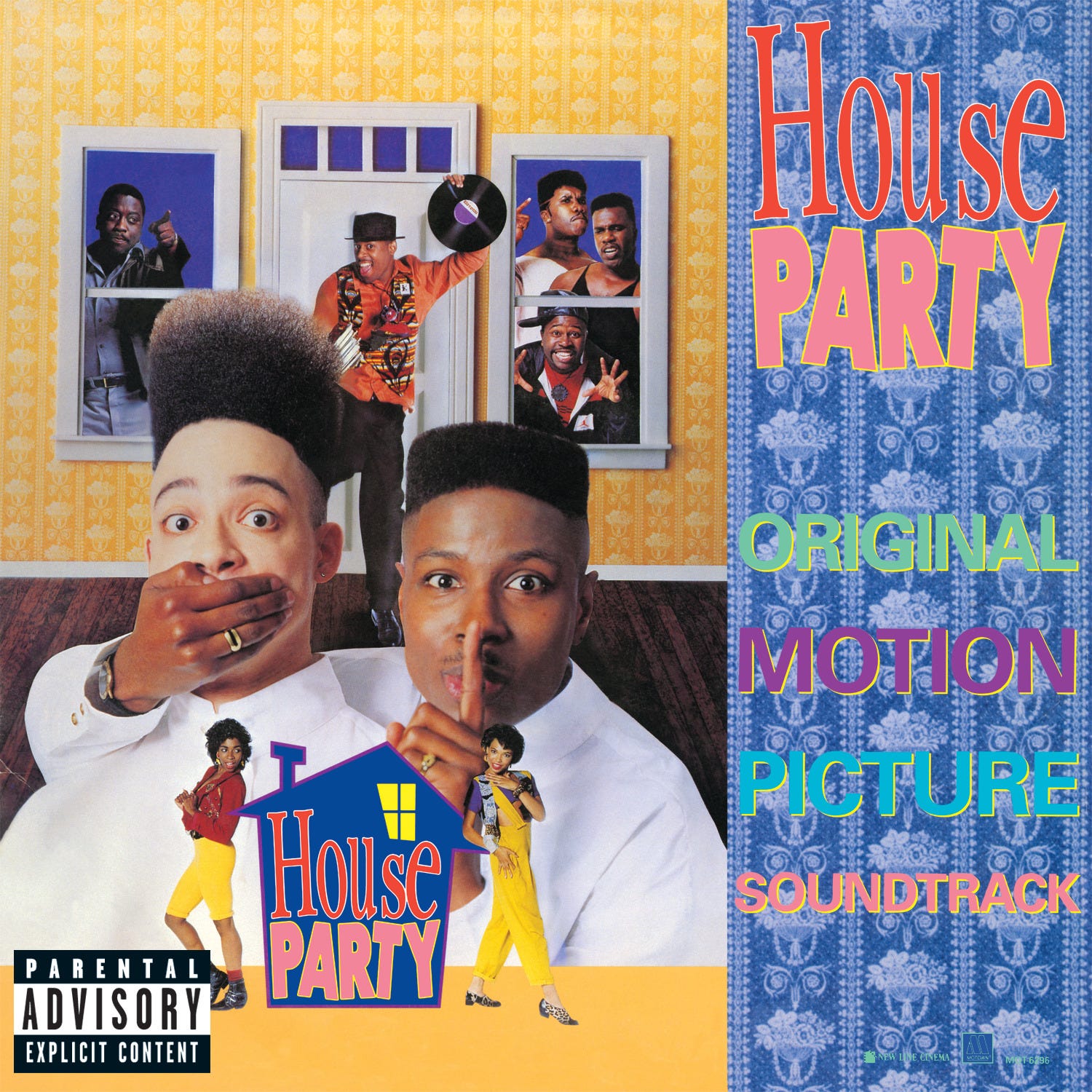
Reginald Hudlin and his brother Warrington sold Motown on a soundtrack the way they’d sold New Line on the movie, by pitching a Sundance-premiering Kid ‘n Play comedy as the center of a serious commercial operation. Hurby “Luv Bug” Azor, Salt-N-Pepa’s long-running producer, ran most of the sessions. The LP has Today chasing Jam and Lewis on “Why You Get Funky on Me,” Full Force turning in the kind of buttery Brooklyn R&B they’d been sharpening for five years, Flavor Flav stepping out from behind Chuck D for a solo nobody at the label had asked for, and LL Cool J’s “To Da Break of Dawn,” the Kool Moe Dee and MC Hammer and Ice-T diss more vicious than any PG-13 soundtrack in 1990 came close to—LL rapping at the breaking-voice pitch he reserved for people he actually hated. Azor also coaxed Kid ‘n Play into “Kid vs. Play (The Battle),” with Play writing into Kid’s punchlines as they traded verses in real time. Uneven, sure, in the way any eleven-producer package has to be uneven, and the rap-to-R&B ratio tilts harder toward rap than any Motown release had tilted before it. Motown knew exactly what they were doing.
Mo’ Better Blues
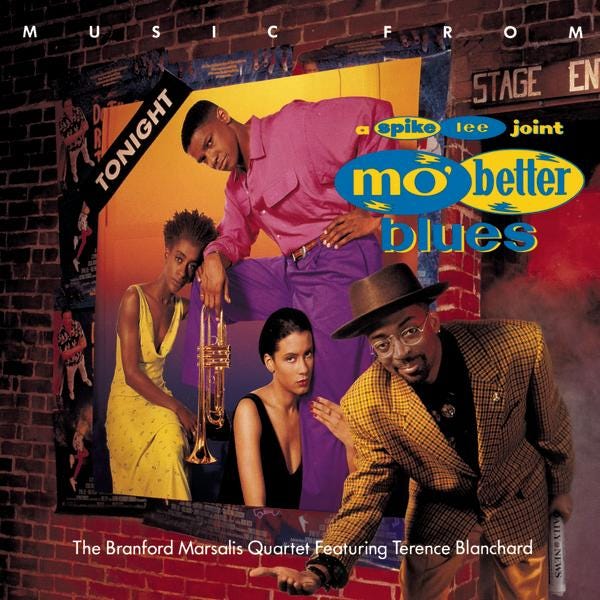
Bill Lee, the jazz composer and bassist whose son was directing the picture, wrote most of this one, which tips it past film-score territory into something closer to a straight-ahead jazz date. The Branford Marsalis Quartet plus Terence Blanchard on trumpet treat the recording as a working band gig, which is what it is for much of the runtime. Cynda Williams, playing Clarke in the movie, handles W.C. Handy’s “Harlem Blues” over a Marsalis arrangement with smoked-room deference—enough to make you believe her character earns her rent at Beneath the Underdog. The one direct rap tie-in is Gang Starr’s “A Jazz Thing,” with Kenny Kirkland on keys and Robert Hurst on bass. Premier’s drums spell out the lineage Spike was arguing for, Guru recites a compressed history of Black American improvisation, and Branford’s quartet plays behind him the way a working band plays for an old friend. Denzel Washington and Wesley Snipes briefly sing on a thing called “Pop Top 40,” which is exactly as amateur and charming as their speaking voices suggest. Columbia released it as a jazz LP, and it charted as one. Spike’s brief to his father was to document what the musicians could do in a room together. Bill Lee built him something that does precisely that.
Return of Superfly
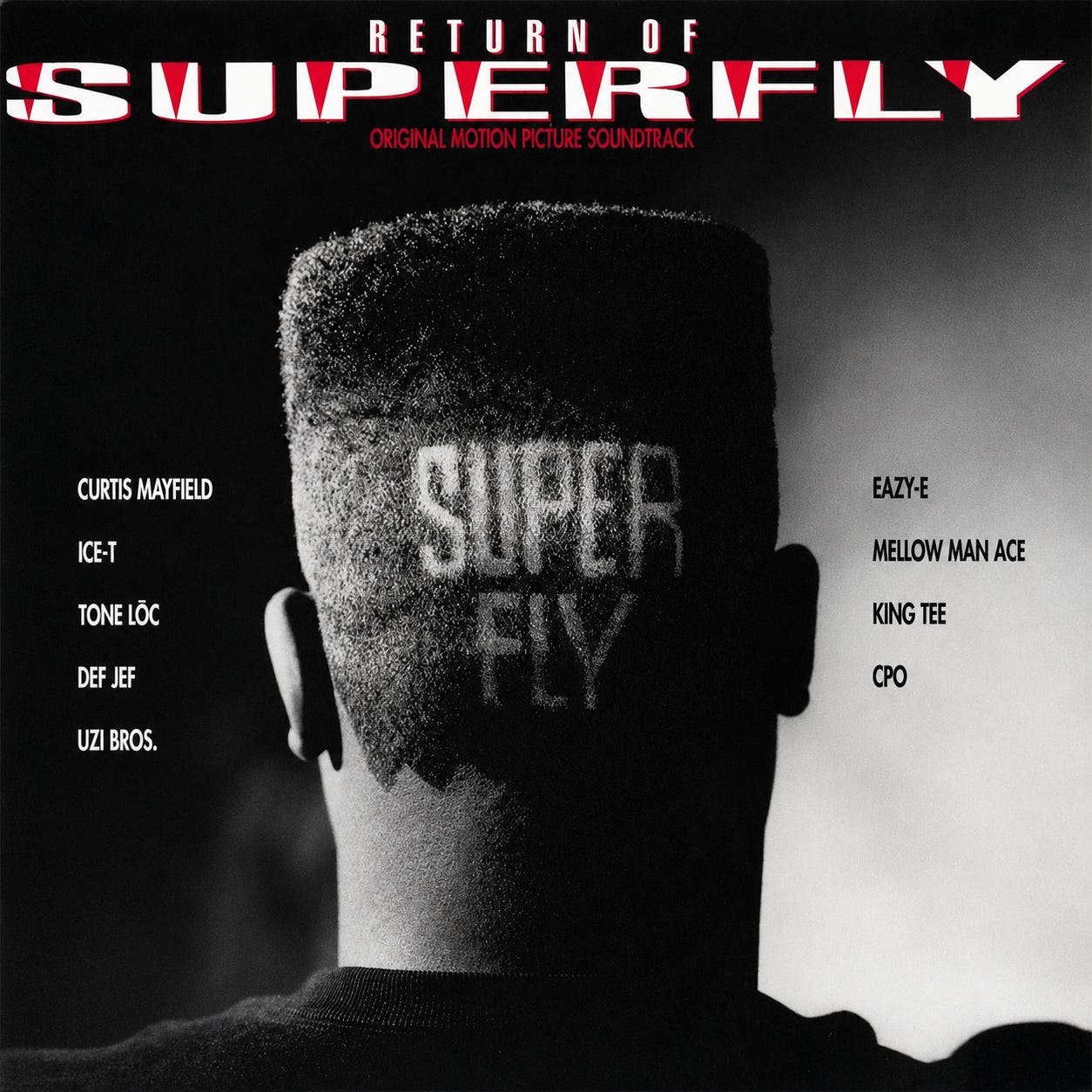
Curtis Mayfield wrote four new songs for Sig Shore’s sequel to his own 1972 masterpiece, turned in the Ice-T duet “Superfly 1990” with additional production and guitar from Lenny Kravitz, and walked off that work into the accident that would end his ability to perform. A stage-lighting rig collapsed on him during an outdoor show in Brooklyn, leaving him paralyzed from the neck down. Mayfield is still moving inside his old falsetto on the title track, writing the drug-dealer morality play from the same vantage he’d held in ‘72, and Ice-T plays the student, staying out of the way and letting Mayfield’s half of the duet carry the argument. The rest of the program is a Capitol Records lineup card of the 1990 West Coast hip-hop roster (CPO’s “Somethin’ Like This,” Eazy-E’s “Eazy Street” with Dr. Dre at the boards, King Tee, Def Jef, Mellow Man Ace), all of them playing into the updated blaxploitation frame Shore was selling. None of it has aged as well as the four Mayfield songs, which were cut at his home studio in Atlanta and still hold that room’s close, airless warmth. “Superfly 1990” and the closing ballad “For the Love of You” are the ones to return to; they’re among the last recordings of Mayfield made while he was still on his feet.
Marked for Death
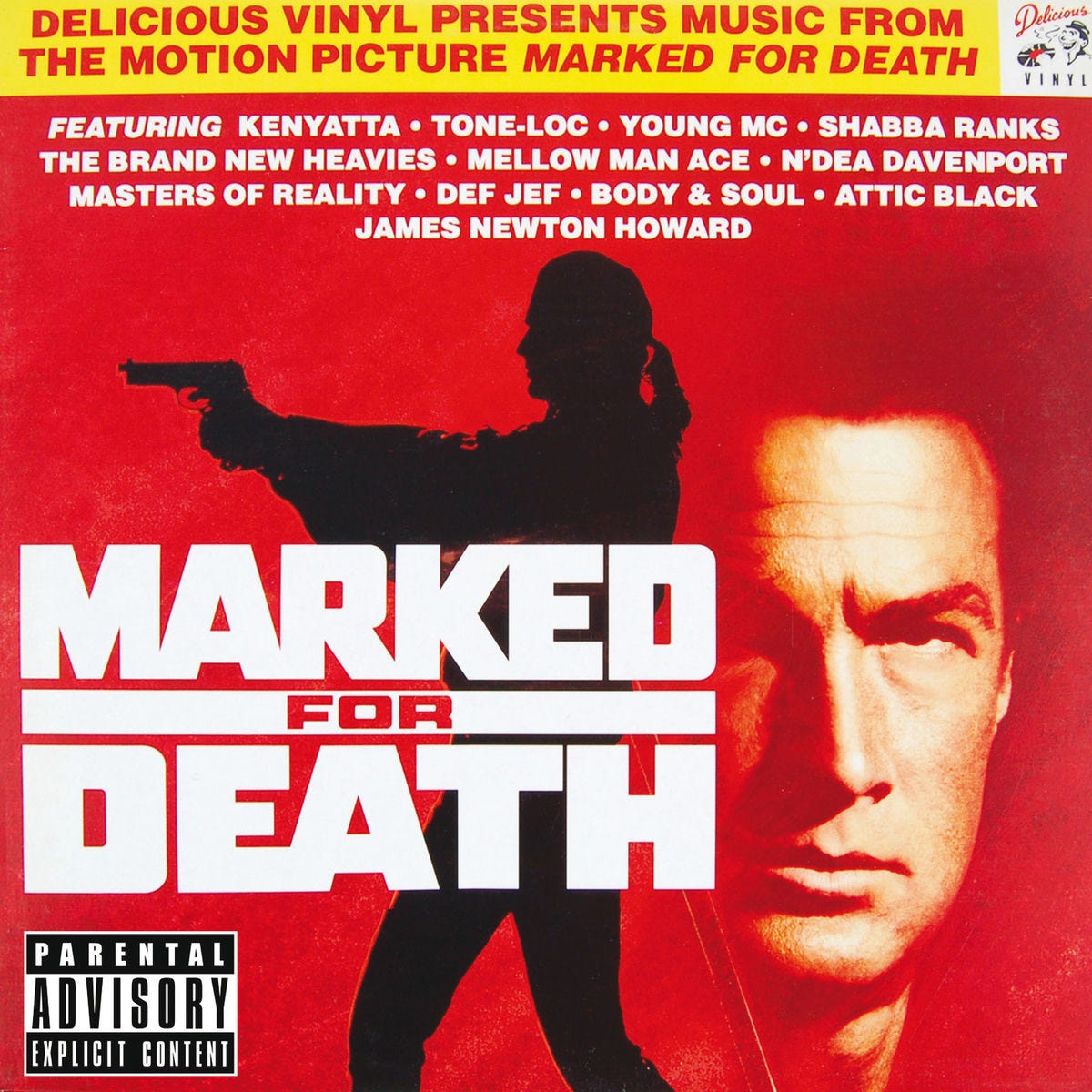
Delicious Vinyl’s Matt Dike and Michael Ross had built the label on Tone Lōc and Young MC and were sitting on a pile of credibility when Steven Seagal, who co-wrote and sings on the title song “John Crow” with Jimmy Cliff, made them executive producers on the soundtrack to his reggae-revenge action movie. What they assembled was mostly the Delicious Vinyl roster. The Brand New Heavies turned in their first US-released cut “Put the Funk Back in It.” Def Jef and Tone Lōc added contributions. Around them Dike and Ross built out the serious reggae the movie’s plot required: Peter Tosh’s “Steppin’ Razor,” Shabba Ranks’ “Roots & Culture” from a year before his stateside crossover, and Jimmy Cliff’s own “No Justice.” The two Cliff solo cuts are the durable pieces, with “No Justice” a plain-worded protest number he handles as though he’d been writing it for twenty years, and “John Crow” strange in a way only the Seagal connection could have produced, with the star audibly standing in the booth. The LP is weirder than its marching orders required, which is the reason to give it a second look today. A hip-hop, R&B, and roots-reggae anthology put together around a Steven Seagal vehicle about dreadlock drug lords has no business being as strong as its durable stretch.
1991
New Jack City
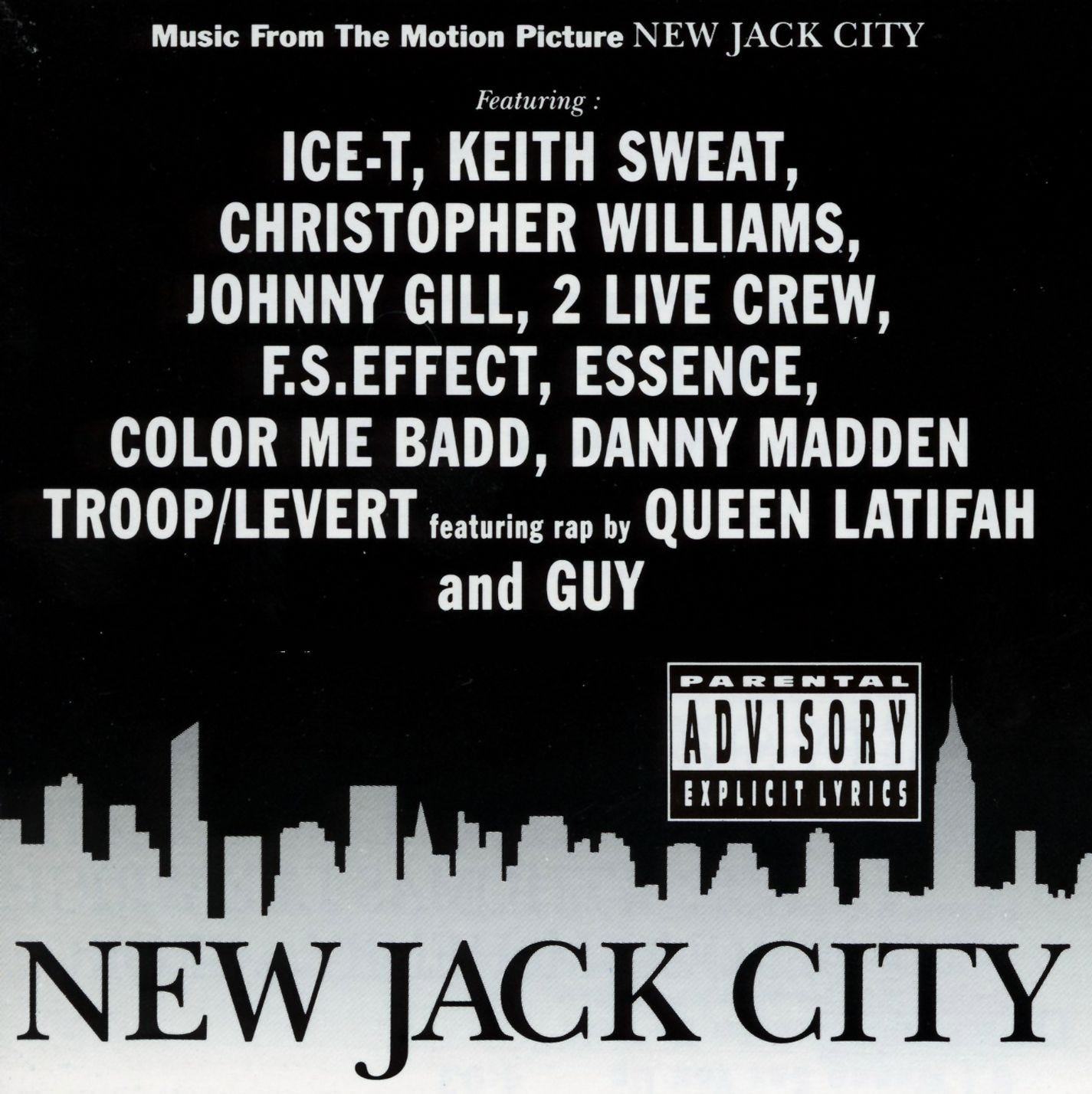
The producers behind “I Wanna Sex You Up” walked the Betty Wright-sampling new jack swing number past Bell Biv DeVoe, Keith Sweat, and Christopher Williams, all of whom turned it down before it reached Color Me Badd, an Oklahoma City quartet newly signed to Giant. Williams ended up on the same soundtrack with “I’m Dreamin’” instead, and the rejects’ consolation went to number two on the Hot 100 and sold platinum. A Mario Van Peebles gangster picture about the crack era somehow incubated the horniest R&B single of 1991. The format was that loose in its first full year. Ice-T’s “New Jack Hustler (Nino’s Theme)” is the piece that holds the film and the LP together; Nino Brown was a morality play, and Ice-T writes the song from inside Nino’s head as a first-person hustler’s creed. Guy’s title cut and Keith Sweat’s “(There You Go) Telling Me No Again” give the record its New Jack Swing backbone. The Troop and LeVert medley of “For the Love of Money” and “Living for the City,” with a Queen Latifah feature, extends that argument with Teddy Riley’s whole sonic signature on display and Riley himself producing none of it. It sold triple platinum. The formula it put together, with an R&B ballad as crossover lead, a rap anthem as critical anchor, and Teddy Riley aesthetics filling the middle, became the one every major studio urban-film soundtrack copied through the next four years.
The Five Heartbeats
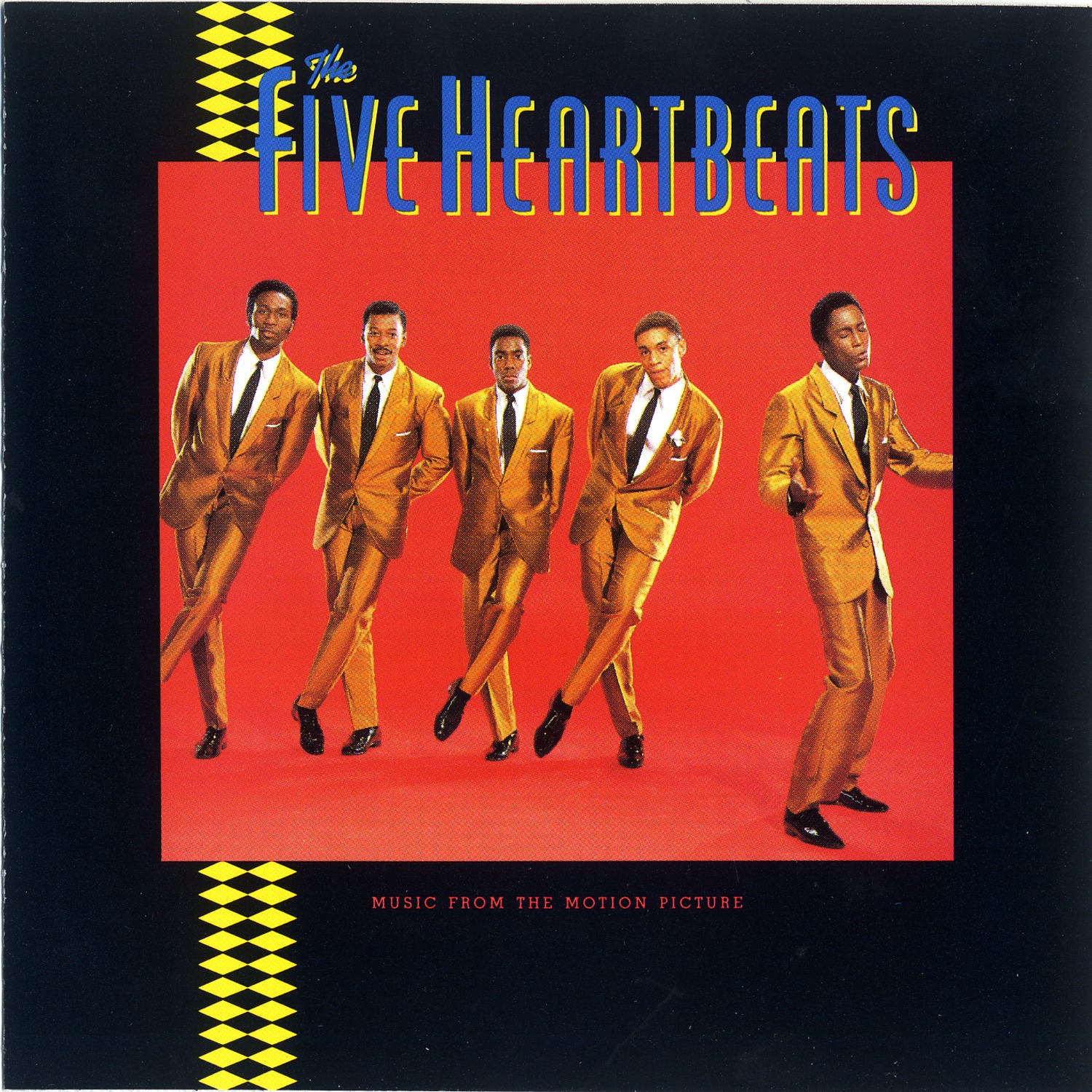
Robert Townsend originally wanted David Ruffin and Eddie Kendricks as technical advisers, but Berry Gordy’s team warned 20th Century Fox away from the Temptations parallel, so Townsend ended up with the Dells instead, and what the Dells had actually lived through is the story his film traces. Stanley Clarke was brought on to score the picture. Thom Bell, the Philly International architect who’d produced the Delfonics and the Stylistics, contributed an old song of his own. The actual Heartbeats voices on the disc are mostly session singers working behind the actors. Billy Valentine ghosts Eddie King’s leads throughout, doing the real singing the film pretends its star is doing. Marvin Junior of the Dells handles the late-act “Stay in My Corner,” and Tressa Thomas, the only cast member performing on wax, takes “We Haven’t Finished Yet” with Patti LaBelle providing the reprise. “A Heart Is a House for Love,” credited to Billy Valentine with the Dells, reached number thirteen on the R&B chart, which means Townsend’s film produced a top-twenty hit under a fictional band’s name. It is an odd fit with the year it came from, a period-correct doo-wop and Philly-soul pastiche made in 1991 for a movie set across three decades starting in 1965, and it is as serious about the craft of that older songwriting as any major-label release of the year.
Livin’ Large!
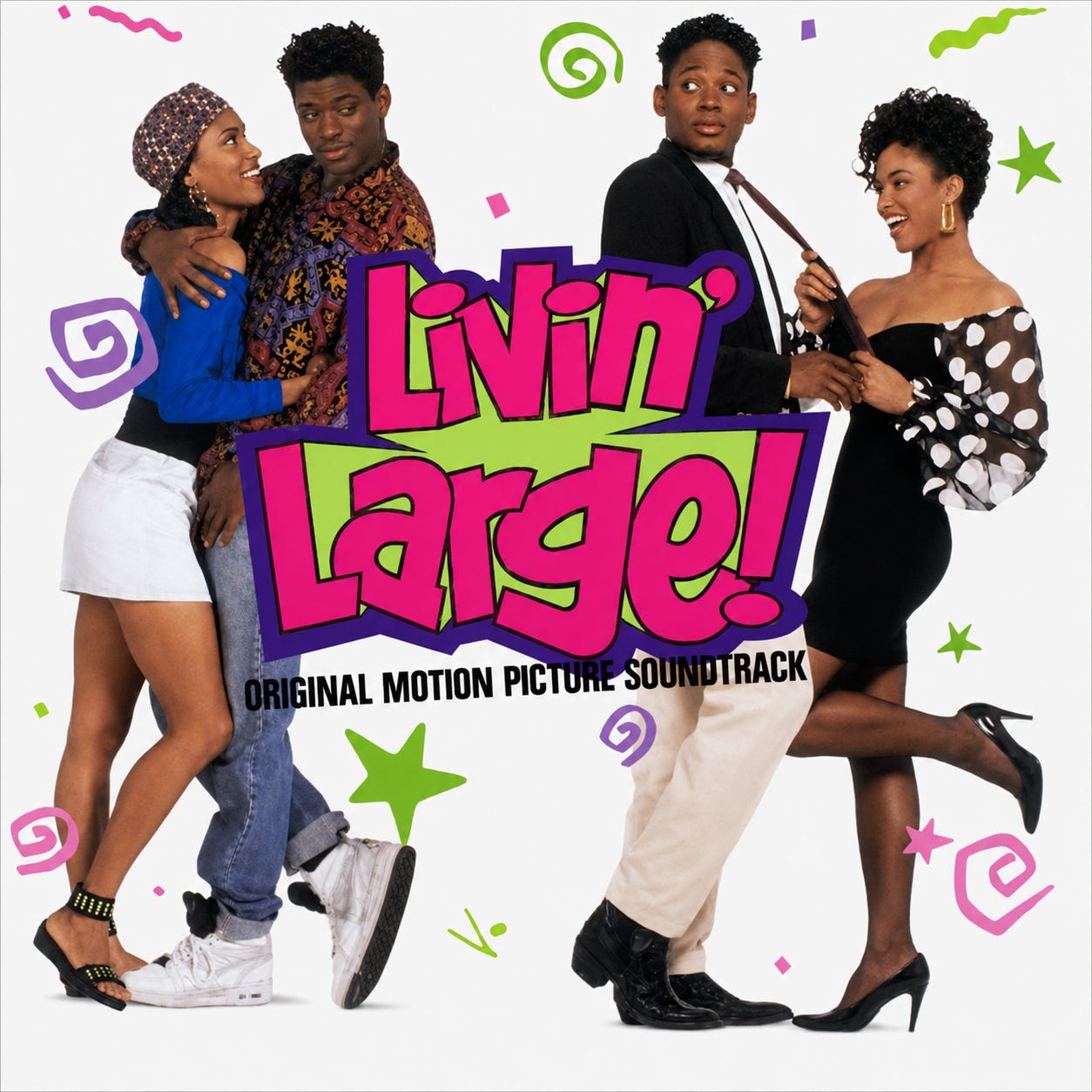
Def Jam wasn’t in the soundtrack business yet. Rick Rubin (fuck him) had split for Def American three years earlier, Russell Simmons (fuck him, too) was running the shop mostly as a rap imprint, and the label’s Atlantic deal didn’t really cover movie tie-ins, so it was an odd call when Def Jam put its name on Michael Schultz’s satire about a Black television news anchor slowly turning white on air. The movie flopped; the compilation is the interesting object left behind. The Jungle Brothers opened it with “Doin’ Good for Yourself,” one of their sharpest singles since Done by the Forces of Nature. Slick Rick, in the middle of the legal trouble that would send him to prison the following year, cut “The Ruler” with Mr. Lee over a skidding drum loop Rick handles like a hand-me-down melody, and his melodic writing is as sharp as on anything from his first-album stretch. Alyson Williams and Newkirk handled the R&B; Herbie Hancock produced the title track with a studio outfit billed as The Don; Downtown Science, the Bobbito García and Sam Sever duo, turned in a feature that was most listeners’ first exposure to either of them. Deadline-rushed, attached to a movie nobody remembers, and the Slick Rick song is the whole reason to keep it on a shelf.
Jungle Fever
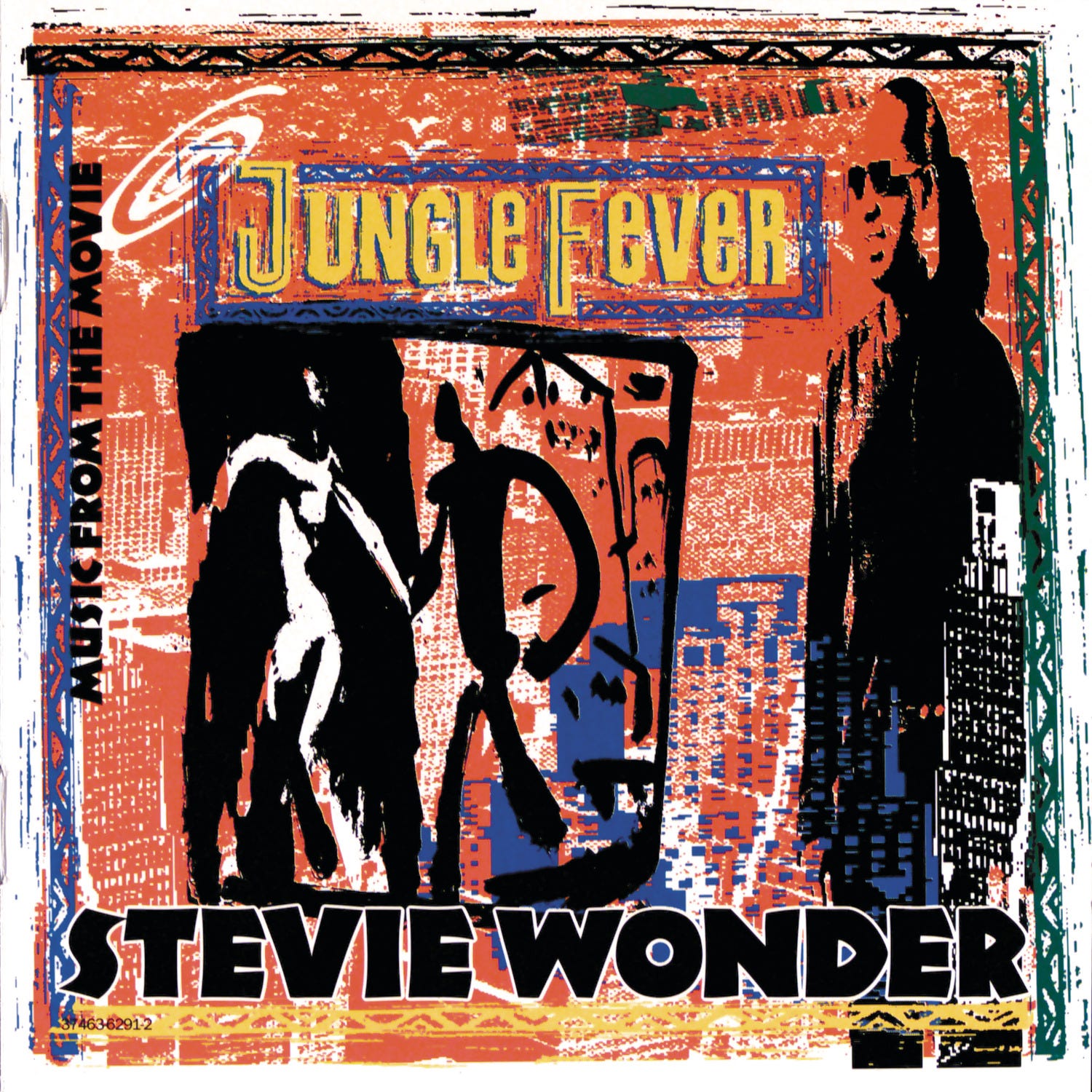
Stevie Wonder scoring a Spike Lee film without a guest list, without rap tie-in singles, and without any co-producers above or below him was the strangest commission of the year. He turned in fourteen songs that play more like a suite than a compilation, with “Gotta Have You” and “Fun Day” carrying the biggest singles and deeper cuts like “These Three Words” and “Queen in the Black” doing more writing than the radio numbers ever got credit for. Vintage Stevie it isn’t. The Synclavier-and-programmed-drums aesthetic he’d been running since In Square Circle has dated faster than the keyboard textures of Songs in the Key of Life, and a few of the instrumental pieces hover somewhere between score cues and finished songs without quite becoming either. But he’s also the only artist on this entire list whose involvement guaranteed the result would function as a complete album rather than a label A&R exercise, and what he gave Spike is a real Stevie Wonder LP, warmer and more invested than most of what he released over the rest of the decade.
Boyz N the Hood
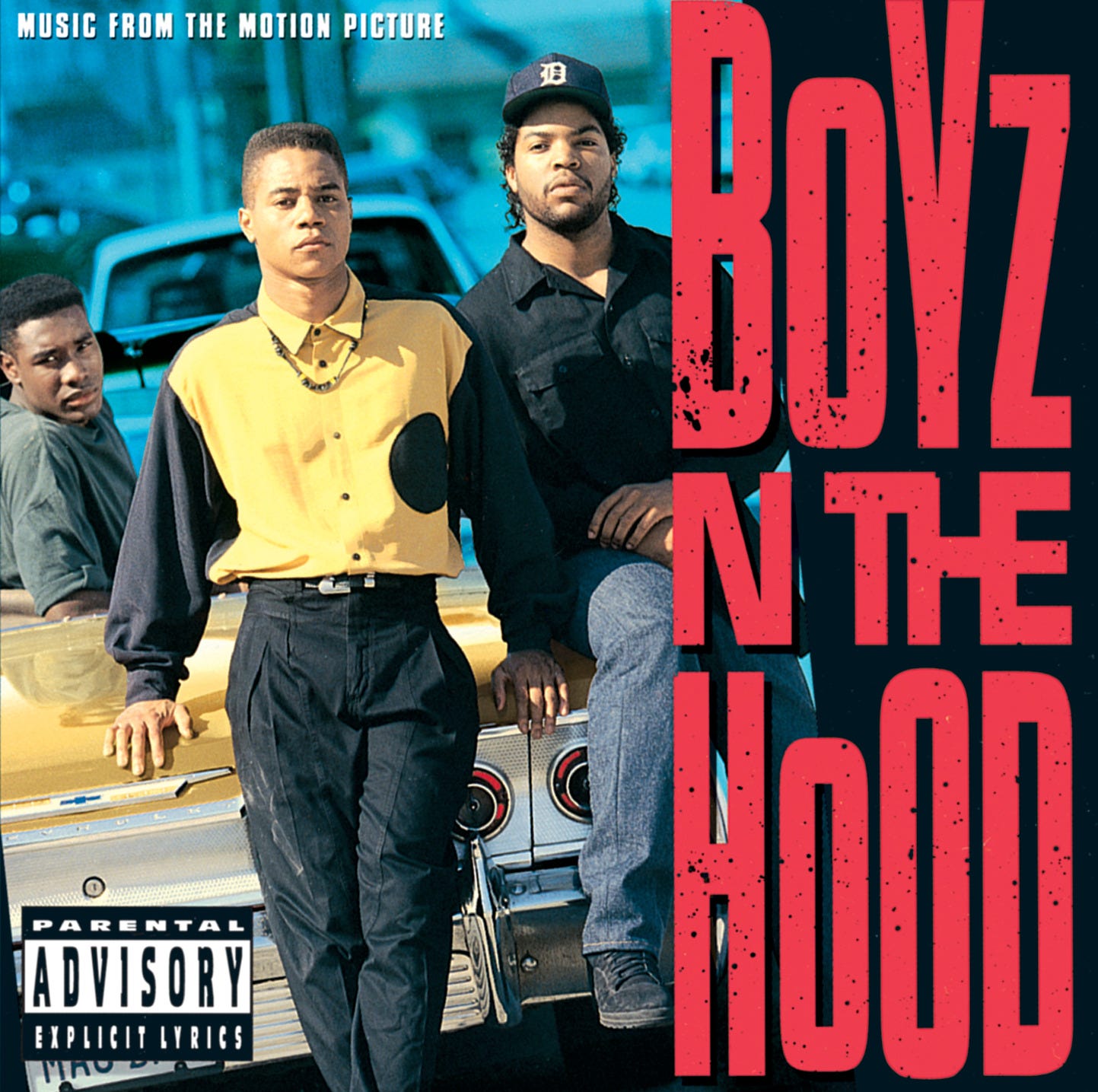
Qwest Records put this one out under Quincy Jones’s name. The elder-statesman fingerprints are audible on material that otherwise belongs to twenty-two-year-old John Singleton’s point of view, and the distance between those two sensibilities is what makes the LP strange. Ice Cube leads with “How to Survive in South Central,” a plainspoken instructional in the voice of a tour guide who knows that what he’s describing has no good ending. Tevin Campbell and Chubb Rock trade verses and hook on “Just Ask Me To,” a rap-R&B duet three years ahead of the radio default that duet format would become. Compton’s Most Wanted’s “Growin’ Up in the Hood” could have lived on their Orpheus Records debut and is sharper for sitting on a Qwest release instead. Main Source’s remix of “Just a Friendly Game of Baseball” takes the Breaking Atoms version into drumbreak territory it hadn’t reached the first time around. Quincy tucked a Brazilian instrumental of his own, “Setembro,” near the end, and Stanley Clarke closed the program with “Black on Black Crime,” an older musician’s two cents on his protégé’s material. And the soundtrack itself doesn’t fit cleanly against the film. It runs parallel, with its own ideas about what Singleton’s story needed that the movie itself doesn’t always share.
Hangin’ with the Homeboys
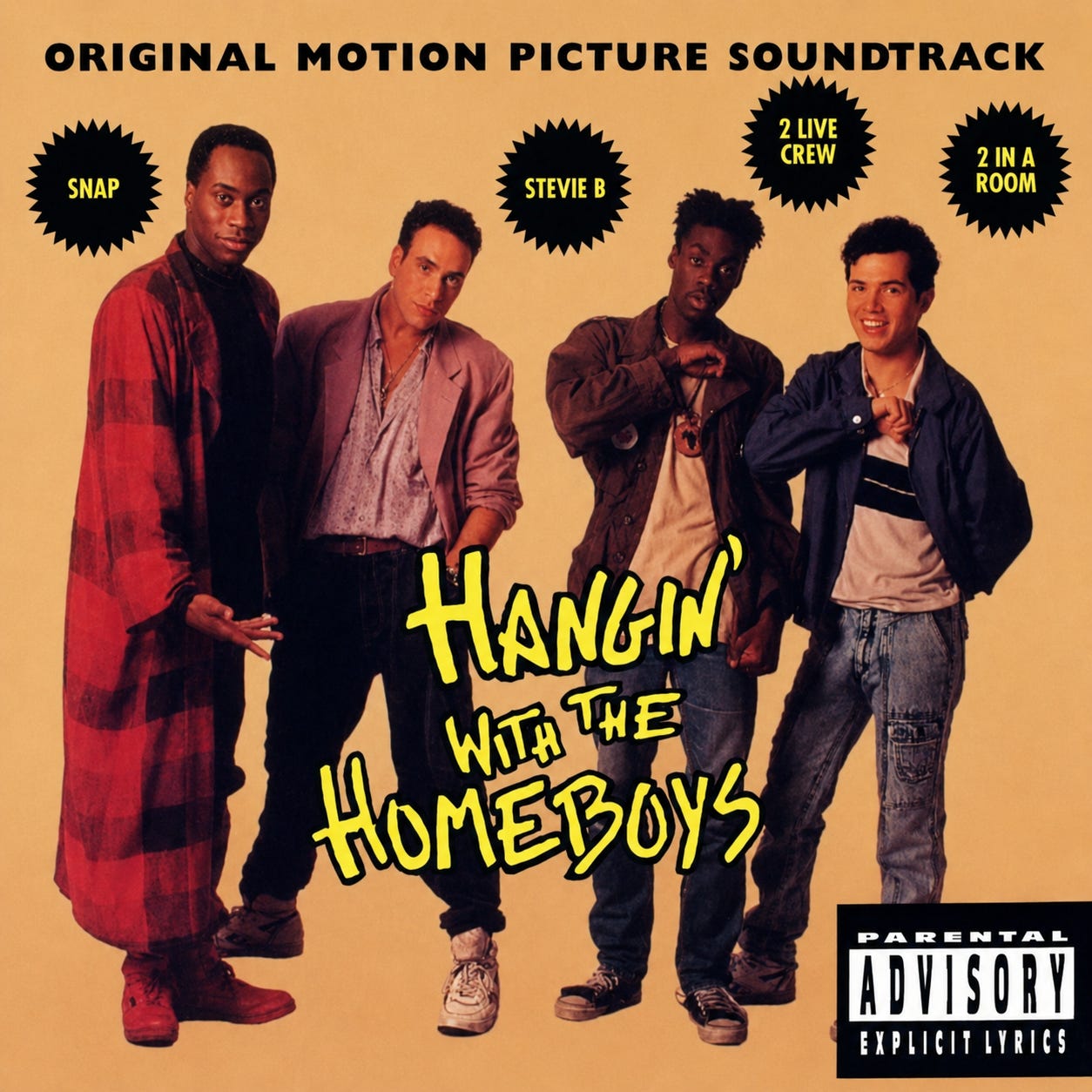
Joseph Vasquez’s Bronx-night-out movie won the Waldo Salt Screenwriting Award at Sundance and opened in April with a soundtrack built almost entirely by Luther Campbell’s Luke Records, while 2 Live Crew were still fighting the Florida obscenity cases that had made them the most famous First Amendment defendants in American music. Luke ran the compilation through his lens, and the title track is a Bronx-meets-Sunset-Strip mash that has 2 Live Crew interpolating Mötley Crüe over the Brenton Wood “Oogum Boogum” sample that was inescapable that year. Nobody in the room is taking it seriously, which is the charm of the thing. Everything else inside the program is Luke Records B-team material (Triple XXX, Poison Clan) with a detour for Snap!’s “The Power” and a couple of jazz-leaning interludes. A snapshot of a label rebuilding its catalog under serious legal duress, with the title track the only 2 Live Crew recording from that stretch where the group come off as party guests rather than First Amendment combatants.
Cool as Ice
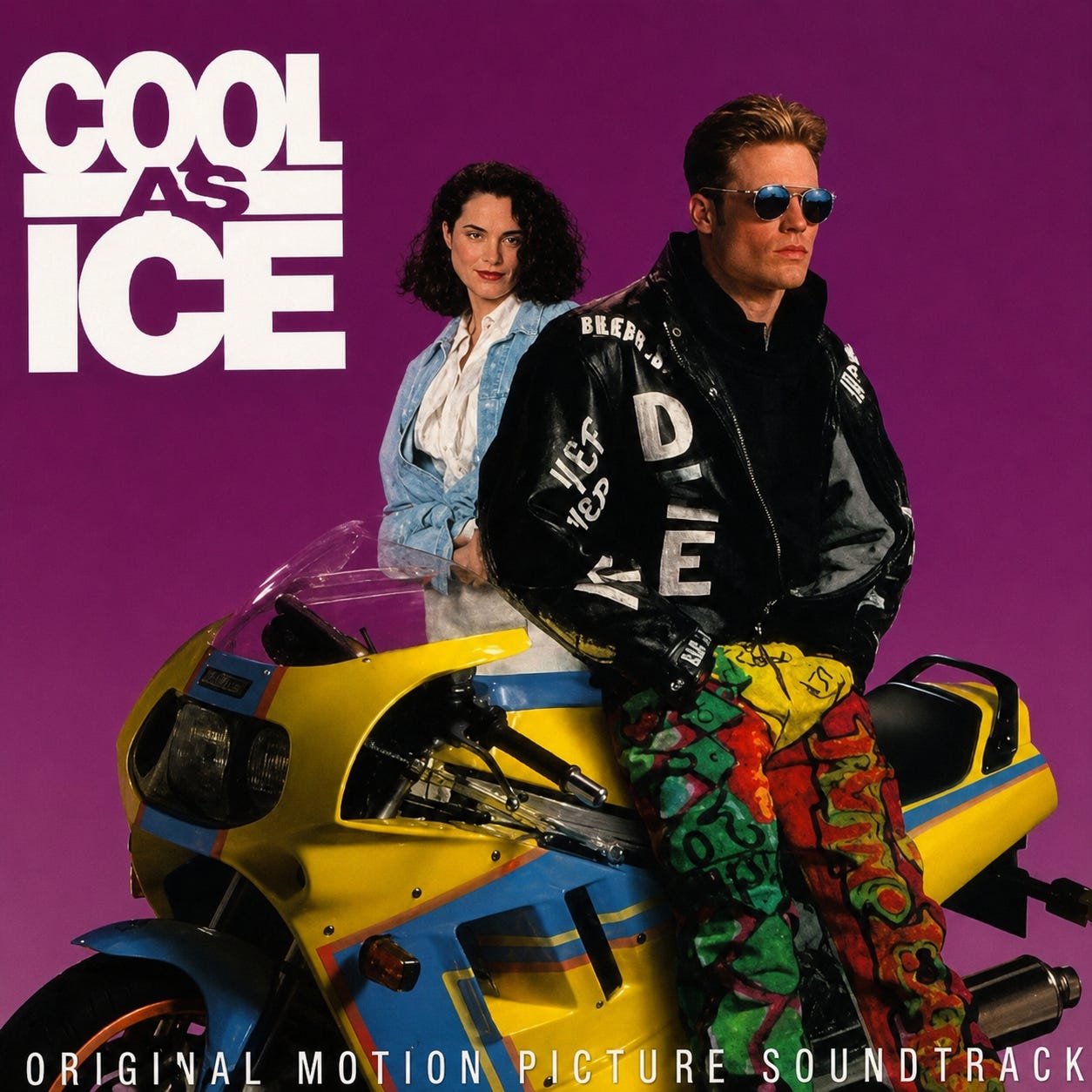
Vanilla Ice had moved eleven million copies of To the Extreme in the fifteen months before Cool as Ice got made, and eleven million was the number the producers had in mind when they green-lit a motorcycle movie about a white rapper crashing into a preppy girl’s life. What came out is the catastrophe you’d expect, then a little more. Side one opens with “Cool as Ice (Everybody Get Loose)” and proceeds through contributions from Naomi Campbell (in her co-starring role, which means she sings), Partners in Kryme, Monie Love, and a cover of “Sympathy for the Devil” by Rozalla. The only cut with real conviction on it is “The People’s Choice,” where Ice at least sounds committed to the cadence he’s trying to sell. Everything else is as rushed and expensive and as visibly embarrassed by itself as the film that produced it. Archival value only. Vanilla Ice had been the biggest pop-rap act in America the year before and would never come close to those numbers again, and this is the LP cut during the collapse.
House Party 2
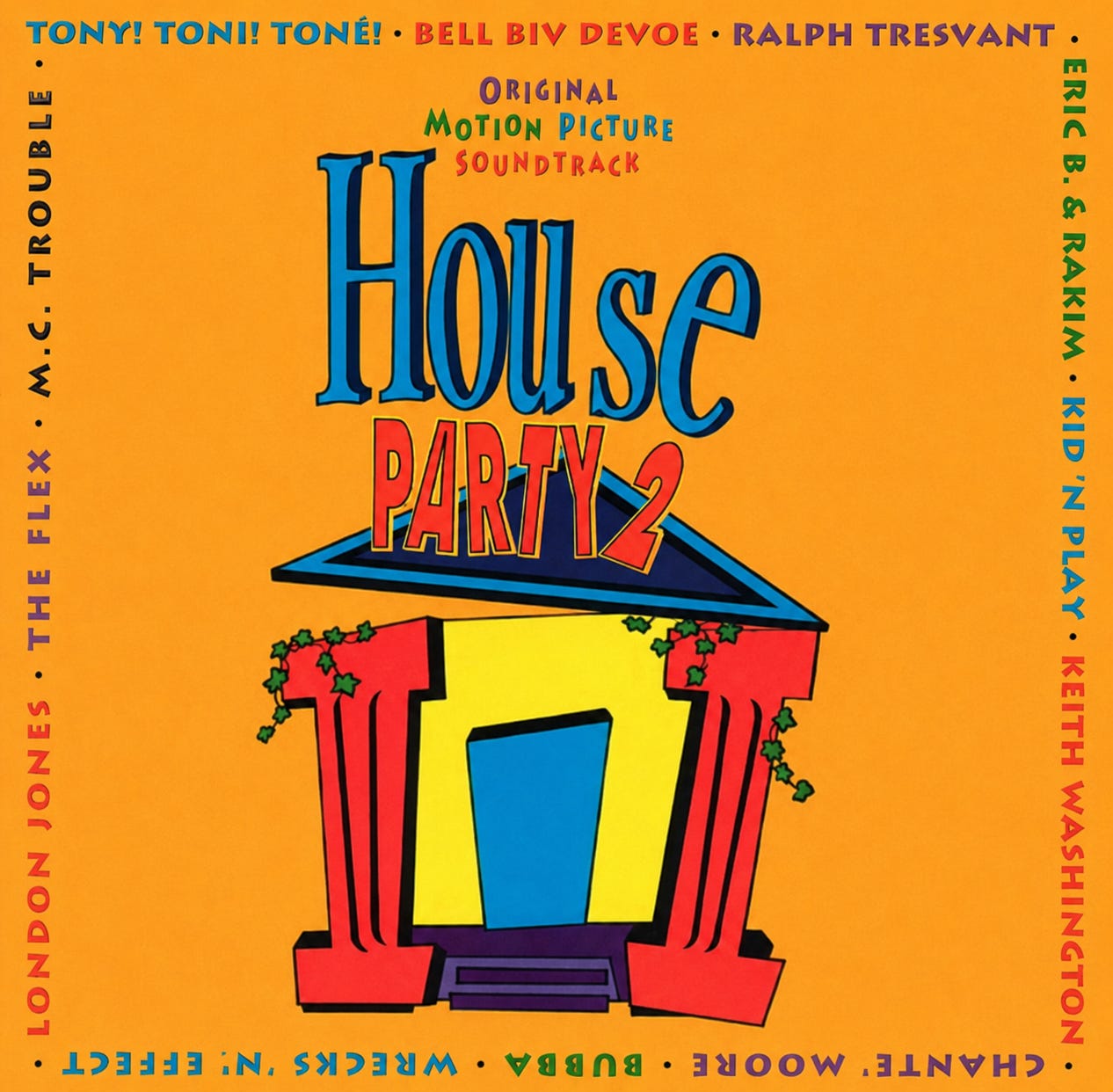
MC Trouble, a twenty-year-old Motown signee and one of the first women the label had signed as a solo rapper, died of an epileptic seizure in June of the year this soundtrack was released. Her final recording, “Big Ol’ Jazz,” is buried deep on this Kid ‘n Play sequel compilation, which is the kind of tonal collision only an early-’90s MCA release could have produced. Everything else on it improves on the first House Party soundtrack, with tighter production throughout and less of the session-band filler that padded the earlier installment. The title cut, “House Party II (I Don’t Know What You Come to Do),” belongs to the Oakland trio fronted by Raphael Saadiq and Dwayne Wiggins, and is one of their sharpest singles before Sons of Soul. Bell Biv DeVoe (credited as “Bubba” for contractual reasons) slide in with “I Like Your Style,” Ralph Tresvant’s “Yo Baby Yo” is one of his better post-New Edition solo turns, and Eric B. & Rakim’s “What’s on Your Mind” is a loose-limbed R&B-rap hybrid the duo would sharpen six months later on Don’t Sweat the Technique. It is the better of the two House Party soundtracks, and MC Trouble’s “Big Ol’ Jazz” outlasts the rest of it.
Strictly Business
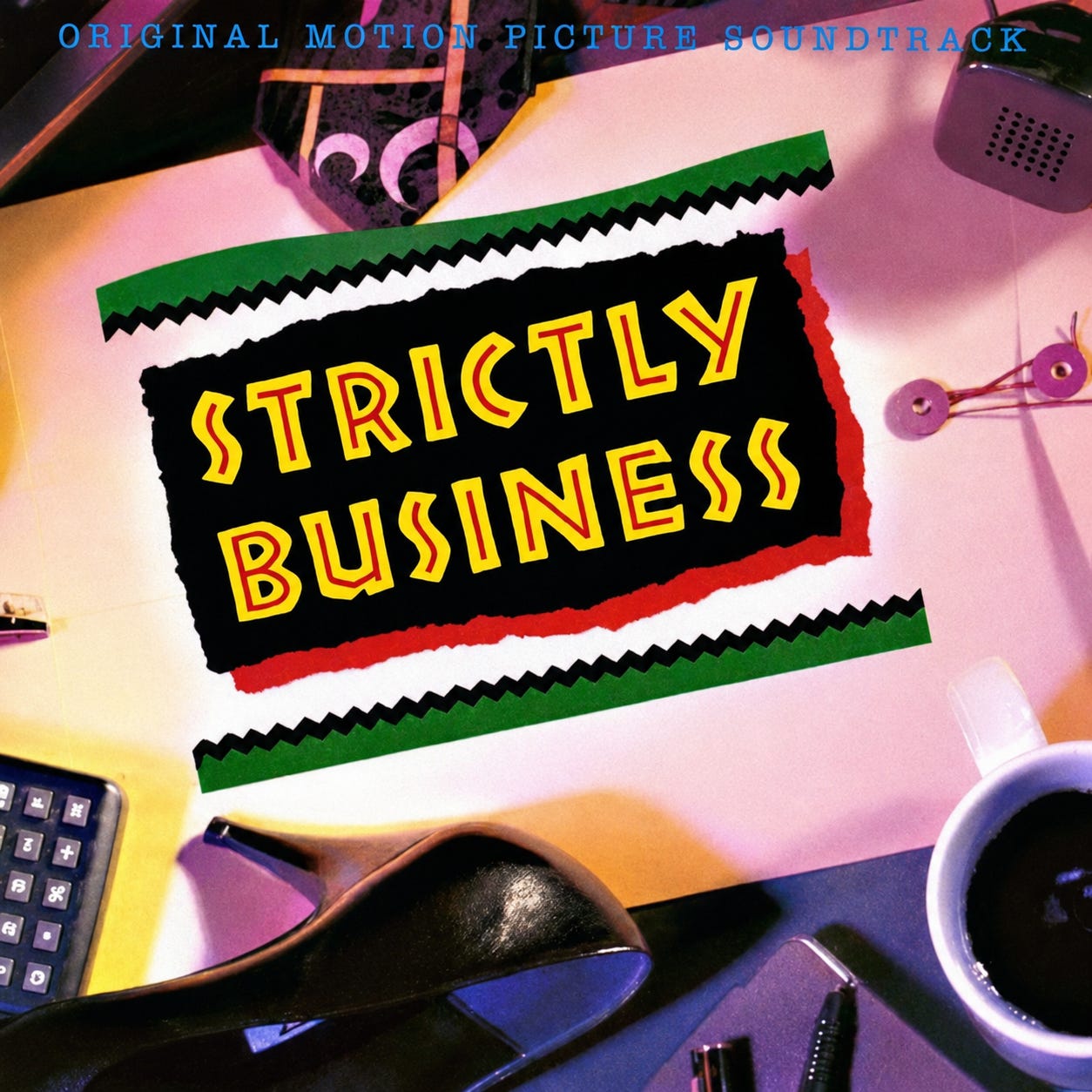
Andre Harrell built this soundtrack the way he built Uptown Records itself. His R&B and rap acts shared producers, session dates, and marketing budgets, and the compilation put that pairing on record in real time. Kevin Hooks’ movie was a Halle Berry and Tommy Davidson romantic comedy almost nobody still talks about, but the soundtrack launched Mary J. Blige. “You Remind Me” was her first single, produced by Dave “Jam” Hall, and it appeared on the Strictly Business soundtrack a full year before Uptown released it as the lead single from What’s the 411?, where it topped the R&B singles chart. LL Cool J’s title track, a Marley Marl production, is the only LL single from 1991 cut for a full-length he himself wasn’t putting out. Jodeci’s contribution arrived six months before Forever My Lady and has the group already rehearsing the harmonies that would sell three million copies of that debut. Heavy D, Stephanie Mills, and Jeff Redd round out the set. The compilation charted at a brutal 64 on the R&B list, terrible for a package this deep. Doesn’t matter. The Mary J. track alone rewrote what mainstream R&B was going to sound like for the rest of the decade.
Juice
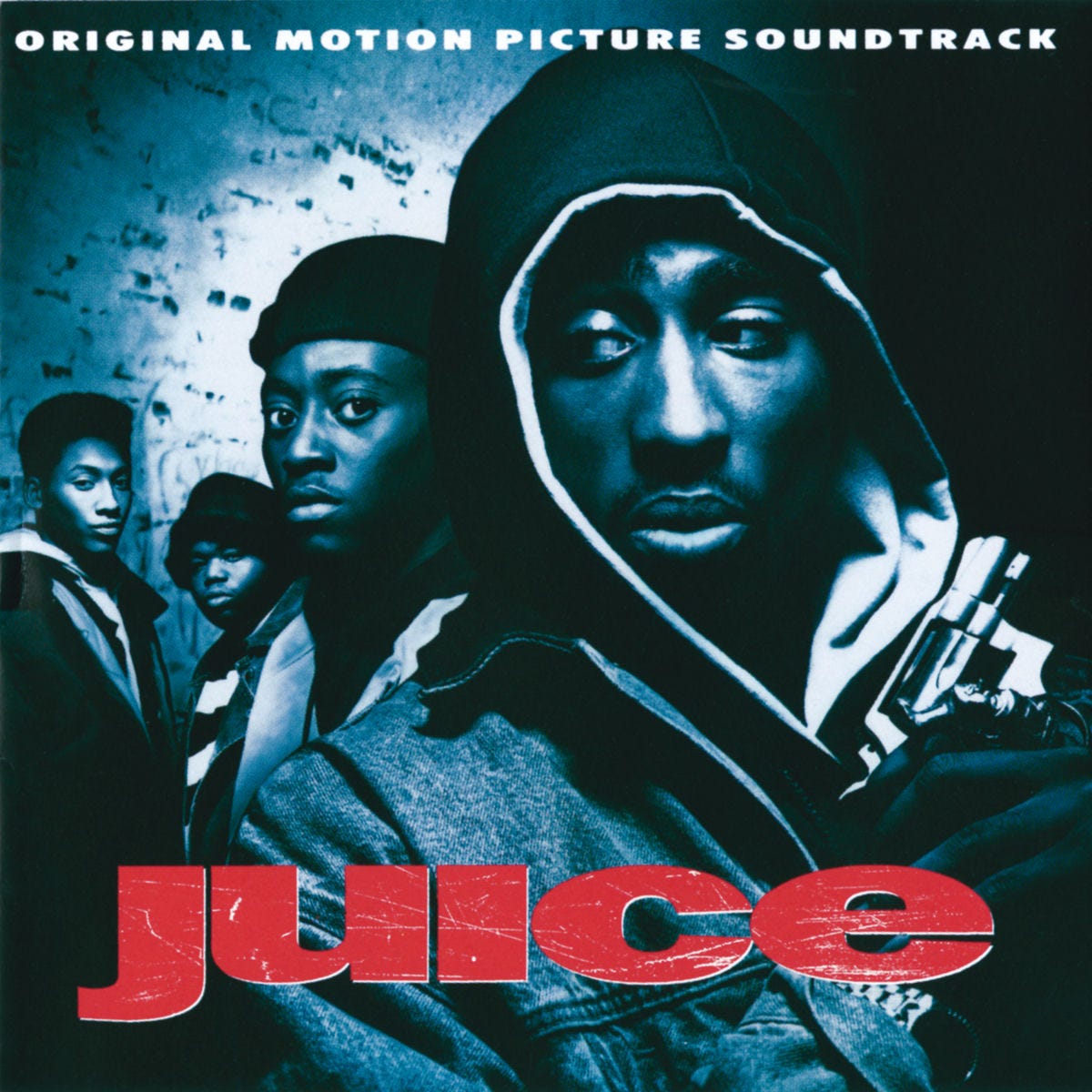
Hank Shocklee A&R’d this one, and the curatorial sense he’d built across the late ‘80s producing Public Enemy shows up on almost every track. Ernest Dickerson’s film needed current New York rap, and Shocklee pulled the best available from his Rolodex. Naughty by Nature’s “Uptown Anthem” opens with Treach writing at the peak of the second-album confidence he’d carry into 19 Naughty III. Eric B. & Rakim’s “Juice (Know the Ledge)” is Rakim at full flex over an upright bass loop and a chopped flute, turning Bishop-adjacent first-person violence into a writer’s exercise that pays attention to what a character would and wouldn’t actually say. Big Daddy Kane’s “Nuff Respect” and EPMD’s “It’s Going Down” slot in as proof both acts were still working at the top of their writing. Salt-N-Pepa’s “He’s Gamin’ on Ya’” is a rare sisterly warning number aimed at the listener’s friend, a move the trio would revisit on Very Necessary. Aaron Hall’s “Don’t Be Afraid” is the Teddy Riley-adjacent R&B ballad the format required; Cypress Hill’s “Shoot ‘Em Up” is the only West Coast voice on an otherwise thoroughly East Coast compilation. It went to number three on the R&B chart. Treach’s “Uptown Anthem” and Rakim’s “Know the Ledge” are the two to put on anything built from 1991’s New York rap archive.
1992
Deep Cover
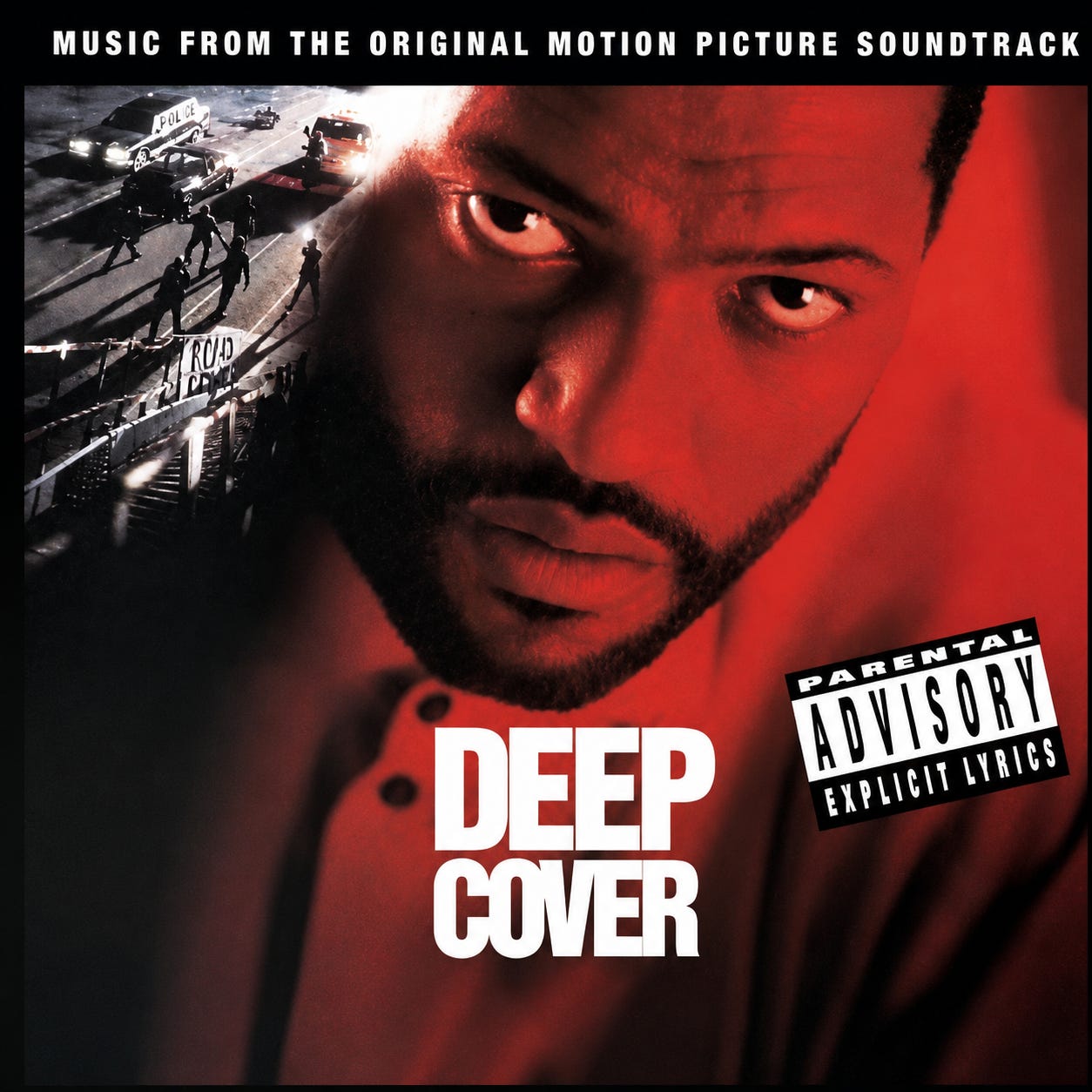
Dr. Dre had walked out on Ruthless and was still months away from signing the Death Row paperwork at the point Bill Duke’s people called him about scoring a detective picture. The paycheck mattered. Dre was in the middle of the lawsuit Eazy-E and Jerry Heller had filed to hold him to his old contract, and SOLAR Records was the front Suge Knight had set up to move him while the case worked itself out. The title track is what Dre cut inside that arrangement. It’s the first recording of his post-N.W.A. life, and the song is mostly a vehicle for a twenty-year-old from Long Beach nobody outside the studio had heard of. Snoop takes the long verse, drawls “it’s 1-8-7 on an undercover cop” at the laconic half-speed that would become the whole sound of The Chronic six months later, and walks off the track as if he’s been doing this for years. The rest of the compilation is the SOLAR roster filling out a Laurence Fishburne cop drama. Ice-T’s “Depths of Hell,” Kokane working a Roy Ayers sample into “Nickel Slick Nigga,” Shabba Ranks’ “Mr. Loverman” a full year before his American crossover. Solid back-end material that would have anchored other tie-in albums and got buried here under the four minutes Dre handed to Snoop. Suge’s lawsuits against SOLAR ate the masters within a year of release. The album still cannot be streamed in 2026. Charted quietly, slipped out of commercial circulation almost immediately, became impossible to buy legally. G-funk’s first commercial pressing remains a document no label has been able to release.
White Men Can’t Jump
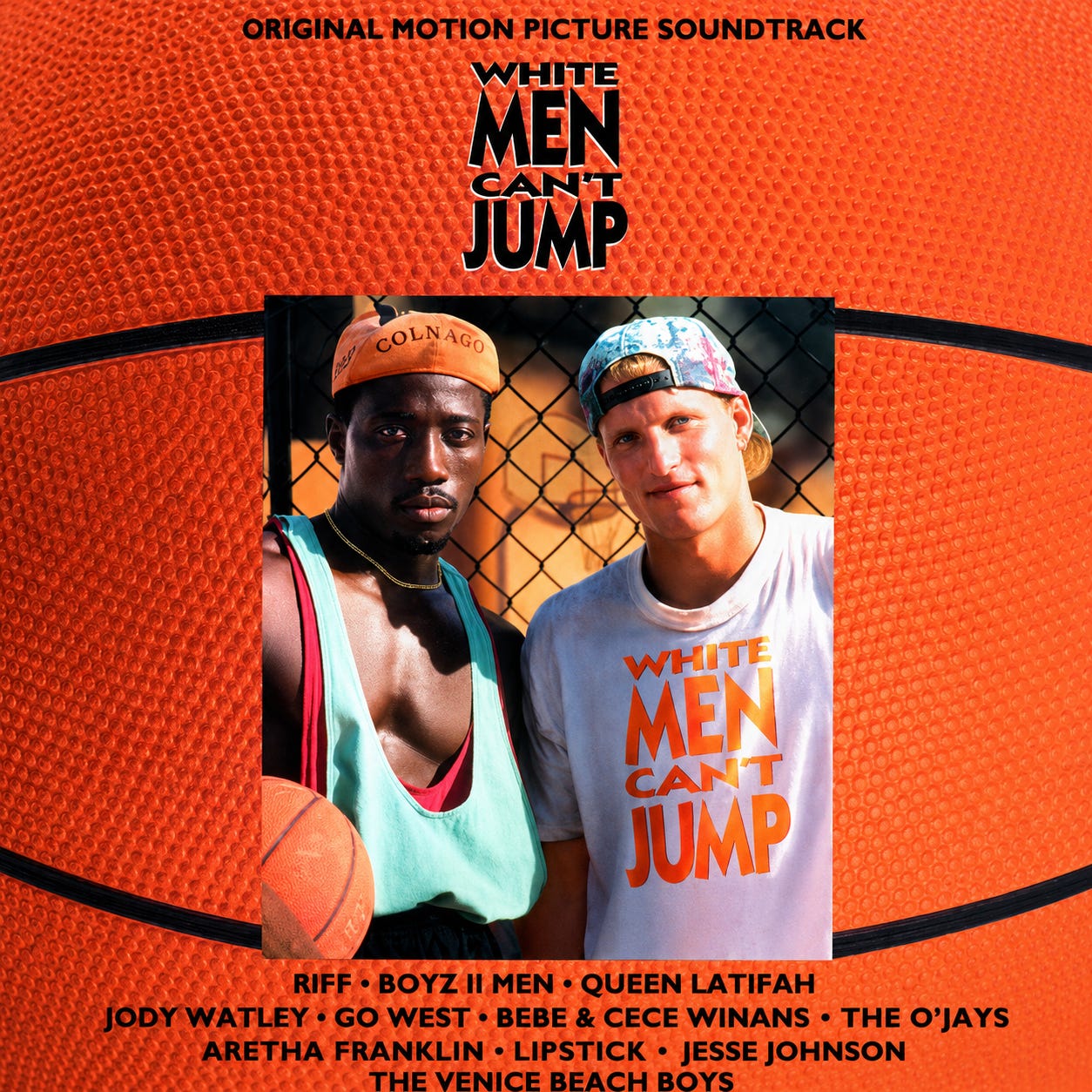
Ron Shelton shot a basketball comedy that thinks seriously about race and hustle and handed EMI the rough cut to score, and the label came back with soft-pop R&B that has almost nothing to do with what the movie is about. Riff’s title cut is the kind of new jack product you’d get from an A&R department that didn’t understand what Venice Beach sounded like in the actual spring of 1992. Boyz II Men appear in the middle of the program with “Sympin Ain’t Easy,” an early rehearsal for the Philly group’s eventual breakout on the Boomerang tie-in three months later. Queen Latifah’s sole contribution to the main disc is a rap placeholder. Aretha Franklin shows up with an older vault cut called “If I Lose” that EMI pulled off a shelf to fill a slot. The actual record Shelton’s film wanted came out a few months later as a five-song companion EP called White Men Can’t Rap, a low-budget EMI afterthought nobody paid attention to, and it happens to contain Cypress Hill’s “A to the K,” Main Source’s “Fakin’ the Funk,” Boo-Yaa T.R.I.B.E.’s “Area Code 213,” a Gang Starr cut, and a College Boyz piece. The EP is closer to what was actually playing on a Black streetball court in 1992 than anything on the official soundtrack, and the fact that EMI had to ship the same movie’s music on two discs, one for the Columbia House mail-order audience and one for the audience the film was about, is a tell about where the format still was in the middle of 1992.
Class Act
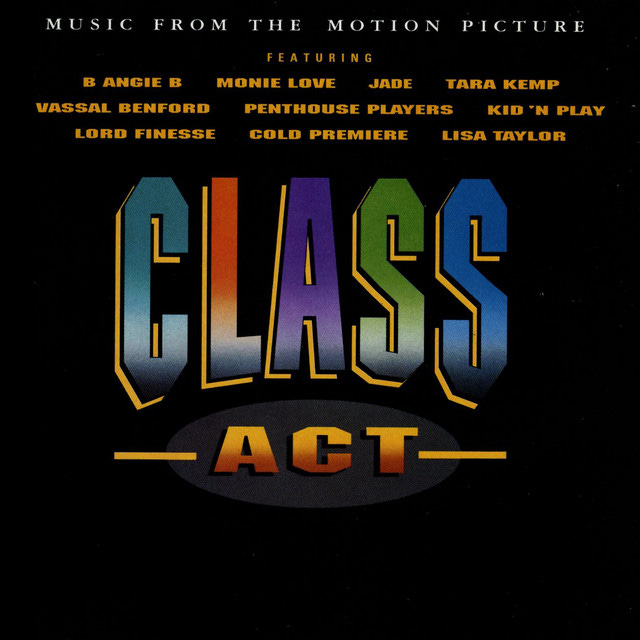
Randall Miller’s 1992 body-swap comedy is the last Kid ‘n Play theatrical vehicle before the House Party sequels took over their release schedule, and it sits in the shallow end of the early-’90s studio comedy depth chart. The Giant Records tie-in runs forty-five minutes and is mostly filler. The one reason to hold on to it is Monie Love’s “Full Term Love.” Cut during the window between Down to Earth and In a Word or 2, the track catches Monie inside a slow-grooving Afrocentric love song she’d barely get to use again as Warner Bros. quietly stopped pushing her solo career across the next year. Jade’s “I Wanna Love You” predates their eventual MCA breakout. Lord Finesse turns in a commissioned piece that’s sharper than the surrounding material had any business extracting from him. The duo’s own contribution, “Get It Right,” is the clearest indicator of where Kid ‘n Play had ended up commercially by 1992. Monie Love’s underrated single, the Finesse feature, and the Jade cut are what you’re paying for.
Mo’ Money
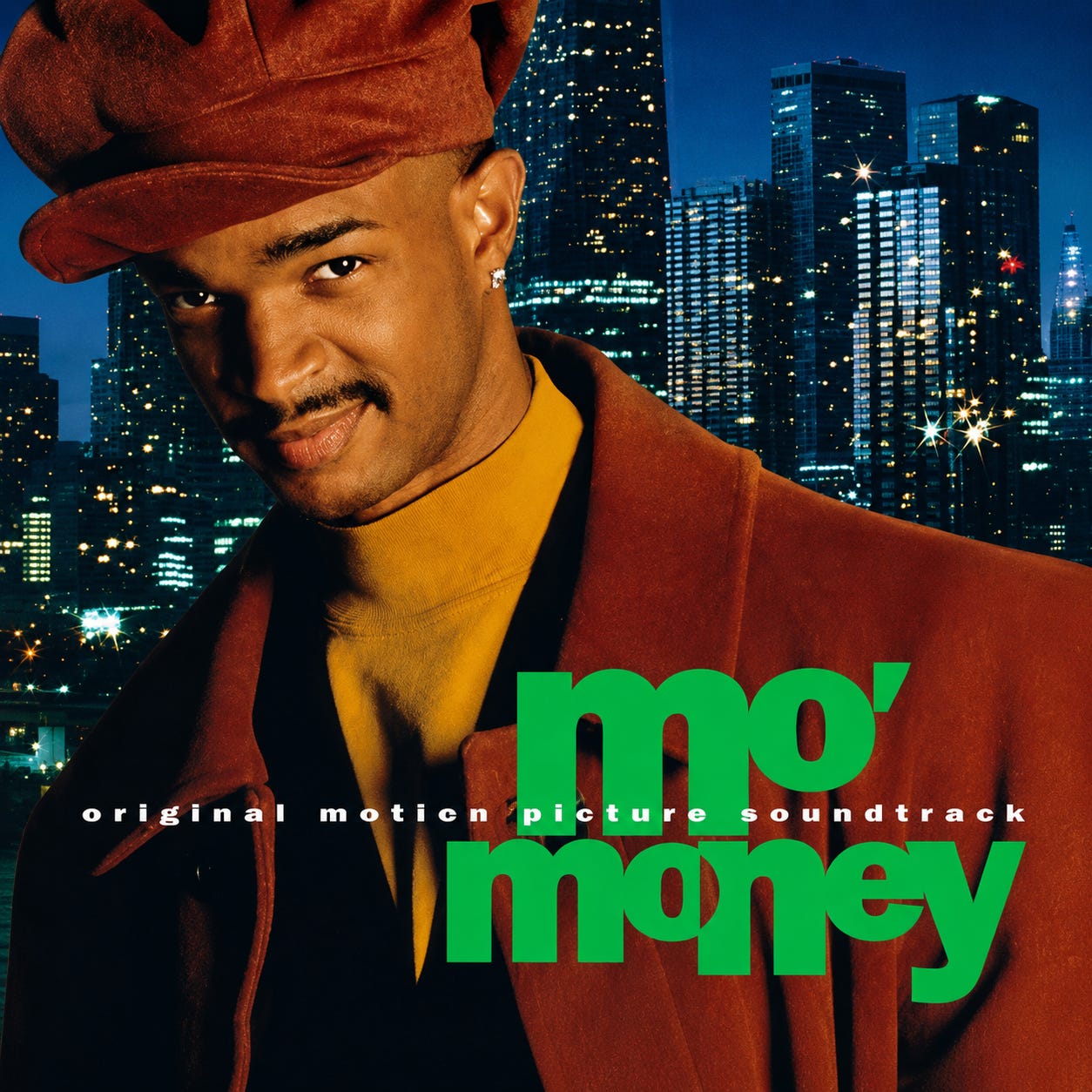
The first thing to understand is that Perspective Records wasn’t the label attached to Damon Wayans’s film. Perspective was Jimmy Jam and Terry Lewis’s own imprint, two years old by then and still working out what kind of music it wanted to be known for, and the Wayans tie-in was what they were using to find out. The album went platinum almost entirely on “The Best Things in Life Are Free,” a Janet Jackson and Luther Vandross duet Jam and Lewis wrote around a Lyn Collins sample they’d been sitting on for the right vehicle. Those rap tracks are the interesting part, and they disagree with the argument the ballads around them are trying to sell. Public Enemy’s “Get Off My Back” hands lead vocals to Flavor Flav for the first time on any PE recording. Big Daddy Kane’s “A Job Ain’t Nuthin’ But Work” with Lo-Key? is a deadpan, sardonic character piece about a grifter refusing to clock in and sits as maybe the driest performance of Kane’s career on record. MC Lyte’s “Ice Cream Dream” anchors the middle as the one genuinely underground cut in a program otherwise aimed at adult radio. Damon Wayans’s movie is nothing anyone needs to revisit. The Perspective launch it quietly powered turned Jam and Lewis into a boutique that would sign Solo, Mint Condition, and eventually Sounds of Blackness, and most of the sound of Perspective through 1994 starts with the Janet and Luther duet and works outward from there.
Boomerang
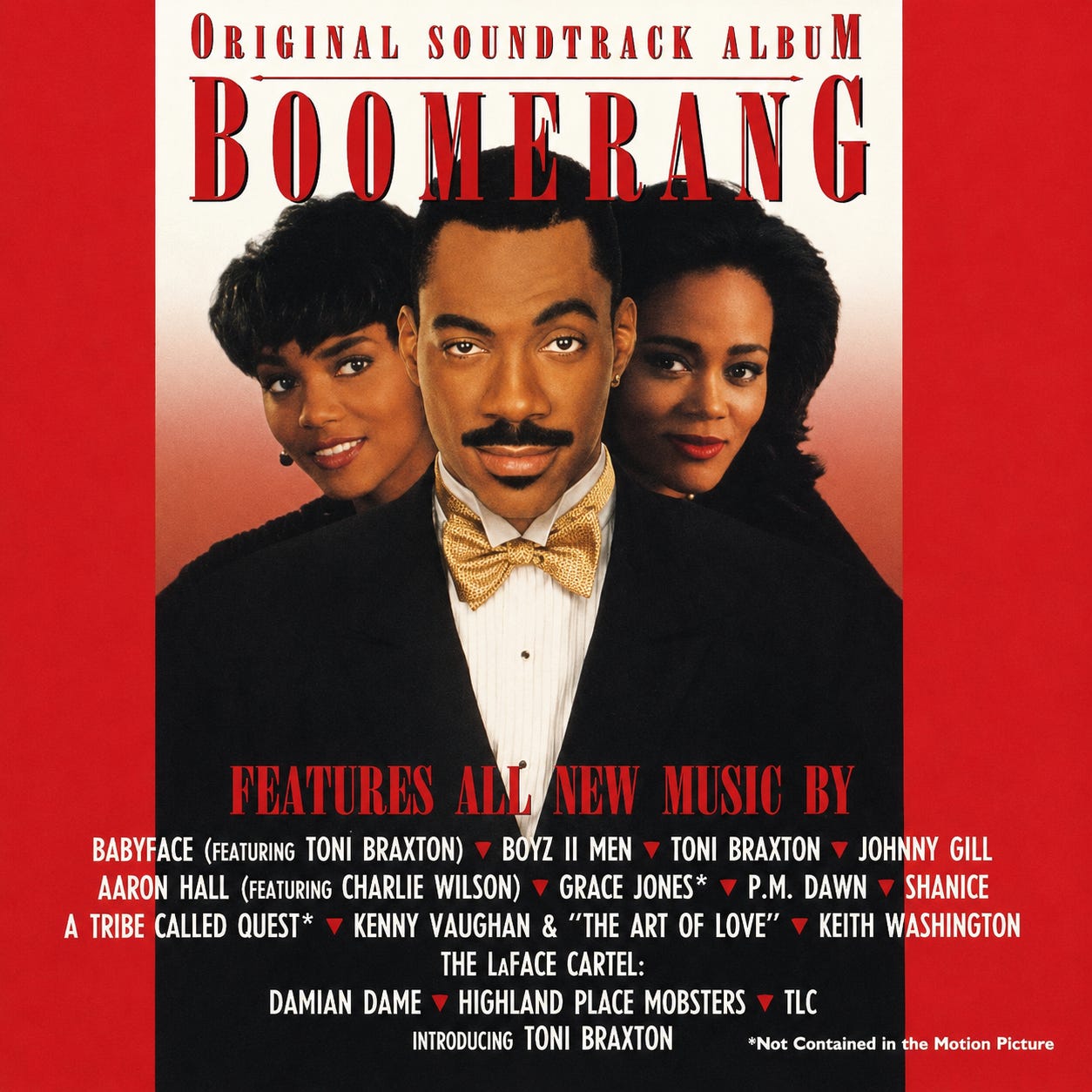
L.A. Reid and Babyface had been running LaFace Records out of Atlanta for two years before Reginald Hudlin asked them to score the Eddie Murphy romantic comedy he was directing, and the album they turned in is the one that retired New Jack Swing and quietly introduced LaFace as a national operator. The story worth telling is “End of the Road.” Babyface co-wrote it with Reid and Daryl Simmons, flew to Philadelphia to cut it with Boyz II Men in a three-hour session on a tour off-day—the only studio window the group’s schedule would allow—and the song ran thirteen weeks at the top of the Hot 100, becoming Babyface’s biggest credit of the decade. Toni Braxton made her recorded debut on the same album with “Give U My Heart,” a Babyface duet nobody at the label had asked for, and by year end she was the next act LaFace was going to break. P.M. Dawn landed “I’d Die Without You.” Johnny Gill took “There U Go.” A Tribe Called Quest’s “Hot Sex” is the one rap cut on the album, a loose Q-Tip and Phife session piece from the gap between their second and third LPs that doesn’t much belong on the LaFace record it wound up on. The record went triple platinum and put the LaFace machine on its first national-scale document. Every major-label R&B compilation of the next three years was working from the template this album laid down.
Stay Tuned
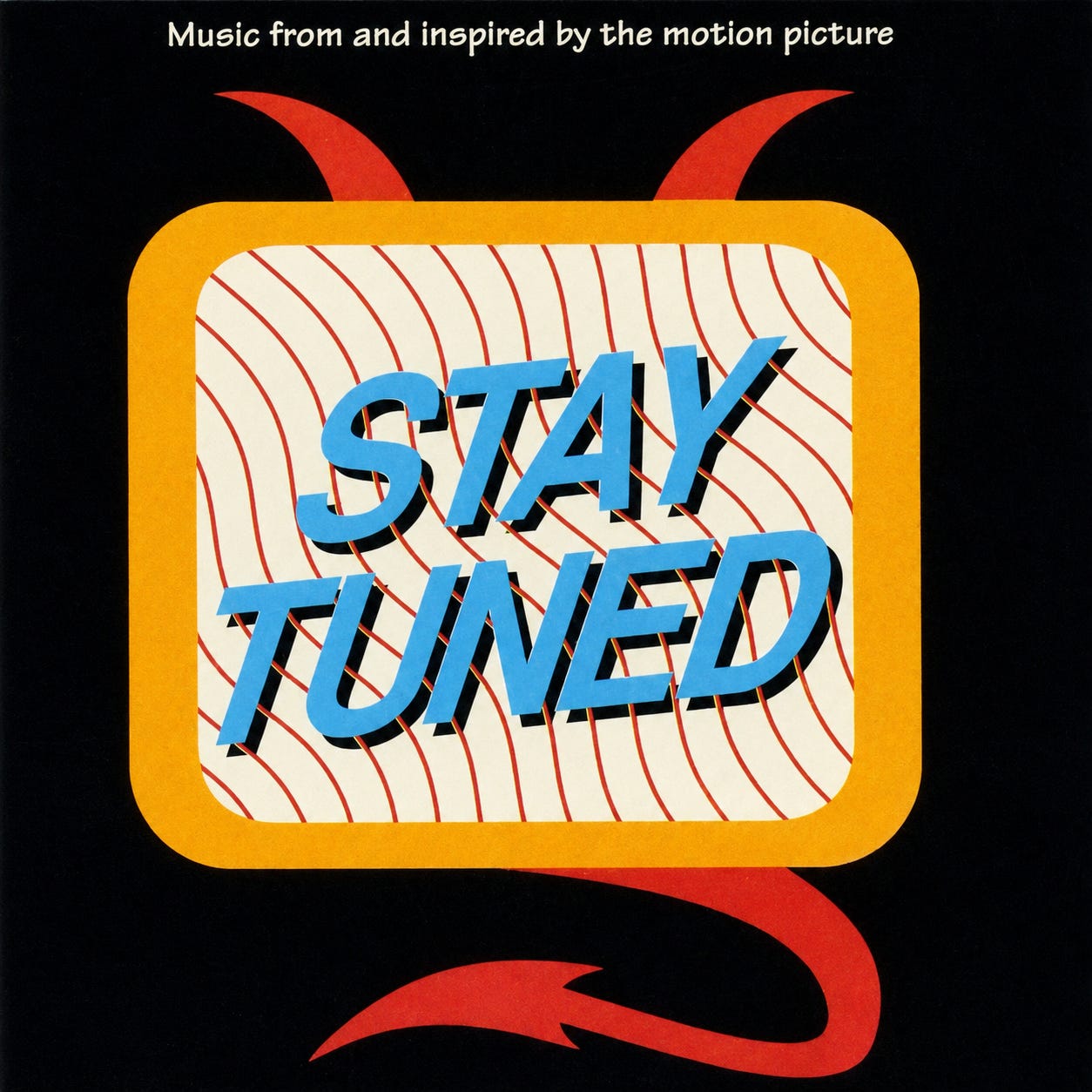
Nobody has been able to fully reconstruct why this album was made. Peter Hyams directed a PG-13 satanic-cable-television comedy starring John Ritter and Pam Dawber, a white suburban horror farce about a husband sucked through his satellite dish into a 666-channel afterlife where the game shows kill you, and Morgan Creek Records commissioned a tie-in album for it that is almost entirely rap. Salt-N-Pepa’s “Start Me Up” is the only song Morgan Creek commissioned new for the film. Everything else was licensed in from other releases. Black Sheep’s “The Choice Is Yours” and “Strobelite Honey” off A Wolf in Sheep’s Clothing. Ultramagnetic MCs’ “Message from the Boss” off Funk Your Head Up. X Clan’s “Xodus.” A couple of Kool Moe Dee cuts. Two Bruce Broughton score cues at the end of side B to remind listeners there was a film involved. What Morgan Creek’s A&R department appears to have done is reach for the Stay Tuned demographic and come back with a budget Tommy Boy compilation with a Broughton orchestral suite stapled to the back of it. Somewhere in a Los Angeles warehouse there is a pallet of unsold 1992 Morgan Creek cassettes with X-Clan songs on them. That fact, more or less, is the entire recommendation.
South Central
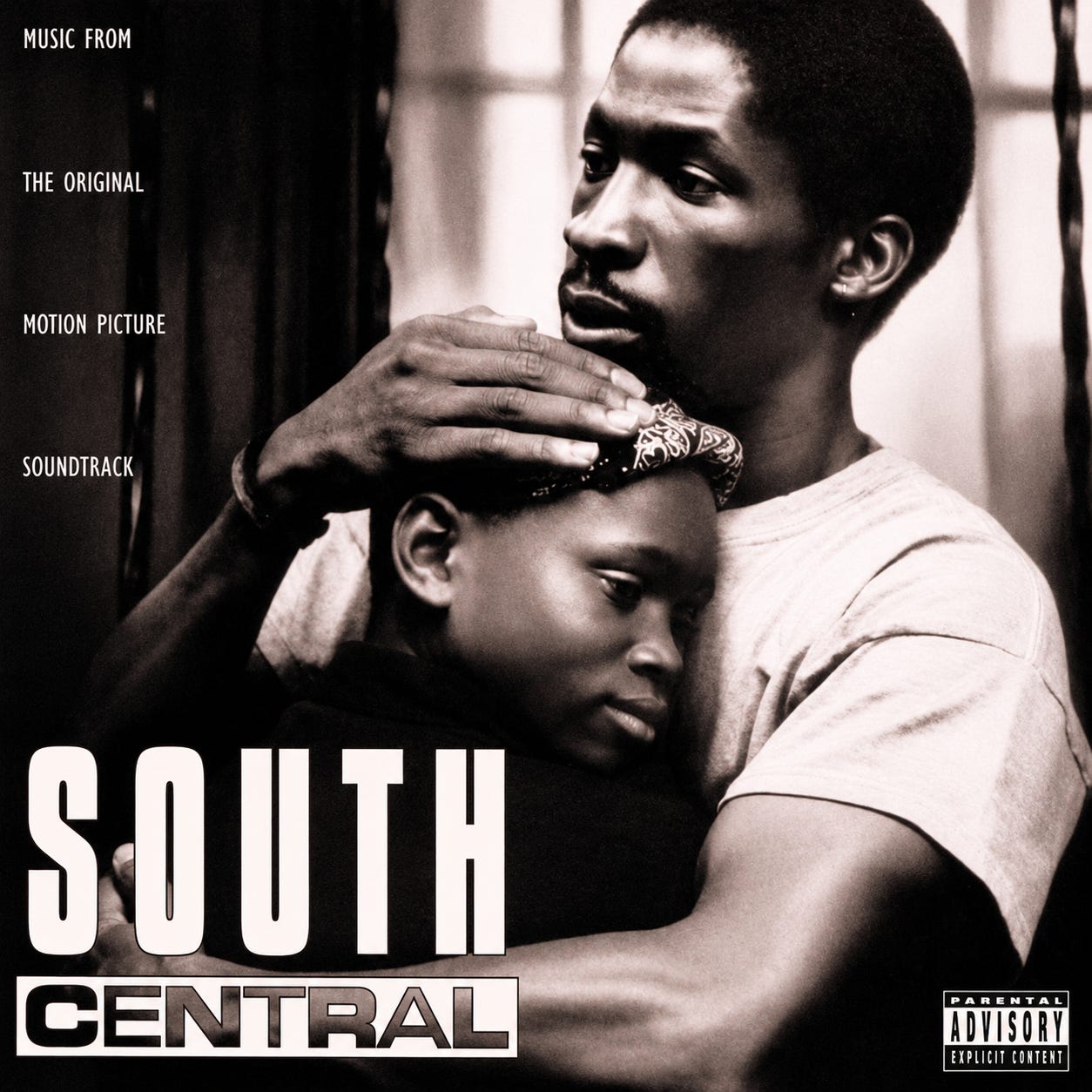
Hollywood Basic was the hip-hop imprint Hollywood Records launched in 1991 and mostly gave up on by 1993, distributed through Elektra and staffed by A&R people who’d been trying to break into rap for years. South Central was only their second full release. Stephen Milburn Anderson adapted Donald Bakeer’s novel about the Hoover Street Deuces, Oliver Stone produced, and the film mostly disappeared within six months of release. What got pressed is better than any part of its infrastructure deserved. DJ Quik, Hi-C, and Kokane anchor a Compton contingent whose tracks fit comfortably inside the Way 2 Fonky-era Quik sound. Boo-Yaa T.R.I.B.E.’s “Rumors of a Dead Man” is a slow-crawling paranoid-funk piece about gang-funeral hearsay moving through the streets around 110th. Eric B. & Rakim deliver one of their two 1992 soundtrack placements. Classic Example’s “It’s Alright” is the one cut that got radio life, creeping to the lower end of the Hot 100. Hollywood Basic folded inside two years. The reason to track this album down now is that a chunk of the material on it doesn’t appear anywhere else in the participants’ catalogs, and a couple of those songs are as strong as what the better-promoted hood soundtracks were shifting half a million copies of in the same calendar year.
Zebrahead
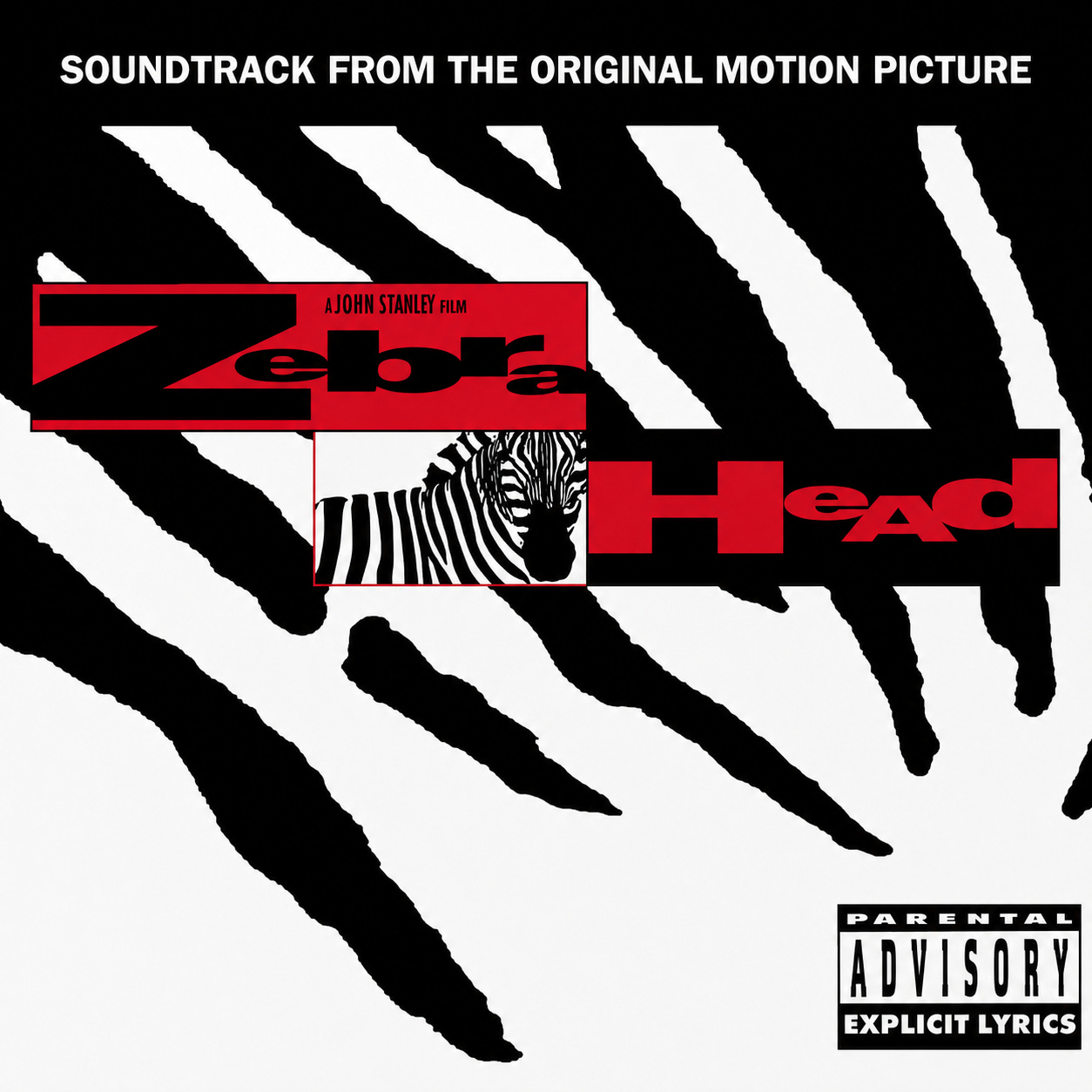
The only reason this compilation stays on any serious list is “Halftime.” Nas’s debut single, produced by Large Professor over a Gary Byrd loop, placed on a small Ruffhouse tie-in two years before Illmatic as the first commercial pressing of a Queensbridge rapper almost nobody outside of a few magazine writers had heard of. MC Serch brought Nas into the Ruffhouse offices in late 1991. Large Professor had the beat sitting in the rack. Faith Newman, the Columbia A&R running the Ruffhouse imprint, signed Nas on the strength of the single song he cut for Anthony Drazan’s forgotten Detroit interracial-romance drama. “Halftime” is the earliest vinyl appearance of the writer who would reshape New York writing for the next fifteen years, and the accidental fact that his first vinyl landed on a tie-in for a movie almost nobody saw is one of the quiet ironies the soundtrack format turned up. Pete Rock & C.L. Smooth’s “Looks Like a Job For…” and an Ex-Girlfriend cut with a bizarre Tim Dog cameo fill out the rest of the cassette. None of that matters. You’re looking for one song, and it’s the first one on the tape.
Trespass
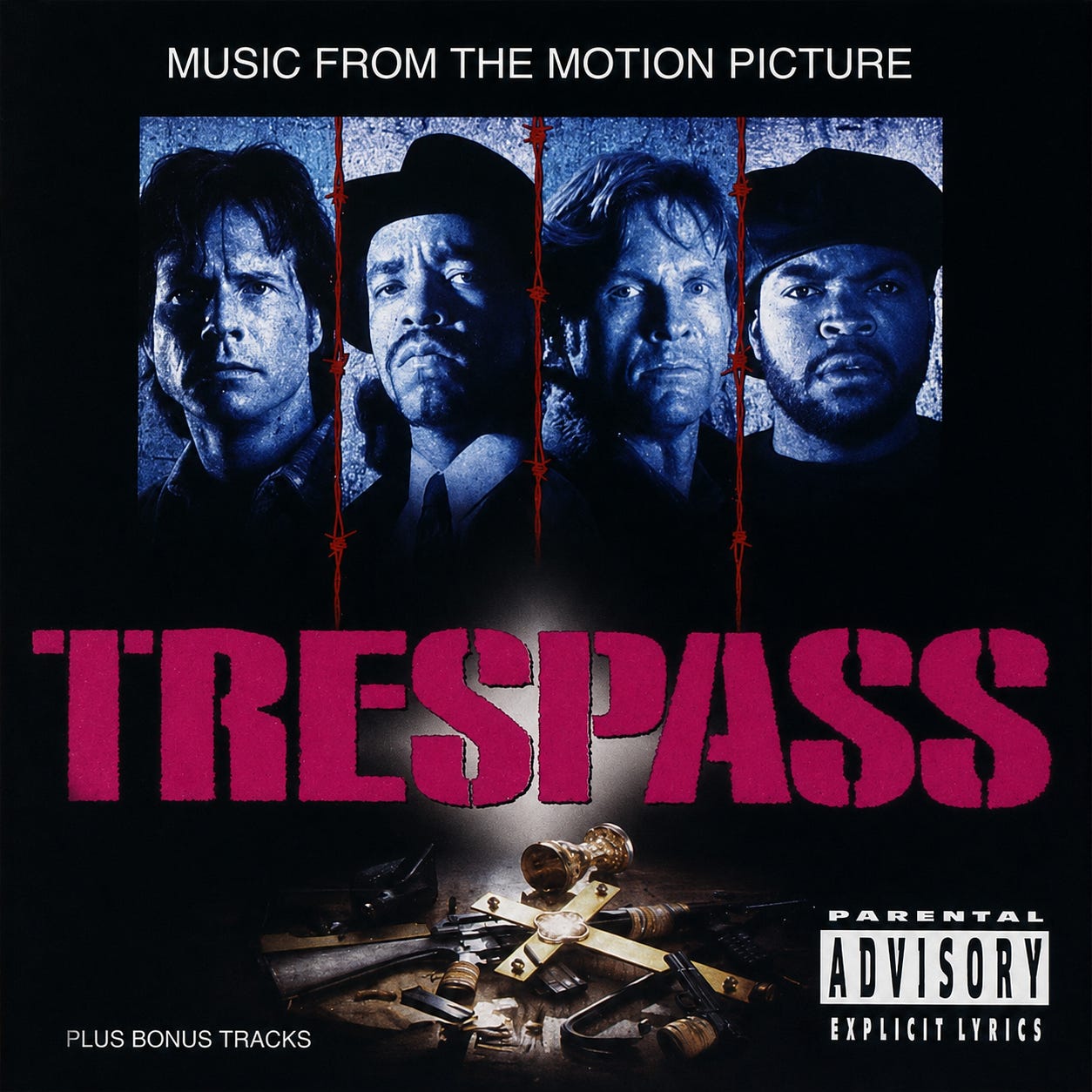
Walter Hill made his 1992 action movie inside an abandoned factory in East St. Louis, cast Ice-T and Ice Cube as rival gang leaders stumbling into a cache of gold guarded by two Arkansas firefighters on a demolition job, and somehow generated a Sire Records compilation with no business being this strong. The title cut is the first commercially recorded pairing of Ice-T and Ice Cube, produced by Sir Jinx, and the rappers move through the track with the cautious wariness long-standing professional rivals fall into once they have to share a booth. Public Enemy’s “Gotta Do What I Gotta Do” came out of one of the last sessions Hank Shocklee ran with the full Bomb Squad intact. Gang Starr’s “Gotta Get Over (Taking Loot)” is a DJ Premier cut Guru never placed on any studio album of his own. Lord Finesse’s “You Know What I’m About” appeared on this soundtrack and nowhere else, and the diggers are still chasing the vinyl. Throw in a WC and the Maad Circle piece with a Coolio writing credit, a Sir Mix-A-Lot cut, a Black Sheep feature, AMG, Penthouse Players Clique, Donald D, and a closing Ry Cooder and Jim Keltner instrumental called “King of the Street,” and you have the deepest pure-rap comp of 1992 buried inside the worst-performing Walter Hill movie of his career. Neither the box office nor the chart position explains it.
The Bodyguard
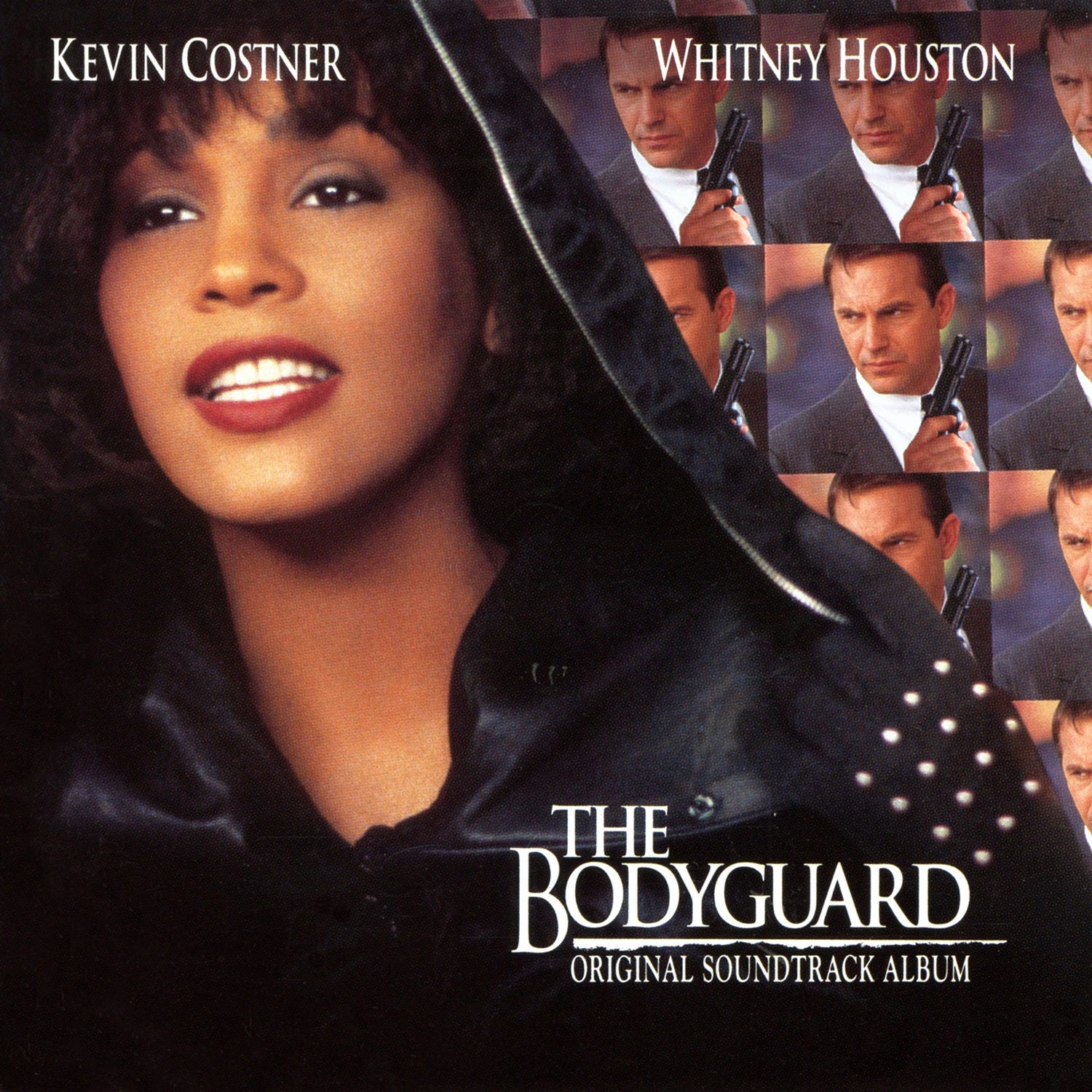
The story here is Clive Davis’s deal with Warner Bros. Reading an early draft of Lawrence Kasdan’s screenplay in 1991, Arista’s president noticed Whitney Houston was being given the role of a pop singer in a thriller that had almost no music written into the script, called Warner Bros. directly, and told them it wasn’t going to work. The studio agreed to expand the musical sequences. Davis then negotiated a deal giving Whitney co-executive producer credit on the soundtrack album, the right to choose her own songs, and back royalties on every unit sold. Kevin Costner heard Linda Ronstadt’s 1975 recording of Dolly Parton’s “I Will Always Love You,” suggested it to Whitney as the film’s centerpiece, and pushed for her to open her own recording a cappella. That single production note ran fourteen weeks at the top of the Hot 100 and sold over twenty million copies of the single alone, which makes it the biggest-selling song by a woman in recorded-music history, and the album it anchors moved forty-five million copies worldwide. The rest of the disc is a Lisa Stansfield track, a Kenny G and Aaron Neville ballad, a Joe Cocker and Sass Jordan duet, Curtis Stigers, and a Whitney-and-BeBe Winans rewrite of “Jesus Loves Me” for the baptism scene. Almost nobody remembers those. The story of the album is Davis’s deal-making, and the commercial proof inside the deal is that a Black female star with a production credit could carry a film all the way to the top of every soundtrack chart ever compiled. Arista used the same template for Aretha Franklin and Toni Braxton across the rest of the decade. Every tie-in released after this one had to argue with what it had already taken.
1993
CB4
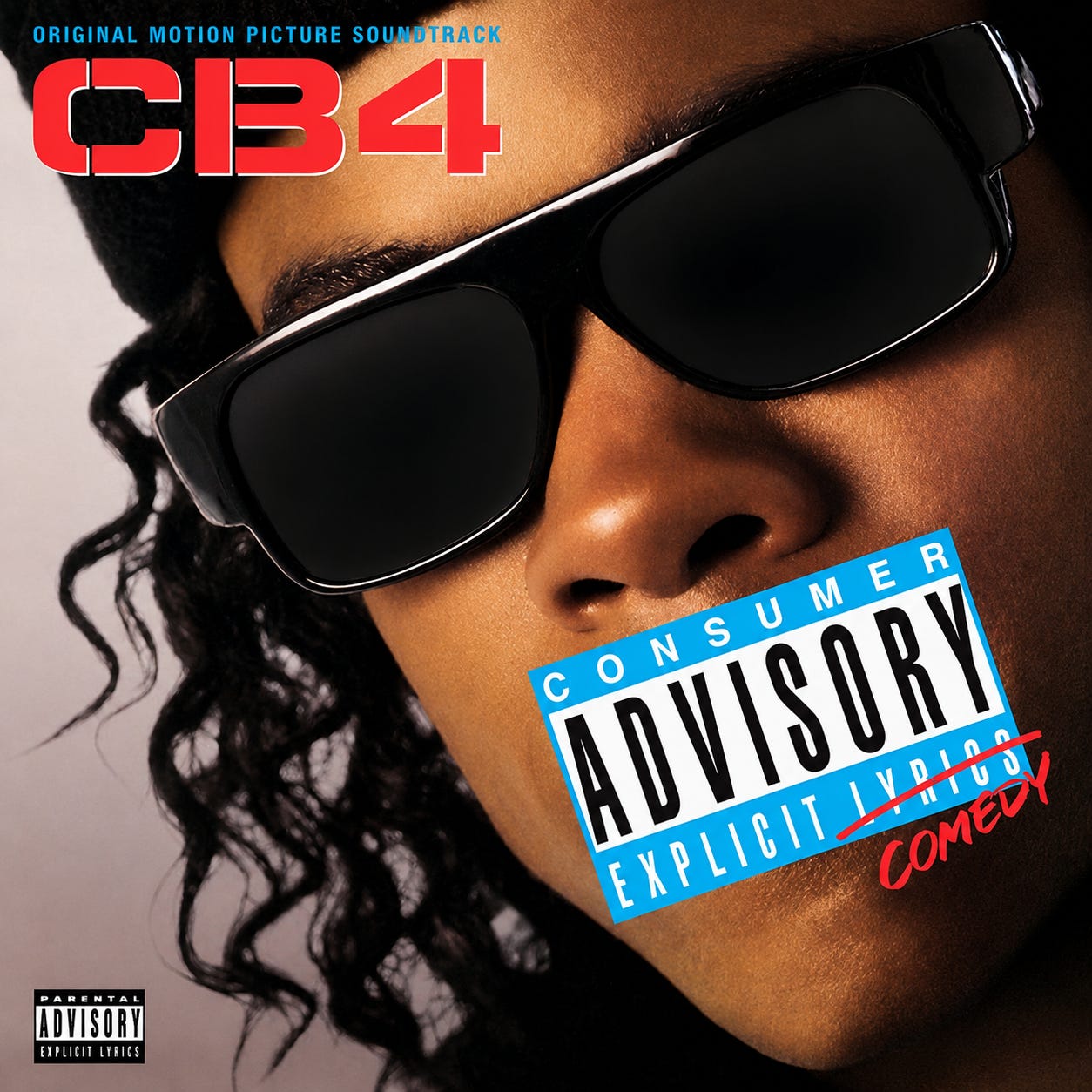
Chris Rock and Nelson George co-wrote and produced an N.W.A. mockumentary together that hit theaters in March, and the MCA companion album for it carries real songs by real groups. Public Enemy’s “Livin’ in a Zoo” came out of a Hank Shocklee session that never landed on a proper PE album, the group being mid-hiatus, and the cut has aged stronger than most of the late-period Bomb Squad material that did get placed. Boogie Down Productions’ “Black Cop” was cut for this soundtrack first and then dropped unchanged onto KRS-One’s Return of the Boom Bap six months later, as direct an endorsement as KRS could have offered of his own song. MC Ren’s “Mayday on the Front Line” got recycled onto Shock of the Hour in November. Parental Advisory’s “Lifeline” is an Organized Noize production cut a full year before Southernplayalisticadillacmuzik and one of the earliest commercially released documents of what became the Dungeon Family sound. Blackstreet’s “Baby Be Mine” is Teddy Riley’s first released Blackstreet recording, months ahead of the self-titled debut. The Rock and Daddy-O and Hi-C CB4 songs are the comedy layer sitting on top of a tape that has real late-era Bomb Squad, real nascent Atlanta, and real pre-debut Blackstreet on it. The mockumentary ended up accidentally curating the sharpest rap sampler of its calendar quarter.
Who’s the Man?
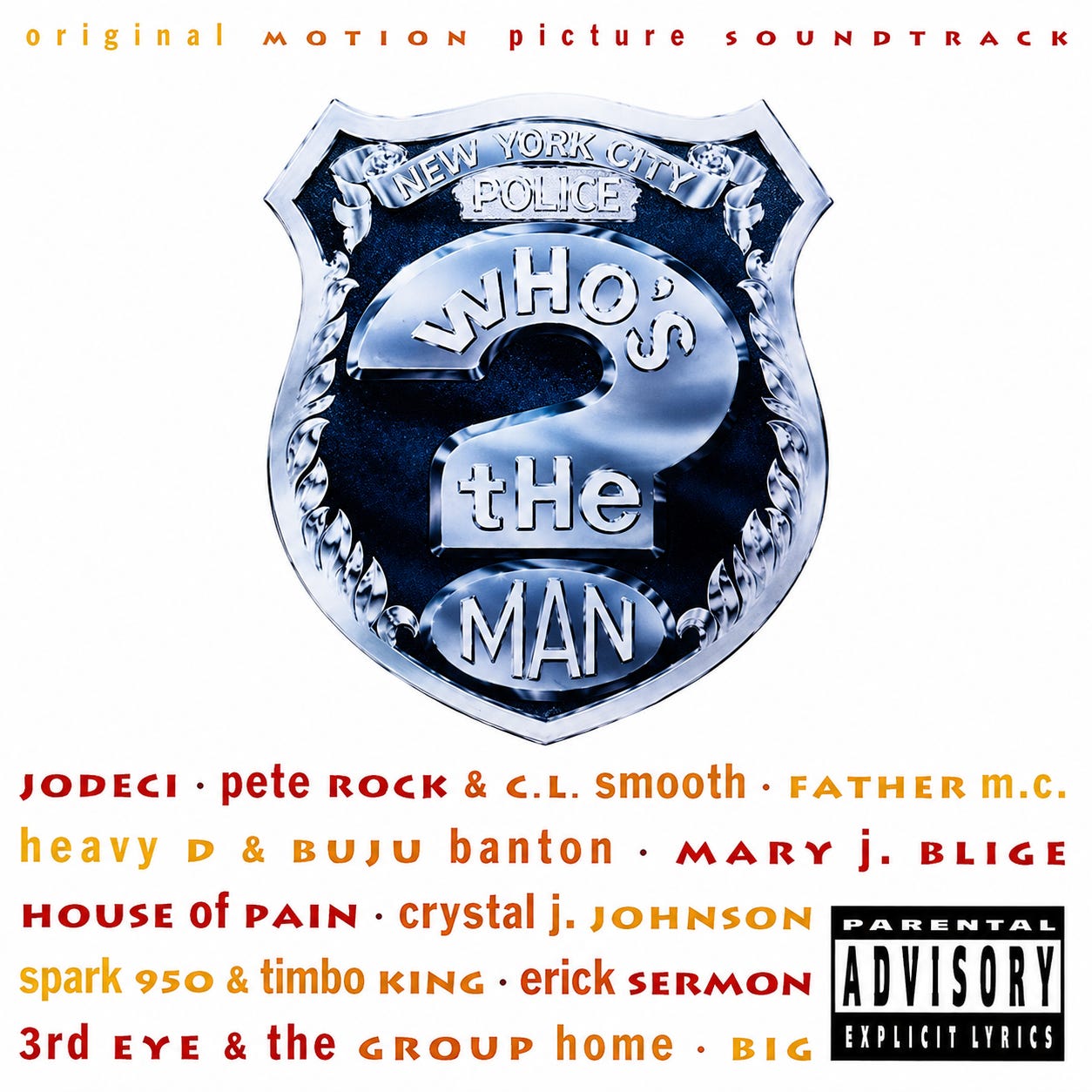
Ted Demme directed a Yo! MTV Raps cash-in starring Ed Lover and Doctor Dré as bumbling cops, and the Uptown/MCA tie-in album for it carries the first commercially released recording of the Notorious B.I.G., sitting at track seven. “Party and Bullshit” was produced by Easy Mo Bee over a Last Poets sample, arrived nine months before Ready to Die, and is Biggie at his loosest and most conversational, already writing the observational late-night-in-Brooklyn stretches he’d extend into his mature catalog. Around the Biggie cut sits a working cross-section of Andre Harrell’s Uptown roster in its most productive year. Mary J. Blige’s “You Don’t Have to Worry” flips a Biz Markie “Vapors” loop into post-411 adult R&B. Pete Rock and CL Smooth’s “What’s Next on the Menu” is a late off-cut from the The Main Ingredient writing sessions. Heavy D and Buju Banton split “Hotness.” House of Pain handle the title track. Jodeci, Father MC, and Erick Sermon round out the sequence. If Zebrahead is where Nas first showed up on vinyl, this album is where his Brooklyn counterpart did, in the same calendar year, through the same accidental-debut-slot device inside a movie nobody went to see.
Menace II Society
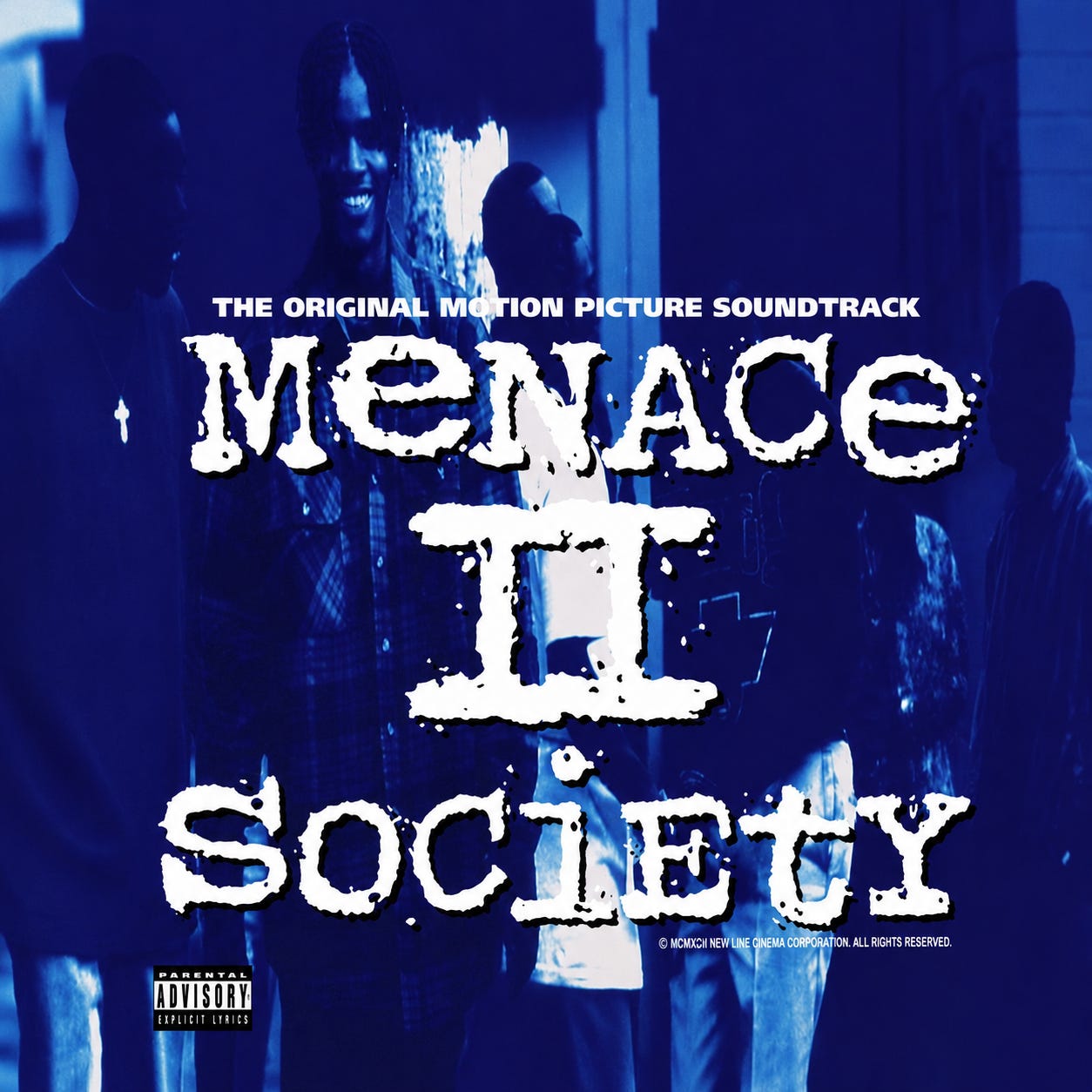
Allen and Albert Hughes cast MC Eiht as A-Wax in the film. A-Wax is a neighborhood veteran who tries briefly to keep O-Dog out of trouble and then disappears once the trouble arrives. Eiht took the acting job and then agreed to write the film’s single. “Streiht Up Menace” is what he turned in, and it succeeds in places where hood-film soundtrack cuts almost never succeed. Eiht wrote the song in character from O-Dog’s first-person point of view, narrating the plot of the film back to itself from inside the head of the protagonist while also appearing on screen in the picture as a different character. That kind of stacked integration had never been done on a hood-film soundtrack before, and the Jive Records compilation organizes itself around Eiht’s anchor. Spice 1’s “Trigga Gots No Heart” ran as the actual lead single, one of the last fully first-person-killer Spice 1 records before his writing started getting interested in consequence. Da Lench Mob’s “Guerillas Ain’t Gangstas” is the T-Bone-and-Shorty-era Lench Mob writing a hard, paranoid, anti-cop verse that holds up alongside anything Cube put on his own albums in the same year. UGK’s Port Arthur remix of “Pocket Full of Stones” is one of the earliest major-label Pimp C placements outside Texas. DJ Quik’s “Can’t Fuck Wit a Nigga” is a shadow-diss aimed at House of Pain that never reached a Quik studio album. The tape went platinum. Eiht’s single became the example every hip-hop film music supervisor quietly started pointing at across the next decade if they needed a cue that could actually do what the film was doing.
Poetic Justice
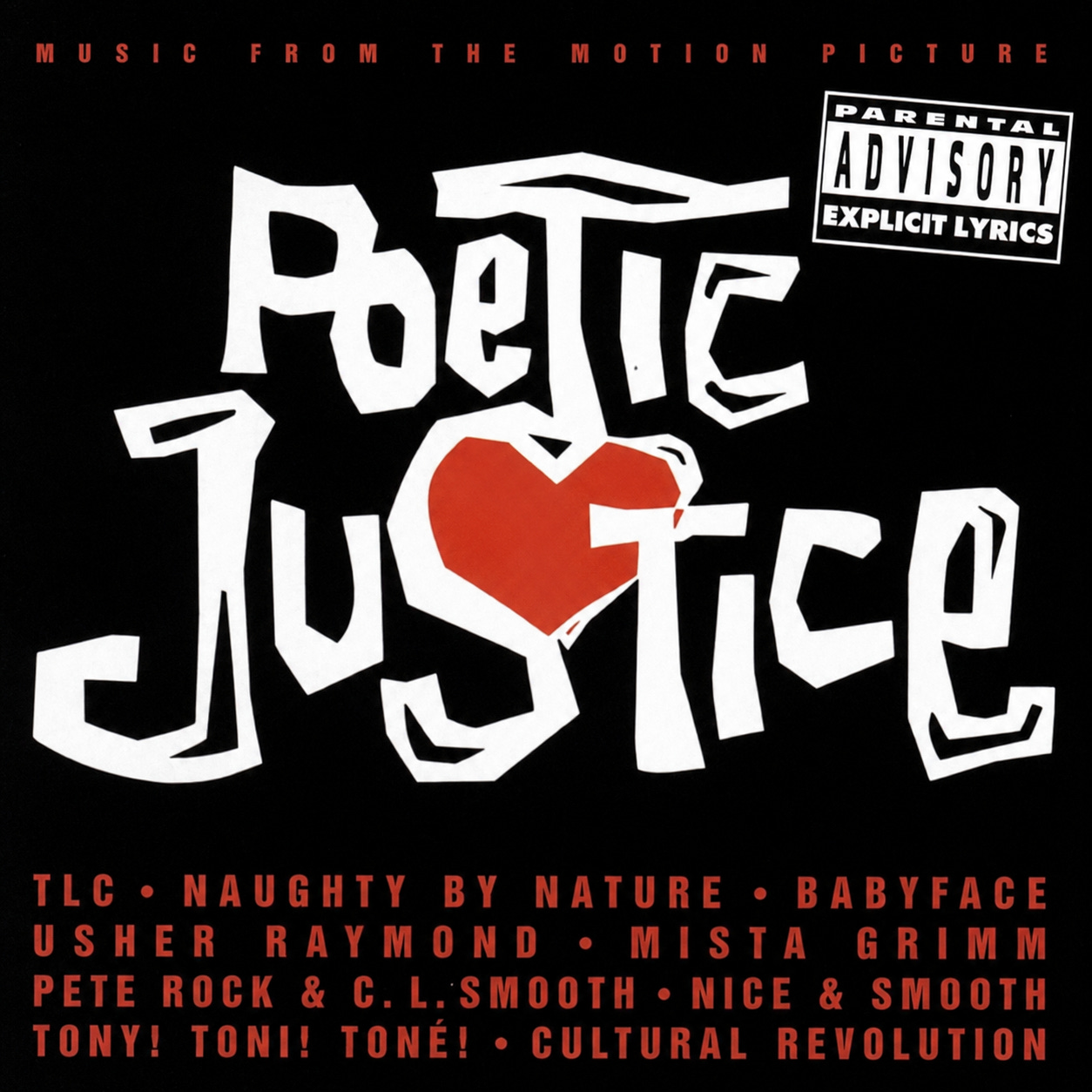
The single most important song on the Epic Soundtrax tie-in for John Singleton’s road movie got kept off the record by Virgin Records’ legal team. Janet Jackson wrote “Again” with Jimmy Jam and Terry Lewis expressly for the film’s closing scene and recorded it for the final credits, but by 1993 Janet was signed to Virgin, Virgin’s lawyers refused to license the master to Epic, and the tie-in album went to market without its own ending. The record that’s left behind plays more like a debut reel than a traditional soundtrack. Mista Grimm’s “Indo Smoke” is Warren G’s first producer credit on a released commercial recording and one of Nate Dogg’s first hook appearances, two years ahead of “Regulate.” A fourteen-year-old Usher Raymond’s “Call Me a Mack” is his actual recorded debut as a solo artist. TLC cover Prince’s “Get It Up” at L.A. Reid’s suggestion. Pete Rock & CL Smooth hand over “One in a Million,” a leftover from the Mecca sessions. A 2Pac recording called “Definition of a Thug Nigga” that wouldn’t get a second release until the posthumous R U Still Down? in 1997. Naughty by Nature, Nice & Smooth, Tony! Toni! Toné!, and Stevie Wonder’s 1971 Where I’m Coming From deep cut “Never Dreamed You’d Leave in Summer” as the closing-scene cue. Four careers got their first commercial vinyl on this one record, and you keep the album on the shelf even knowing the real hit got kept off it by lawyers.
Free Willy
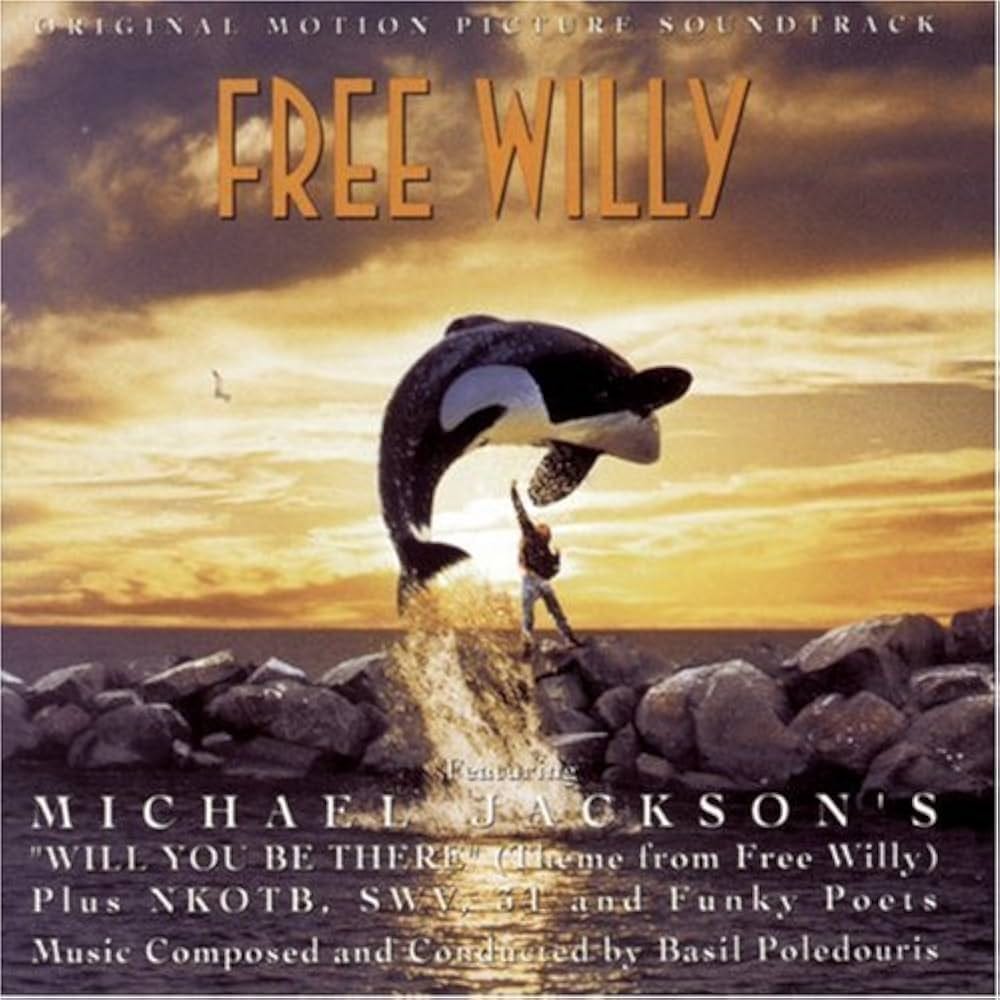
Michael Jackson had already put “Will You Be There” on Dangerous eighteen months before Jerry Greenberg, the president of Jackson’s MJJ Music imprint, pitched Simon Wincer on using it as the emotional closer for Wincer’s orca-rescue family film. Jackson had cut the song in 1990 with the Cleveland Orchestra backing him and Andraé and Sandra Crouch arranging the chorale interlude. He agreed to let the recording be repurposed but couldn’t find the time to write anything new for Wincer. MJJ lightly re-edited the track for the film’s end credits. The soundtrack album led with the re-edit, the single climbed the Hot 100 eighteen months after its original Dangerous pressing, and the spike dragged Jackson’s album back up the catalog charts at the exact point in the sales window where Dangerous had started drifting. That recycling operation is the whole reason the album got made. New Kids on the Block are on it with “Keep On Smilin’,” late-cycle filler from the group’s last recording window under the full name. 3T, Michael’s nephews, make their recorded debut with “Didn’t Mean to Hurt You.” SWV’s “Right Here (Human Nature Remix)” is Teddy Riley flipping Michael Jackson’s own “Human Nature” into the SWV single everybody actually remembers, and it’s the other piece on the album worth holding on to. Everything else is soundtrack furniture. Greenberg pulled off a quiet marketing coup with an eighteen-month-old Jackson album cut, and Dangerous climbed back into relevance riding an orca.
The Meteor Man
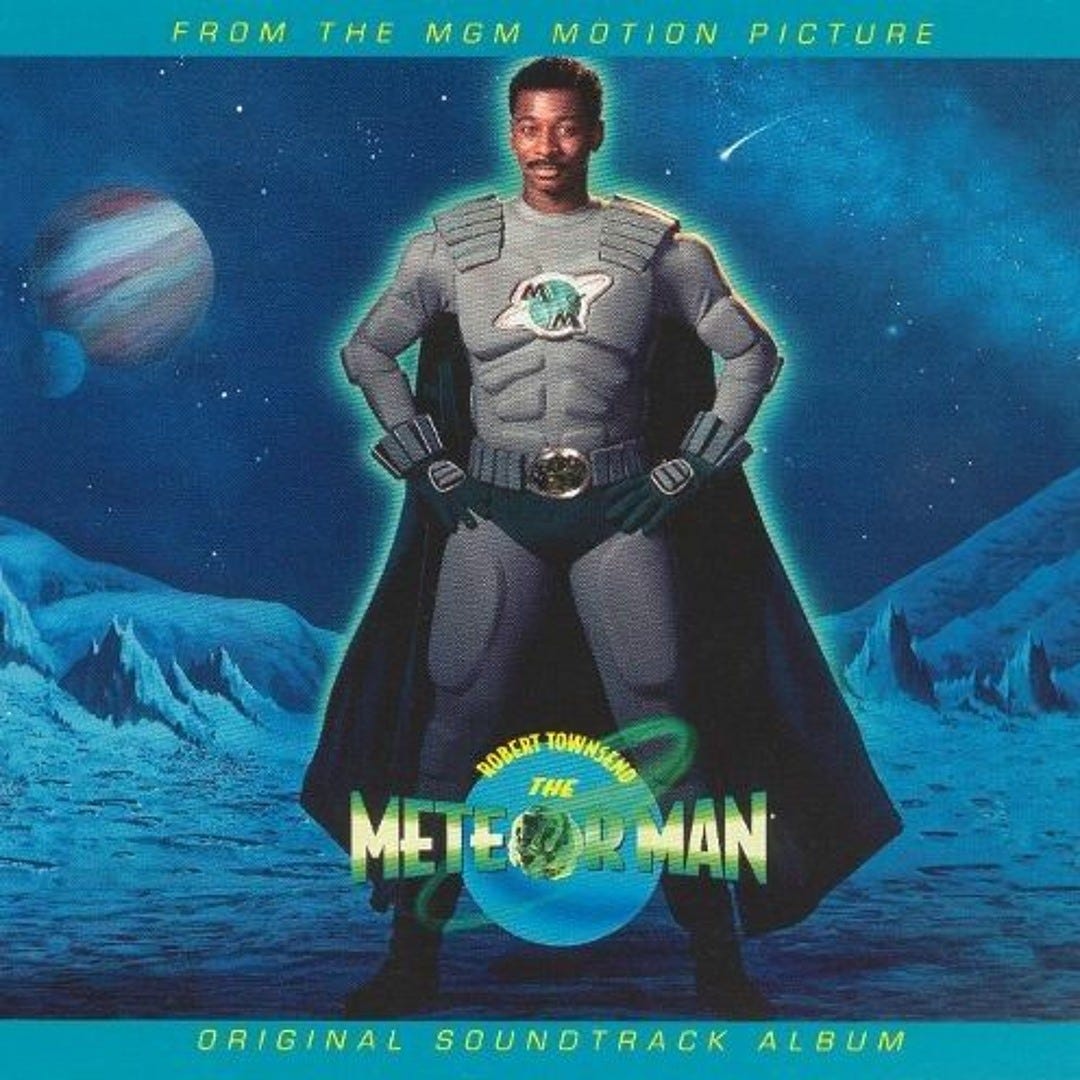
Robert Townsend wrote and directed a Washington DC superhero comedy, casting himself as the lead, about a substitute teacher who gains powers after a meteor strike and takes on a local drug gang called the Golden Lords. The thing worth remembering is the casting. Naughty by Nature play the Golden Lords’ rival Bloods crew on screen. Cypress Hill play the Crips. Big Daddy Kane plays an enforcer called Pirate. Another Bad Creation play the Junior Lords. Don Cheadle shows up as a gang member named Goldilocks. Luther Vandross has a cameo, Bill Cosby plays a mute vagrant, and James Earl Jones rounds out the supporting cast. What Townsend essentially did was invert the soundtrack’s conceit. The actual MCA album that emerged from production runs shorter and thinner than the on-screen lineup of rappers inside the film itself, and the lineup of rappers inside the film is the meaningful artifact. Naughty by Nature’s “It’s On” is the one durable cut from the CD, a Treach piece built on a Donald Byrd sample. Keith Washington’s George Duke-produced “Is It Just Too Much” is the romantic-subplot ballad. Another Bad Creation turn in late-group material nobody asked for. The real document of The Meteor Man is the cast list, not the CD MCA pressed, and whether you pick up the tie-in depends on whether you want to hear Treach actually rapping inside the footprint of a part Townsend wrote for him.
Judgment Night
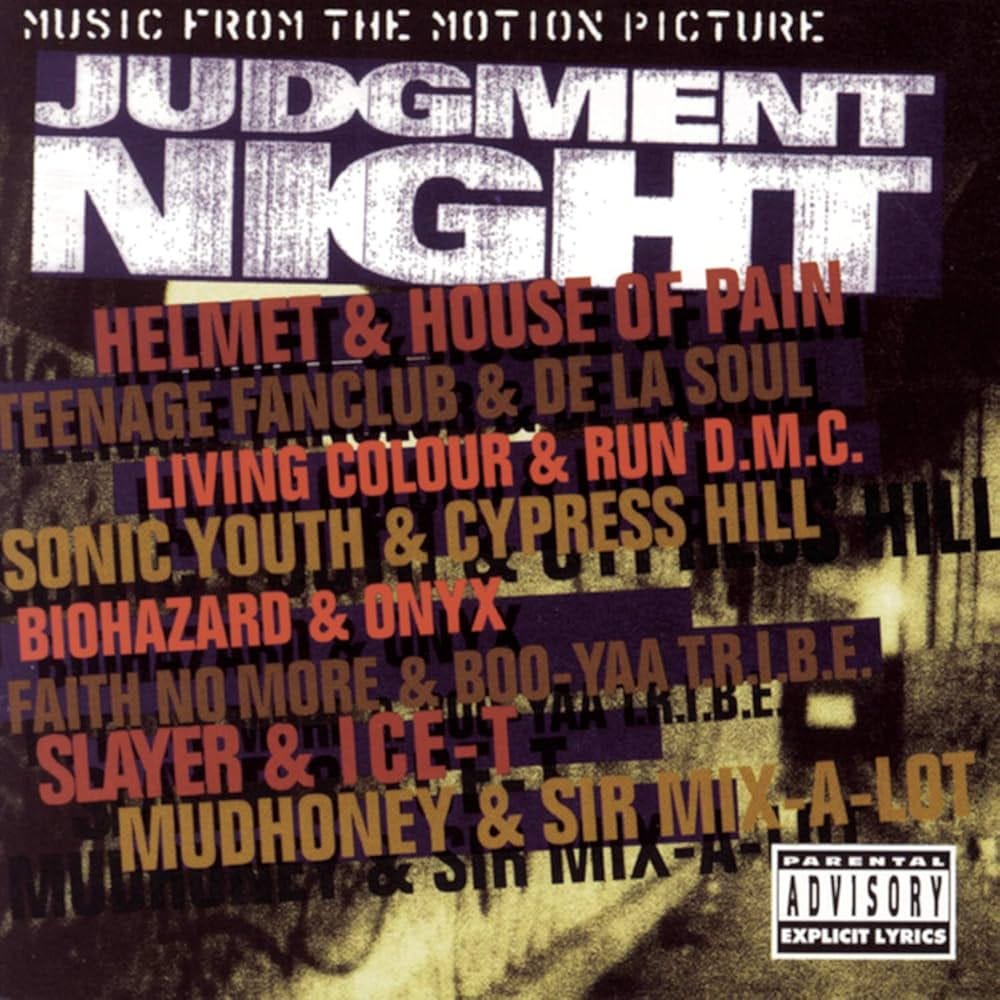
Happy Walters was twenty-two years old, managing Cypress Hill and House of Pain, and running an Immortal Records imprint he’d founded to handle the two groups at the point he pitched Jimmy Iovine on a concept album built entirely out of hip-hop and rock collaborations. One pairing per track. Eleven tracks total. His occasion was the soundtrack to Stephen Hopkins’s Judgment Night, a forgotten Emilio Estevez and Cuba Gooding Jr. thriller about four suburbanites trapped overnight inside a Chicago tenement. Walters put the album together over the summer of 1993, and every one of the eleven pairings was a first-time collaboration, none of them existing before Walters made the calls. Helmet and House of Pain opened with “Just Another Victim.” Teenage Fanclub and De La Soul cut “Fallin’” over a Tom Petty “Free Fallin’” sample, a pairing originally slated for P.M. Dawn before the DGC A&R swapped in De La. Living Colour and Run-DMC went “Me, Myself & My Microphone.” Biohazard and Onyx took the title cut, Jam Master Jay looping Biohazard’s drummer for the backbone. Slayer and Ice-T medleyed three Exploited punk songs into “Disorder” with Rick Rubin producing.
Faith No More and Boo-Yaa T.R.I.B.E. cut “Another Body Murdered.” Sonic Youth and Cypress Hill made “I Love You Mary Jane,” Kim Gordon on bass, DJ Muggs building the fog around B-Real’s verses. Mudhoney and Sir Mix-A-Lot took “Freak Momma.” Dinosaur Jr. and Del the Funky Homosapien cut “Missing Link,” and Del has credited J Mascis ever since as the reason he started studying music theory. Therapy? and Fatal worked up “Come and Die.” Pearl Jam’s three instrumentalists backed Cypress Hill on “Real Thing,” and Eddie Vedder skipped the session to go surfing. A Tool and Rage Against the Machine pairing called “Can’t Kill the Revolution” was attempted and never finished. What the album prefigured across the rest of the decade is a long and mostly embarrassing inheritance (nu-metal, rap-rock, every radio rock station’s playlist from 1999 through 2003), but the Judgment Night comp predates all of it, and the thing about it that still works is that every one of those eleven pairings is an actual thought-out collaboration where the participants showed up and wrote together in the same room. Walters was twenty-two while he was putting all this together. Imagine what his Rolodex looked like five years on.
1994
House Party 3
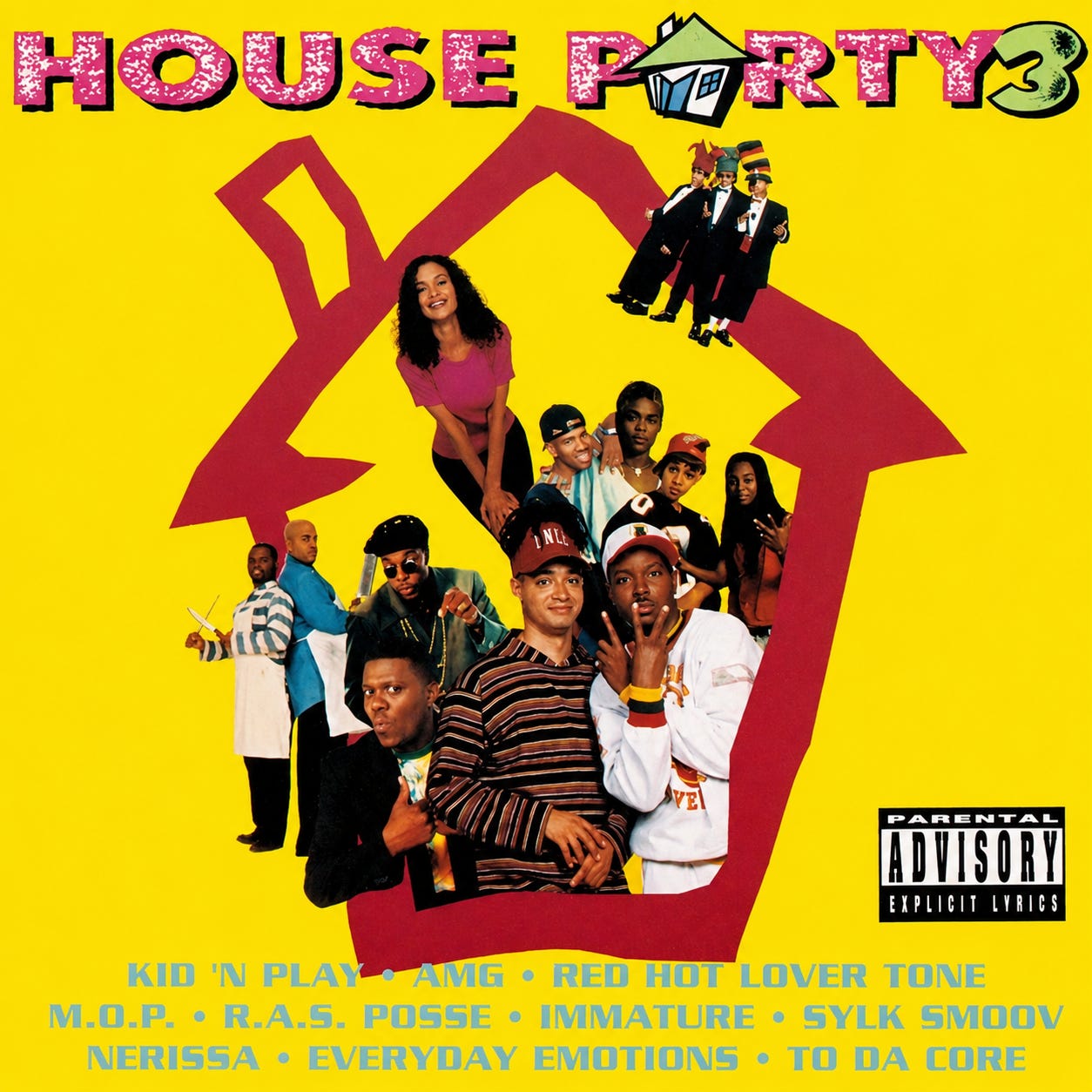
Kid ‘n Play had stopped selling records. Their last studio album, Face the Nation, had come and gone on Select in 1991, and once New Line greenlit a third sequel they were a brand more than a working act. Six songs on the Select Records tie-in album are credited to them, and none charted, and none of them ever appeared on anything else, and none were followed by anything. To date, those six tracks are the last commercially released original recordings the duo has made. Around them sit TLC (on “Make Some Noise,” which the duo share with another marquee act), Immature a year before “Never Lie,” Red Hot Lover Tone on what turned out to be the cut with real legs, and a solitary Top 40 crossover in AMG’s “Butt Booty Naked,” which is the only song on the album anyone in 2026 can still hum. The tape dragged itself to the lower reaches of the R&B album chart and disappeared. What the soundtrack is really documenting is the point at which a commercial rap-comedy brand exhausted itself, captured on a Select Records tie-in that nobody bought to hear Kid ‘n Play and everybody stopped caring about by March.
Gunmen
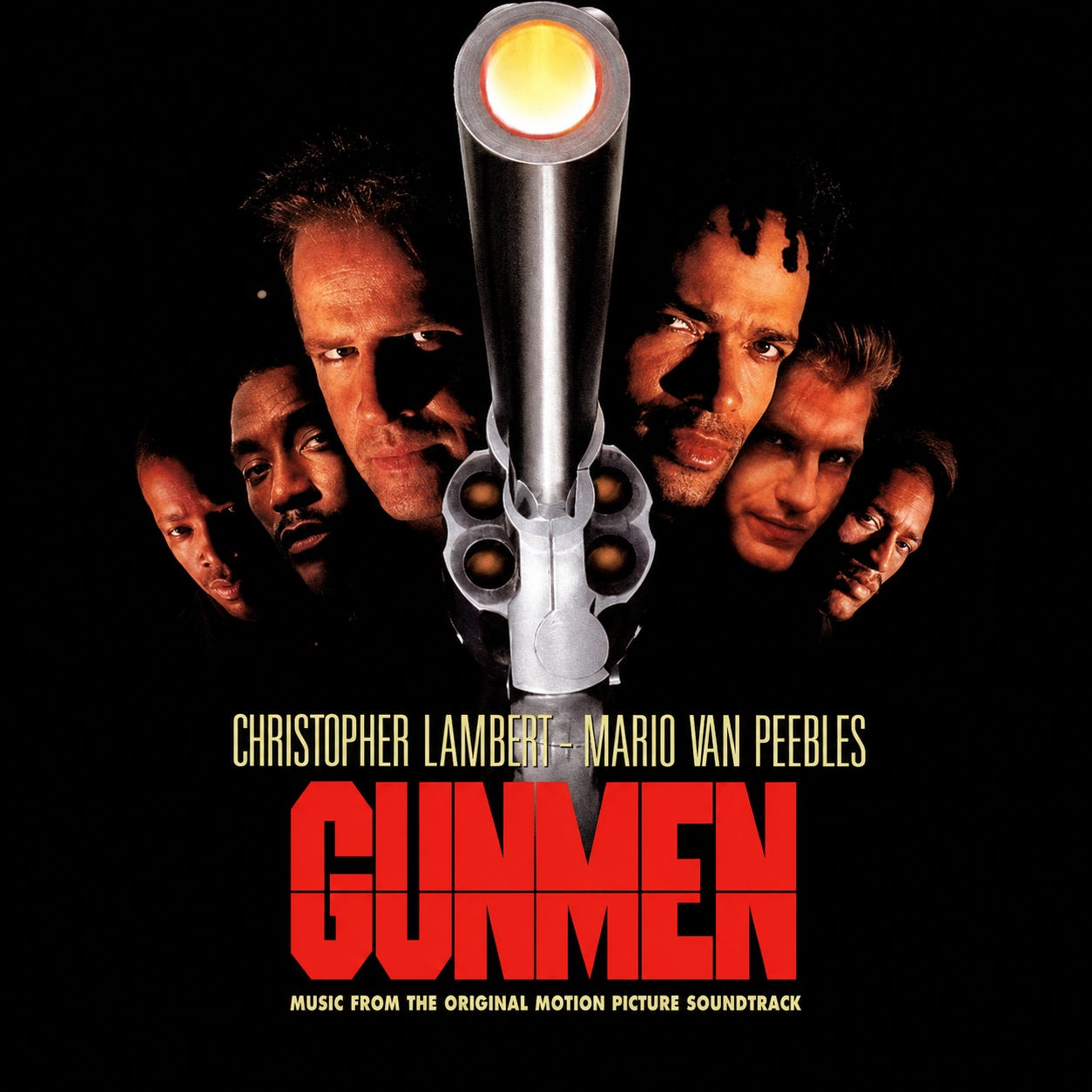
Deran Sarafian directed a Christopher Lambert and Mario Van Peebles action comedy that Dimension cut by five minutes and released onto 800 screens in February, grossed three-and-a-half million dollars, and then disappeared. What anyone remembers about the movie is a single scene inside the film’s South American hip-hop club, which corresponds to nothing in actual Central American geography and appears to have been invented by the production design department for the sole purpose of justifying three music cameos. Big Daddy Kane performs “Gunman” on stage in that scene, and the sequence runs long enough that the movie stops so he can do the first verse. Rakim sits in the audience with Kadeem Hardison in an earlier cut. Later Rakim returns and performs “I Know You Got Soul” with Eric B, even though by late 1993 the group had broken up and Rakim was in the middle of the contractual dispute with MCA that would delay his solo debut for another three years. Ed Lover and Doctor Dré cameo in the same club sequence. The MCA tie-in album came out two months ahead of the picture and holds what may be the last Kane-as-Cold-Chillin-veteran-in-transition recording (produced by Kane and Michael Stokes, co-producer on “Groove With It” from five years earlier), shortly before Kane signed to MCA directly and moved over full-time. Kid Frost’s “Bite the Bullet” opens the tape. Young Black Teenagers, Morgan Heritage, Los Lobos, and Christopher Williams fill out the remaining slots as filler, but the three on-screen cameos alone make the Gunmen album one of the stranger documents of the transition point where a late-eighties rapper’s career turns over.
Mi Vida Loca
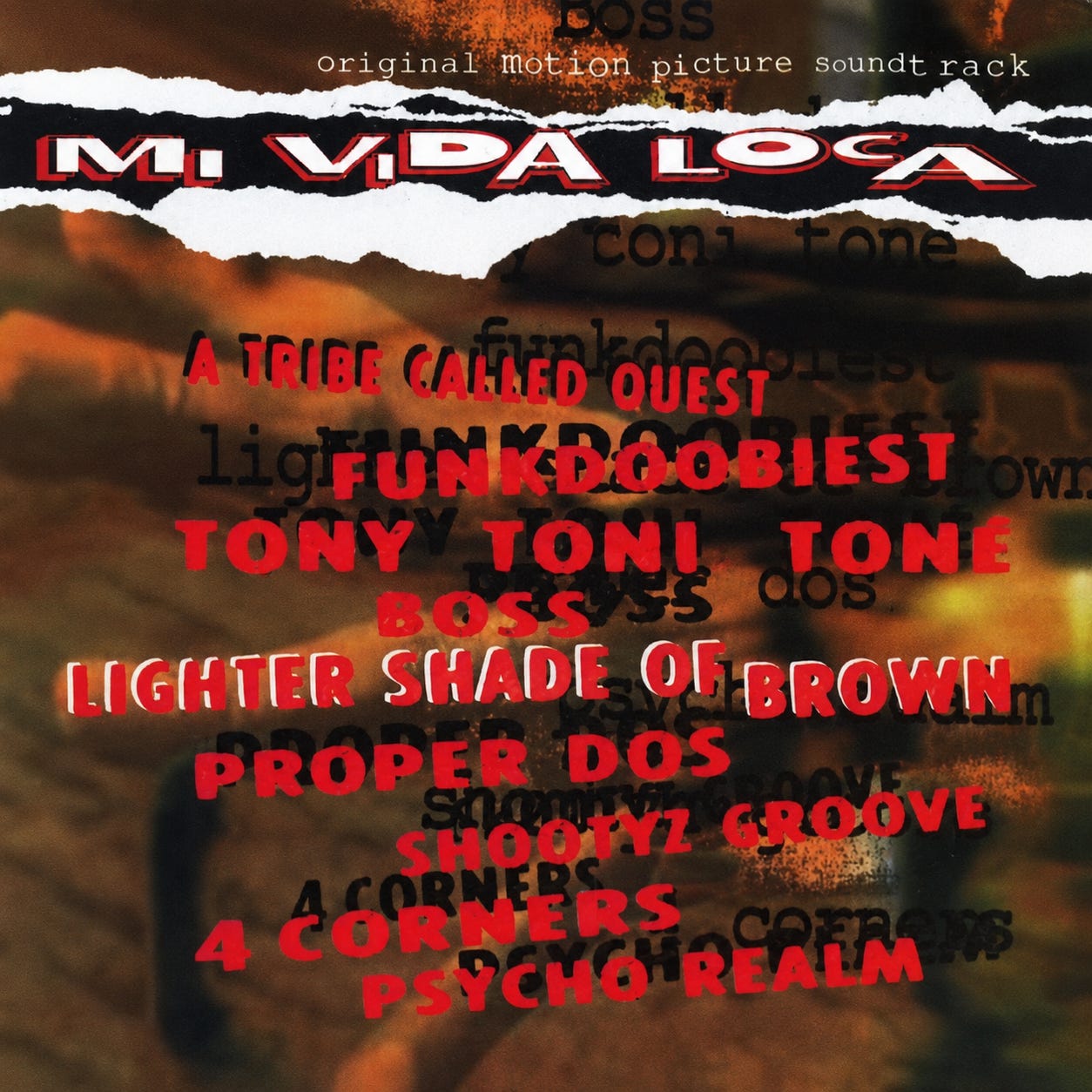
Allison Anders directed the East LA chola drama after years of pushing the script around studios, and what kept it out of the hands of the usual bad-faith interpreters was the manifesto she wrote insisting she would not let the film be “colonized by a white liberal.” Jellybean Benitez handled music supervision on the Mercury tie-in. Benitez is a Nuyorican DJ who came up in South Bronx disco and ran Freestyle production through the mid-eighties, and what he assembled here gets closer to 1994 Latino West Coast rap than anything the Mercury A&R department would have known how to put together on its own. Proper Dos opens with “Tales From the Westside.” Lighter Shade of Brown’s “Hey DJ” was the only crossover single, a light-end-of-the-charts placeholder most radio programmers mistook for a throwaway. Funkdoobiest’s “The Good Hit” and A Tribe Called Quest’s “If the Papes Come” are the East Coast concessions, and Tribe’s contribution is a loose Q-Tip piece that never appeared on any of their studio albums. Boss’s “Run Catch & Kill” is the one fully-gangsta cut on the tape, West Coast in production but East Coast in personnel. Cypress Hill affiliates who wouldn’t release their own debut until 1997 also appear. Tony! Toni! Toné! close the record. What Benitez turned in is one of the earliest commercially available documents of mid-nineties Chicano rap, placed inside a film that never found anything like the audience it deserved. The album reached the lower end of R&B and sank.
Above the Rim
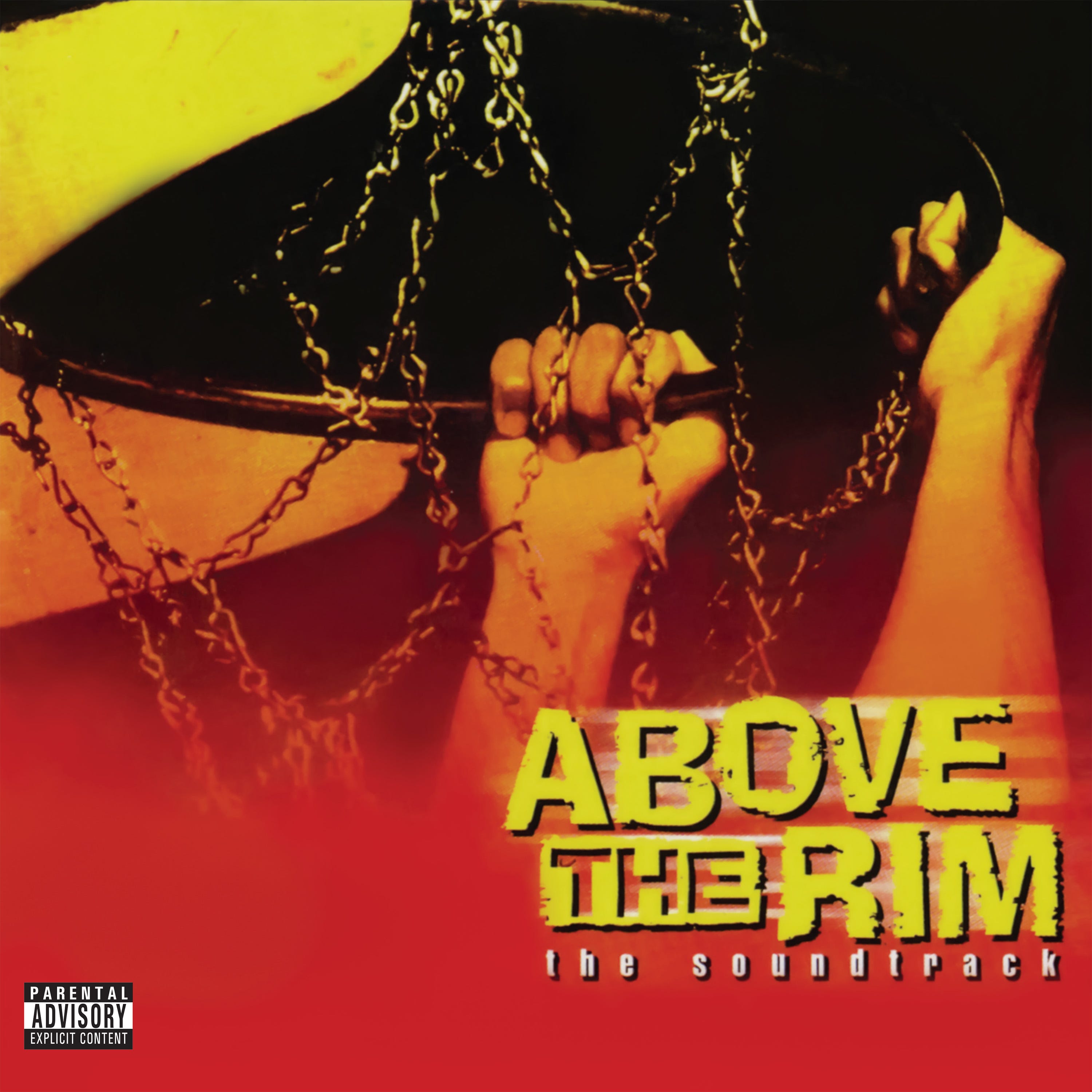
Everything that matters about the Death Row soundtrack to Jeff Pollack’s basketball drama comes down to a song on it that Def Jam owned and Death Row needed. Warren G had signed to Def Jam as a solo artist around the time of The Chronic sessions. Dr. Dre was his stepbrother, and Warren had been around the Track Record studio in North Hollywood during the Chronic tour instrumentals, befriending engineer Greg Geitzenauer, who wound up cutting Warren’s demos on the side. “Regulate” came out of one of those sessions. Warren played the track for Dre, Dre wasn’t initially impressed, and Warren walked out of the room worried that if his stepbrother didn’t like it nothing about it was going to work, then pushed the song through anyway.
Getting it onto the Death Row soundtrack for a film Suge Knight was executive-producing required Def Jam and Death Row’s lawyers to hammer out an entente around a single Warren G was signed nowhere near. The song sampled Michael McDonald’s “I Keep Forgetting” and featured Nate Dogg singing over it, ran the album to two million in sales by the middle of the year, and three months after Above the Rim released, Russell Simmons and Lyor Cohen repackaged the single as the lead track on Warren’s own Regulate... G Funk Era debut. Around “Regulate” sits the full Death Row roster flexing (SWV’s “Anything,” Lady of Rage’s “Afro Puffs,” Thug Life’s “Pour Out a Little Liquor” sampling the O’Jays, 2nd II None, Jewell and Aaron Hall, Al B. Sure!, Tha Dogg Pound’s first “Big Pimpin’”), plus three bonus tracks that only made the cassette release because the CD couldn’t fit them, one of which is the 2Pac and Stretch song “Pain” that Dre had initially rejected and that engineer Norman Whitfield Jr. personally pushed back into the running. 2Pac is the film’s lead actor and appears on exactly one non-bonus track. The soundtrack won Source Soundtrack of the Year and shipped two million copies, and what the album actually is is where G-funk finishes converting the commercial center of rap into a West Coast operation.
Fear of a Black Hat
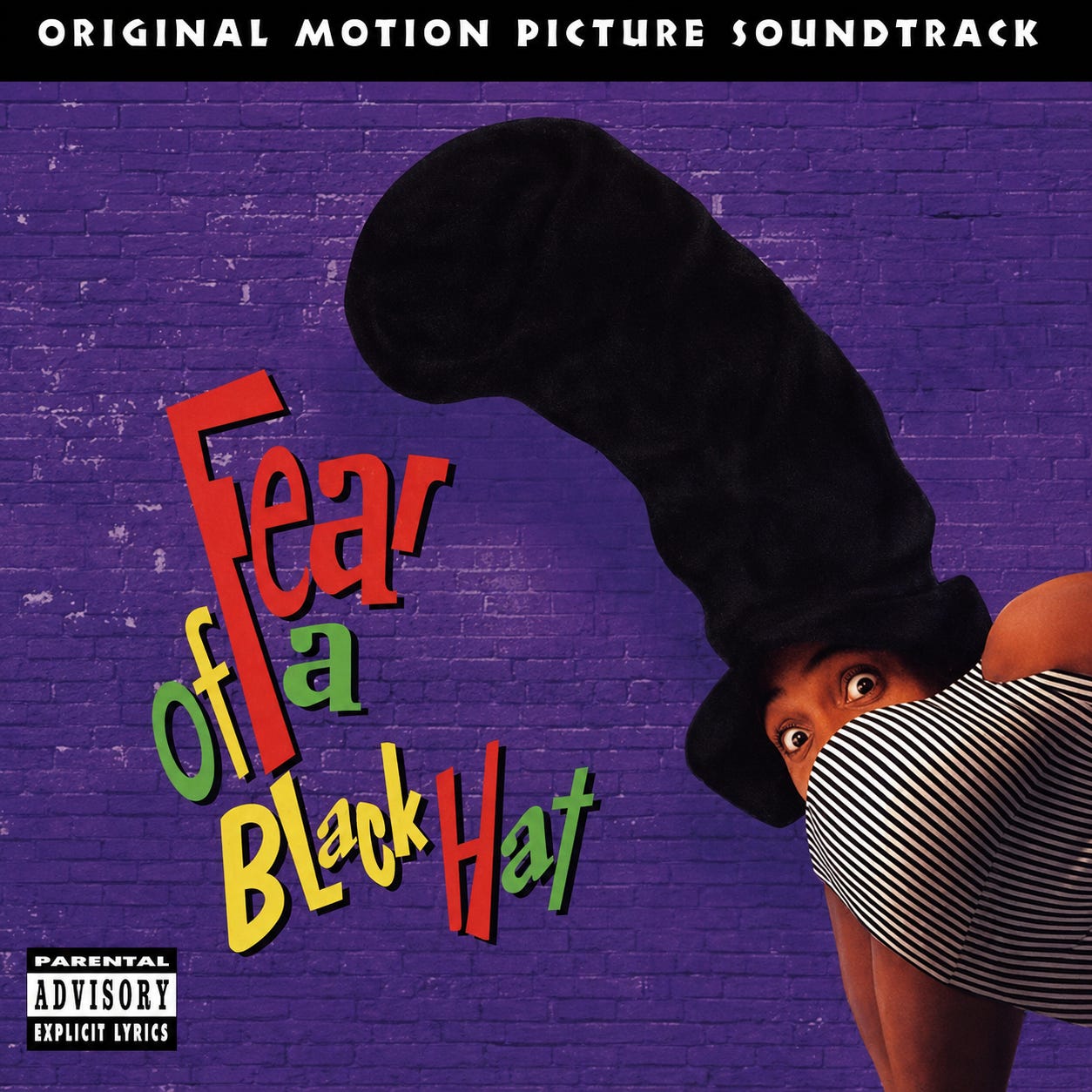
Rusty Cundieff made the hip-hop counterpart to This Is Spinal Tap about a fictional Los Angeles gangsta rap trio called N.W.H. (Niggaz With Hats), premiered it at Sundance in January 1993, watched his distribution deal fall apart, and waited a full eighteen months for the picture to get a limited theatrical release. CB4 came out in the interval, covered much of the same ground to a wide audience, and effectively closed the window on Cundieff’s film before it opened. What the delayed release left behind is a document about a joke history had already told. The eleven-song Avatar Records soundtrack came out the week before the theatrical run and is almost entirely Cundieff writing fictional rap songs in character as Ice Cold (co-written with Larry Robinson), performed by N.W.H. as actual produced tracks. “Fuck the Security Guards” is Cundieff’s “Fuck tha Police” parody, sampling Kool G Rap and DJ Polo’s “Talk Like Sex.” “Guerrillas in the Midst” does Public Enemy. “A Gangsta’s Life Ain’t Fun” does Ice-T’s “New Jack Hustler.” “Booty Juice” parodies the rap-video pool scene to the letter. “White Cops on Dope” features an inexplicable Rick Ocasek of the Cars cameo. Cundieff engineered his parodies more carefully than Chris Rock and Nelson George engineered theirs. Every N.W.H. song is a working facsimile of a specific 1988-to-1992 rap record, constructed to read as a parody at the production level and not only the joke level. The movie missed its window. What got pressed is still the hardest piece of hip-hop formal comedy anyone had attempted on a commercial release.
Beverly Hills Cop III
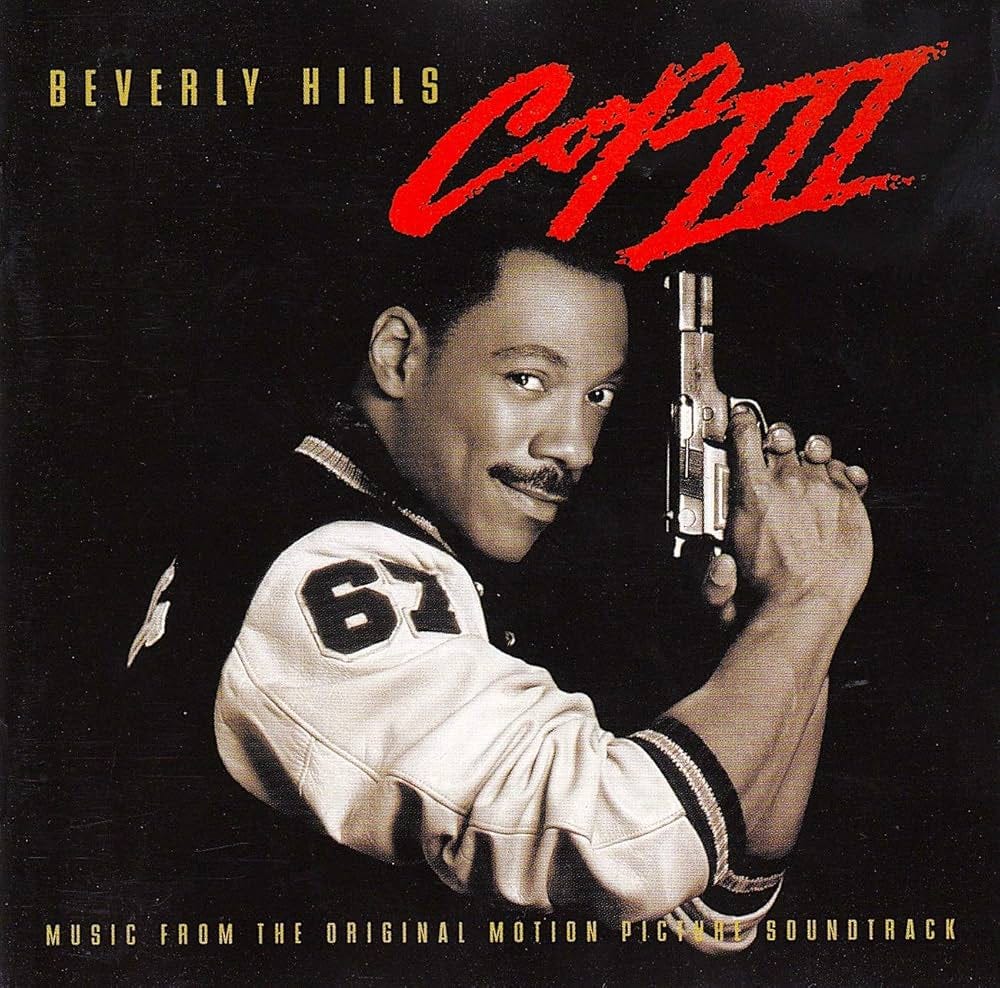
John Landis directed the third Axel Foley sequel, Nile Rodgers was hired to replace Harold Faltermeyer on the score, and MCA assembled a tie-in album that has nothing to do with Beverly Hills beyond the photograph of Eddie Murphy on the cover. The commercial single was Patti LaBelle’s Babyface-produced “The Right Kinda Lover,” a fully-arranged adult R&B vehicle that would have landed on a LaBelle solo album as readily as a movie tie-in. Shai placed a single. Tony! Toni! Toné! contributed “Leavin’.” Terence Trent D’Arby and Chanté Moore handled the middle of the album. What buries the album historically is the inclusion of Eazy-E’s “Luv 4 Dem Gangsta’z,” his first placement on any major-label compilation in two years, ten months before his AIDS diagnosis and eleven months before his death. It amounts to the last Eazy track to reach a general mainstream audience during his lifetime. Nile Rodgers turned in an instrumental funk rearrangement of Faltermeyer’s “Axel F” to close the album. The record peaked outside the Billboard 200 top 100 and slipped. In 2025 La-La Land Records issued a limited pressing of Rodgers’s score by itself. The MCA soundtrack proper was the kind of rushed compromise major labels turned in for declining franchise films; what it unintentionally preserved was the last commercial sighting of Eazy as a living Ruthless artist on a platform big enough for his name to land on the cover.
Fresh
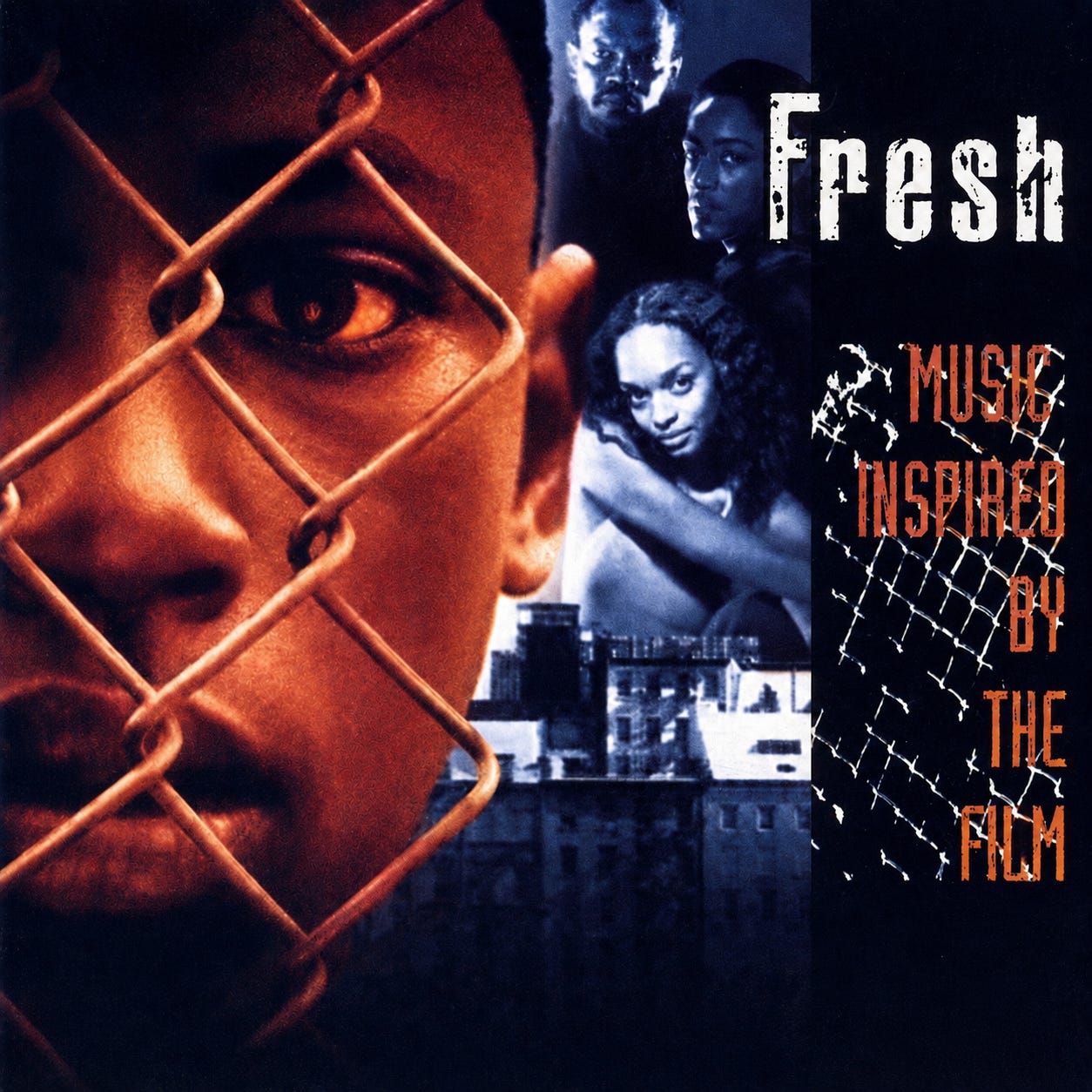
Miramax tried to force a hip-hop soundtrack onto Boaz Yakin’s drug-runner drama about a twelve-year-old chess prodigy in New York, and Yakin and producer Lawrence Bender held the line. Stewart Copeland, the drummer from the Police, turned in a melancholic, acoustic, Ry Cooder-inflected score that has nothing to do with rap music and is part of what gives the movie the strange out-of-era quality critics kept circling. Miramax got the soundtrack album they wanted anyway. RCA, through its deal with Loud, put out an “inspired by” companion record in August 1994 that includes zero songs from the actual film. What went on the album instead is one of the stranger half-decade juxtapositions a studio compilation ever attempted. Side one carries three pre-release solo Wu-Tang cuts. GZA’s “I Gotcha’ Back” arrived fourteen months ahead of Liquid Swords, Raekwon’s “Heaven & Hell” a full year before Only Built 4 Cuban Linx..., and the “Fresh” remix of “Can It Be All So Simple” is a completely different mix from the one that would land on Raekwon’s debut. Side two is 1980s old-school history. Cold Crush Brothers, Whodini’s “Freaks Come Out at Night,” the Fearless Four, T-Ski Valley, Grandmaster Flash & the Furious Five’s “It’s Nasty,” Funky Four Plus One More, Spoonie Gee, the Masterdon Committee. The Loud–RCA deal was two and a half months old at the point of the album release, and Wu-Tang’s manager Mitchell “Divine” Diggs had leverage to place solo off-cuts wherever the label needed compilation material. What the inspired-by album actually is is a Wu-Tang mini-sampler smuggled out under the cover of a Boaz Yakin drama that had no rap in it at all.
Blankman
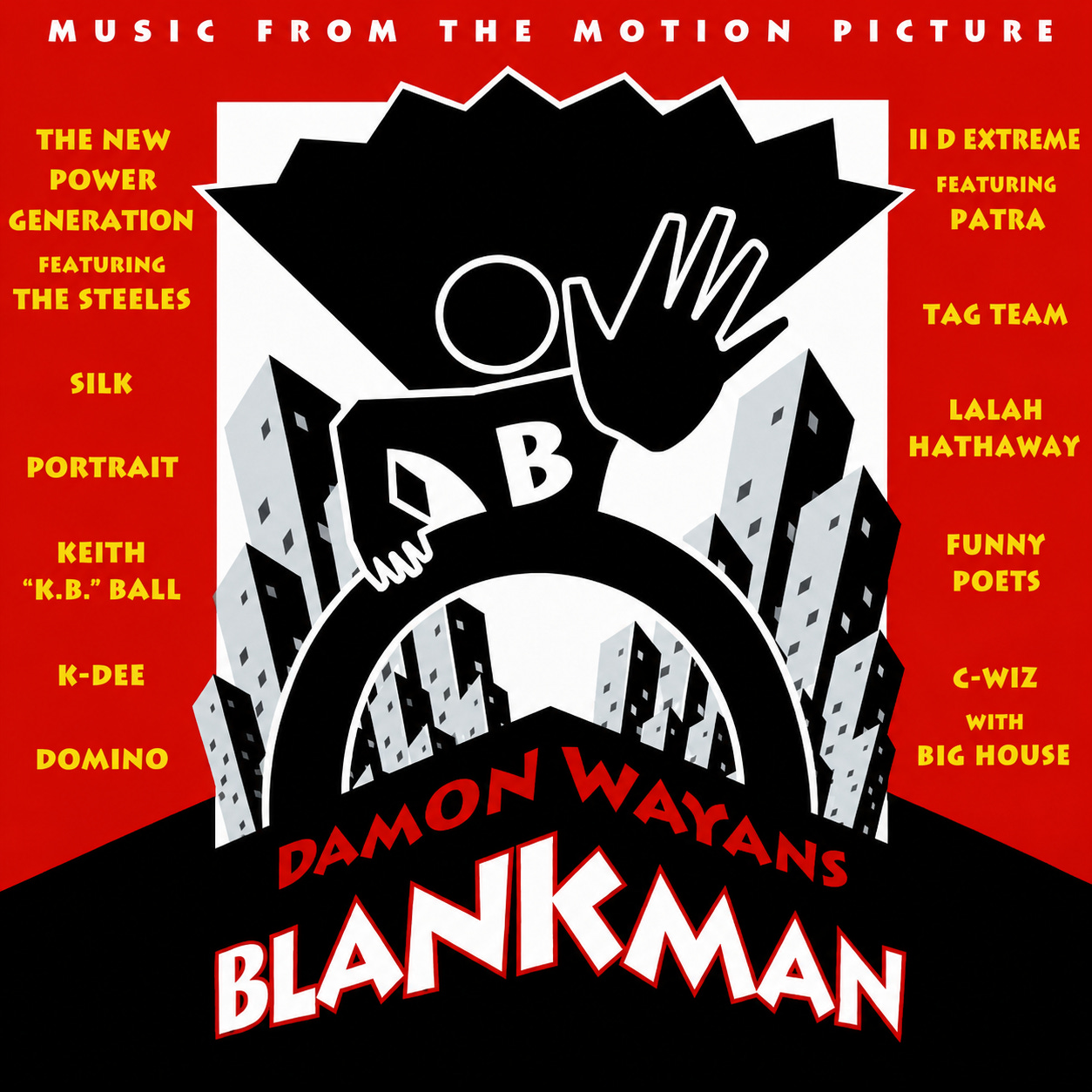
The Damon Wayans Batman parody got made at Columbia, Mike Binder directed, the Hudlin brothers had been attached to direct at an earlier stage before creative-control issues pushed them off the production, and the Epic Soundtrax tie-in album is mostly forgettable except for the one thing on it that nobody expected. New Power Generation opens the album with “Super Hero,” credited to NPG featuring the Steeles, courtesy of NPG Records. Prince was nine months into his war with Warner Bros. at the point of the August 1994 recording sessions, had already written SLAVE on his cheek for his public appearances, and was moving the recording of anything he controlled out of the Warner pipeline entirely. “Super Hero” got cut between the Record Plant in West Hollywood and Paisley Park in Minnesota, then licensed to Epic through Prince’s own NPG imprint, and Epic placed it at the front of a Damon Wayans soundtrack the rest of which consists of a late Tag Team single (”Dig Deep”), Domino a year after “Ghetto Jam,” Silk’s ballad contribution, a K-Dee cut (K-Dee being Ice Cube’s Lench Mob affiliate), and five pieces by R&B acts nobody asked for. The movie bombed at the box office and the album went with it. What the record actually preserves is a specific five-week window in 1994 during which Prince was licensing post-Warner work to any third party that would take it, and Damon Wayans’s superhero parody happens to be where that window hit public commercial release first.
Jason’s Lyric
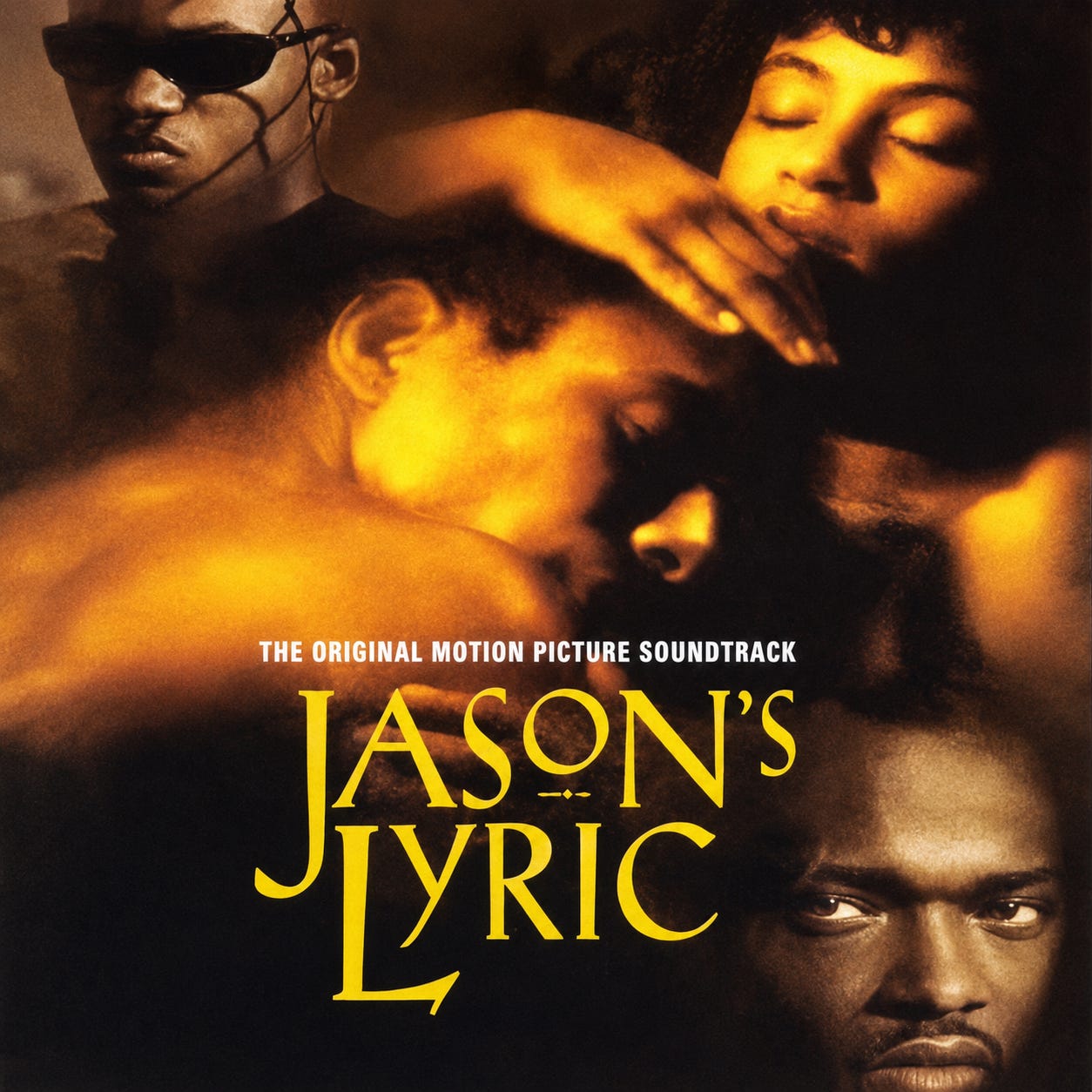
Doug McHenry directed a star-crossed-lovers drama set in Houston, with Allen Payne and Jada Pinkett in the leads, and the Mercury soundtrack led with an eighteen-member R&B supergroup nobody had heard of, fronted by a twenty-year-old songwriter from Richmond, Virginia, whose name was printed in small type on the liner credits. Brian McKnight convened Black Men United in a Los Angeles studio to record the song “U Will Know,” with music composed by the then-unknown D’Angelo and lyrics written by his brother Luther. Aaron Hall, After 7, Al B. Sure!, Boyz II Men, Brian McKnight, Christopher Williams, El DeBarge, Gerald LeVert, H-Town, Joe, Keith Sweat, Portrait, R. Kelly, Silk, Sovory, Stokley of Mint Condition, Tevin Campbell, and Usher all show up trading lead vocals on the recording. Raphael Saadiq played bass. Lenny Kravitz played guitar. It was nothing anyone had attempted at that scale before or since for a film soundtrack, and it belongs to a songwriter who would not release Brown Sugar for another nine months. Everything else on the record is lower-stakes and less interesting; Brian McKnight’s “Crazy Love” ran as a single, K-Ci of Jodeci covered Bobby Womack’s “If You Think You’re Lonely Now,” and the remainder is contemporaneous Mercury R&B material. What “U Will Know” turned out to be, in hindsight, is D’Angelo’s first major commercial credit, placed three years before anyone in the industry started using the phrase neo-soul.
Murder Was the Case
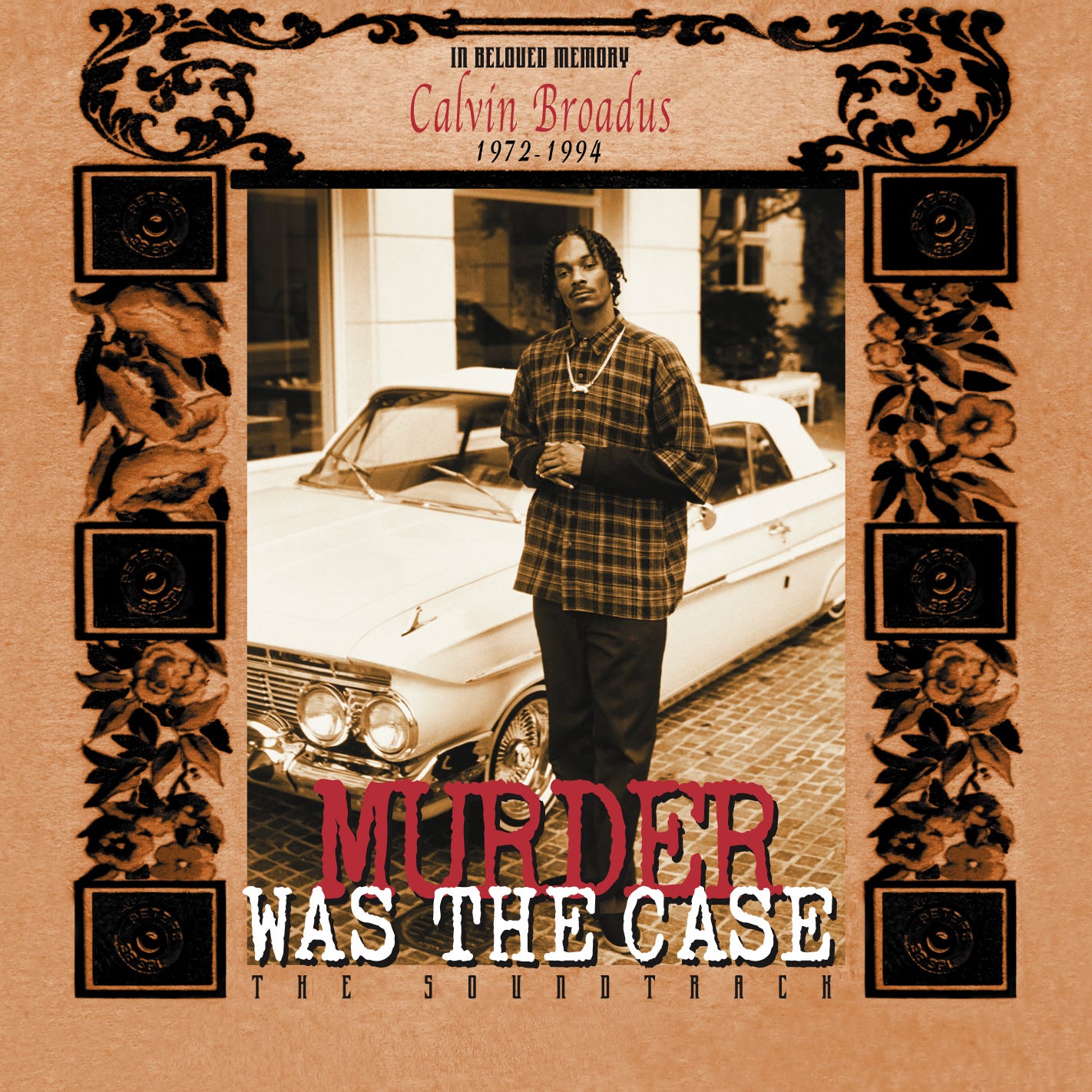
Dr. Dre and Fab 5 Freddy co-directed an eighteen-minute short film about Snoop Doggy Dogg getting shot, meeting the Devil, and coming back to life, and Death Row released a tie-in album for that short film that ran seventy-two minutes, held fifteen tracks, debuted at the top of the Billboard 200, and moved two million copies by April 1995. No major record label had ever put this much album behind a film of this length before, and no label has since. What still anchors the tie-in is what happens on track two. “Natural Born Killaz,” the Dr. Dre and Ice Cube collaboration, is the first new recording the two had put on a commercial release together since they separated over the Straight Outta Compton royalty dispute of 1989. It’s a post-N.W.A. reunion with both men rapping about murder in a sequence that was, at the time, read as the possible opening shot of a full-scale Dre-and-Cube album that kept getting teased and never happened. Around it on the album sit Tha Dogg Pound’s Grammy-nominated “What Would U Do?” (later repurposed for Natural Born Killers), Nate Dogg’s “One More Day,” Sam Sneed’s “U Better Recognize” with Dre, DJ Quik’s “Dollars & Sense,” and Dat Nigga Daz’s production work throughout. Suge paid 2Pac two hundred thousand dollars to cut “Life’s So Hard” for the album, and the track never made the sequence. Everything about the enterprise is excessive relative to the short film it was theoretically supporting, which was the point. The soundtrack is where Death Row declares, eighteen months into its run, that it is no longer a record label operating inside an industry.
A Low Down Dirty Shame
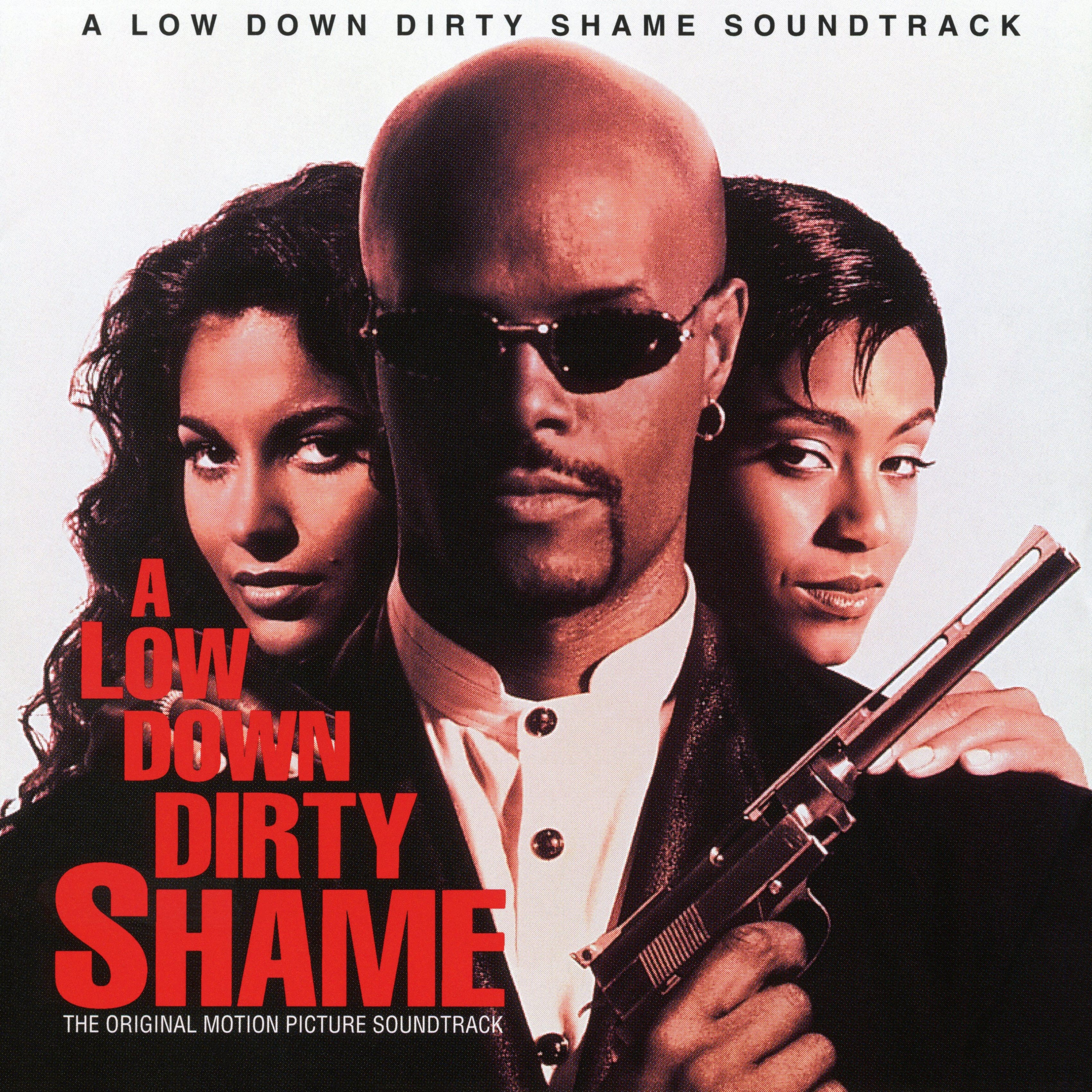
Keenen Ivory Wayans self-produced a comedic Shaft pastiche with Jada Pinkett and Charles S. Dutton. Hollywood Pictures released it in November and it flopped. The Jive soundtrack released two weeks ahead of it moved half a million copies and reached gold inside four months. Barry Weiss was running A&R at Jive, and the record he assembled is the one piece of this trio of Wayans-brother soundtracks of 1994 (the others being House Party 3 and Blankman) where the underground roster leaked into a commercial comedy tie-in and nobody at the studio flinched. Souls of Mischief show up with “Get the Girl, Grab the Money and Run,” a post-93 ‘til Infinity reunion-energy cut from the Hieroglyphics crew. Casual’s “Later On” arrived as his second commercial release after Fear Itself. Extra Prolific, another Hiero affiliate, handled “In Front of the Kids.” Organized Konfusion’s “Let’s Organize” is a Pharoahe Monch and Prince Po production recorded a year before Stress: The Extinction Agenda. Zhané covered Evelyn “Champagne” King’s 1977 “Shame” as the title cut. Aaliyah appeared with “The Thing I Like,” recorded during her R. Kelly apprenticeship window a month before the Kelly-annulment scandal broke. Heavy D, Fu-Schnickens, the Brand New Heavies filled out the commercial end. Marcus Miller composed the instrumental score. The A Low Down Dirty Shame album is one of the hardest straight-line indictments of the gap between an unsuccessful comedy and its accidentally excellent soundtrack the decade ever produced, and it moved gold inside a quarter.
Street Fighter
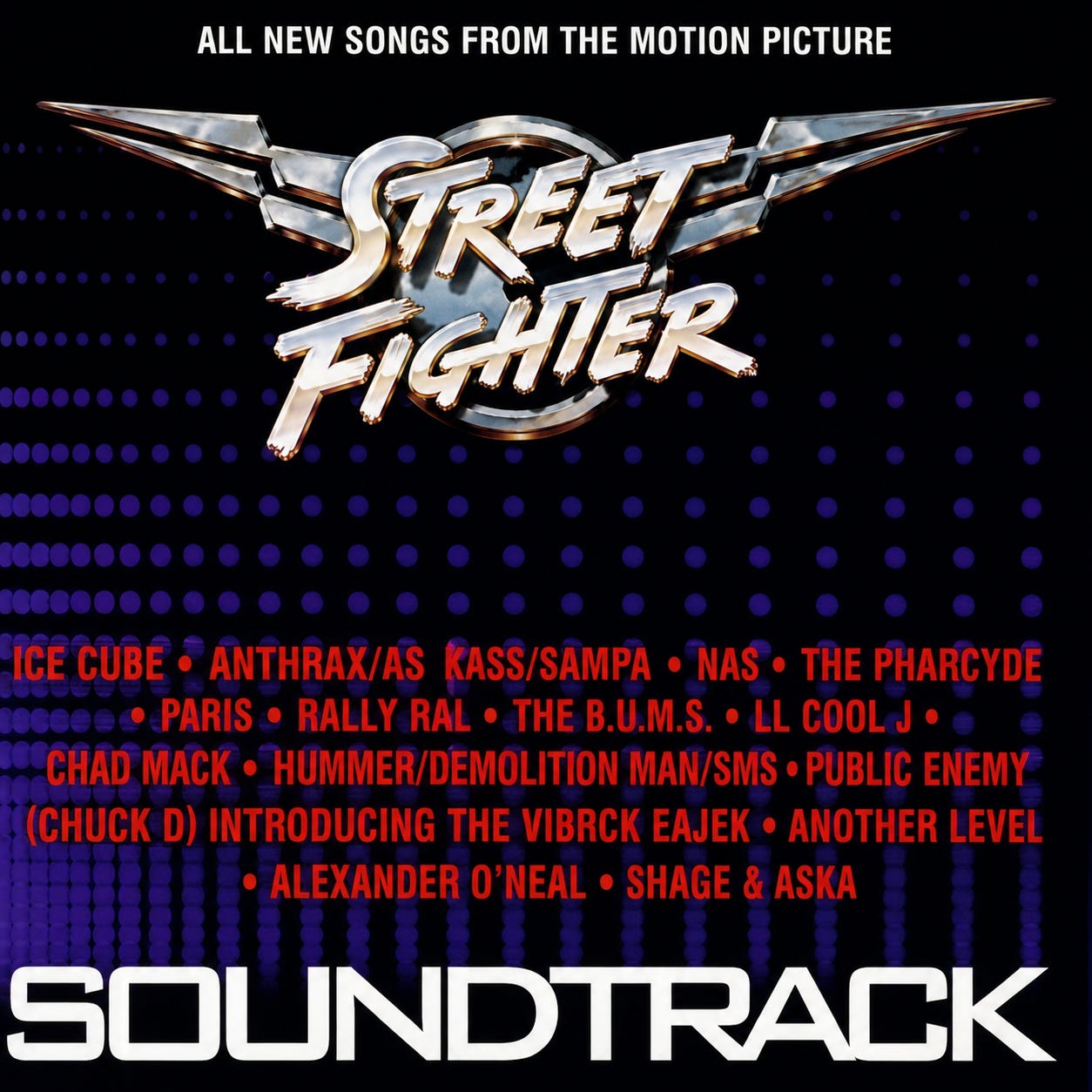
Priority Records A&R chief Andrew Shack called Capcom’s American licensing office about putting together a soundtrack album for the video-game adaptation months before anyone at Priority had seen a script or knew what the film’s plot was going to be. The pitch was for Priority to make its first serious play at the film-music business on an IP license whose brand was already internationally recognized; what the movie was actually about was incidental. The album came out December 6, 1994, two weeks ahead of the film’s theatrical release. It was the first major film soundtrack composed almost entirely of hip-hop recordings, shipped half a million copies, and operated above the commercial ceiling the actual film could reach. Ice Cube opens the album with the title cut. Ahmad, Ras Kass, and Saafir trade verses on “Come Widdit” in one of Ras Kass’s earliest major releases ahead of Soul on Ice.
Nas quietly slipped “One on One” into track three, an Illmatic-era off-cut from an artist then signed to Columbia who had never shown up on a Priority release before or since. The Pharcyde delivered “Pandemonium,” their one non-album cut between Bizarre Ride II and Labcabincalifornia. Paris turned in “Street Soldier,” written by Ice Cube and produced by Paris himself. LL Cool J handled “Life As...,” an Easy Mo Bee production from the pre-Mr. Smith interval. Craig Mack showed up days off “Flava in Ya Ear.” Hammer and Deion Sanders recorded “Straight to My Feet” together. Public Enemy introduced a Chuck D offshoot called the Wreck League on “Rumbo in da Jungo.” What Priority assembled inside the licensing shell of a Van Damme cash-in is one of the most coherent 1994-era rap compilations any studio put out; Shack was right that the game franchise was bankable enough to carry the sales, and whether anyone watched the movie was beside the point. The Nas placement is the forgotten piece. It was the one 1994 Nas track not on Illmatic or a posse cut, and the only time he crossed labels in that calendar year.
1995
Higher Learning
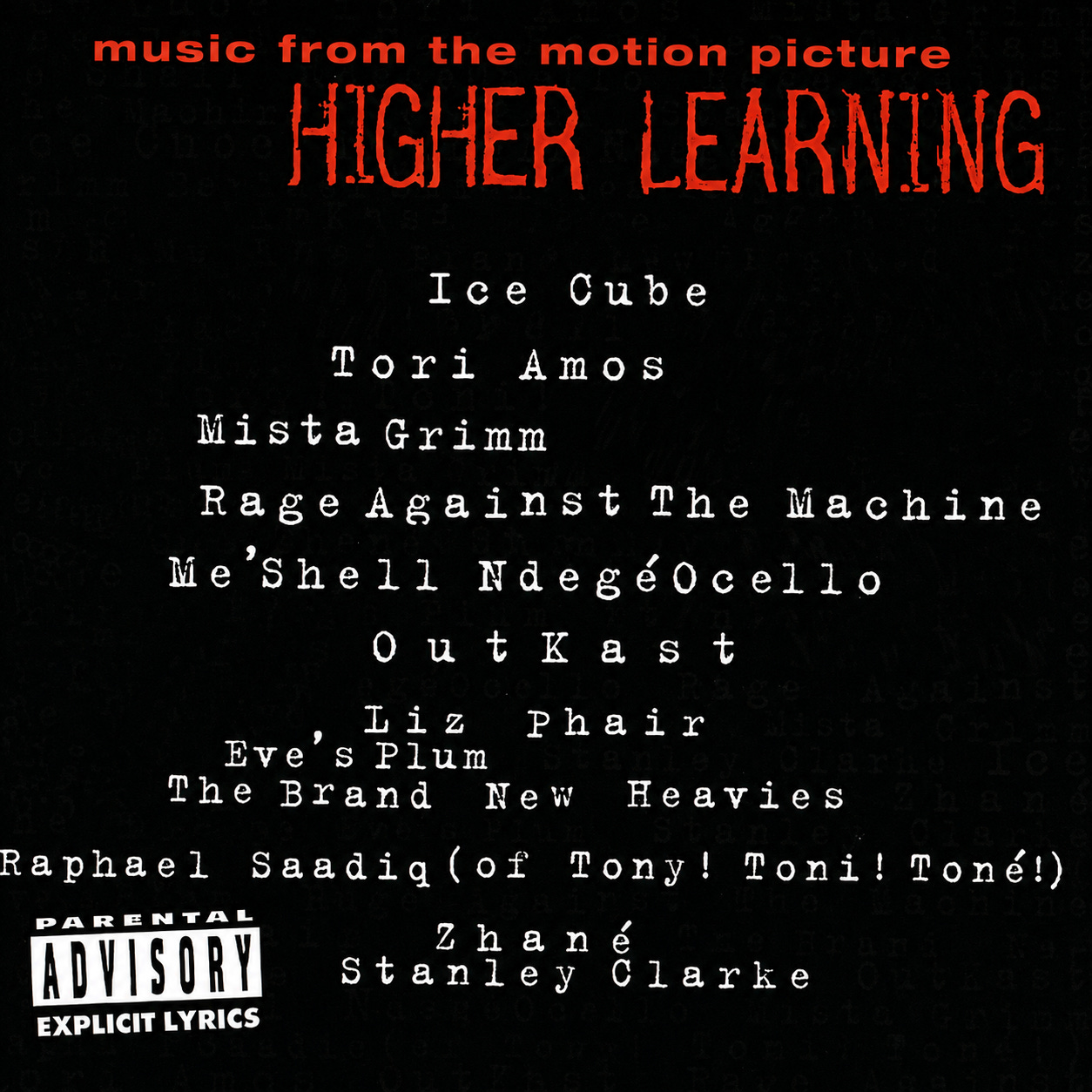
Singleton put this one out through his own imprint a week ahead of the movie, which made it the first Black-cinema soundtrack of the year and a sharper argument than the film it came attached to. Ice Cube’s “Higher” puts Columbia on trial in four and a half minutes of tight L.A. drums, and Cube’s voice is the same deadpan editorial monotone he’d been sharpening across Lethal Injection. Me’Shell NdegéOcello’s “Soul Searchin’ (I Wanna Know If It’s Mine)” stretches six minutes of low-end paranoia through a bass tone nobody else owned that year. OutKast, still inside the Southernplayalisticadillacmuzik afterburn, drop “Phobia.” Rage Against the Machine pitch in “Year of the Boomerang.” Tori Amos covers REM’s “Losing My Religion.”
Nobody expected the actual hit. Raphael Saadiq’s “Ask of You,” a solo move he produced himself during his exit from the Tonies, climbed the Hot 100 to #19 and hit #2 on the R&B chart, outselling everything else on the disc and the movie it came with. What Singleton wanted was a mess, and it’s a mess worth owning, a Friday-afternoon discman CD whose rap side and rock side refuse to shake hands.
Bad Boys
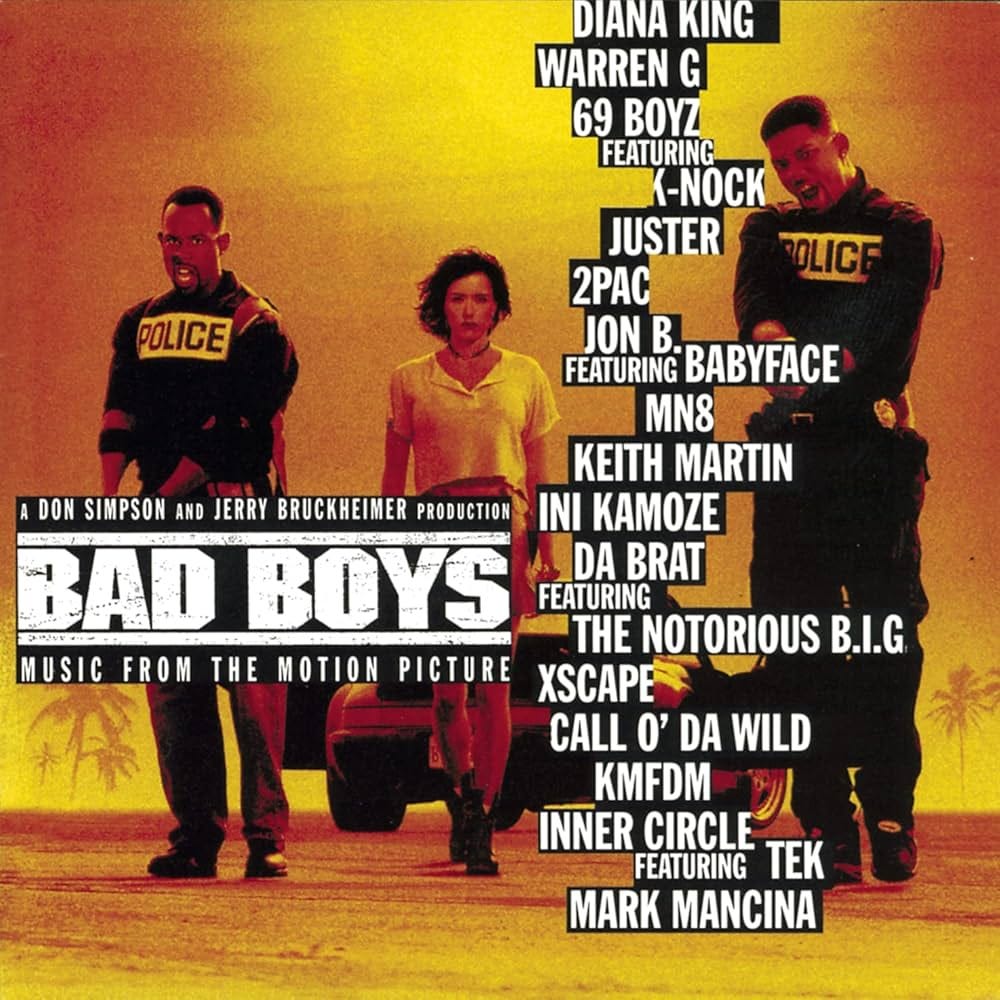
Diana King had the patois. A Kingston-bred session singer signed to The Work Group with one 12-inch to her name, she wrote “Shy Guy” with Kingsley Gardner and Andy Marvel, who built the track on a Charlie Chaplin dancehall hook and a replayed sample from Average White Band’s “School Boy Crush.” Her chorus is the call-and-response everyone remembers, “Mercy mercy mercy, what you gonna do.” That single climbed the Hot 100 into the top 20, sold Jamaican dialect to American shopping-mall radio, and had nothing to do with the Michael Bay buddy-cop picture that was paying for it.
But the rest of the disc has more going on than people remember. 2Pac’s “Me Against the World” shows up with a Burt Bacharach interpolation Pac laid down weeks before he went inside. Xscape’s “Work Me Slow” lands in peak Daryl Simmons territory, with Jermaine Dupri co-producing. Da Brat and Biggie trade verses on “Da B Side” in what amounts to a So So Def/Bad Boy handshake caught on tape. Ini Kamoze, Inner Circle, and Jon B. fill out the rest of a disc whose strongest single is sung by a woman the camera never cuts to.
New Jersey Drive, Vol. 1
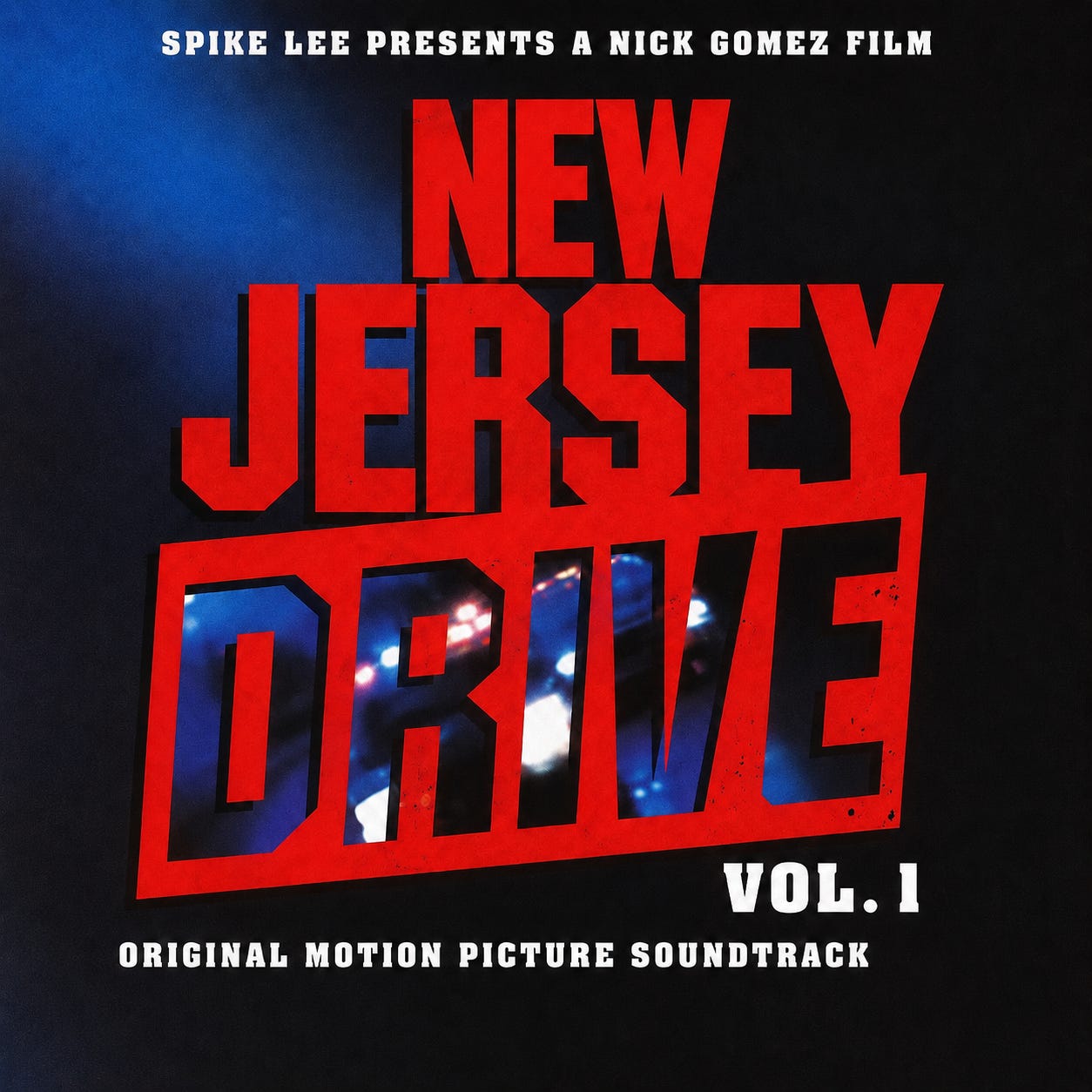
Nick Gomez’s Newark car-theft drama had Spike Lee’s 40 Acres on the executive line and Tommy Boy president Monica Lynch running the music. Gomez and Lynch shared exec credit on the soundtrack, which is how a movie financed out of Universal wound up with a rap compilation that plays like a Lench Mob mixtape. Redman rolled through “Where Am I?” into Keith Murray’s “East Left” into the Lords of the Underground’s “Burn Rubber” with MC Eiht sliding over from Compton for a verse. Queen Latifah turns in “Jersey,” the one cut on the record that actually says the state out loud, and Heavy D & the Boyz, Ill Al Skratch, and Coolio all circulate inside the margins.
The track that took the CD gold was Total’s “Can’t You See,” their debut single and Biggie’s only verse as the group’s sideman instead of their star. Puff Daddy produced it, built it around a James Brown “Payback” loop, and let Keisha Spivey carry a low, unbothered lead that would define girl-group R&B for the next three years. Total were still office assistants at Uptown when they cut it. The compilation peaked at #3 on the R&B albums chart, and Newark had its own Above the Rim.
Friday
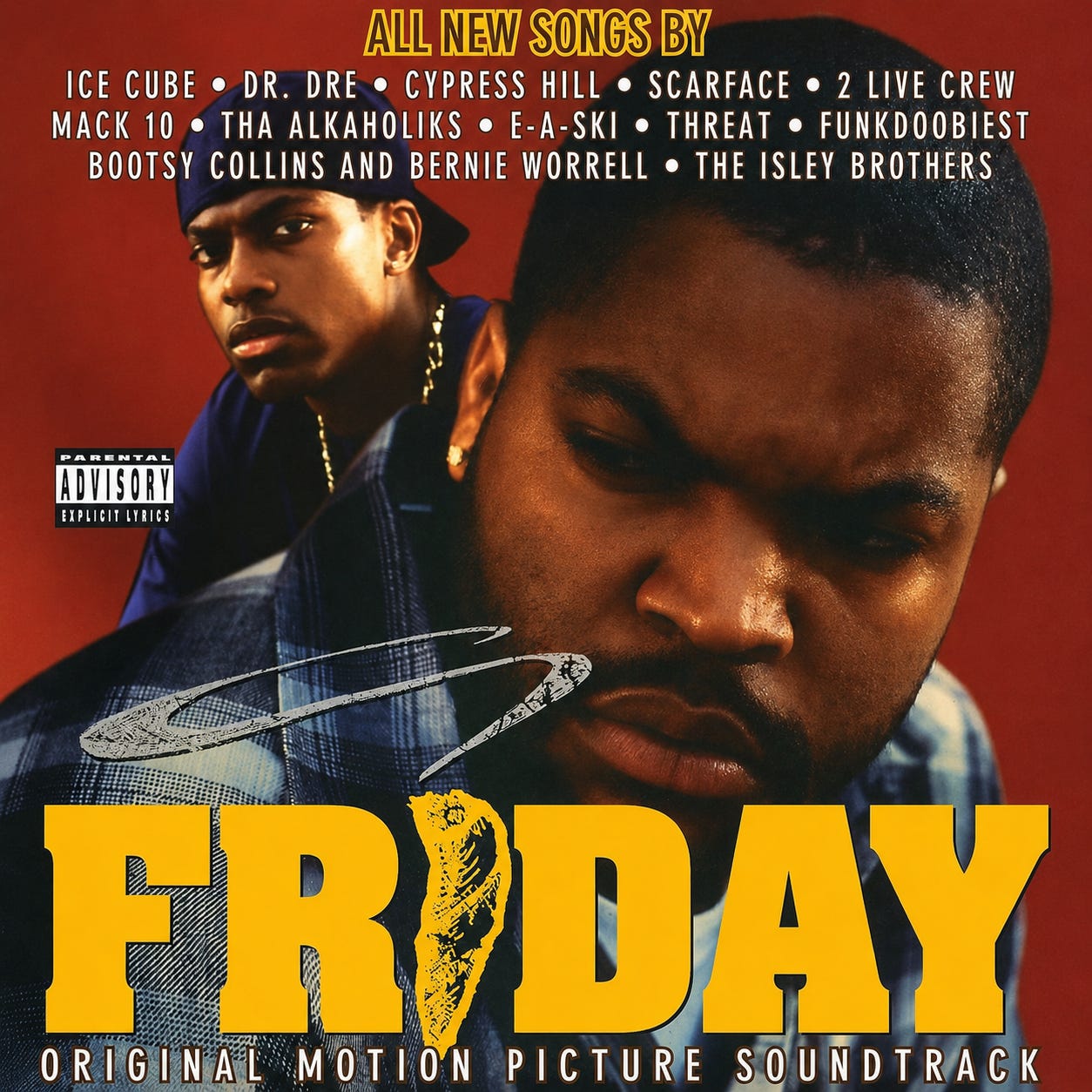
Andre Young’s quietest revolt against Death Row was “Keep Their Heads Ringin’.” He recorded it during his slow exit from the label, co-produced it with Sam Sneed, and let the masters stay with Suge Knight while Priority handled the soundtrack itself. Buried in the verses is an interpolation of “Funk You Up” by The Sequence, the first all-woman rap group ever signed to Sugar Hill, a nod Young never explained and Cash Box clocked at the time. Nanci Fletcher sings a melodic refrain behind him. The video, shot by Gary Gray inside an airplane hangar, put the cast of the movie behind Young at the mic. The single climbed to #10 on the Hot 100 and kept him on radio during a stretch where The Chronic remained his last marquee release.
Cypress Hill went public claiming Cube had asked to use “Throw Your Set in the Air,” been told no, and made a sound-alike out of spite. The feud simmered in the rap press for months, and Cube let it simmer without denying it outright. He was on a streak that year where his title tracks read as insurance against silence. South Central party music piles up around the title song, with Scarface and CJ Mac on “Friday Night,” Mack 10 announcing himself on “Take a Hit,” Tha Alkaholiks on “Coast II Coast.” Older funk holds the spine. Rick James contributes “Mary Jane,” Rose Royce returns with “I Wanna Get Next to You,” the Isleys turn up alongside Bootsy and Bernie Worrell, and Roger Troutman covers Marvin Gaye. Double platinum followed inside a year, and nobody who owned the album was surprised.
New Jersey Drive, Vol. 2
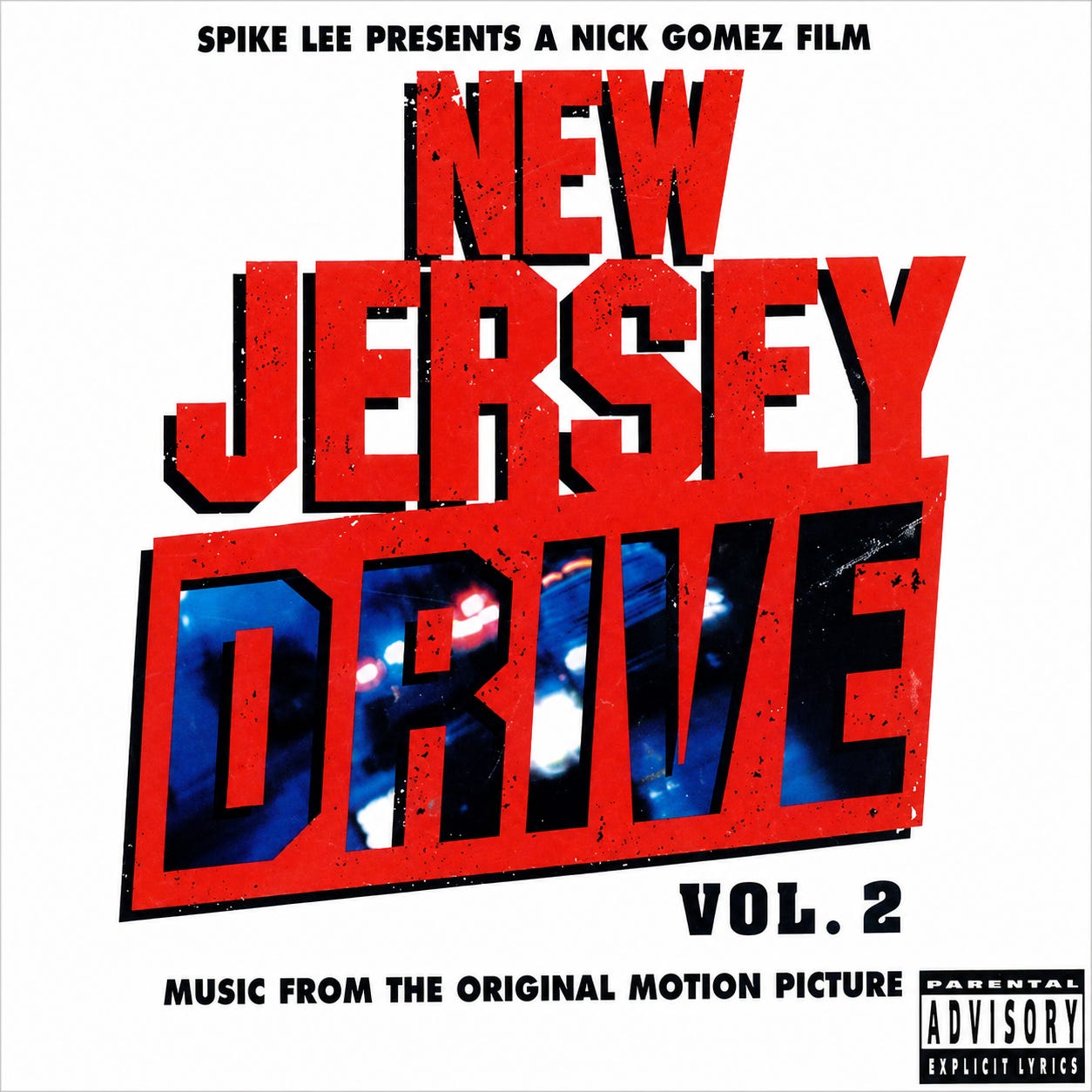
The first volume went gold and paid for the underground cousin with no obvious radio cut. This one stacks Boot Camp Clik, Jeru the Damaja, Naughty by Nature, Mad Lion, and a team-up between Organized Konfusion and OC across eight tracks. Production credits read like a mid-’90s East Coast depth roster, with DJ Premier on the Organized Konfusion collab, Da Beatminerz on Boot Camp’s “Headz Ain’t Ready,” Marley Marl on the Biz Markie cut, KRS-One on Mad Lion’s “Own Destiny.”
Boot Camp is where the sequel justifies the pressing. Black Moon, Smif-N-Wessun, and Heltah Skeltah pile onto a single track, Buckshot rides it out front, and the Beatminerz laid a beat so dusty it sounds like the tape got left in a radiator. Jeru’s “Invasion” is the Premier companion piece to “Come Clean,” all piano sting and grimy taper hiss. Naughty by Nature’s “Connections” is the Jersey hometown anthem Vol. 1 somehow didn’t bring. Peaking at #58 on the Billboard 200 meant nothing; it was built for the crate.
Panther
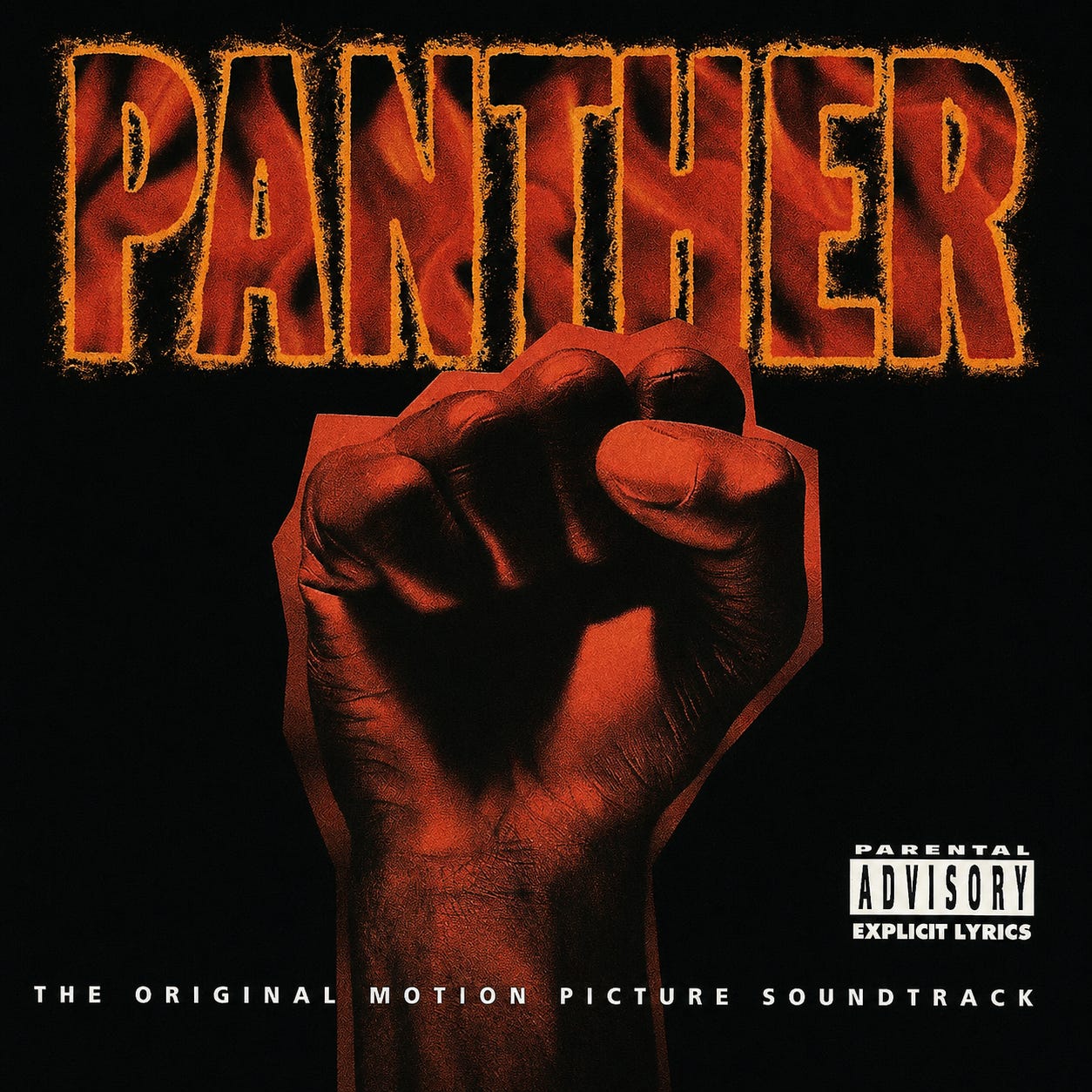
Joi Gilliam’s psychedelic-soul oddity “Freedom,” buried on her slept-on 1994 debut The Pendulum Vibe and known mostly to the Dungeon Family rotation, is the song Mercury exec Ed Eckstine reached for when he wanted to build the Panther theme around Black women’s voices. He pulled them all into one room in January 1995, the morning after the American Music Awards, with Dallas Austin and Diamond D producing. Sixty-plus singers and rappers from R&B, hip-hop, and pop crowded into the session for the cover. Austin and D kept Joi’s lyrics and shifted every “I” and “me” to “we” and “us” so the call could carry every voice in the room. Mary J. Blige, Aaliyah, SWV, En Vogue, Queen Latifah, MC Lyte, Salt-N-Pepa, Left Eye from TLC, Vanessa Williams, Me’Shell NdegéOcello, Yo-Yo, Patra, Monica, Brownstone, Zhané, Xscape, Changing Faces, on and on. The single peaked at #45 pop and #18 on the R&B chart, and it remains the biggest all-women posse cut of the decade.
Outside the all-star theme, the disc takes some unexpected detours. Monica and Usher duet on “Let’s Straighten It Out,” their first collaboration, two teenagers attempting to sing like grown people. Blackstreet reach back to “We’ll Meet Again” while Teddy Riley was still in the group. Aaron Hall delivers “Stand,” the Tonies turn up with their own “Stand!” from the Raphael Saadiq camp, and Bobby Brown contributes “Slick Partner” in his post-Don’t Be Cruel phase. The Last Poets close things out with “Don’t Give Me No Broccoli,” a spoken piece about Black food politics that has no business working on the same disc as a Bobby Brown record and somehow does.
Dangerous Minds
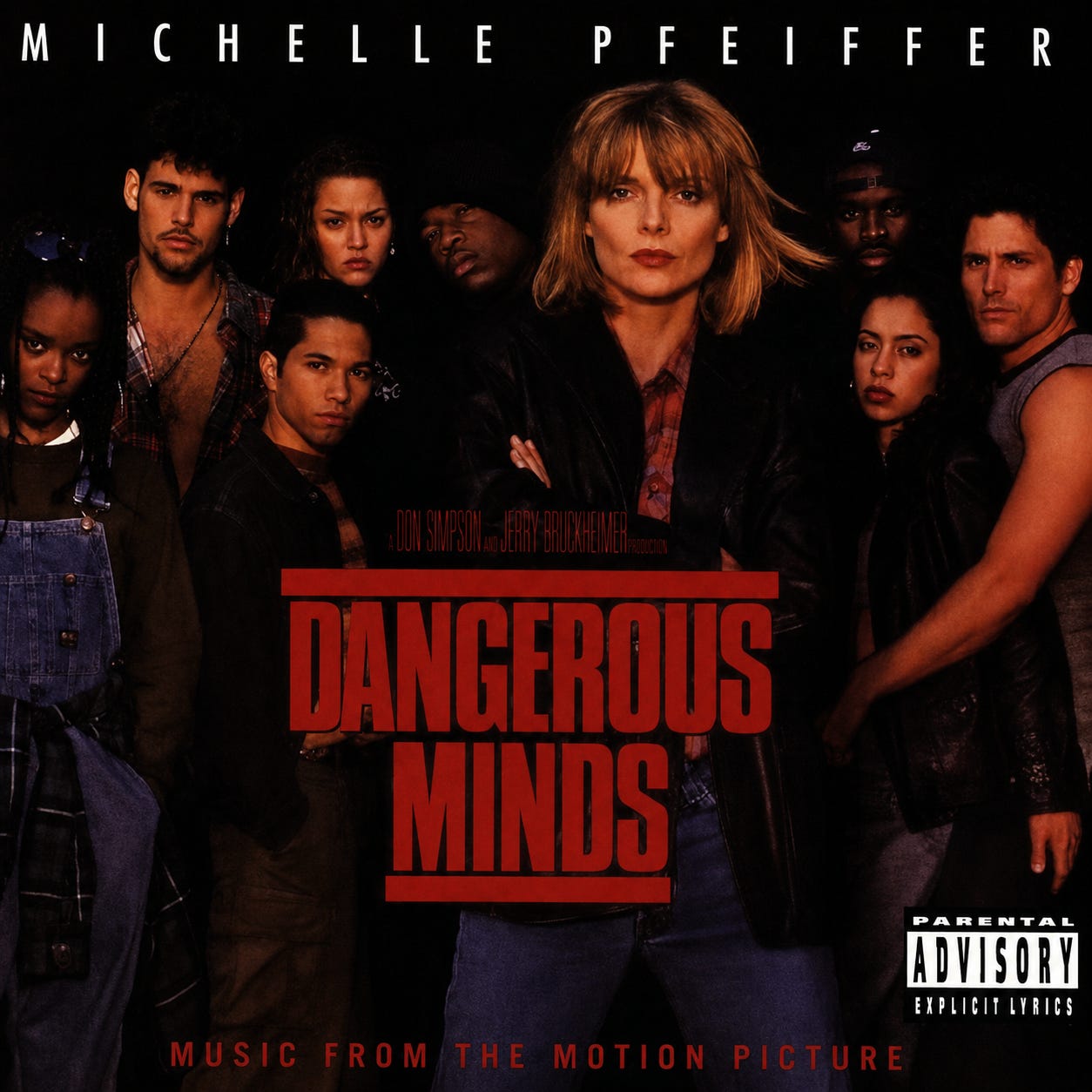
Coolio wrote “Gangsta’s Paradise” in a single sitting after he freestyled the Psalm 23 intro into a studio mic and let producer Doug Rasheed loop Stevie Wonder’s “Pastime Paradise” from Songs in the Key of Life, with the singer L.V. carrying a sung line behind Coolio’s verses. Antoine Fuqua, a decade before Training Day, directed the video with Michelle Pfeiffer reprising her LouAnne Johnson teacher role, and the single climbed to #1 in the United States and became the first rap record ever to enter at the top of the UK chart. It finished the year as America’s top-selling single.
Nine tracks deep into the album, Sista turn in the only commercial release the four-woman group would ever get out the door. Their full debut, 4 All the Sistas Around da World, was already finished and shelved indefinitely after Jodeci’s DeVante Swing buried the group at Swing Mob, leaving a pre-solo Missy Elliott and Timbaland to go quiet for a year while building toward a deal of their own. Their Dangerous Minds cut featured Craig Mack on the second verse and was the closest thing on the album to a window into the Missy/Tim sound that would explode on Supa Dupa Fly two years later.
The rest of the disc fans out into MCA’s late-Uptown depth. Aaron Hall flexes his post-Guy falsetto on “Curiosity” over a Fred Wesley loop. Big Mike turns in “Havin Thangs,” Rappin’ 4-Tay reworks the Jackson 5’s “I Want You Back” into “Message for Your Mind,” and Tre Black, 24-K, and Wendy & Lisa fill out the lower card. Triple platinum inside six months, and almost everyone under Coolio’s name on the back of the case used the check for rent.
Tales from the Hood
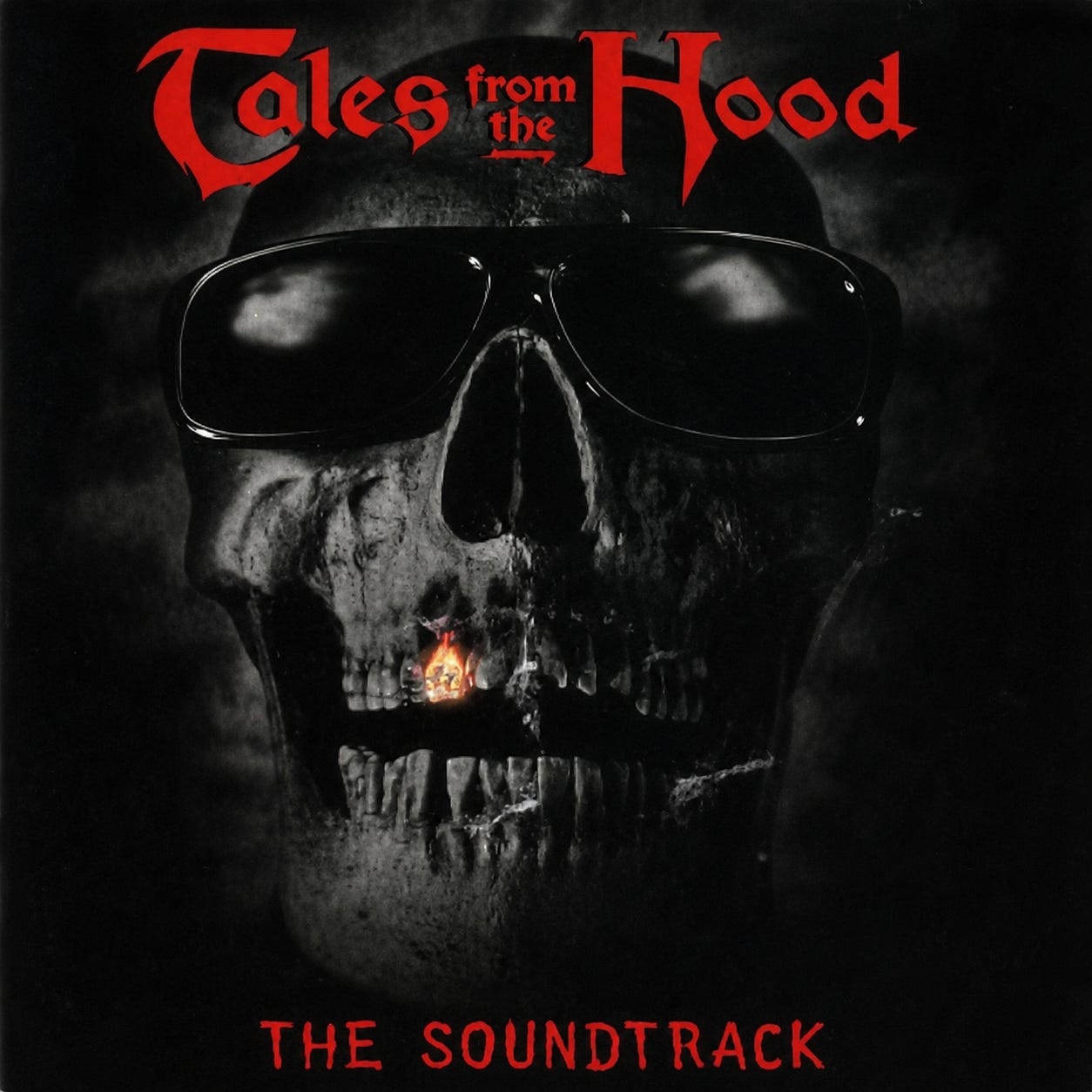
The Gravediggaz—Prince Paul and RZA on production, Frukwan on rhymes, Too Poetic recording as the Grym Reaper—cut “From the Dark Side” for this soundtrack, and it might be the cleanest piece of horrorcore the year produced. The morgue conceit on the song matches the morgue conceit on Rusty Cundieff’s anthology film. A mortician walks a trio of young hustlers through four stories of Black death in America while Spike Lee’s 40 Acres handled the executive producer credit. Ol’ Dirty Bastard’s “Ol’ Dirty’s Back,” originally slated for Return to the 36 Chambers, shows up a few tracks later doing none of the horror work and all of the ODB work.
The Bay and L.A. contingent weigh the rest down into something harder to categorize. Spice 1 growls “Born II Die” over Ant Banks’s thickest bass of the year. MC Eiht turns in “One Less Nigga,” unfiltered even by his Compton’s Most Wanted standards. The Click and Scarface’s Face Mob cover the Texas-to-Vallejo pipeline. Inspectah Deck and Kurupt split production credits with NO Joe on the same insert. The album hit #1 on the R&B chart, and it’s one of the few rap soundtracks of the year that matched the film’s body count.
New York Undercover (Season 1 Soundtrack)
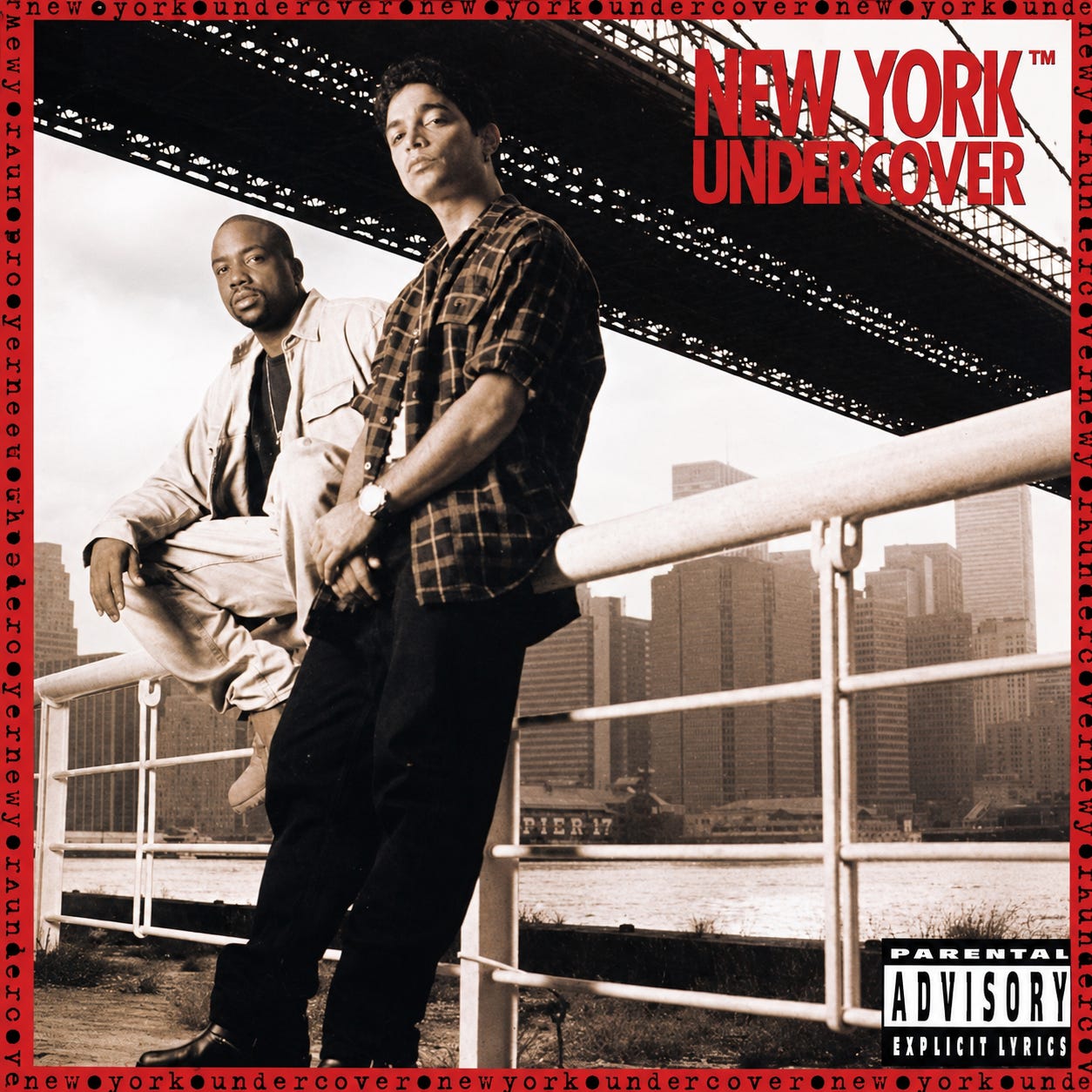
Mary J. Blige opens this album with a cover of Aretha’s “(You Make Me Feel Like) A Natural Woman,” and halfway through she’s pulled the song down into her Uptown-era grainy alto and made it hers. The cover concept came from James Mtume, who wrote the show’s theme and co-executive-produced the album with Mark Siegel, and it gave Andre Harrell a vehicle for what he did best, which was refitting older soul records for the Uptown/MCA roster. Fox was running the show as Thursday-night counter-programming against Must See TV, sitting on a block with Martin and Living Single, while Harrell himself was still running Uptown and feeding Puffy signings into Bad Boy.
Out in Queens that fall, Cheeks and Freaky Tah were running their own borough, and “Jeeps, Lex Coups, Bimaz & Benz” was the first time anyone outside Jamaica heard them. A low, half-shouted hook over a beat that sounded like it came together in a basement on Linden Boulevard. The track became Lost Boyz’s debut single, kicked off one of the year’s strongest rookie classes, and was the only song on the soundtrack with no relationship to the cover concept whatsoever. Around it, Al B. Sure! contributes “Erase the Dayz (Come Home)” in a comeback bid, and Monifah debuts with “I Miss You (Come Back Home)” two years before “Touch It.” The NAACP nominated the album for an Image Award. Harrell was engineering a career for every person on it.
The Show
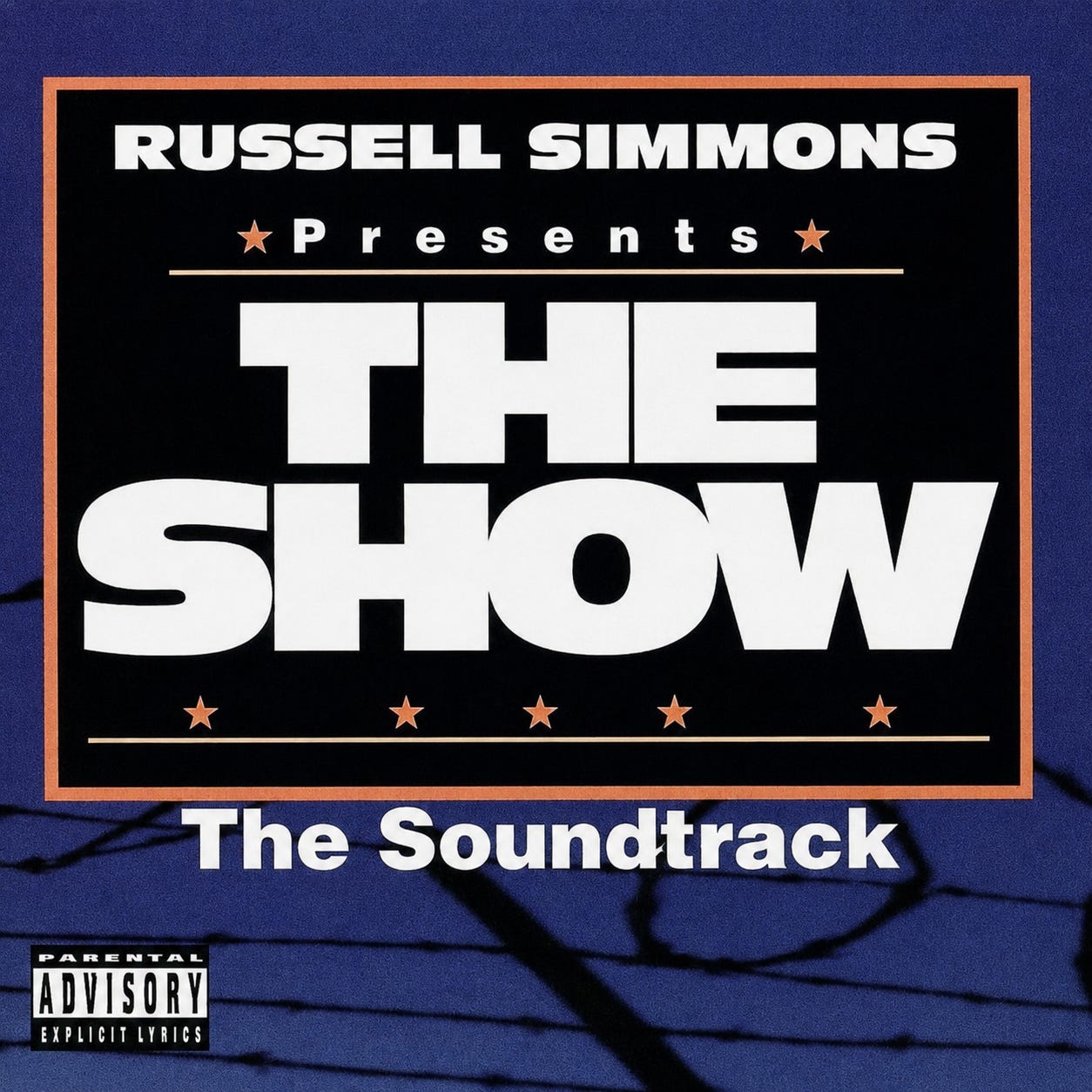
Track seven on this CD is the first Method Man and Redman duet ever recorded. Erick Sermon produced it alone. Meth had a deal through Def Jam, Red had a deal through Def Jam, and nobody on either label quite understood yet what the pair of them stoned in the same booth was going to become, which was a fifteen-year duo franchise with two Blackout! albums, their own Fox sitcom, and an entire stoner-comedy lineage that owes them royalties. “How High” runs four minutes and stays inside a knotted loop of weed talk.
Around it, Brian Robbins’s hip-hop tour documentary gave Def Jam an excuse to put out a sampler with Russell’s name on the front. The film centered Biggie, Wu-Tang, Run-D.M.C., and Slick Rick, and it’s remembered for the scene where Russell visits Slick Rick at Rikers and the one where Wu-Tang argue on a Japanese bullet train. 2Pac’s “My Block” lives on this disc in its earliest version. Slick Rick’s “Move On” was recorded while he was still inside. Onyx go full throat on “Live!!!,” and Mary J. Blige drops “Everyday It Rains” into the same tracklist. The platinum plaque arrived in October. The Meth and Red catalog started here.
Waiting to Exhale
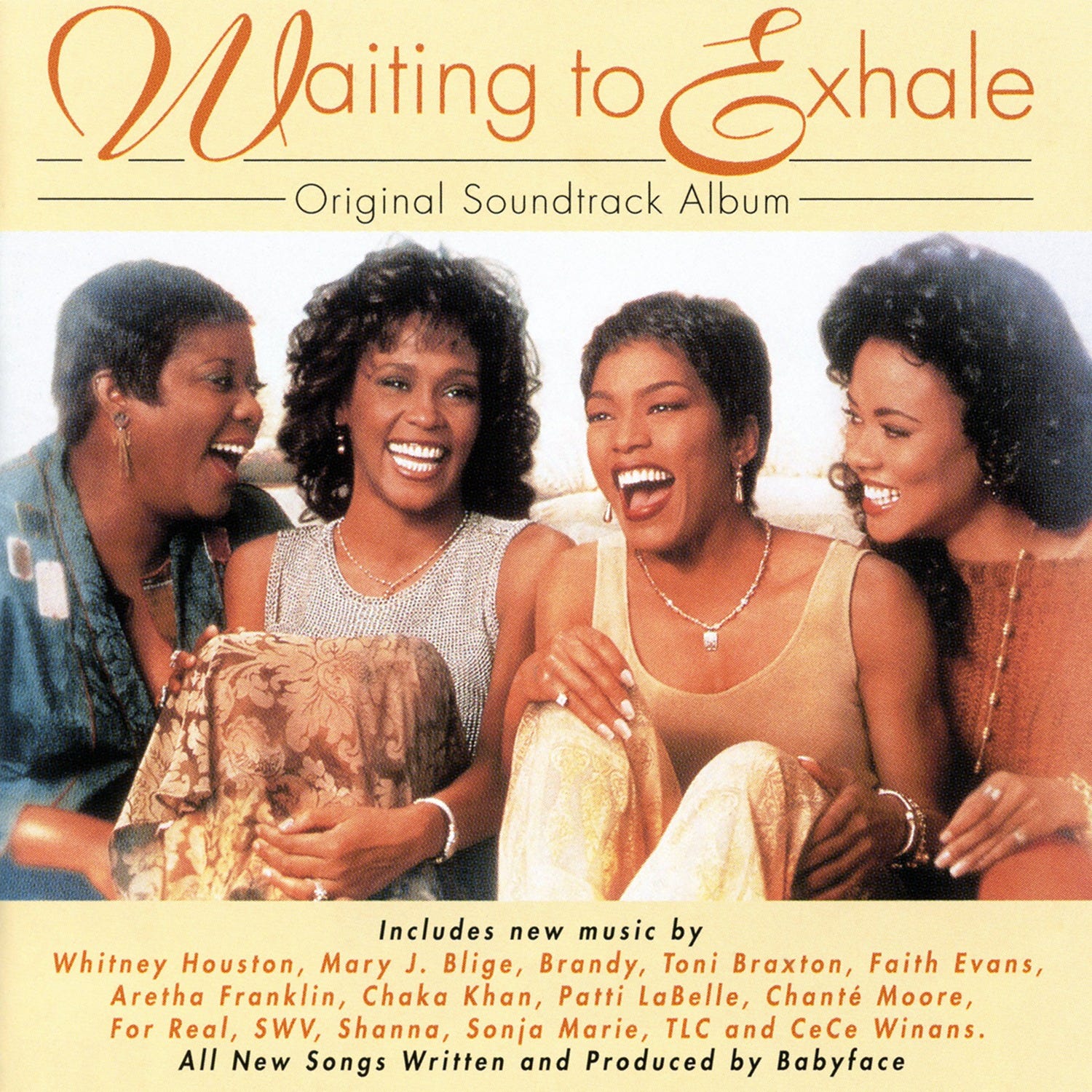
The best R&B album of 1995 is a soundtrack, and the argument basically ends there. Babyface wrote and produced all sixteen songs himself, Whitney Houston picked every singer on the record personally, Forest Whitaker was directing his first theatrical feature, and Arista handed the whole thing over to Babyface to score Terry McMillan’s novel about four Black women in Phoenix. It went seven times platinum and parked at #1 on the Billboard 200 for five weeks. “Exhale (Shoop Shoop)” held a #2 berth for eleven straight weeks behind Mariah Carey’s “One Sweet Day,” at the time the longest runner-up stretch in Hot 100 history.
But the range of what Babyface pulled off one song at a time is the real story. Mary J. Blige’s “Not Gon’ Cry” is a grown-woman grief ballad Mary was too young to have lived, and she sings it anyway with the low-throat gravity that became her default on slow numbers for a decade. Brandy’s “Sittin’ Up in My Room” is a sixteen-year-old writing a schoolgirl letter into a track that peaked at #2 on the Hot 100. Aretha Franklin’s bruise-blues entry lands in the sob-gospel mode she usually saved for Sunday mornings. Patti LaBelle, Chaka Khan, Toni Braxton on “Let It Flow” (which became half of her first #1 when it shipped as a double A-side the following year), TLC on a Lisa Lopes co-write, Faith Evans, SWV, CeCe Winans joining Whitney on “Count on Me.” Twenty-two women contributing, and Babyface holding the writer’s pen on every single track.
Clockers
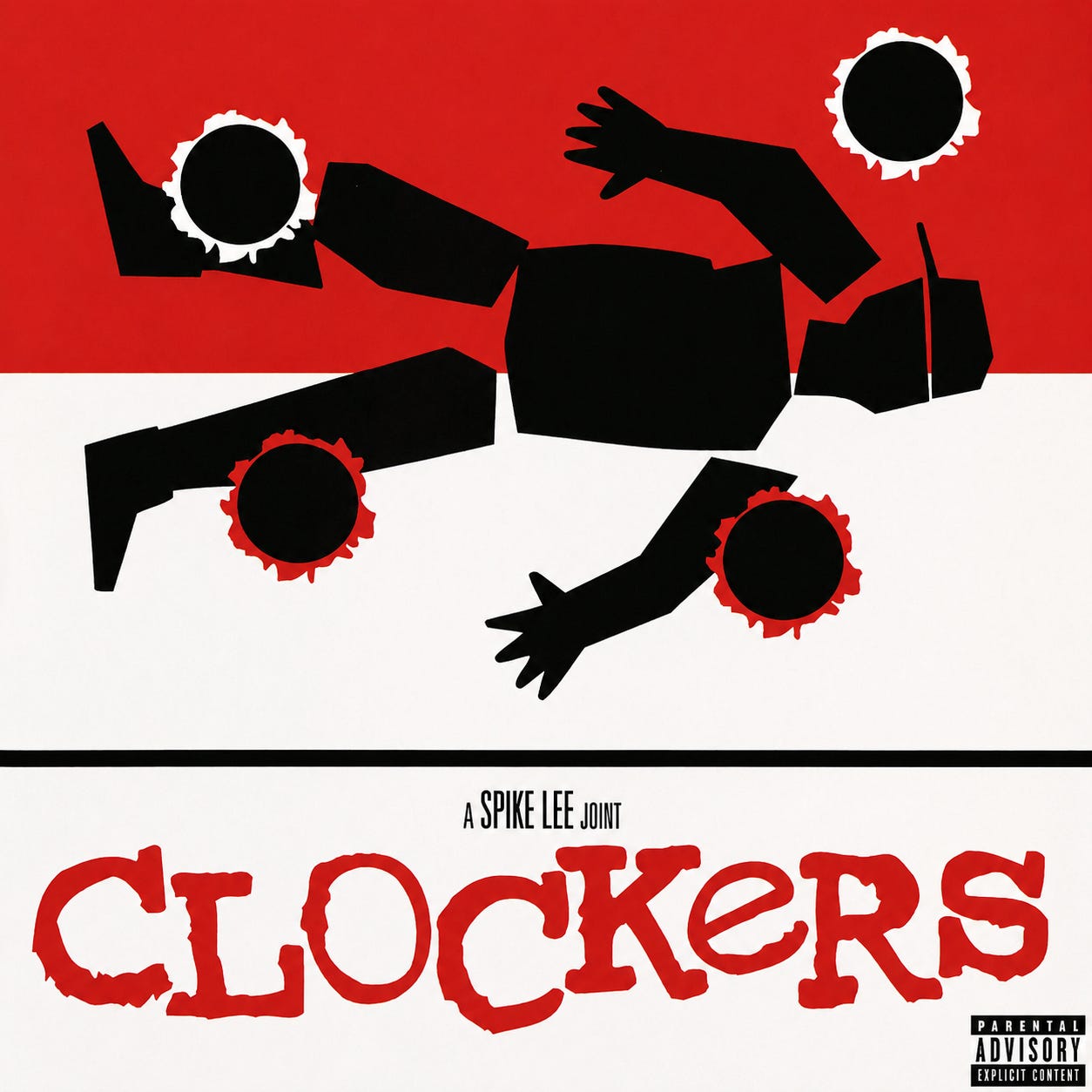
Martin Scorsese was supposed to direct this one. He dropped it for Casino, leaving Richard Price’s novel in the hands of Spike Lee, who rewrote the screenplay himself and came back to Brooklyn carrying 40 Acres and Bill Stephney on executive production for the soundtrack. Stephney was a Public Enemy co-founder and a Def Jam veteran by 1995, and what he built around Lee’s movie played as a Brooklyn record through and through, with the loudest cut on it earned by DJ Premier. “Return of the Crooklyn Dodgers” is the Premier beat backing the second Crooklyn Dodgers lineup, pairing Chubb Rock with O.C. and Jeru the Damaja while Omar Credle carries the anchor, and Jeru’s turn on it remains the one his longtime listeners pull out when they want to argue his floor is higher than anyone’s.
Around Premier’s record, the soundtrack widens into what Brooklyn music could absorb. Chaka Khan and Bruce Hornsby co-wrote “Love Me Still,” a slow piano ballad Hornsby played on himself and one of the two charting singles from the set. Seal recorded “Bird of Freedom” with Trevor Horn behind the boards, Des’ree’s “Silent Hero” arrived in post-I Ain’t Movin’ mode, and Branford Marsalis’s jazz-rap hybrid Buckshot LeFonque contributed “Reality Check” on a Marsalis and Ricky DaCosta co-write. Marc Dorsey opens the record with “People In Search of a Life,” the Raymond Jones ballad that plays over the film’s autopsy sequence in the cold open, and closes it with “Changes.” Mega Banton supplied the dancehall side, Rebelz of Authority and Strictly Difficult handled the harder Brooklyn street-rap cuts, and BrooklyNytes filled out the local-rookie slot. The album peaked at #54 on the R&B chart, which is nothing. But the Crooklyn Dodgers record is the reason the album still turns up on ‘95 crate lists at all.
1996
Don’t Be a Menace to South Central While Drinking Your Juice in the Hood
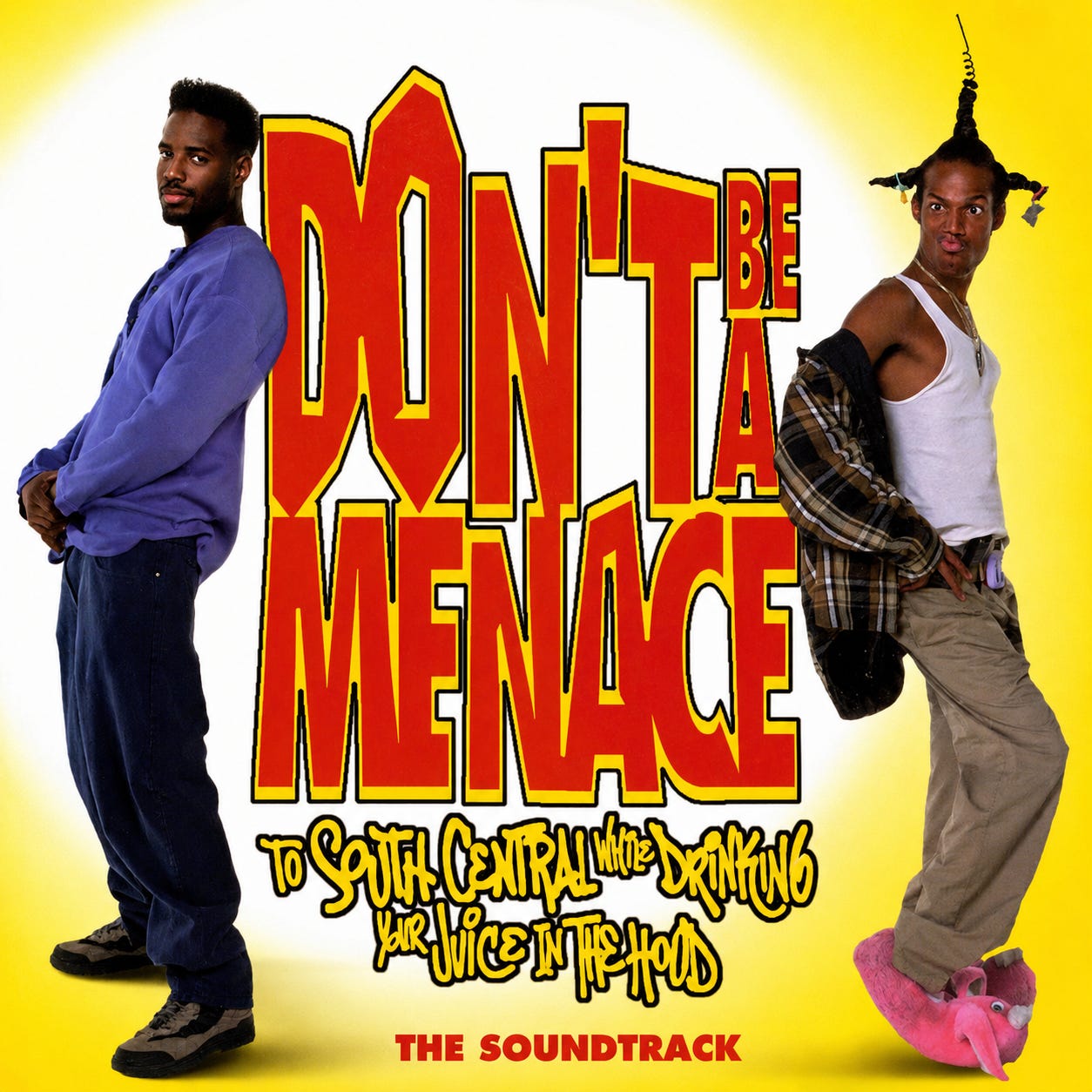
Cappadonna’s verse on “Winter Warz” is two minutes of knotty, barbed internal rhyme. He was not yet an official member of Wu-Tang Clan the day Island put this Ghostface-helmed posse cut at the top of the Wayans parody soundtrack, and the verse plays as a formal audition for the group he’d join a year later. Raekwon, Masta Killa, and U-God take brief turns around him, but Cappa swallows the song whole. Lost Boyz’ “Renee” tells the story of Mr. Cheeks falling for a woman he met on the train from John Jay College, their romance cut short when she’s killed in a robbery, the narrative delivered with the level tone of someone who’d already done his crying in private. Joe puts “All the Things (Your Man Won’t Do)” into circulation here before his own LP picked it up. Mona Lisa and Lost Boyz stretch out on “Can’t Be Wasting My Time,” Tim Dawg and Mr. Sex producing them over a KRS-One sample. Nothing about the music betrays the comedy it’s attached to.
A Thin Line Between Love and Hate
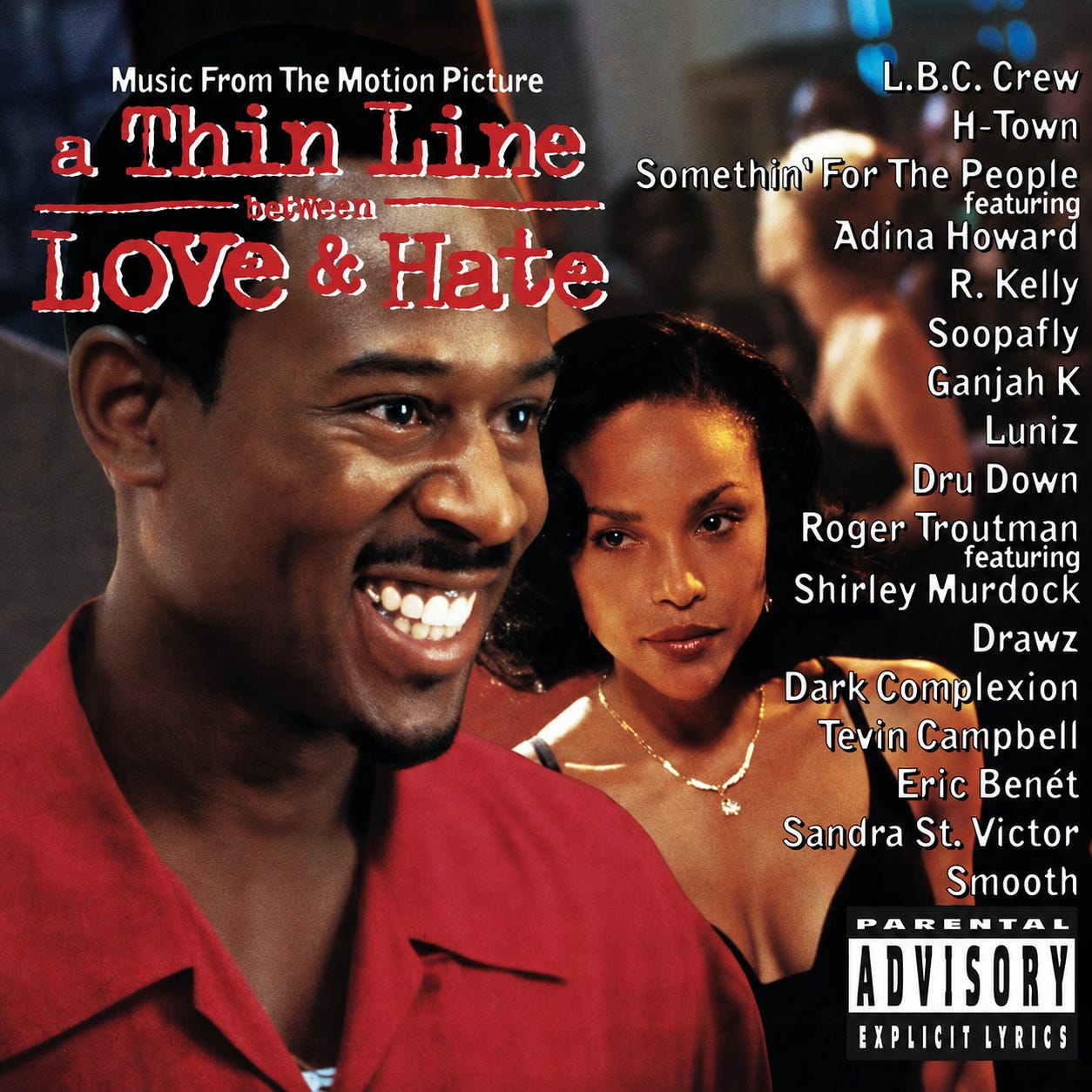
The Persuaders cut “Thin Line Between Love and Hate” in 1971, Douglas Scott telling the story of what can go wrong after too many slights accumulate in a marriage. H-Town’s remake, featuring Shirley Murdock and Roger Troutman, doubles every dramatic stake in the original without altering the chord progression underneath. Murdock measures her phrasing with the same deliberation she brought to “As We Lay” a decade earlier, and Troutman’s talkbox weaves through the verses as an extra vocalist, holding the arrangement open for her. That recording anchors an album whose other business hews to Warner’s 1996 R&B and West Coast bench. LBC Crew moves through “Beware of My Crew” at DJ Battlecat’s walking-pace Long Beach bounce. Eric Benét covers Al Green’s “Let’s Stay Together” on a soundtrack attached to a film about obsessive jealousy, a juxtaposition the album never acknowledges. Tevin Campbell handles Stevie Wonder’s “Knocks Me Off My Feet” with the caution of someone covering scripture. Martin Lawrence’s directorial career didn’t outlast this year gracefully; the compilation fared better.
Sunset Park
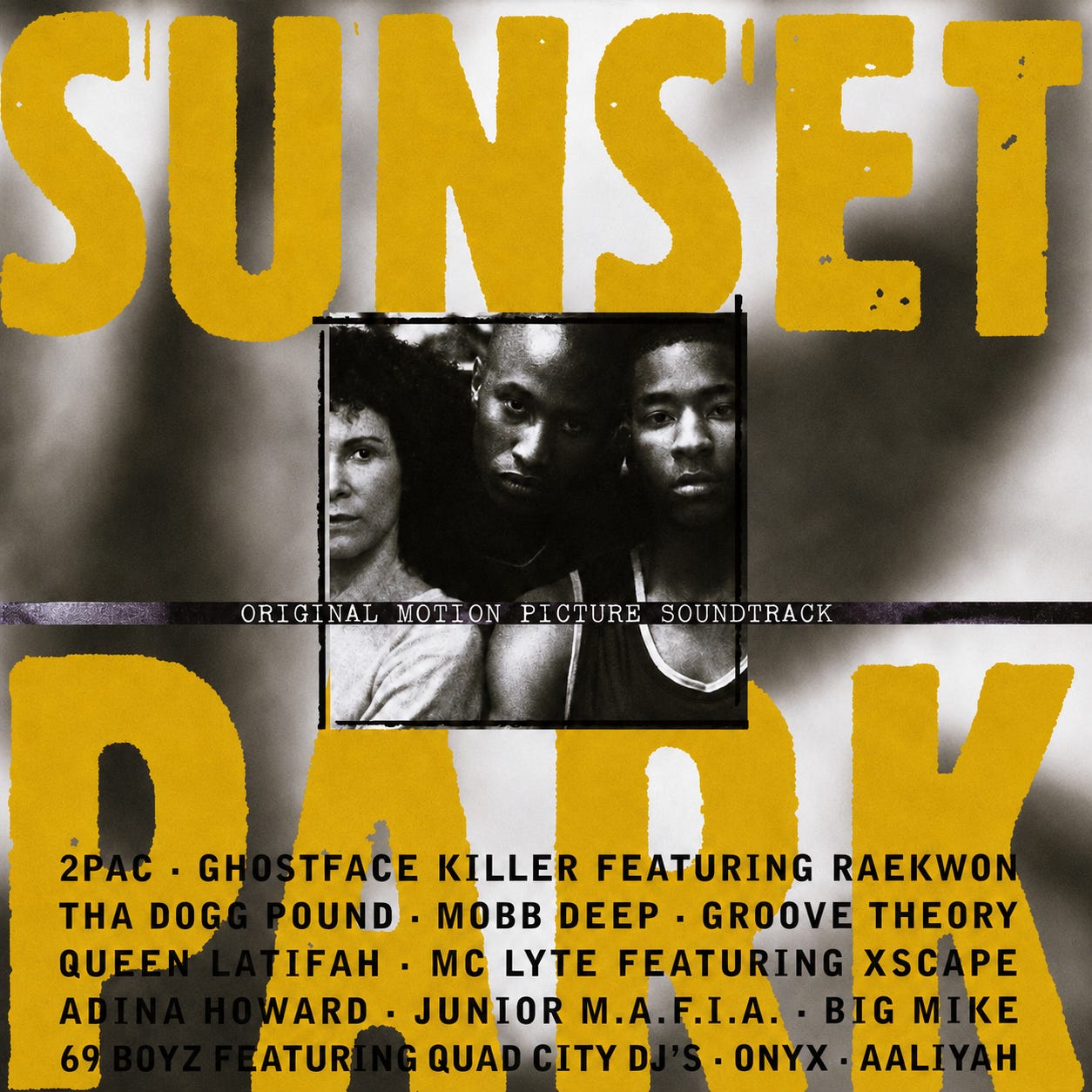
2Pac opens “High ‘Til I Die” with his Digital Underground-era weed philosophy and runs through three verses about never quitting the habit, recorded during his brief breathing spell between incarcerations. It anchors an EastWest comp Queen Latifah and KayGee Gist executive produced, and the set went platinum despite the basketball movie attached to it going nowhere. Havoc’s beat on Mobb Deep’s “Back at You” became the template every menacing New York snarl record chased for the next five years, Prodigy rapping through cigarette smoke about sons of the gun. Ghostface and Raekwon hand off “Motherless Child” in their unchanged Cuban Linx mode. Aaliyah asks the question on “Are You Ready” four different ways over a Bryce Wilson arrangement that barely touches her. Groove Theory bridges R&B radio and the rap around it on “It’s Alright.” Adina Howard darkens her Baby Face era on “For the Funk.” Tha Dogg Pound bring Nate Dogg back in on “Just Doggin’.” Put it on now and everything still holds.
The Substitute
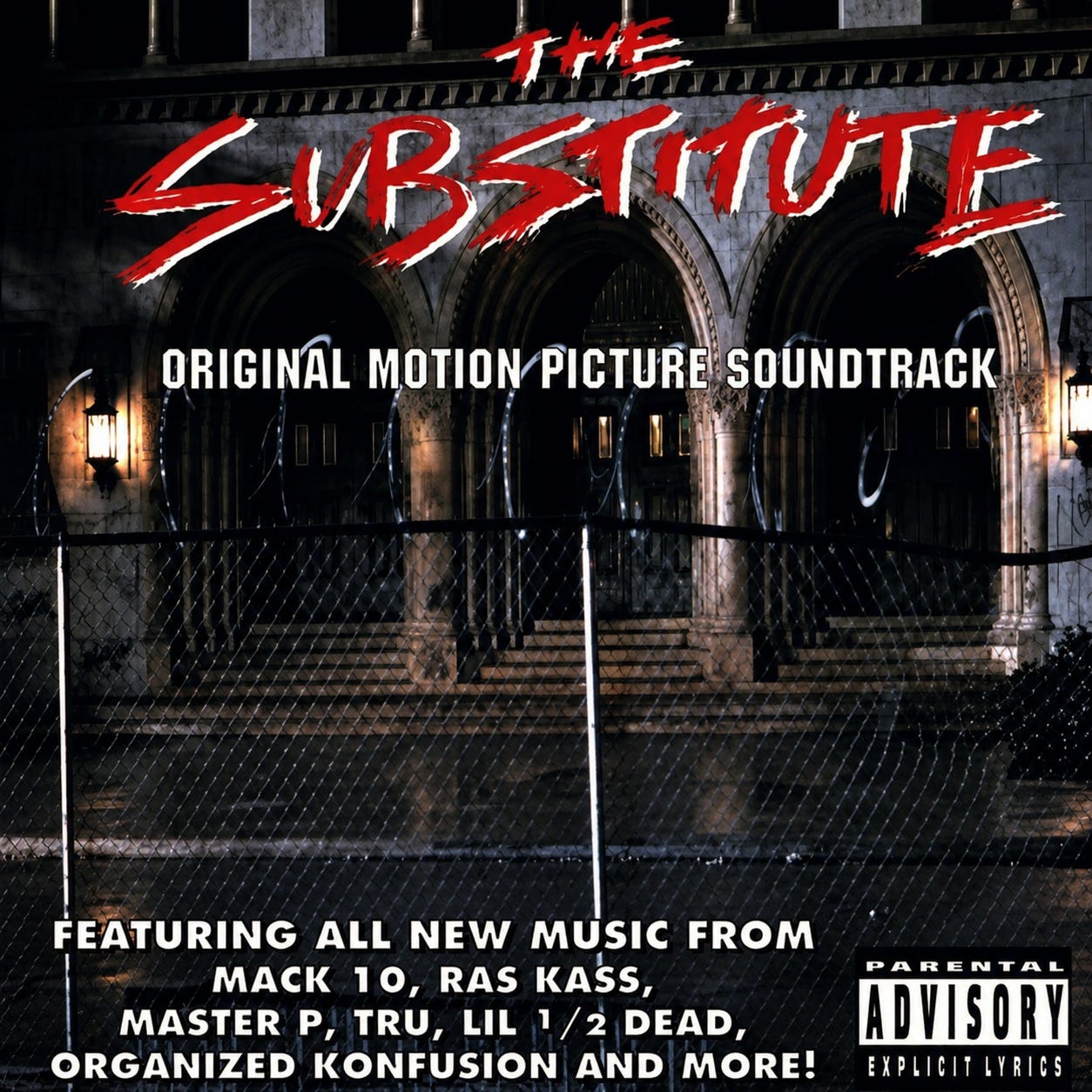
Ice Cube’s Lench Mob production team built the keyboard figure behind Mack 10’s “Hoo-Bangin’” out of the identical parts that ran through half of Priority’s West Coast output across 1996. The track carried the whole compilation to radio on its back. Tom Berenger’s Vietnam-vet-as-undercover-teacher thriller was the excuse, but the reason to own this CD in 1996 was Mack 10 doing his full Inglewood Hoover shtick over Cube’s production. Ras Kass raps “Miami Life” across a beat from Bird, his Cali lyrical-exercise style parked in the film’s actual setting. Organized Konfusion turn up with Pharoahe Monch and Prince Po right before Stress: The Extinction Agenda reframed what they were capable of. Master P slots in with Intense and Road Dawgs in his No Limit-affiliated mid-period, still a year before Ghetto D made the world pay attention. The strangest inclusion is “Genie in the Bottle” from Afro-Rican, a group unrecognizable from the Miami bass act they’d been earlier in the decade. For a compilation barely anyone tracked down, the Priority bench work alone justifies owning it.
The Great White Hype
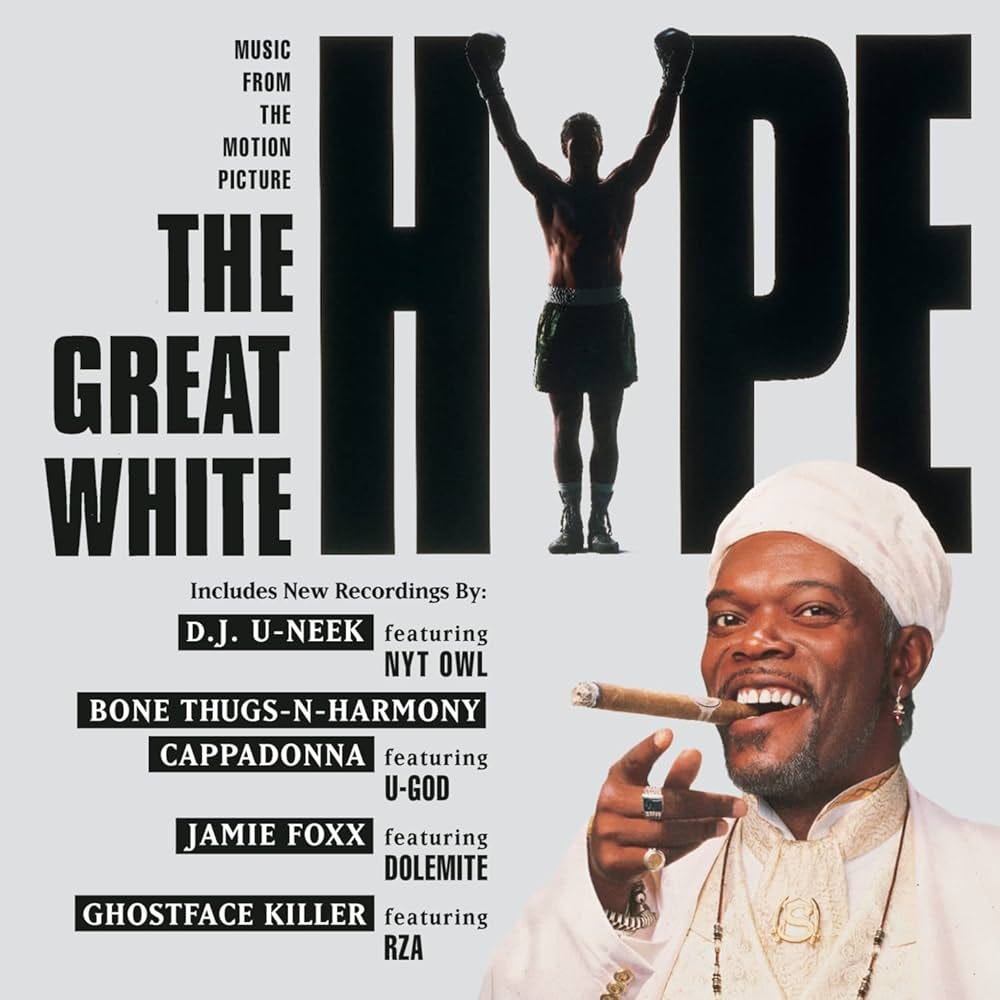
Ski Beatz looped Janet Jackson’s “Funny How Time Flies” for Camp Lo’s “Coolie High” and let Geechi Suede and Sonny Cheeba carry the rest of the way. The duo had been deep in Uptown Saturday Night sessions, but Reginald Hudlin’s boxing satire compilation got the single first. Geechi raps in the nimble, wry high-low delivery that would become the duo’s signature. Listeners first hearing them here typically went home and waited for the full-length. Rappin’ 4-Tay brings “Ain’t No Future in Yo Frontin’” into rotation. The Whoridas’ “Shot Callin’ & Big Ballin’” gave the Bay Area slang its first real national distribution channel. Queen Latifah handles a swing-era vocal on “I Can’t Understand,” a curiosity from the year she was also on Flavor Unit duty across town. Most of what else appears here is forgettable post-Friday West Coast filler. Anyone who came up listening to Camp Lo probably owes their first encounter to this record.
Original Gangstas
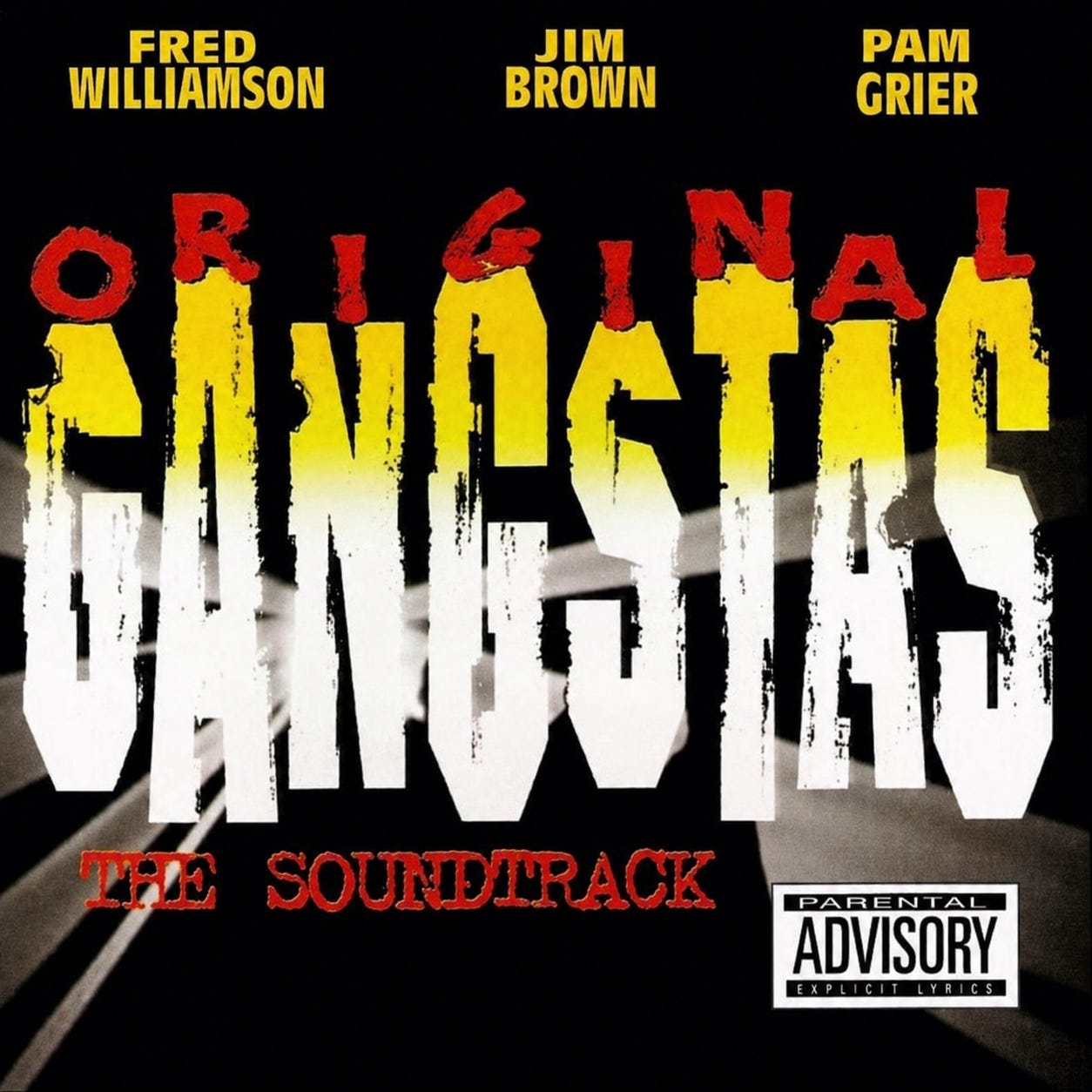
Larry Cohen reassembled Pam Grier, Fred Williamson, Jim Brown, Ron O’Neal, and Richard Roundtree for a blaxploitation reunion set in Gary, Indiana. Virgin’s Noo Trybe imprint used the occasion to turn the compilation into a covers exercise. Mobb Deep and The Almighty RSO reengineered War’s 1972 “The World Is a Ghetto” into an East Coast crime-scene procedural, Prodigy sounding especially like he meant every line. Facemob, the Houston Rap-A-Lot collective featuring Scarface and Devin the Dude, took on Marvin Gaye’s 1971 “Inner City Blues,” slowing the original down and letting Scarface testify through it. Both groups refused to mimic their source material, reaching instead toward what a 1996 rapper could say about a song written when those neighborhoods had been different but also exactly the same. Mack 10 shows up again, as he does on half the rap compilations this year. Erick Sermon contributes “Do Your Thing.” Rappin’ 4-Tay and Spice 1 handle the close. The covers exercise alone justifies pulling it up.
Eddie
Dru Hill’s first single ever was “Tell Me,” which Stanley Brown and his co-writers built for the group and which Island Records placed on the soundtrack to a Whoopi Goldberg movie about coaching the New York Knicks. Sisqó holds the lead on that ballad like he’s daring the other three in the group to match him, still a year before the quartet would release their debut album, still two years before Enter the Dru. Coolio’s “It’s All the Way Live (Now)” gave the compilation its other charting single in a nostalgic reworking of his Gangsta’s Paradise flow. Jodeci find second life for “Freek’n You” in a Mr. Dalvin remix. House of Pain turn in “Jump Around” for its obligatory mid-decade compilation appearance. Ill Al Scratch and Luke fill the bench work Island needed for volume. Eddie the movie is a footnote. The soundtrack put Dru Hill on radio for the first time.
The Nutty Professor
JAŸ-Z’s “Ain’t No Nigga” with Foxy Brown had been out for months before it landed on Eddie Murphy’s Sherman Klump remake compilation, a Jaz-O production sampling The Whole Darn Family’s “Seven Minutes of Funk” that gave Foxy her first national look at seventeen, trading filthy couplets with a rapper most critics hadn’t yet taken seriously. Def Jam’s whole approach to the album amounted to repackaging radio heat the label already owned. Case and Foxy handle “Touch Me, Tease Me” with Mary J. Blige uncredited behind them, the Schoolly D “P.S.K.” sample underneath turning the song into the car-stereo record of the summer. Monica and Treach ride a Dallas Austin production on “Ain’t Nobody,” for another banger, Treach matching her energy bar for bar. Montell Jordan’s “I Like” brings Slick Rick out for a verse, Rick recording his first major feature after nearly six years behind bars on attempted murder charges, fables back in circulation. 2x platinum on radio catalog and a Murphy fat suit.
Kazaam
Alecia Moore was a teenager in Doylestown, Pennsylvania when she joined an R&B trio called Choice, and the first time her voice reached a commercial release was on a Shaquille O’Neal movie about a rapping genie. “Key to My Heart,” the Choice recording that contains Moore’s first professional vocal before anyone had ever called her P!nk, sits buried deep in the Kazaam compilation, one of the wildest what-became-of entries in any soundtrack of this era. Around her, everything you’d expect from a Shaq vehicle unfolds. Usher’s “I Swear I’m in Love” predates his My Way breakthrough by a year. Subway’s “I’ll Make Your Dreams Come True” went to #64 R&B. Nathan Morris from Boyz II Men solos on “Wishes” for roughly identical chart treatment. Shaq himself contributes a stack of his own material, rapping as a genie across whole stretches of the album, while Backstreet Boys and Spinderella occupy the strangest roster real estate. In retrospect, the LP reads as a casting call of 1996 pop futures nobody at Perspective/A&M saw coming, and the P!nk curio alone justifies the archive search.
Fled
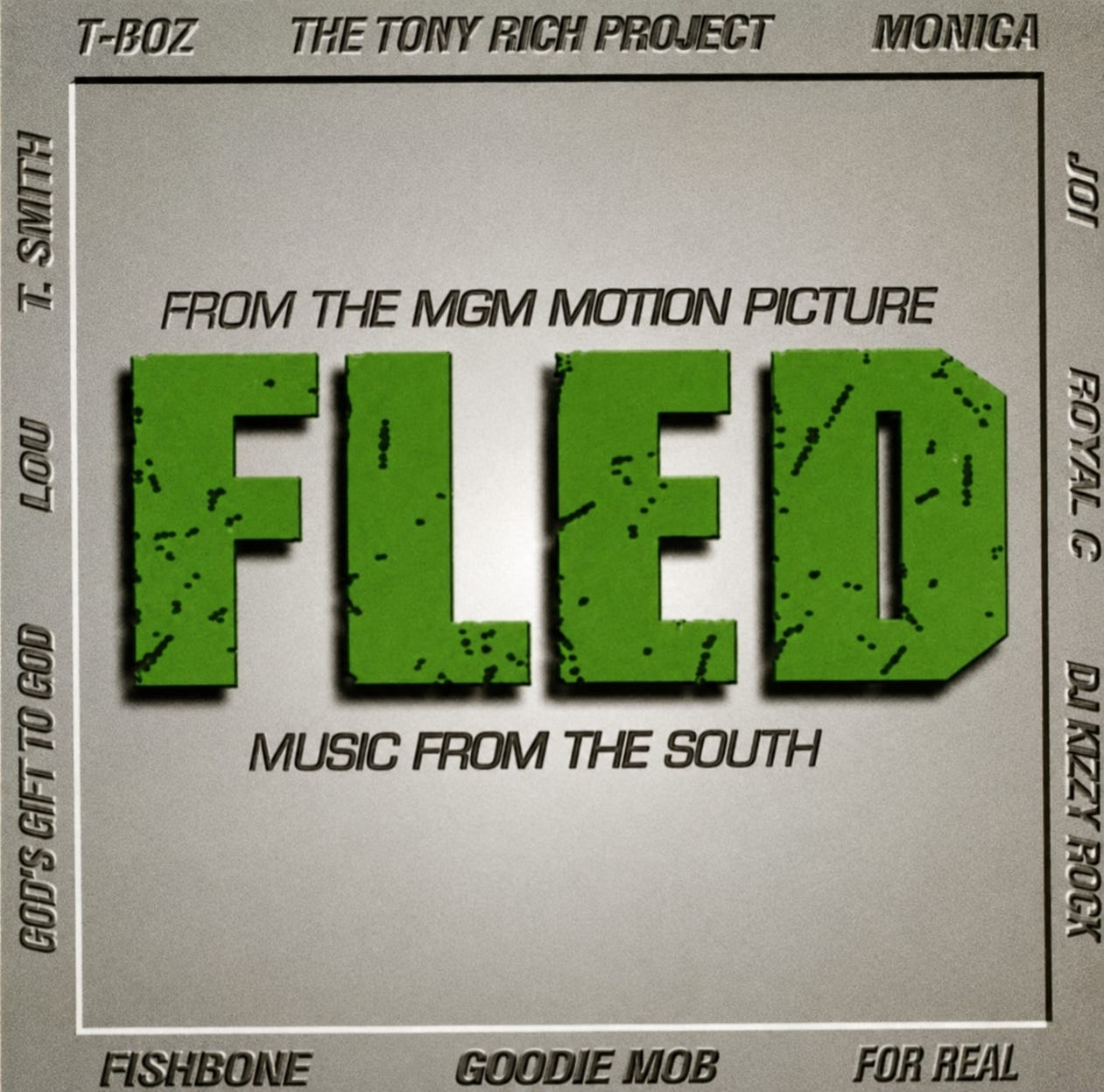
MGM gave Dallas Austin the compilation for Laurence Fishburne and Stephen Baldwin’s chained-together-convicts action picture on the strength of his recent Monica and Da Brat breakthroughs at Rowdy Records. Austin turned the LP into a roster drop with T-Boz’s first solo cut at the center of it. Her “Touch Myself” is the high point here, a smoky, grainy hook Austin and his team wrote for T-Boz in her fullest Toni Braxton-era contralto, the TLC frontwoman alone and comfortable with it for four minutes. Changing Faces contribute “I Got Somebody Else” in their R. Kelly-penned ballad mode, Cassandra Lucas and Charisse Rose harmonizing through another Kells lyric about being the other woman. For Real place “The Saddest Song I Ever Heard” into circulation. Subway turn up again, as they did on roughly every Island-adjacent compilation this year. Austin’s Atlanta roster takes up most of the back end. For a movie nobody saw, the album delivered exactly what Austin took the gig to do. The afterlife belongs to T-Boz.
Phat Beach
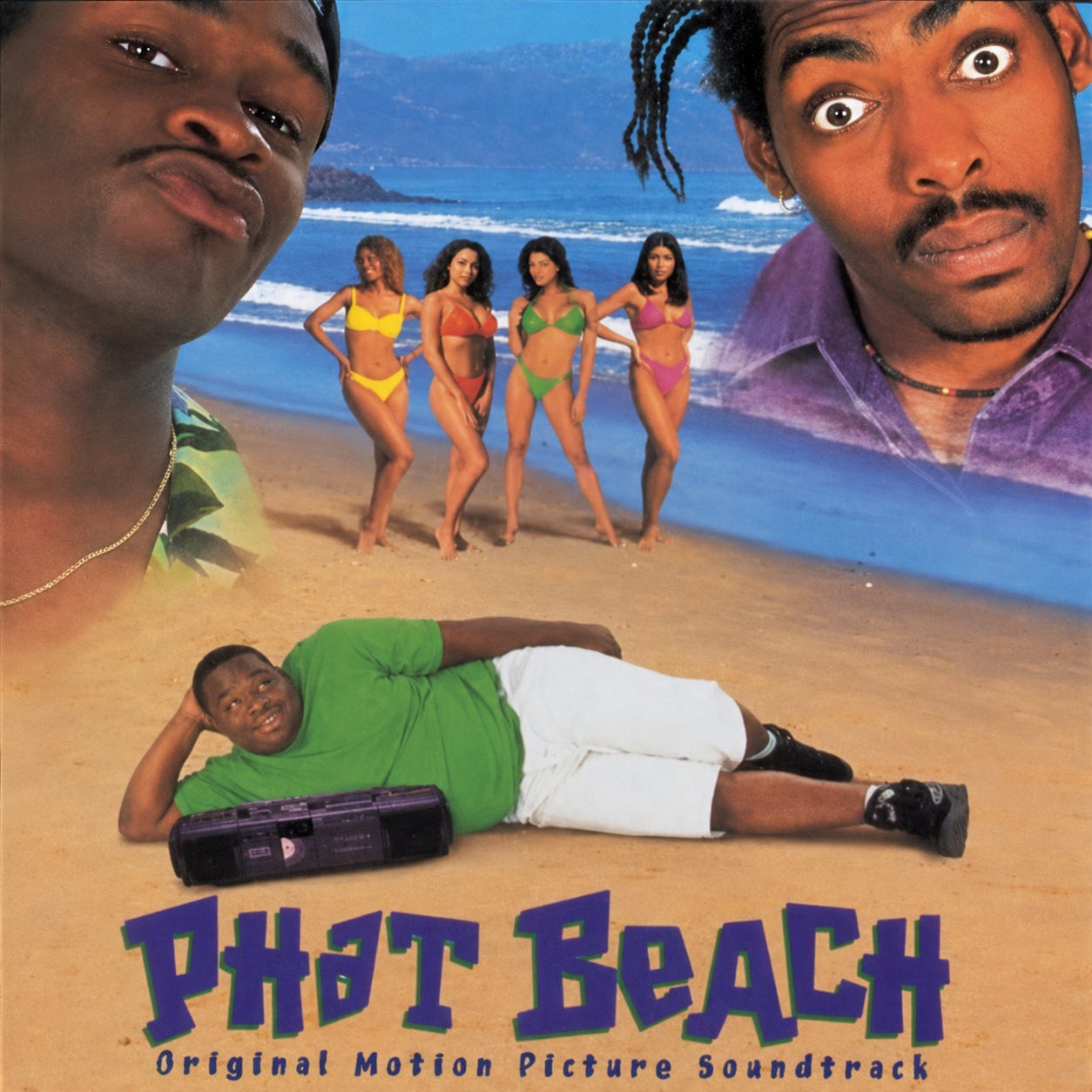
E-40 opens “Fatal” with Vallejo slang most of the country wouldn’t have recognized on first listen, Studio Ton producing him over a flipped James Brown “Payback” sample that somehow sounds nastier than the original. The premise of the movie was two heavyset friends trying to pick up women on Venice Beach. TVT threw every Southern and Bay Area rapper on its bench onto a single CD. Eightball & MJG drop “Up to No Good” in the DJ Squeeky-adjacent Memphis slow-roll they’d perfected on On the Outside Looking In. Biz Markie turns up with “Studda Step,” decades into his career and rapping about food as always. The Click’s “Scandalous” has Suga-T and the rest of E-40’s family stretching out. Chubb Rock contributes “I’m Too Much.” Nutt-So and Celly Cel round out TVT’s 1996 Rolodex on a single disc.
High School High
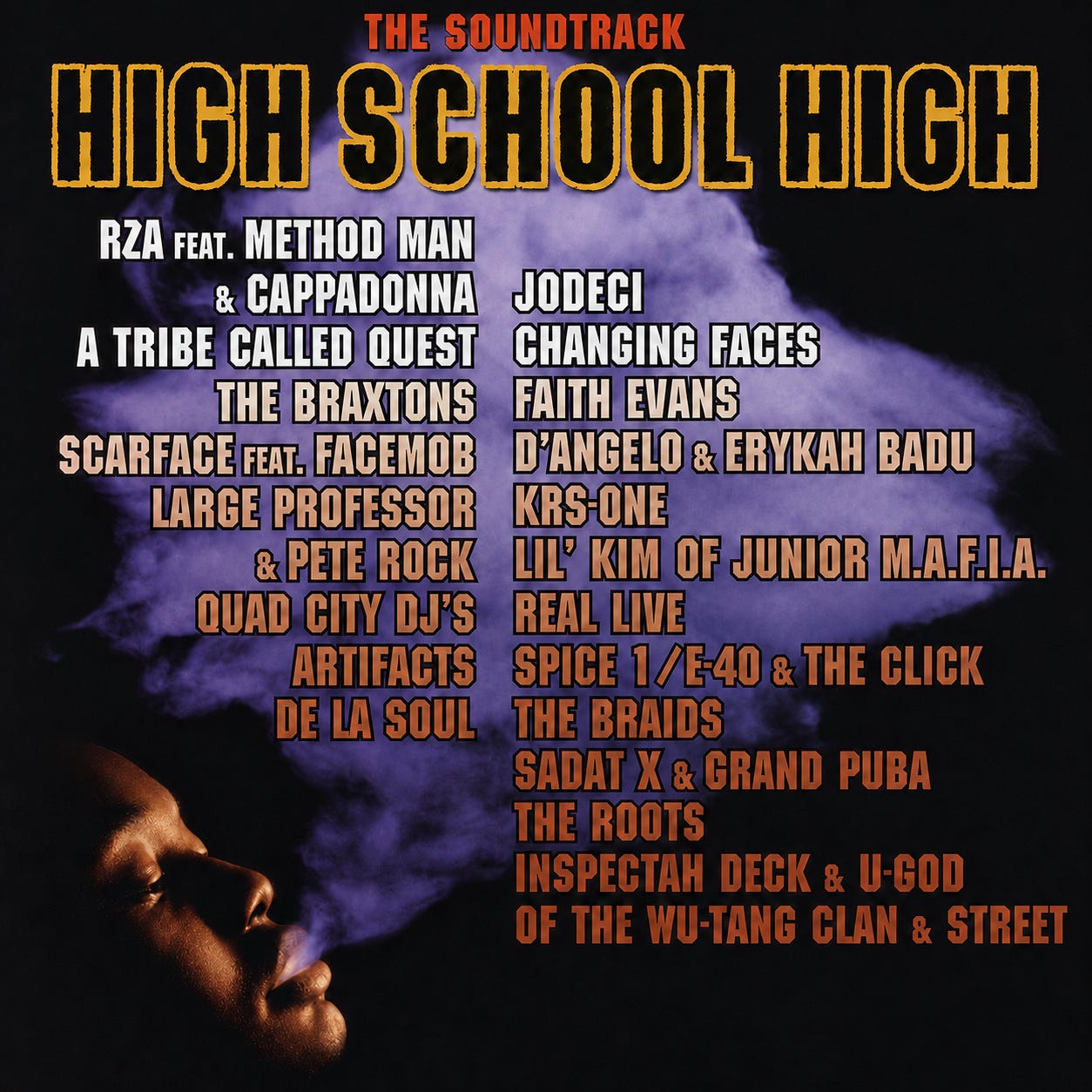
Big Beat’s Craig Kallman authorized RZA to write a song celebrating the newly launched Wu-Wear clothing line. What came back was “Wu-Wear: The Garment Renaissance.” Method Man and Cappadonna trade verses over a horn-and-piano loop while Oliver “Power” Grant, Wu-Tang’s CFO and the actual architect of the clothing brand, explained in a 2011 interview that the whole idea had started with a handful of custom T-shirts he’d been selling out of his own trunk. The density beyond that song keeps up for the rest of the run. The Braxtons’ “So Many Ways” became the radio-single pick, Jermaine Dupri’s So So Def production pushing the sisters into a bounce Toni herself might have sung on had Babyface not already claimed her. A Tribe Called Quest deliver “Same Ol’ Thing” in their Beats, Rhymes and Life late-period stride. De La Soul’s “Wonce Again Long Island” reads as a victory lap for the Long Island sound they’d pioneered. Raekwon and Ghostface contribute “Fish,” another Cuban Linx exchange. Erykah Badu closes the R&B side with “Stay with Me.” Commercially this went top-10 R&B and then got buried by the movie flopping, but the density is why heads still pull it out.
Bulletproof
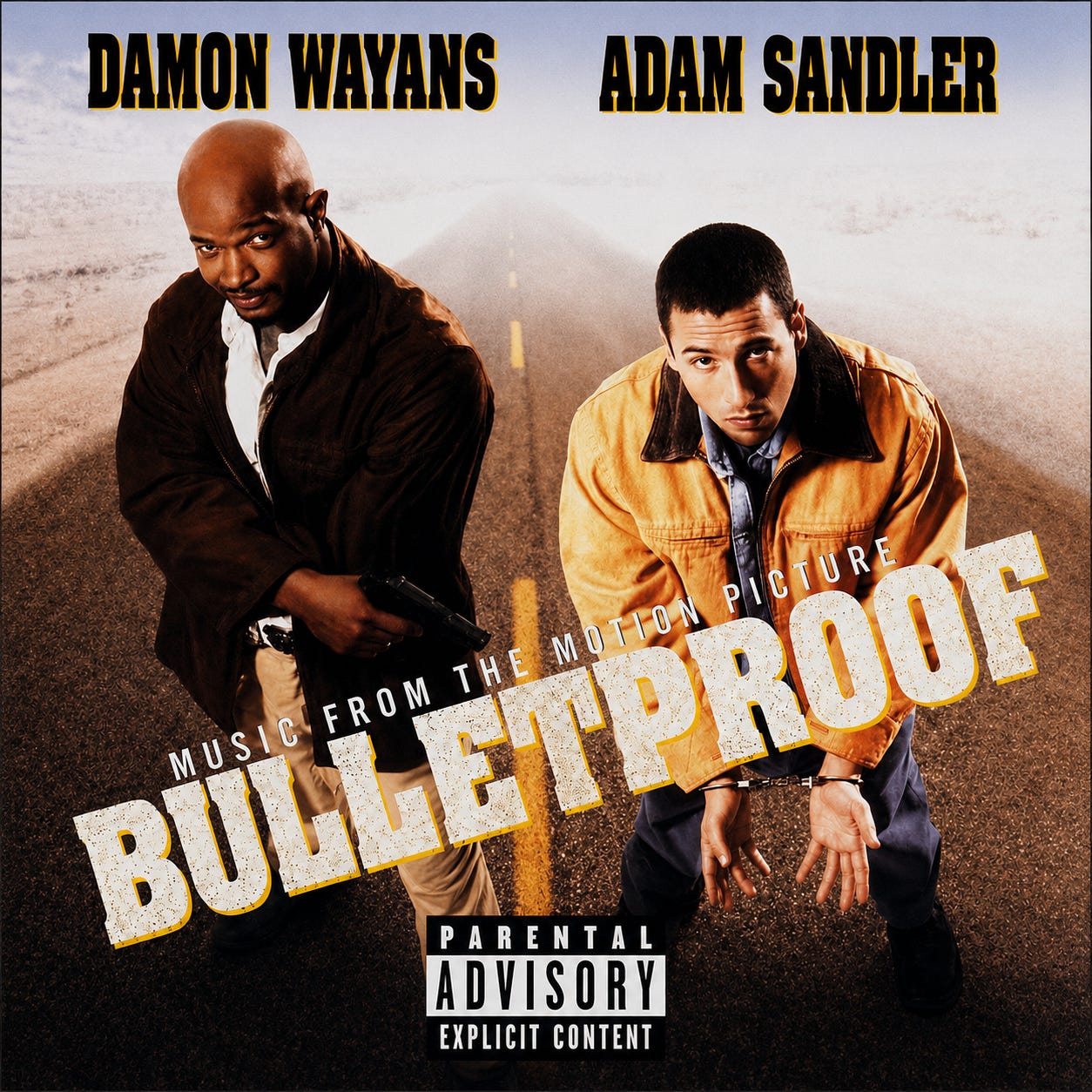
Nothing on Rahsaan Patterson’s own self-titled debut LP touches the track he contributed to a forgettable Adam Sandler-Damon Wayans buddy comedy soundtrack released around the holidays. “Where You Are” is his solo ballad here, an aching, hushed mid-tempo soul recording that sounds captured in one take with a single microphone running. Salt-N-Pepa’s “Champagne” was the promotional single and an early preview of the Brand New era after Hurby Luv Bug had stopped producing for them. Mista deliver “Lady,” their only pre-Blackstreet hit, seventeen-year-old Bobby Wilson already sounding signed for a reason. Ray J, Brandy’s younger brother, not yet tabloid-famous, puts “Everything You Want” out in what was meant to launch him as a teen R&B concern. Montell Jordan, Chantay Savage, Diana King, and Miles Jaye fill in around them. This comp barely charted and its physical version is out of print. Patterson collectors already know to look here first.
Set It Off
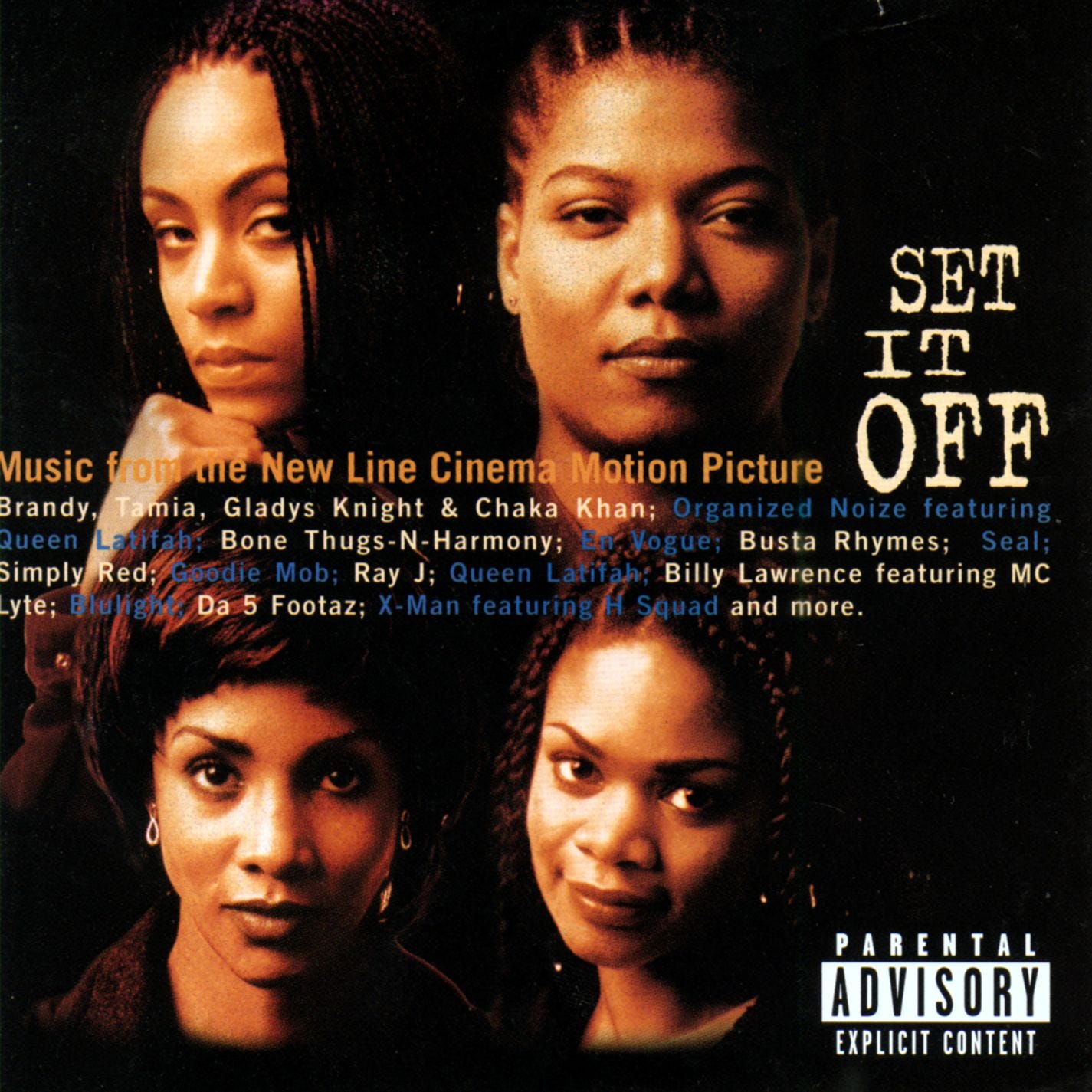
Ivan Matias and Andrea Martin wrote “Don’t Let Go (Love)” in a single afternoon and pitched it to Aerosmith first, before the production team realized the song needed a female group. En Vogue got it. Cindy Herron-Braggs rides the lead with the same control she’d always brought to En Vogue’s tightest harmonies, sitting inside the feel Matias and Martin built for rock guys, and Dawn Robinson stacks the harmonies around her with restraint enough to make the record feel like it was always meant for four voices. The single climbed higher on the Hot 100 than anything else the group would ever release. Organized Noize supervised the rest of the compilation coming off Southernplayalisticadillacmuzik, their fingerprints running through Seal’s “Free My Heart” and Queen Latifah and Organized Noize’s own “Set It Off.” Brandy, Tamia, Gladys Knight, and Chaka Khan join up for “Missing You,” a Babyface-produced tribute ballad that outlived every movie it was ever attached to. Chaka’s eight-bar stretch at the end of it is the whole song. F. Gary Gray’s bank-robbery film is a beloved Black action classic, and the compilation on its own merits is what plenty of listeners return to first.
Get on the Bus
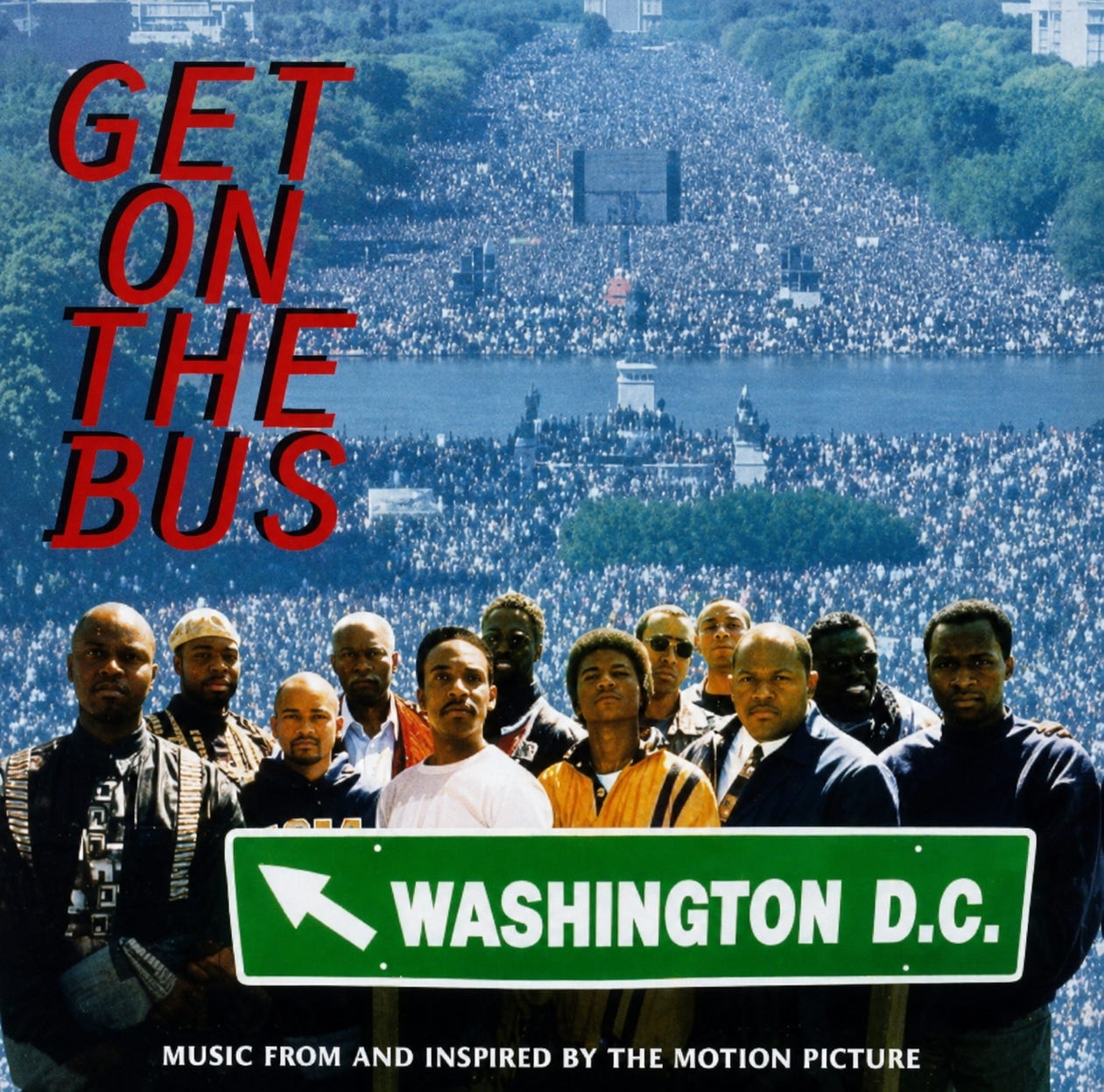
Curtis Mayfield had been paralyzed from the neck down since a 1990 stage accident in Brooklyn, and he recorded his contribution to Spike Lee’s Million Man March ensemble film on his back with a microphone suspended above his face. His version of “New World Order” sits on this LP, the same title cut as his 1996 comeback release and the last piece of solo music he ever put out. Stevie Wonder’s cover of Bob Marley’s “Redemption Song” is the emotional anchor, Stevie transposing the tune into his own Hohner-clavinet language and singing it as if Marley had written it for him. D’Angelo contributes a cover of Eddie Kendricks’ 1973 “Girl You Need a Change of Mind,” his Brown Sugar-era delivery reshaping the Temptations deep cut into something slower and heavier than the original. Michael Jackson’s “On the Line” was recorded for the film and pulled from the album at the last minute by his label, a separate fight that never fully came into public view. This covers-and-contributions format is the rare Spike Lee soundtrack that actually coheres, the rare 1996 album-length tribute that isn’t just an excuse for a Prince back-catalog raid or a rap comp. Mayfield was gone three years later.
Space Jam
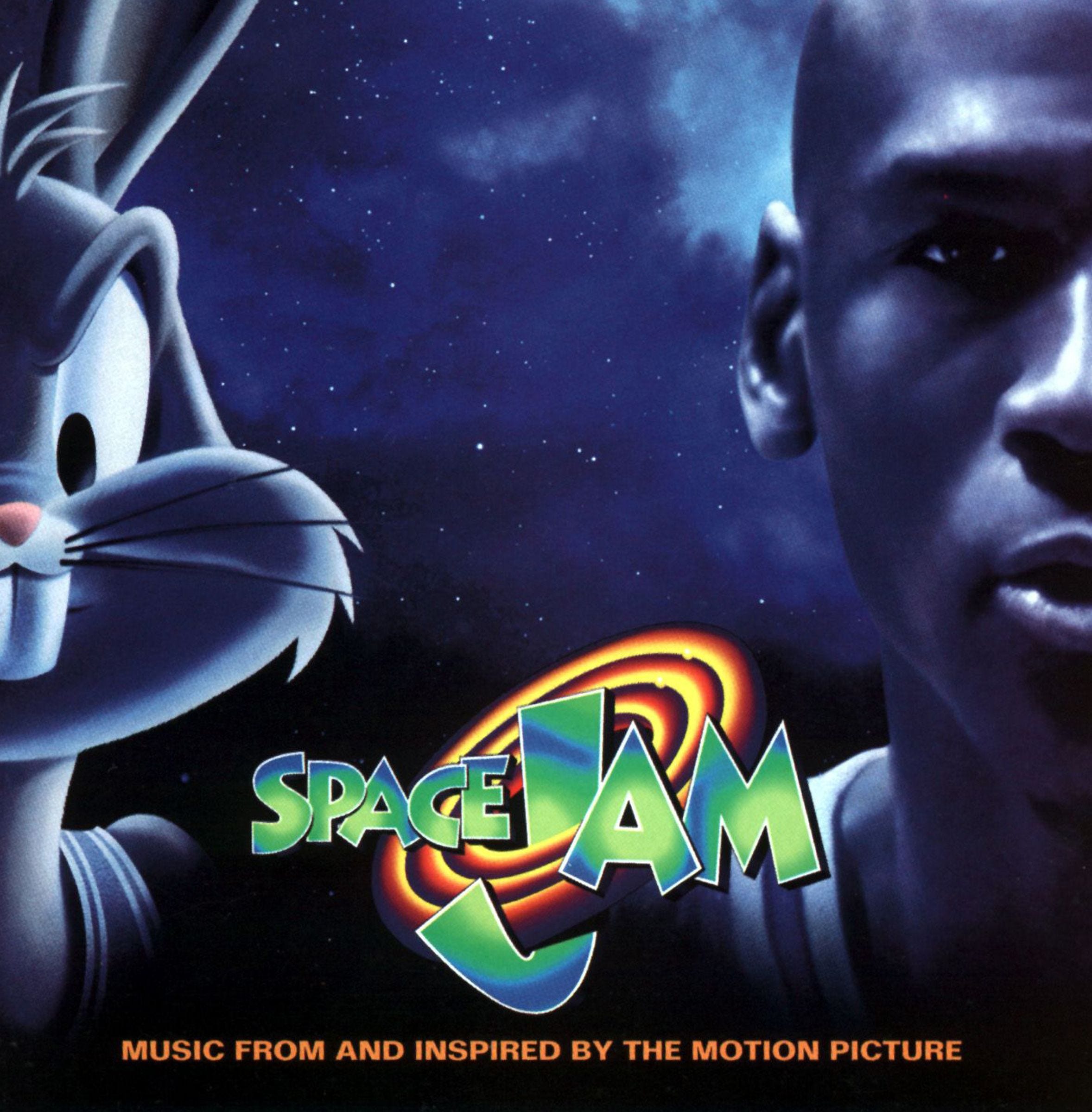
Kells wrote “I Believe I Can Fly” specifically for the Michael Jordan-meets-Looney Tunes vehicle, and the ballad became a standard every gymnasium graduation in America has performed since, the biggest commercial hit of his entire career. That’s the part everyone already knows. The part worth learning if you’re coming in fresh is “Hit ‘Em High,” the Monstars-credited posse cut where B-Real, Busta Rhymes, Coolio, LL Cool J, and Method Man trade verses over a Rashad Smith beat aggressive enough to read as the shadow twin of Kells’ ballad. D’Angelo turns in “I Found My Smile Again” for the compilation, one of the few pieces of Brown Sugar-era original D’Angelo music that never ended up on anything else and now only lives here. Seal covers Steve Miller’s “Fly Like an Eagle” for the closing-credits slot. Monica, Quad City DJ’s, Salt-N-Pepa, and Spin Doctors round out the field. Six million copies sold. A children’s movie somehow making space for both Kells and D’Angelo on one CD is the strangest major-label pop LP of 1996.
The Preacher’s Wife
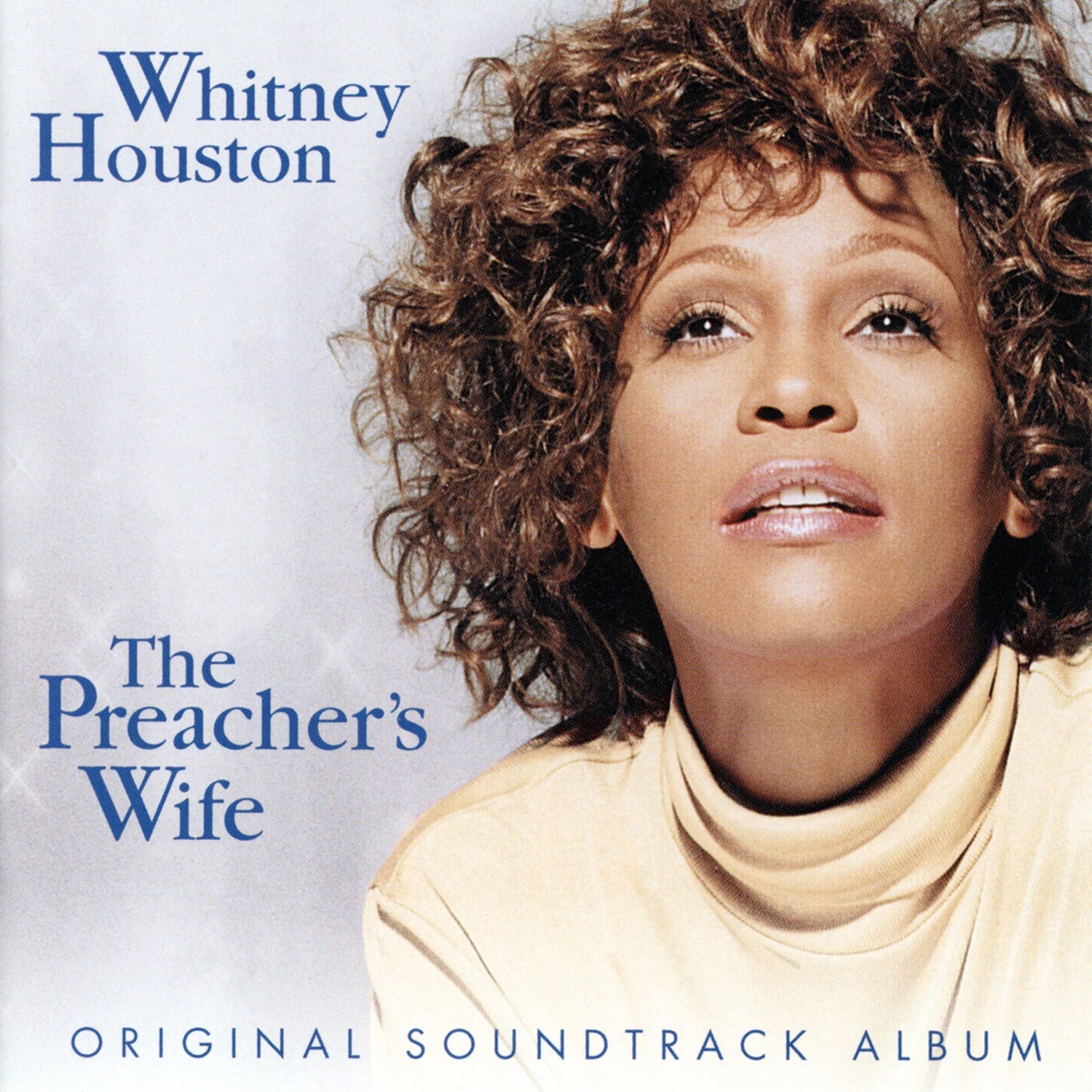
Whitney Houston came up in gospel. Cissy Houston sang backup for Aretha Franklin, Dionne Warwick was her cousin, and before any of the pop crossover Whitney was a soloist at New Hope Baptist in Newark. The Penny Marshall remake of The Bishop’s Wife gave her a Christmas-movie excuse to record the gospel album her label had been steering her away from for a decade, and she brought the Georgia Mass Choir into the studio with her to do it. What came out moved over six million copies and remains the best-selling gospel album in history. “I Believe in You and Me” is the Four Tops cover that became the Hot 100 single. Whitney sits inside the melody in the same key she was singing for choir pews long before any A&R got involved, holding each note the way she had always sounded in church. “Step by Step” is the Annie Lennox song she turned into a call-and-response workout with the Georgia Mass. Cissy Houston takes her own track on “The Lord Is My Shepherd,” one of the few times on the album where Whitney steps aside entirely. Whitney singing the music she’d been raised in, with a choir she trusted and a mother she grew up beside.
1997
Rhyme & Reason
Peter Spirer’s documentary was the most ambitious filmed oral history hip-hop had attempted up to that point, hauling in everyone from KRS-One to MC Eiht to the surviving members of N.W.A. for ninety minutes of testimony about where rap was in 1996. The accompanying compilation tried to do the same job in fifteen tracks, and the regional roll call is genuinely strange in retrospect. Priority paid RZA, paid Tha Dogg Pound, paid Tribe, paid Master P, paid Memphis, paid the Bay, paid New Orleans. Mack 10 and Tha Dogg Pound’s “Nothin’ But the Cavi Hit” carried the album to gold and is the only track most people remember.
RZA’s “Tragedy,” produced by True Master, is one of the loosest things RZA showed up to rap on in ‘97, a Eurythmics flip that does what most of his Bobby Digital experiments would chase for the next three years. Heltah Skeltah, Ras Kass and Canibus piling onto “Uni-4-Orm” was the New York pile-on you’d want from rappers that lyric-bound, with nobody trying to win and everybody scoring. Eightball & MJG’s “Reason for Rhyme” names Memphis as the only sensible answer to the regional argument the documentary was supposed to settle.
Gridlock’d
Pac had been dead four months ahead of the Vondie Curtis-Hall film hitting theaters, and “Wanted Dead or Alive,” his duet with Snoop, was promoted with a video Snoop shot alone, splicing in old Pac footage from the movie. Morbid logistics ran through everything around the album. It was Death Row’s penultimate Interscope release, and you can hear the label running out of road on every cue. Daz produced nearly everything. Sam Sneed cuts got pulled from the vault. Storm and J-Flexx and BGOTI tried to fill a roster that no longer existed.
On “Never Had a Friend Like Me,” Pac’s cadence lands weirdly relaxed for a song about being alone, and the cut has aged better than most of the canonized Death Row vault material. He sounds like a regular member of a posse cut on “Out the Moon (Boom, Boom, Boom).” Buried inside the LBC Crew booth-pile and handed nothing to lead, he hadn’t been a regular member of anything in years. “Life Is a Traffic Jam” with Eight Mile Road rides closer to the radio-baiting Pac of “California Love” but reads now as a deliberate piece of how Curtis-Hall built his movie, not a chart bid. Almost everything else around those four moments is why Death Row collapsed.
Dangerous Ground
Ice Cube walked from rapper to leading man across the late ‘90s without quite letting go of either, and Darrell Roodt’s South Africa-set thriller was one of his odder hand-offs. Cube starred as a returning expat searching Johannesburg for his missing brother and seeded the Jive soundtrack with West Coast favors. “The World Is Mine” is the keeper, a self-produced solo single with a deadpan Cube vocal that pre-dated his War & Peace albums by a year and is sharper than most of what landed on them.
Beyond Cube the album is a B-Legit and Spice 1 record by other means. “Ghetto Smile,” Legit’s collaboration with Daryl Hall (yes, of Hall and Oates), had already been on his 1996 Hemp Museum, and its presence here is the most unlikely Black-pop crossover Jive committed to that year. Keith Murray, Mack 10, Mia X, and Celly Cel each got a slot. Most of the thing reads as label inventory, but the Cube single and the Hall feature are real, and the album charted at number three on the R&B side largely on his name.
Booty Call
What the Booty Call soundtrack tells you about late-‘90s R&B production matters more than the comedy it was attached to. SWV’s “Can We” featuring Missy Elliott was one of the earliest national arrivals of Timbaland’s stutter-snare era, released in the same window as Aaliyah’s One in a Million and three months before Ginuwine’s “Pony” had finished its chart run. Rodney Jerkins, then twenty, produced Joe’s “Don’t Wanna Be a Player,” which became the platinum single that launched his Darkchild empire. A pair of producer careers were being listed on the back of a Jamie Foxx and Tommy Davidson sex comedy.
Around them, you got the polished mid-decade Jive R&B you would expect from this label at this point in the decade. Robert Kelly turned in “Baby, Baby, Baby, Baby, Baby...” for the front of the album. Johnny Gill and Coko traded on “Fire & Desire” with Gerald Levert handling “Hold That Thought” deeper in the sequence. Too $hort and Lil Kim closed the album down on “Call Me.” The Joe and SWV singles pulled the record to platinum and quietly mapped what mainstream R&B was about to become for the next four years.
Love Jones: The Music
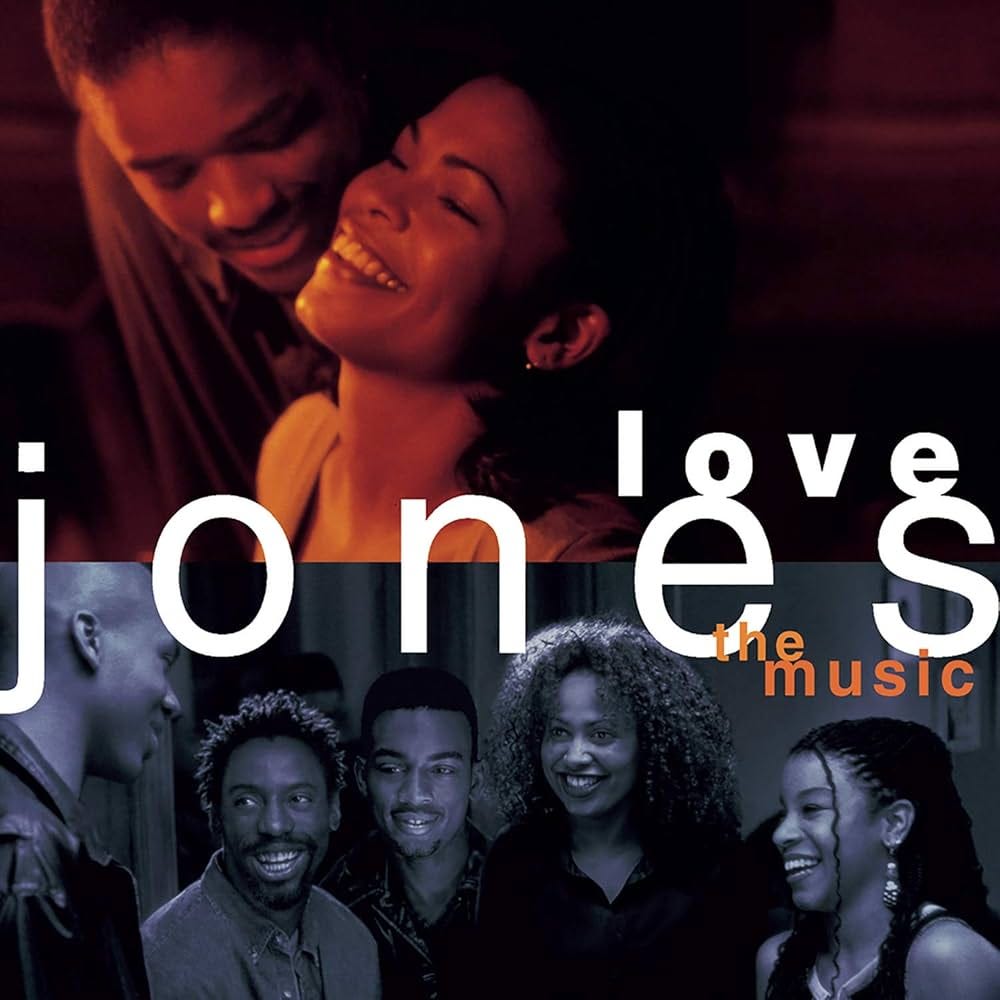
Theodore Witcher’s debut feature was the first major Hollywood movie to put Black bohemia on screen as its own world rather than as backdrop. The Columbia compilation treats the music with the same care. Refugee Camp All-Stars’ “The Sweetest Thing” was the famous one, a Wyclef and Pras production with Lauryn Hill on lead nine months before “Doo Wop (That Thing)” existed in any form a label had heard. You can already hear Miseducation in her, the curl on the word “sweetest” doing the work the album would later teach a generation of singers to do.
Witcher and his music supervisor put this album together with more care than almost any other 1997 soundtrack got. Maxwell contributed an alternate “Sumthin’ Sumthin’ (Mellosmoothe)” that loosens the Urban Hang Suite arrangement into something close to ambient. Cassandra Wilson’s “You Move Me” drops the temperature of the room by ten degrees. Marcus Miller and Me’Shell Ndegéocello’s bass-and-voice “Rush Over” neighbors a Duke Ellington and John Coltrane reading of “In a Sentimental Mood” recorded in 1963. Dionne Farris’s “Hopeless” was the radio play. Larenz Tate’s spoken-word reading of “A Blues for Nina” opens the whole record. Nothing else from the year approaches this album as a snapshot of where neo-soul was about to be born.
The 6th Man
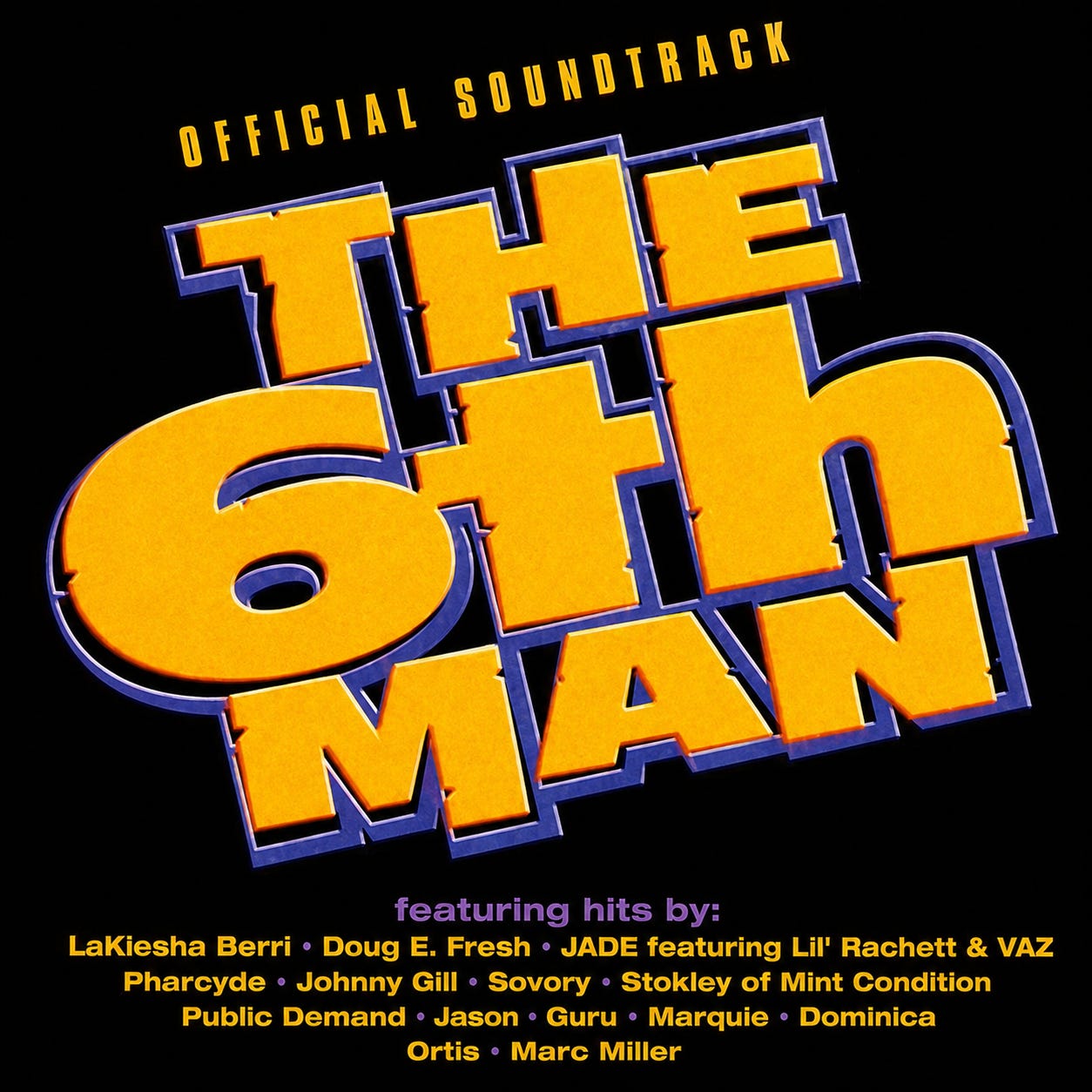
Hollywood Records was Disney’s label, and The 6th Man was a Marlon Wayans basketball comedy with Kadeem Hardison playing a ghost, and the soundtrack came together as a corporate hand-shake the Walt Disney Motion Pictures Group put together once Sony made obvious bank off Will Smith. Marcus Miller scored the film. The compilation gave Mobb Deep’s “More Trife Life” a slot it didn’t need, dropped a Coolio cut, ran some Tevin Campbell, and quietly let Guru and Buckshot and Sadat X collect checks.
Nothing on it became a single. Most listeners remember the album as a curiosity, but the Mobb Deep contribution is one of the better Havoc productions from late ‘97 and the Tevin Campbell ballad “No More Fighting” lives in the unloved late-Tevin period that’s more interesting than its reputation. The model on this one was the model. Rent the IP, fill the booklet with names, hope something crosses over. Nothing did, the LP went to dollar bins quickly, and it’s worth hunting now for exactly that reason.
Sprung
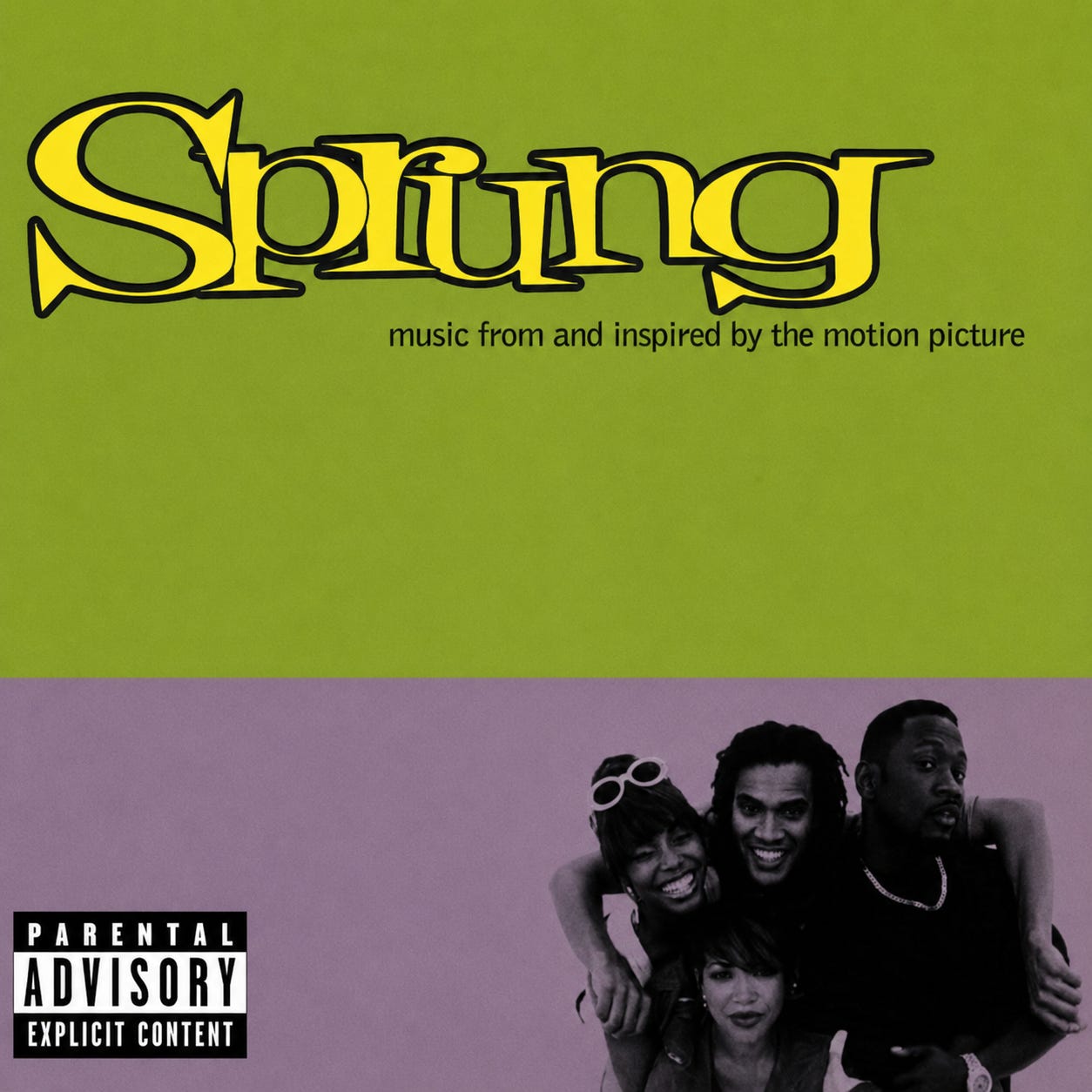
Rusty Cundieff had directed Tales from the Hood two years earlier, and his romantic comedy followup landed in a window where every label was trying to assemble its own Bad Boy, with mixed results. Qwest’s pull on this one was JAŸ-Z, who delivered “Who You Wit” as the opening track. The song doesn’t appear on either Reasonable Doubt or In My Lifetime, Vol. 1 (actually, part two did, which doesn’t deviate much from the original), the two albums it sits chronologically between, and remains a mid-period Hov outlier that Ski produced and that never landed on a JAŸ-Z solo album. It is one of the least-discussed important Jay songs.
The rest leans hard into the Qwest connection. Aaliyah and Ginuwine each show up alongside a Canibus cut called “Group Home Family” with the Lost Boyz, and Pras gets a slot for “Move On (I’m Leaving)” with Forte the year before “Ghetto Supastar.” It’s a soundtrack with no consistent identity, but the Jay opener is the kind of thing crate-diggers still trade for, and the Aaliyah inclusion was Timbaland-produced and ahead of its time.
I’m Bout It
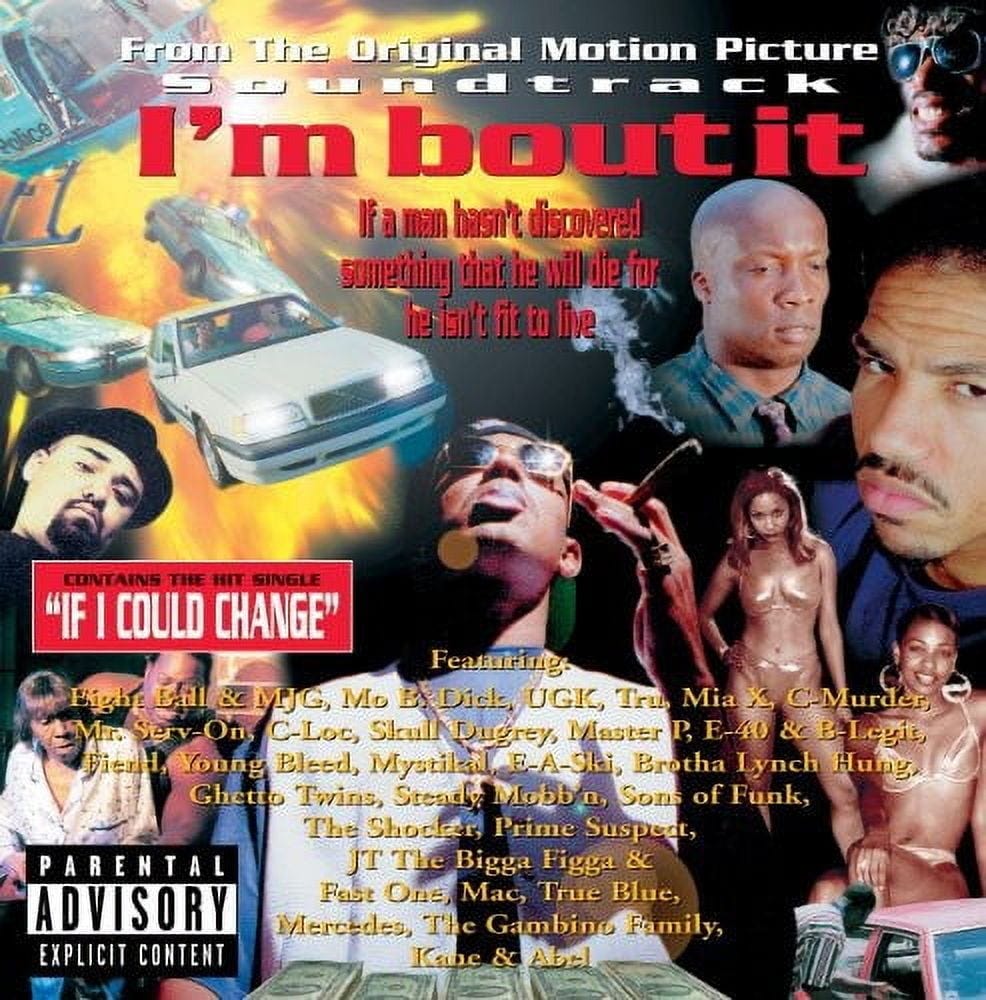
Master P shot I’m Bout It for cheap and sent it straight to VHS, then used the accompanying album to post a chart receipt no straight-to-video movie had any business producing. It hit number one on the Billboard R&B chart and shifted 300,000 units in its opening week. No previous No Limit release had ever topped the Top R&B/Hip-Hop Albums chart. Almost nobody who bought it bothered with the film.
Almost the whole No Limit roster got a feature on this one. Mystikal handled “What Cha Think.” Mia X took “Much Love” while Fiend rode “Don’t Mess Around” and Mr. Serv-On rode “Before I Die,” all of it built on Beats By the Pound production with out-of-house help from Brotha Lynch Hung and E-A-Ski. The track that won was Master P’s “How Ya Do That” featuring C-Loc and Young Bleed, an unlikely crossover hit of late ‘97 that nothing about the keyboards or the chant predicted. Master P’s own “If I Could Change” with Steady Mobb’n is the other one. The middle drags hard, but on the question of how a Black-owned indie hijacked an entire commercial format for one summer, this LP has no real peer.
Men in Black: The Album
Most of what ended up on this album was never actually in Barry Sonnenfeld’s movie. The Danny Elfman score cues and the credit-roll playback of Will Smith’s title track cover the extent of the actual movie overlap. Columbia used the tie-in as cover for a scouting report on who the label was going to bet its next four years on. Destiny’s Child, Beyoncé Knowles’s Houston quartet signed to Columbia a year earlier, landed the first song they ever released to retail on track eleven, under the title “Killing Time.” A sixteen-year-old Alicia Keys made her debut single under her own name here with “Dah Dee Dah (Sexy Thing).” Nas slipped “Escobar ‘97” onto the back end in the gap between It Was Written and the Firm album. The Roots and D’Angelo handed over “The ‘Notic” before Voodoo was even a rumor.
The Will Smith single that moved the units works off a Coko lead vocal borrowed from SWV and stitched to a Patrice Rushen “Forget Me Nots” interpolation. Poke and Tone produced it clean. Strip away the Agent J cosplay and underneath sits one of the year’s better mainstream rap singles. Tribe came through with a Q-Tip and Phife duet called “Same Ol’ Thing” that lives in the run of unreleased Tribe material The Love Movement would later pretend to finish. Snoop and Jermaine Dupri’s “We Just Wanna Party With You” was the album’s second single, and it introduced Atlanta’s most powerful producer to the West Coast as a peer.
Nothing to Lose
No major-label all-women rap cut had ever assembled a lineup on this scale. None would do it again for years afterward. Lil’ Kim was at the top of her Hard Core run. Left Eye was nearly three years past CrazySexyCool and five years away from dying in Honduras. Da Brat was a year past Anuthatantrum with Missy Elliott two weeks out from dropping Supa Dupa Fly, and Angie Martinez was in her Hot 97 on-air peak. Watching their “Not Tonight (Ladies Night Remix)” video now with Left Eye’s verse running in the middle of it is a heavier experience than Tommy Boy ever intended it to be. The song went platinum, climbed to number six on the Hot 100, and hammered MTV rotation all summer on a pink-and-feathers visual that now registers as a documentary of an entire loose federation of women right before it started coming apart.
A second event landed on the album in Coolio and the 40 Thevz’s “C U When U Get There,” a Pachelbel-sampling single that went gold ahead of parody catching up to the sincerity of running a Baroque cello line under a rap vocal. The cupboard thins fast after that. Capone-N-Noreaga cut “Thug Paradise.” Outkast handed over “Everlasting” as B-side material. Naughty by Nature recorded a live take of the title song. Queen Latifah filled the closing stretch next to Black Caesar and Stetsasonic. The Ladies Night remix is one of 1997’s historical events, and almost nothing else around it is.
Good Burger
The stealthiest Mint Condition single of the entire decade ended up parked at track two of a Kenan and Kel Nickelodeon soundtrack, a placement so incongruous it could only happen by accident, an accident that arrives any time a label is doing a band a favor it doesn’t fully grasp. Mint Condition’s “That’s the Way (It’s Goin’ Down)” runs slower and wetter than anything the group had cut for Perspective Records in three years, and the song laid out the patient mid-tempo mode that would carry them through their Elektra catalogue years. Almost nobody bought Good Burger to find it.
Capitol was hunting cross-promotion with Nickelodeon’s children’s-movie pipeline. The album that came out of the hunt has slack written all over it. 702 got the opening slot with “All I Want,” already a top-ten R&B hit for the group from the year before. Deeper in the sequence sits one of 1997’s most overlooked pieces of Capitol R&B, a Tracie Spencer ballad called “I’ll Be There for You.” A De La Soul cut credited to “Pos (Plug Won)” and “Tru (Plug Too)” holds one of the only 1997 De La verses that didn’t end up on Stakes Is High, throwaway by the group’s standards and worth sitting with anyway. Treat the record as a cheap mixtape and it earns the dollar-bin hunting cost back fast.
Steel
Tech N9ne wrote and recorded a song called “Strange” for the Shaquille O’Neal superhero film. Then he watched Qwest cut the song from the album before release. That title later became the name of his label and the foundation of one of independent rap’s most successful business operations. What hit retail stores comes off now as a curiosity. A version of Steel with Tech N9ne actually on it would have been the earliest national rap credit of his career by a full year.
What Qwest did release came with “Men of Steel” as the actual lead single, a Poke and Tone production built on a chop of Margie Joseph’s “Stop in the Name of Love” alongside a KRS-One “Sound of Da Police” rip. Shaq, Ice Cube, B-Real, Peter Gunz and KRS-One himself all squeezed onto it, and five voices that size sharing a track for a DC Comics cash-in earns the song a slot on a shelf as a novelty piece. Mobb Deep snuck a Hell on Earth-era leftover called “More Trife Life” onto the album, and Blackstreet, Tevin Campbell and Jon B each cashed an R&B slot check beside it. Quincy Jones produced the film himself, the movie flopped, Shaq picked up a Razzie nomination for starring in it, and the album stalled out at number 185 on the Billboard 200.
Def Jam’s How to Be a Player
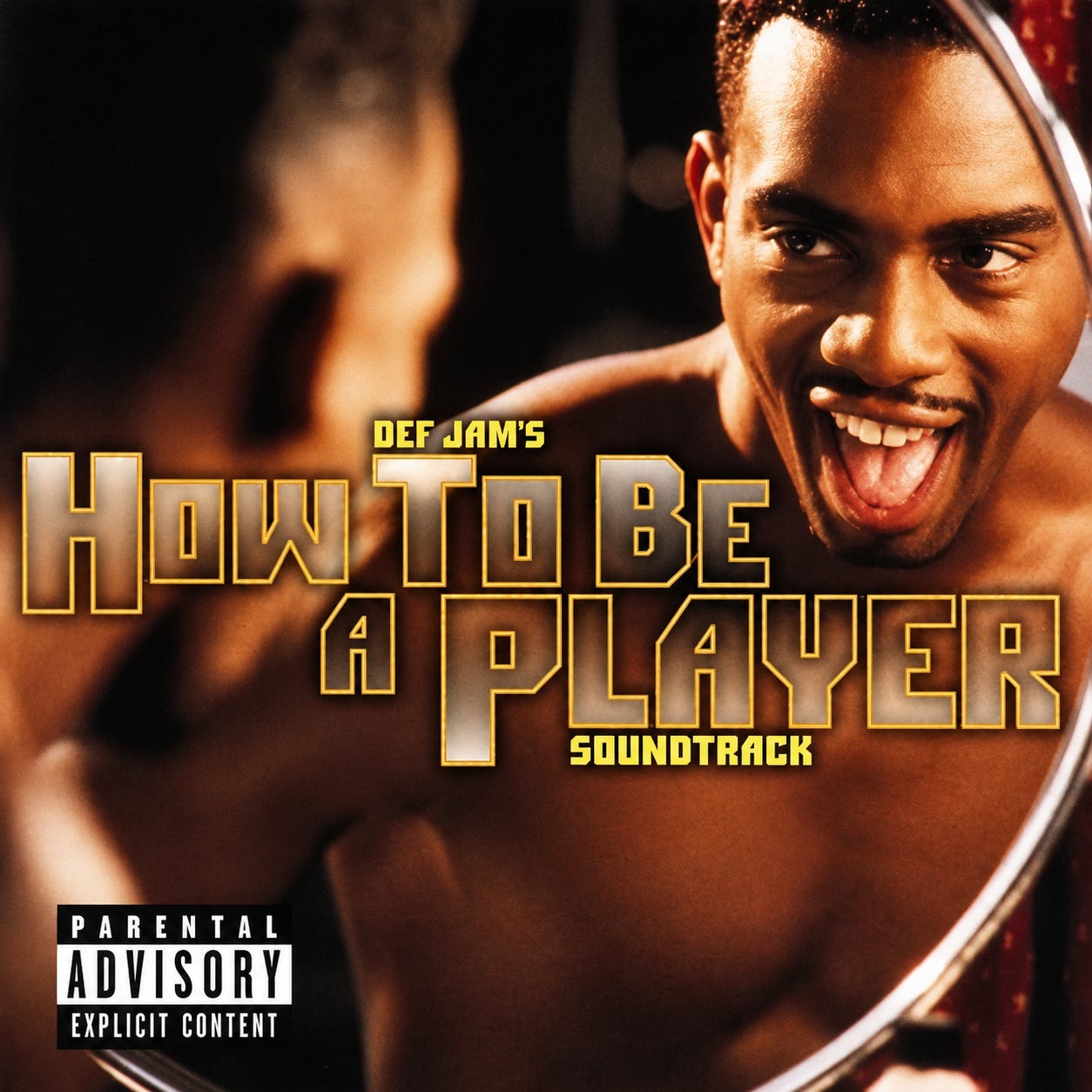
Mic Geronimo’s “The Usual Suspects” put DMX in a booth with Ja Rule and Cormega and Fatal Hussein months ahead of any one of them having a solo Def Jam contract under his own name. That recording endures as the group photograph for the second wave of late-’90s New York street rap. Every one of those rappers would sign to Def Jam within fifteen months. “The Usual Suspects” is the pre-contract version of that entire rollout, each rapper saying exactly what he had to say in barbed, loaded couplets before he had anything to protect.
Foxy Brown’s “Big Bad Mamma” with Dru Hill was the actual lead single. It charted, though the album’s historical interest mostly lives in the rooms around that hit rather than inside it. 2Pac’s “Troublesome ‘96” got placed on the compilation before any other label had released the song. EPMD’s reunion track “Never Seen Before” marked their first joint recording in four years. Master P brought in “How to Be a Playa” with Silkk the Shocker and Fiend, which was a No Limit guest spot Russell Simmons would not have booked twelve months earlier. Junior M.A.F.I.A. let Cam’ron and Mase carry “Young Casanovas” while Lil Cease orbited. Twenty tracks deep across the double vinyl, the album mounts the strongest argument anyone put together that year for running the rap-soundtrack arms race on roster size alone.
Hoodlum
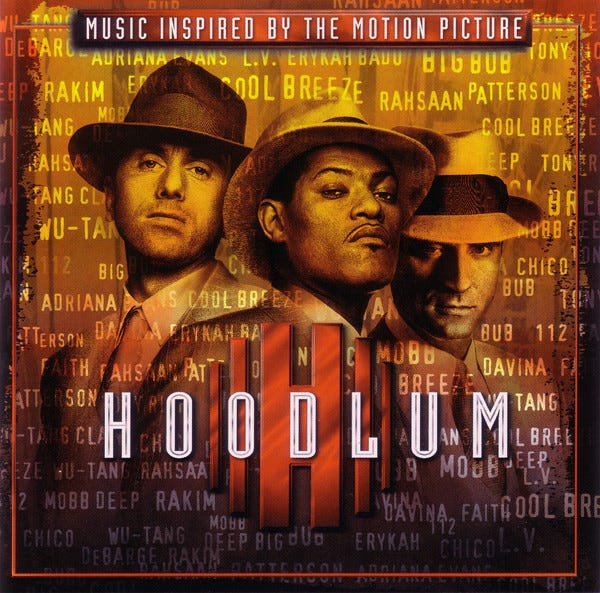
Havoc produced the title track and Rakim rapped its first verse, and that generational Queensbridge handshake is the reason people still pull this album off the shelf. Mobb Deep’s “Hoodlum” featuring Big Noyd and Rakim opens the compilation over a Havoc beat that chops Inner Life, laying three knotty verses across a 1930s Harlem setting that bends into present-tense Queensbridge. Bill Duke directed the film as a numbers-racket crime drama with Laurence Fishburne as Bumpy Johnson, Tim Roth as Dutch Schultz, and Andy Garcia as Lucky Luciano. Tony Rich, who played Duke Ellington in the movie, closes the album with “Harlem Is Home.”
Erykah Badu’s “Certainly” landed here in the middle of her Baduizm touring year, the song carrying the same patient, devotional phrasing she was performing to sold-out rooms with every night. Wu-Tang’s “Dirty The Moocher” is an RZA production with ODB on the mic. L.V. brought the Clayton-Hamilton Jazz Orchestra in for “Basin Street Blues,” the one cut on the album that actually sounds like the 1930s. Cool Breeze and Big Boi’s “Gangsta Partna” is Organized Noize production arriving a full two years ahead of Cool Breeze’s East Point’s Greatest Hit debut on LaFace. 112 and Faith Evans brought “I Can’t Believe” over from Bad Boy, a Puff Daddy production placed on a Loud-Interscope release on the strength of Combs’s leverage that summer. Davina and Raekwon’s “So Good” drew the single push.
Money Talks: The Album
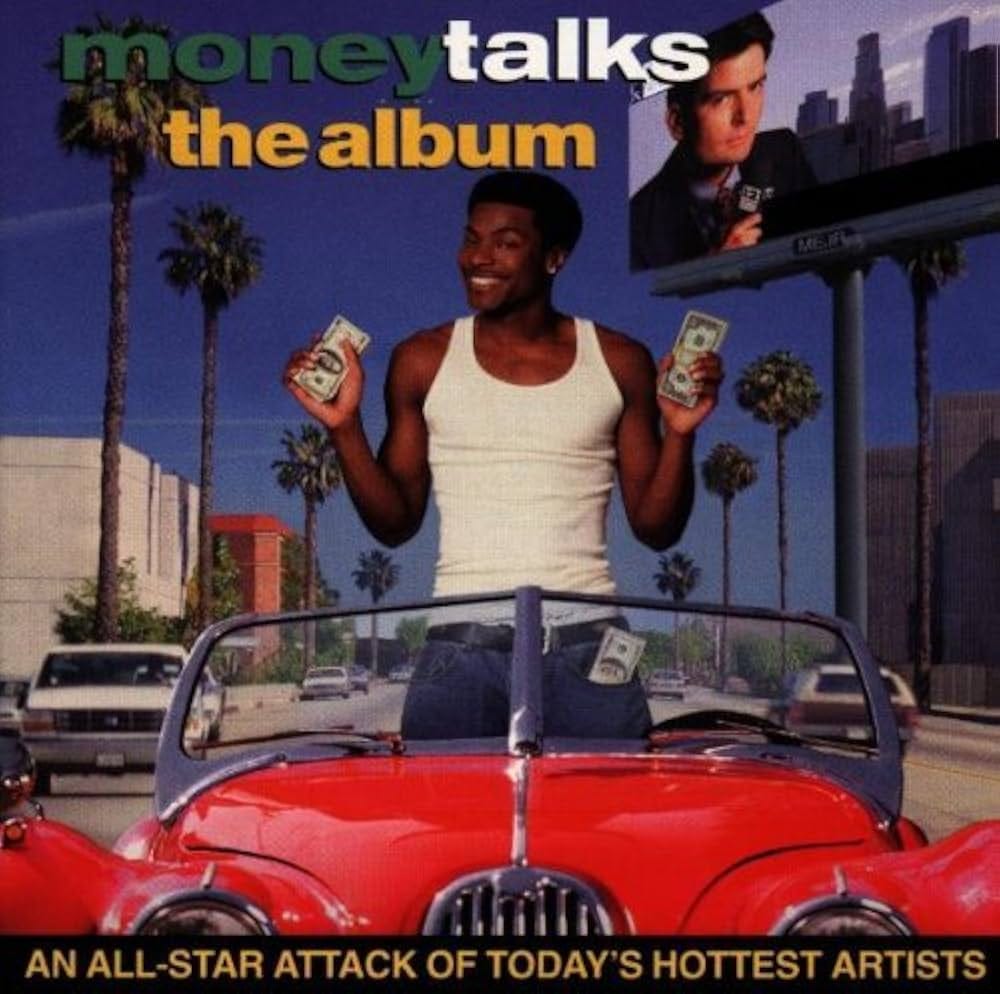
Mase recorded “Feel So Good” in 1997 for Harlem World, his debut album on Bad Boy. Puff Daddy then placed the finished master on the Money Talks soundtrack in August, partly because Bad Boy was still positioning Mase as a lead artist instead of just a roster feature, and partly because Arista and Bad Boy had effectively become the same office by that point in the year. The song gave Mase national exposure two and a half months before Harlem World shipped in late October, and the single went on to peak at number five on the Hot 100 and earn a platinum certification. Reach for this album for that single. Everything else is evidence for what Arista was willing to put behind the push.
What Clive Davis assembled around that song amounted to the deepest bench Arista had ever fielded for one of these soundtrack releases. Refugee Camp All-Stars’ “Avenues” with Pras and Ky-Mani Marley prefigures “Ghetto Supastar” by a year, and it lives now as one of the better tracks Pras guested on between Fugees albums. Mary J. Blige’s “A Dream” comes out of the My Life-to-Share My World transition window and is one of her stranger orphan singles. Lil Kim’s title cut with Andrea Martin belongs to the underrated stretch of her Hard Core afterlife. Brand Nubian took the slot for “Keep It Bubblin’.” Me’Shell Ndegéocello brought “The Teaching.” Deborah Cox contributed “Things Just Ain’t the Same.” Lisa Stansfield closed the non-single sequence with “The Real Thing.” As a label sampler with a movie sticker on the front of it, the album is one of the most coherent soundtrack compilations of the year.
Dead Homiez
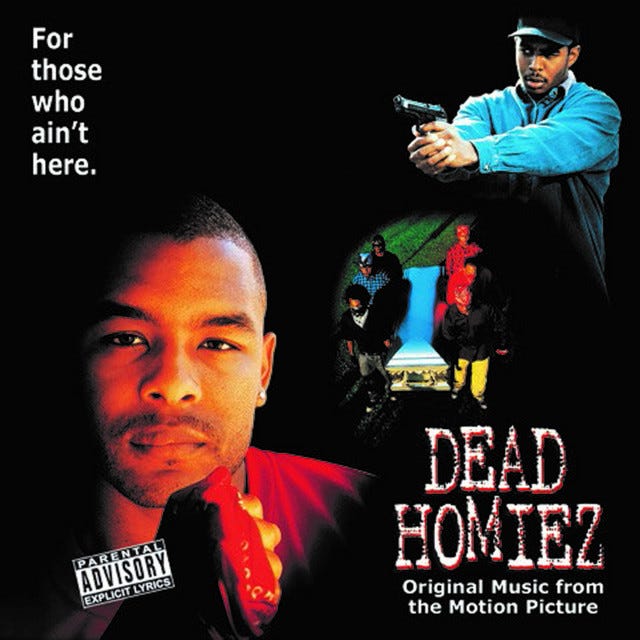
Billy Wright shot his half-documentary, half-fiction Bloods-and-Crips hybrid in 1993 and held the finished cut for four years before releasing it to VHS, by which point the underground Los Angeles rap scene that assembled its soundtrack had outgrown the film it was scoring. Volume 10 was the highest-profile name on the booklet, and his “Servin’ & Dippin’” is the cut most crate diggers can name on sight. Project Blowed affiliates carry the deeper keepers. Abstract Rude’s “Front Row” was later reworked for his Abstract Tribe Unique album South Central Thynk Taynk, and the version here is the original. Buccet Loc’s “Casket Drops” opens the record.
Around them you get DK Toon and Quan and Skubie filling early slots, plus Sinister and Ganjah K and Flowood holding the middle, plus Dutch and GOD closing the compilation out. You could fit the total major-label presence on this record inside a thimble. Drums sound like an SP-1200 nobody cleaned in months. Mixes come straight off a home setup. Most of these rappers stayed local for the rest of their lives. The same summer Master P was moving three hundred thousand units a week through Priority, Dead Homiez was shifting copies out of hatchbacks at South Central swap meets.
Soul in the Hole
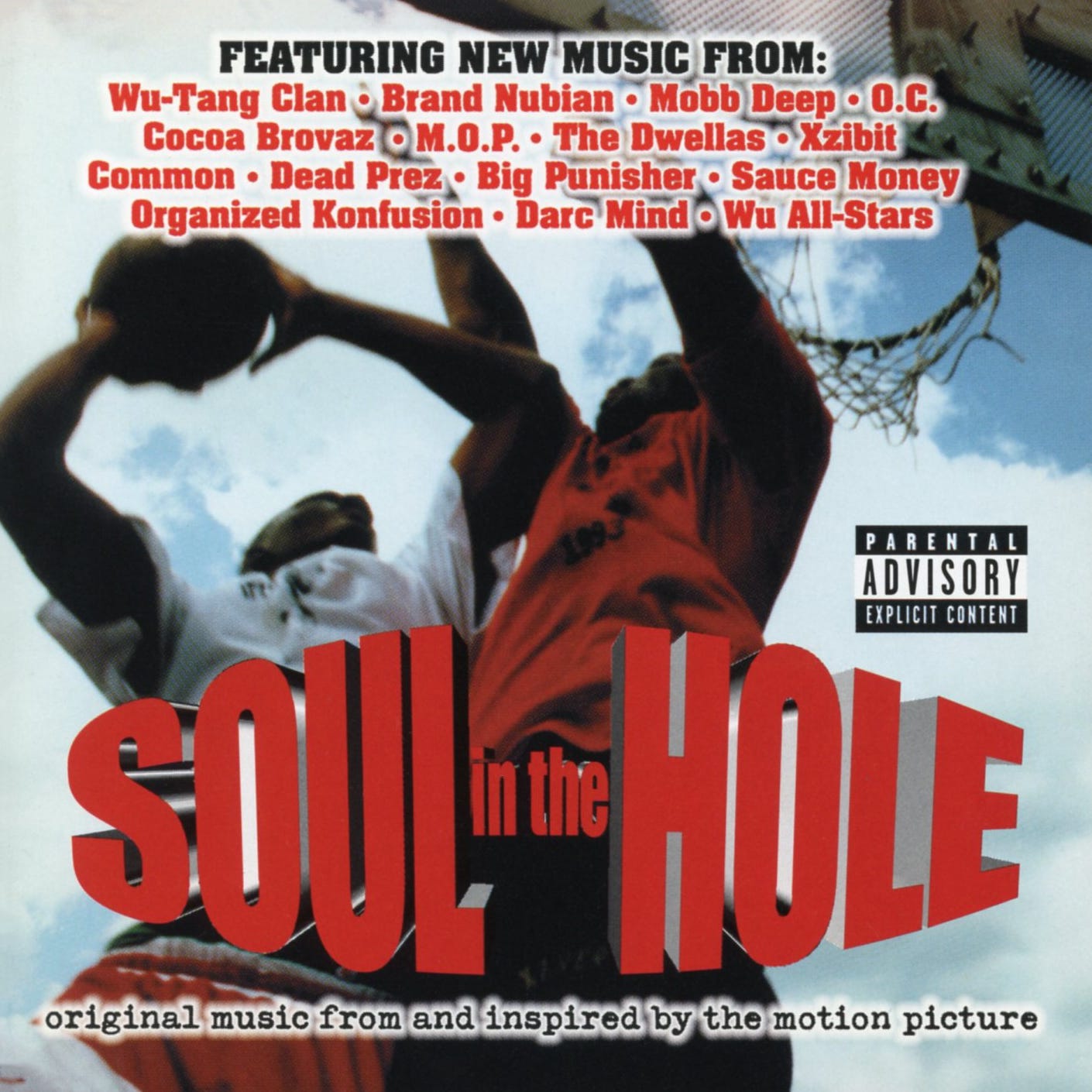
Christopher Rios got his first solo release through Loud Records a full week ahead of “I’m Not a Player” hitting retail, the song “You Ain’t a Killer” becoming the first thing Loud ever put out with Big Pun’s name as the lead billing on it. Anybody who heard it in July 1997 knew exactly who he was going to be by January. Pun’s Young Lord-produced verse spends the whole song explaining, in knotty Bronx couplet after knotty Bronx couplet, why the rapper being addressed in the title is not a killer at all. It is the cleanest warning shot Pun ever filed. The Brooklyn streetball documentary the album was attached to followed Kenny Jones’s playground squad Kenny’s Kings through a Bed-Stuy summer, and Loud handled the rest of the track listing as if it were a label sampler.
Wu-Tang’s “Diesel” is the loosest post-Forever Clan posse cut of the year, an RZA beat with Method Man in the booth alongside Inspectah Deck and U-God. Common’s “High Expectations” is the One Day It’ll All Make Sense-era leftover that probably should have made the parent album. MOP’s “Ride” predates anything on First Family 4 Life. Sauce Money got DJ Premier to produce “Against the Grain.” Cocoa Brovaz close their run with “Won On Won” and Mobb Deep show up again with “Rare Species.” Around them you get Organized Konfusion alongside Brand Nubian. OC and Xzibit each take a slot, and a young Dead Prez handles the score cut. Complex would later rank this album twentieth on its 25 Best Hip-Hop Movie Soundtracks list, and even that is undercounting it.
5th Ward, Vol. 1
Greg Carter made his low-budget Houston street drama with regional money, released it through a small local label nobody outside the city had ever heard of, and brought Willie D from the Geto Boys in to coordinate the music. What Willie put together is the only 1997 soundtrack on this entire list that moves entirely as a Houston scene document. DJ Screw appears on the compilation in 1997, roughly a year into the mixtape run that would later make him a local institution. Lil Keke rides a Willie D production called “We Bust” the year before Don’t Mess Wit Texas made him a regional phenomenon. Mass 187 shows up from Houston’s north side. Street Military, Botany Boys, Most Hated, and Nuwine fill the rest of the track listing. Pen and Pixel Graphics, the Slidell-based design house that did most of the Southern rap album art of the decade, pressed the cover.
Almost none of these names were known outside of Texas at the time. Most never did leave the state. Hearing the album now is hearing exactly where Houston was in 1997, eight years before Mike Jones and Slim Thug would break the city nationally. Nothing here was cut for radio. There are no out-of-state guest features anywhere on the album. This is the rare 1997 soundtrack that wasn’t trying to be anything other than what it actually was.
Gang Related: The Soundtrack
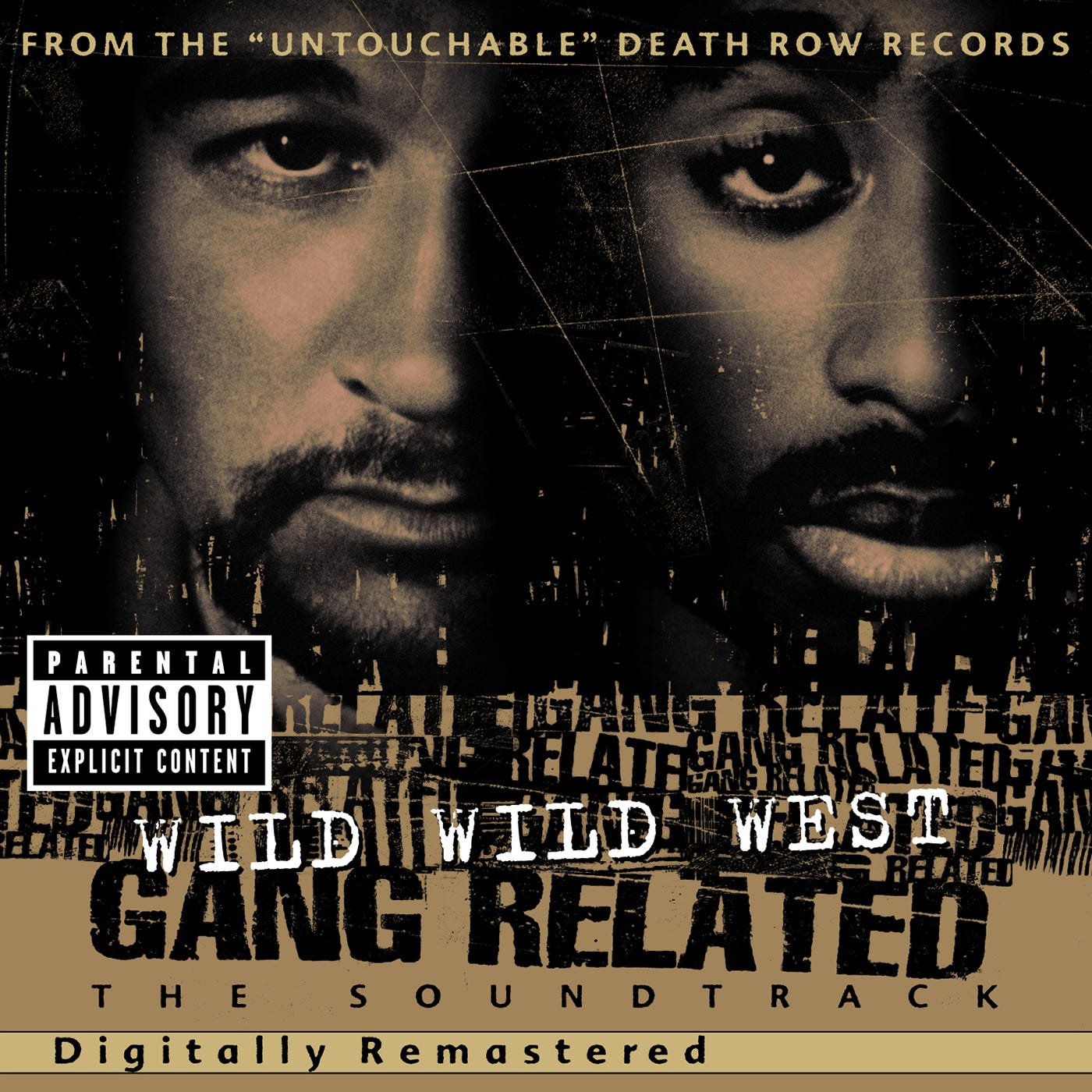
By October the Death Row that had made All Eyez on Me was in receivership. Pac had been dead thirteen months, and Dre had been gone from the label nearly a year. Snoop was filing paperwork to leave the imprint while Suge counted down eight months until his federal sentence began. Jim Kouf’s crime film with Tupac and Jim Belushi as corrupt cops became the last real shot the label had at an unreleased Pac asset, and Gang Related was the first Death Row release distributed by Priority after Interscope walked away from the label deal. It shipped as a double LP with four previously unreleased Pac songs spread across the two discs.
The headline cut here was “Staring Through My Rear View,” built around a Phil Collins “In the Air Tonight” interpolation and now one of the half-dozen most-played Pac songs of the posthumous run. It also taught a generation of rap producers what a Phil Collins sample could do. Pac pulled up with the Outlawz on “Made Niggaz” for the hardest performance he cut anywhere on the double LP. “Lost Souls” closes the second disc with four minutes of conscience-wrenching. An unreleased Pac vocal gets paired with a Snoop take stitched in afterward on “Life’s So Hard.” Around him Daz and Kurupt and Nate Dogg and Storm and Tha Realest ran the final Death Row roster lap. Ice Cube grabbed “Greed” and Mack 10 got “Get Yo Bang On.” Tech N9ne’s “Questions” was his first national credit, arriving years before anyone outside Kansas City had heard the name. The album went double platinum and peaked at number two on the Billboard 200 behind The Velvet Rope. As obituaries go, this one is a real one.
Soul Food
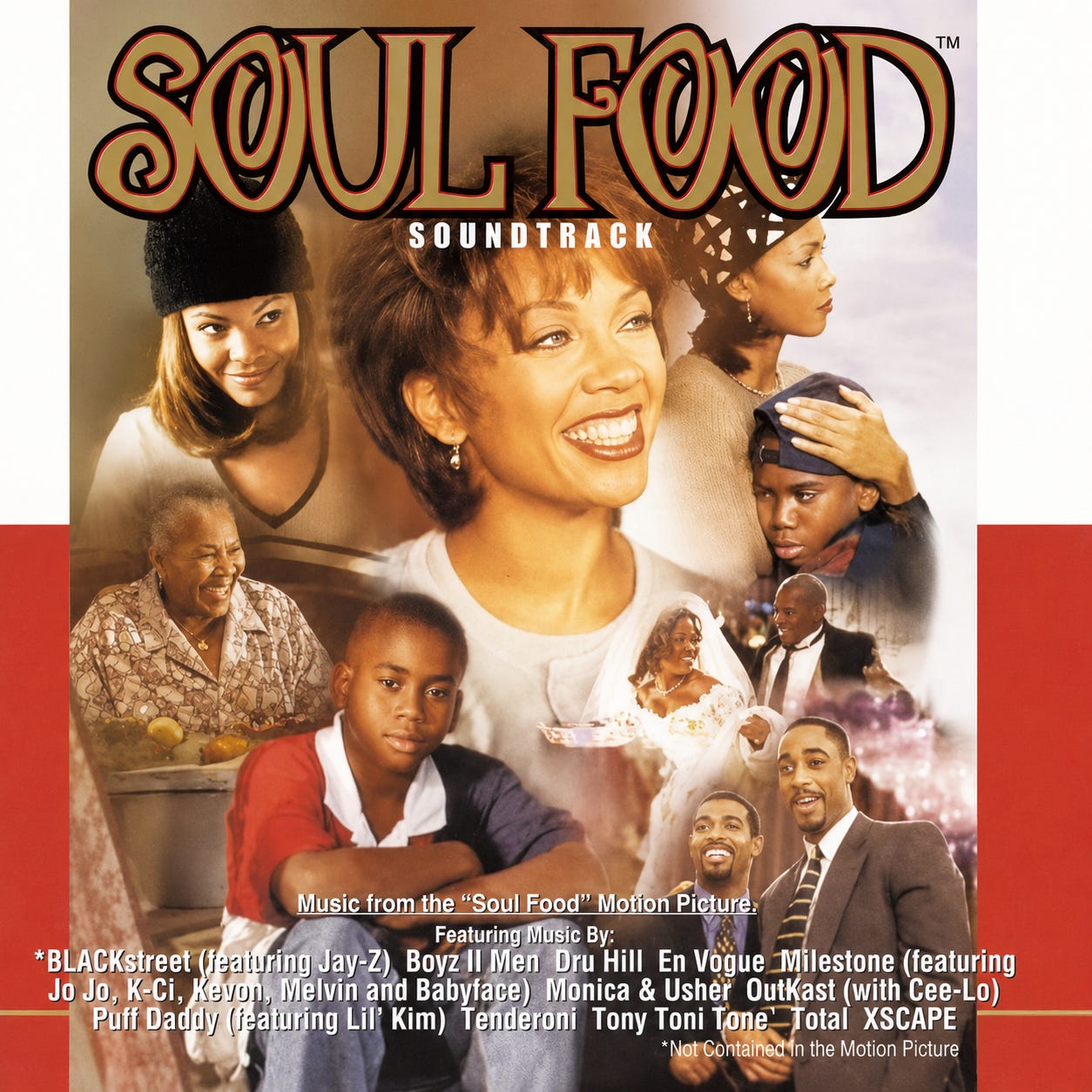
Babyface wrote “A Song for Mama” in the spring of 1997 as a piece for his brothers’ supergroup. He handed it to Boyz II Men to record instead, produced the finished version of it himself, and the song became the group’s last top-ten Hot 100 single and their last number one on the Billboard R&B chart. That cue runs underneath the opening sequence of George Tillman Jr.’s film, which Babyface co-produced with his then-wife Tracey Edmonds, as the matriarch holding the family together goes about her afternoon. Nothing else Babyface wrote in the late ‘90s put him anywhere near the neighborhood of his own “I’ll Make Love to You.”
The supergroup move here was Milestone, a one-time-only assembly of K-Ci and JoJo with Kevon and Melvin Edmonds from After 7, plus Babyface himself as the fifth member, organized specifically for this album and never reconvened afterward. Their “I Care ‘Bout You” charted into the top forty of the Hot 100. Total’s “What About Us” is one of Timbaland’s tightest 1997 productions outside his Aaliyah work. Outkast and Cee-Lo brought “In Due Time” as a LaFace roster crossover the label only ever pulled off this once. Usher and Monica handled the duet slot on “Slow Jam.” Blackstreet brought JAŸ-Z in for a guest verse on “Call Me.” Dru Hill picked up “We’re Not Making Love No More.” Two months later Boyz II Men were on the Christmas circuit performing “A Song for Mama” with their actual mothers seated in the front row.
1998
New York Undercover: A Night at Natalie’s
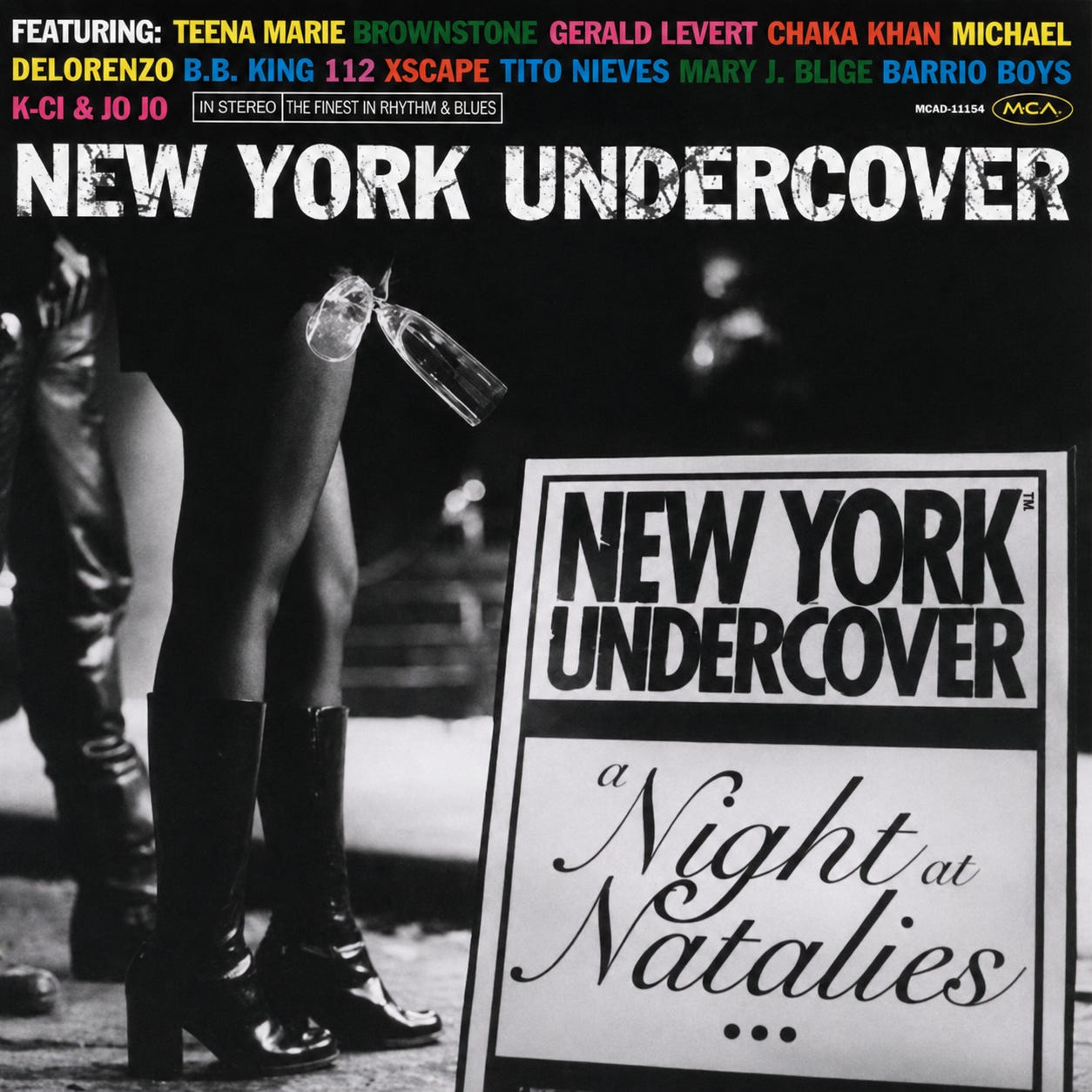
James Mtume ran the music for Dick Wolf’s Fox cop show across all four seasons, and his signature touch was the closing performance at Natalie’s, an invented Harlem jazz spot where every episode wound down with a guest vocalist stepping up to cover somebody’s parents’ favorite. Mary J. Blige sang Rufus and Chaka Khan there, Boyz II Men sang the Beatles, Patti LaBelle sang herself, En Vogue covered Tower of Power. By 1994, the Natalie’s segments were doing more cultural work than the procedural plotlines around them, and in January 1998 Mtume gathered the strongest of the performances for MCA. What Mtume assembled plays not as a tie-in but as an argument that the cover record, taken seriously, can put a younger generation’s voice next to an older generation’s catalog without flattering either one.
Of all the performances Mtume gathered, Teena Marie’s is the one to reach for first. Her reading of Rose Royce’s “Wishing on a Star” rebuilds the 1977 ballad around a Detroit vocalist who elects, against every dramatic impulse a Motown singer would bring to it, to sing below conversation level. The church run she keeps tucked under her cool only arrives once she has lulled the room into thinking she won’t reach for it. What used to be silvery longing is, once Lady Tee has finished with it, a Teena Marie record about patience.
Ride
Bill Stephney came up inside Public Enemy as the producer who helped Hank Shocklee assemble the Bomb Squad, ran his own SOUL imprint at MCA, and by early 1998 was supervising soundtracks for Tommy Boy on the side. His curatorial instinct shows up all over Millicent Shelton’s road comedy. Naughty by Nature open the LP with “Mourn You Til I Join You,” Treach reading the names of dead friends in the same exhausted prayer-cadence he had used on “Ghetto Bastard”; the song became one of the rare hip-hop elegies that played on commercial radio without somebody at the station calling for an edit. Wu-Tang Clan donated “And Justice For All,” Onyx growled through “React,” and Adriana Evans sang “Reality” as if Sade had stopped by to see what the kids in the studio were up to.
The Roots’ contribution is the one most worth tracking down for anyone who loves Things Fall Apart. It came out twelve months before that album shipped, and you can already hear Quest, Black Thought, and Hub workshopping the looser, more conversational mode they would settle into by 1999. Tommy Boy released the comp two months before the film opened, which is also a small confession about which of the two products the label believed in.
Senseless
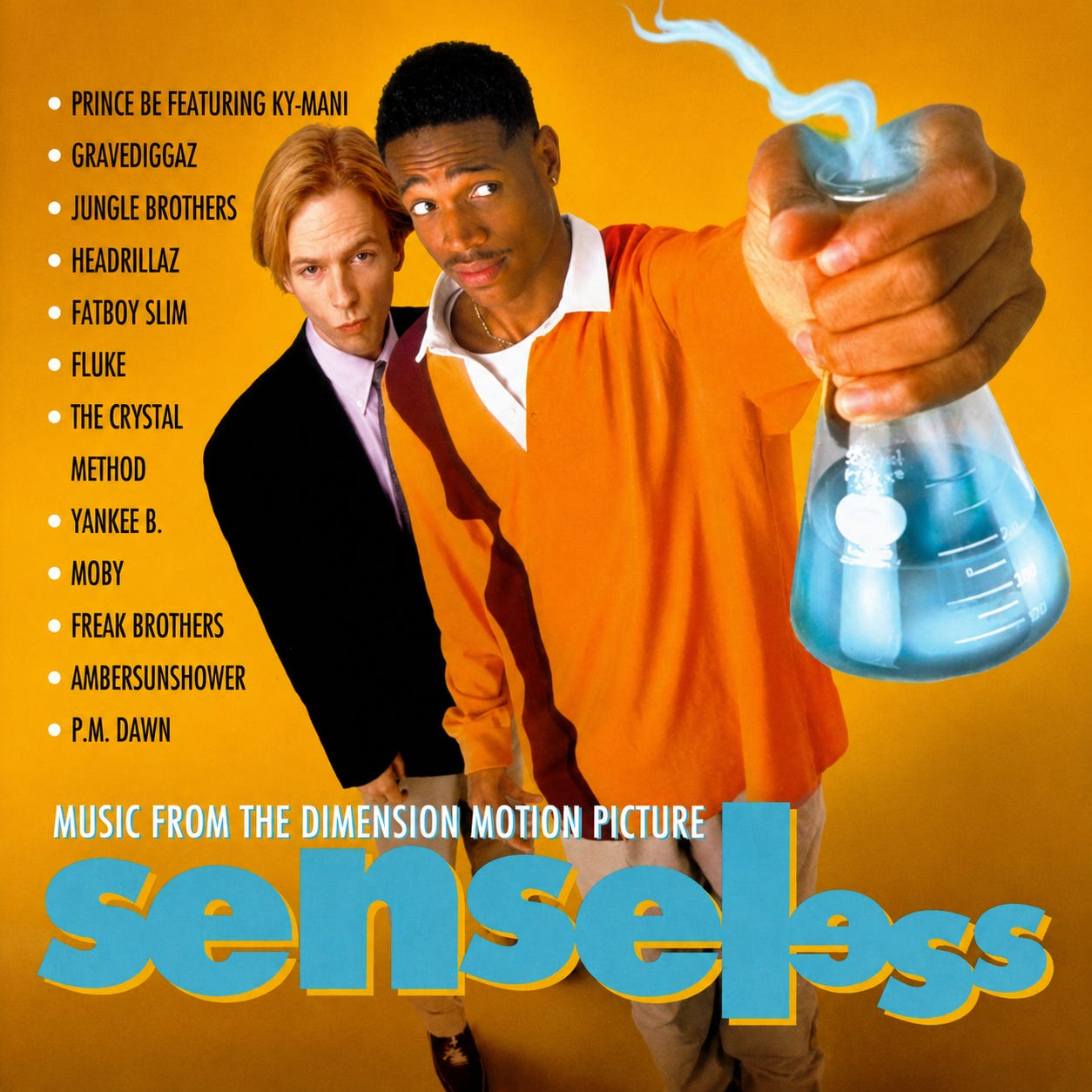
The actual Penelope Spheeris film hired Yello to score it. Yes, those Yello, the Swiss duo behind “Oh Yeah,” scoring a Marlon Wayans comedy about a college kid who takes an experimental drug and gets superhuman senses. It counts as one of the funnier production-credit one-liners of 1998, and it has nothing to do with the album Gee Street put out a week before the film opened. That sampler is a big-beat and underground hip-hop grab bag stapled to a Dimension marketing budget, with the Crystal Method’s “Busy Child” sitting at its center alongside cuts from Goldie, Stereo MCs, Roni Size, and a handful of token rap tracks tossed in at the last minute.
When the Senseless compilers got around to clearing “Busy Child,” the track was twelve months old and well past whatever it might have meant to somebody hearing it fresh off the Crystal Method’s Vegas. Hearing it sequenced next to American hip-hop in a 1998 Miramax context is a small archive of how close drum & bass came to crossing over before Master P closed the door for the rest of the decade. The compilation has its sleepers and its filler about evenly distributed, but it remains one of the few American CDs released over those twelve months you could play without skipping for somebody coming home from a Goldie set.
Caught Up
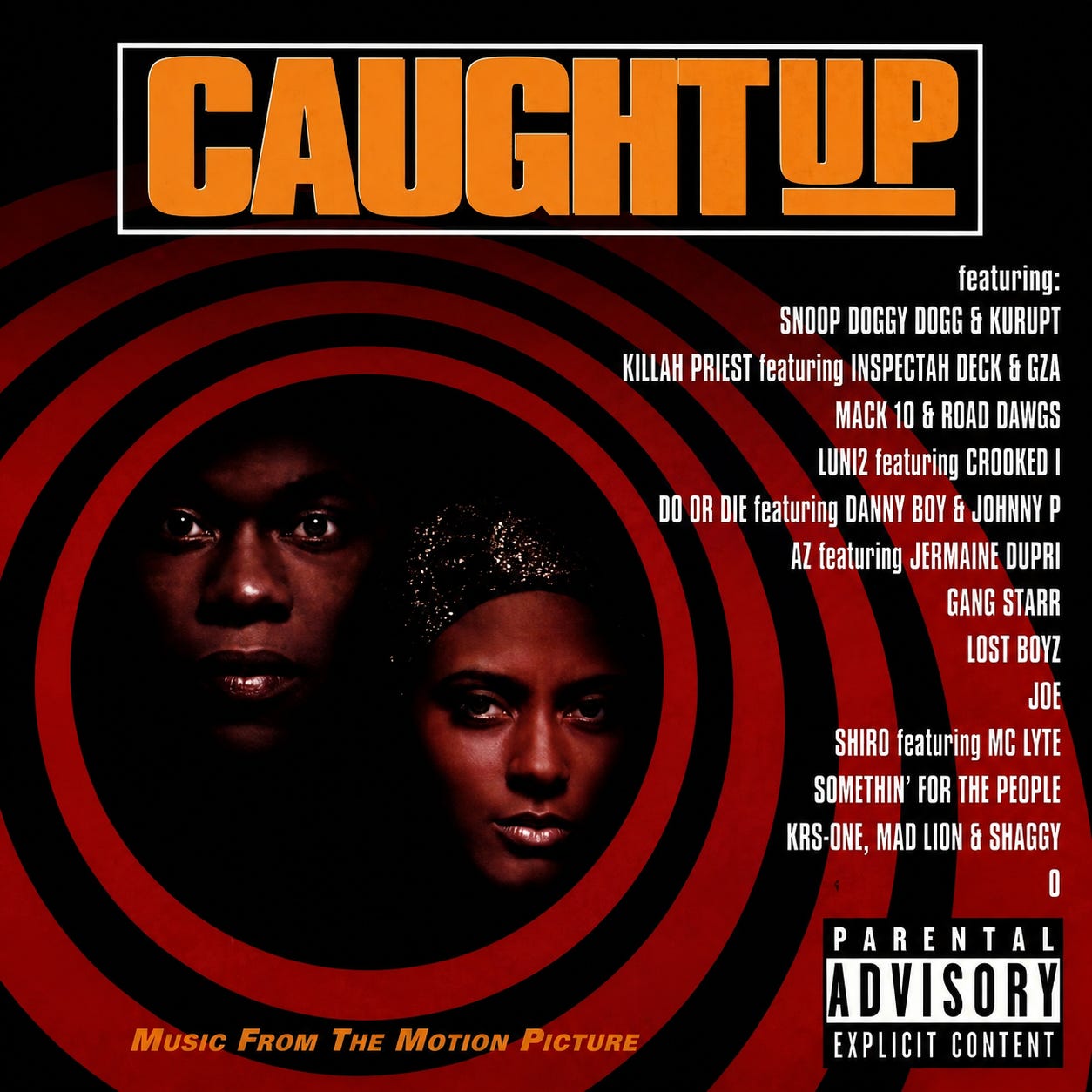
DJ Premier handed in the keeper. Gang Starr’s “Work” buries itself inside the Noo Trybe compilation, a smoky vibraphone loop dragging the drums half a beat behind where you expect them, Guru reciting the rituals of the daily grind in the flattest delivery of his career. “Work” would resurface a few months later on Gang Starr’s fifth LP, but its first appearance was here, on a companion to a Darin Scott crime picture mostly forgotten by the people who made it. Premier let one of his best beats of 1998 walk out the door for an indie film tie-in, and the trade ended up being the smartest move Noo Trybe made that spring. Around “Work,” Snoop and Kurupt rerun the Doggystyle template on the title cut, Mack 10 and Road Dawgs muscle through “You Don’t Want None,” and the Lost Boyz drop “Ordinary Guy” with Mr Cheeks sounding the way Mr Cheeks always sounded, halfway through a phone call he was hoping to get out of. Joe and Somethin’ for the People split the slow-jam slots inside what amounts to a thrift-store assembly that the Premier track alone justifies, and the full-length peaked at six on the R&B/Hip-Hop chart on the strength of nothing else.
The Players Club
Ice Cube’s first time directing a feature was also his first time supervising a companion LP, and the strip-club premise gave him a thematic permission slip to put together fifteen tracks about money and women without anybody at A&M asking what the songs had in common. “We Be Clubbin’” showed up twice, in its solo version and in a Clark Kent remix featuring DMX. Pressha’s “Splackavellie” sat in the middle of the sequence and refused to leave; the song is a slow-grind R&B ballad so committed to its own come-on it loops back into something almost wholesome. The full-length hit number two on the Top R&B/Hip-Hop chart in its first week. Entertainment Weekly told its readers to cancel their membership. Buried four cuts later sits the orphan nobody talks about until they hear it. “From Marcy to Hollywood” has JAŸ-Z, Memphis Bleek, and Sauce Money rapping over a Clark Kent brass-and-bass thump, none of them ever bothering to put it on a Roc-A-Fella album afterward. If you want to hear what Hov sounded like in the gap between In My Lifetime, Vol. 1 and Vol. 2 ... Hard Knock Life, this is the only place to find him.
Bulworth
Pras Michel and Wyclef Jean lifted “Islands in the Stream” off Kenny Rogers and Dolly Parton, kept the Bee Gees songwriting credit, and built “Ghetto Supastar (That Is What You Are)” on top of it. Mýa ended up singing lead after talking her way onto the record; Interscope had pushed for Mary J. Blige, and ODB became the deciding vote, persuading Pras and ‘Clef to use Mýa’s vocals after listening to her self-titled debut on his own time. The song peaked at fifteen on the Hot 100, hit number one across most of Europe, and has outlived almost everything else about Warren Beatty’s senator-raps picture a quarter century later.
Around the Pras single, the LP behaves the way a Soul Assassins mixtape would have behaved if it had wandered onto the Interscope lot. Dr Dre and LL Cool J turn in “Zoom,” exactly as glossy as a Dre production for an LL feature in 1998 had to be, while Method Man, Prodigy, KRS-One, and Kam pile onto the Bulworth title cut under DJ Muggs production. Public Enemy contributed “Kill ‘Em Live” as their second big-screen placement of the month after Spike Lee’s He Got Game dropped weeks earlier, and none of those supporting tracks moved the needle commercially. The Pras single did the lifting; everything else is the kind of MC roundtable Muggs and Wyclef could have assembled in a weekend, and on a few cuts it sounds as if they did.
He Got Game
Spike Lee asked Public Enemy to write a full-length companion to his Jesus Shuttlesworth picture, and Chuck D took the assignment as license to write his angriest late-period record, pulling the Bomb Squad out of retirement to produce it. Stephen Stills, of all people, came in to re-sing his own verse over the title track’s loop of his 1966 Buffalo Springfield record, a meta-historical move Robert Christgau later described as the album’s most brilliant sample deployment. Underneath the songs runs Chuck’s argument that the NCAA and the NBA are running the same hustle on Black athletes that Def Jam and Nike are running on Black rappers, and that the kid Ray Allen plays in the movie is one ankle injury away from being the broken athlete in the seventh cut who can’t get a meeting with a coach.
Masta Killa drops into the album opener for a guest verse, and Chuck D over the next dozen tracks sounds older and angrier than he had any right to, trading bars with KRS-One on “Unstoppable” as if trying to remind the younger man who taught who. A gospel-guitar dirge called “What You Need Is Jesus” sits near the middle of the album like a warning. PE charted at twenty-six in May and fell out of the top hundred by July; Robert Hilburn argued in the LA Times that the slide had nothing to do with the album’s quality and everything to do with where PE landed culturally. Rap audiences in 1998 wanted thug-life heroes their own age, and a forty-year-old Chuck D writing scripture about NCAA exploitation wasn’t what the radio wanted during the rise of It’s Dark and Hell Is Hot. The album he made anyway is the only entry on this list with an actual band, an actual record, and an actual argument running through it from front to back.
I Got the Hook-Up!
By April, No Limit was running so hot Master P could put out a tie-in to a picture almost nobody was going to see and still ship it gold inside a month. Beats By the Pound (KLC, Mo B Dick, Craig B, and the rest of the in-house production line) handled most of the release, and the same drum kits that gave Mystikal’s Unpredictable its swagger turn up here under twenty different rappers, half of them on the No Limit roster and half of them visiting from elsewhere. Master P and Sons of Funk’s title track went gold on its own, while “Ghetto Vet” gave Ice Cube one of his bleakest stories of the era, a wheelchair-bound vet narrating his own paralysis with the unsentimental precision Cube was already losing in his other 1998 verses.
The strangest collision on the LP is “Who Rock This,” where Mystikal and Ol’ Dirty Bastard share three minutes and seem to be daring each other to be the more unhinged of the two. Mystikal wins, but only just; ODB sounds as if he were enjoying himself too much to fight for it. Bone Thugs-N-Harmony show up on “Hook It Up” with Silkk the Shocker, 8Ball & MJG turn in “Let’s Ride,” and Soulja Slim’s “From What I Was Told” is one of the records that argued for him as the best rapper No Limit ever signed before somebody shot him on his mother’s front lawn five years later.
The Big Hit
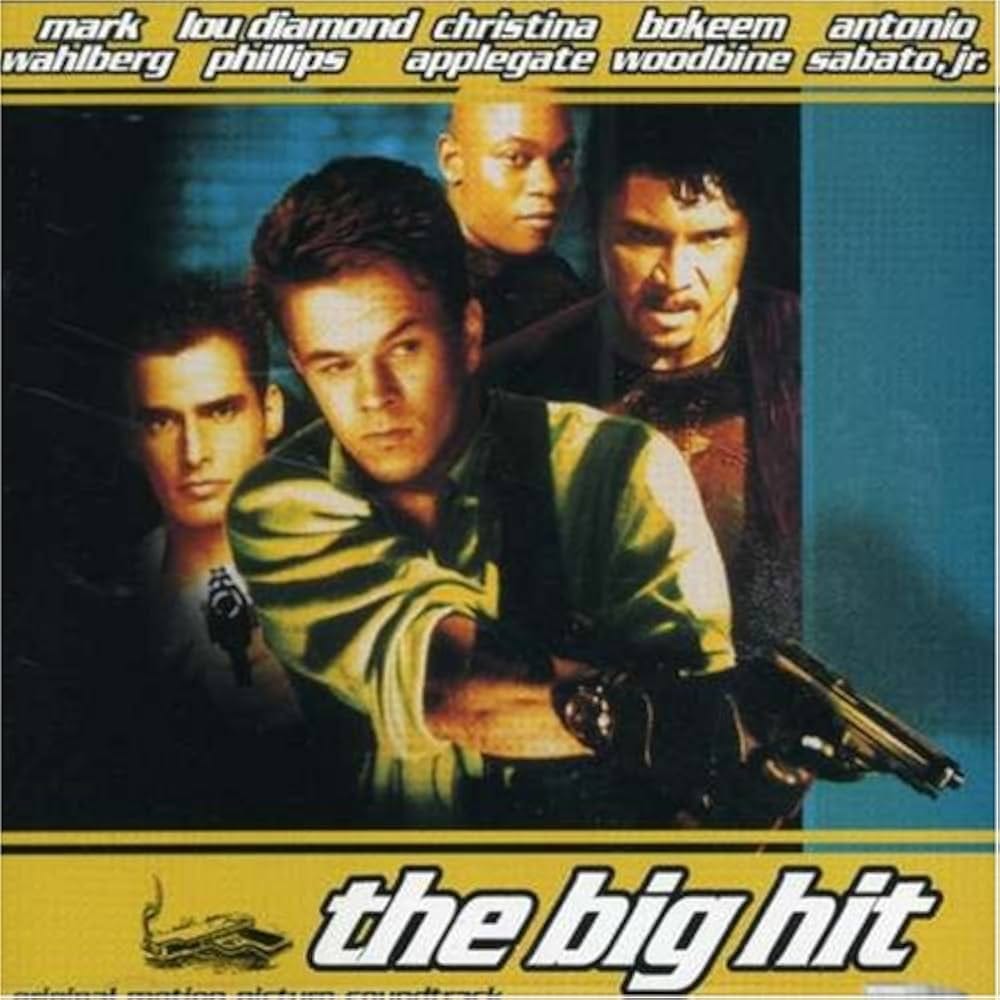
Wesley Snipes produced the Mark Wahlberg hitman comedy, and Snipes leaning on TVT for the music goes a long way toward explaining the lineup. Where else are you going to hear Buddha Monk (Brooklyn Zu, Wu-affiliate, perma-cult figure) opening a tracklisting that also makes room for E-40, Beenie Man, Bounty Killer, Funkdoobiest, Molotov, the Sugarhill Gang re-rubbing “Apache,” and Wahlberg himself on a track called “Don’t Sleep” four years after Marky Mark and the Funky Bunch officially called it? The compiler reached for whatever was available across continents and stapled the haul to a TriStar poster, and somewhere in the middle of the chaos sits a Bounty Killer record about tequila that adopts a death threat. No competing 1998 tie-in was willing to print it.
Woo
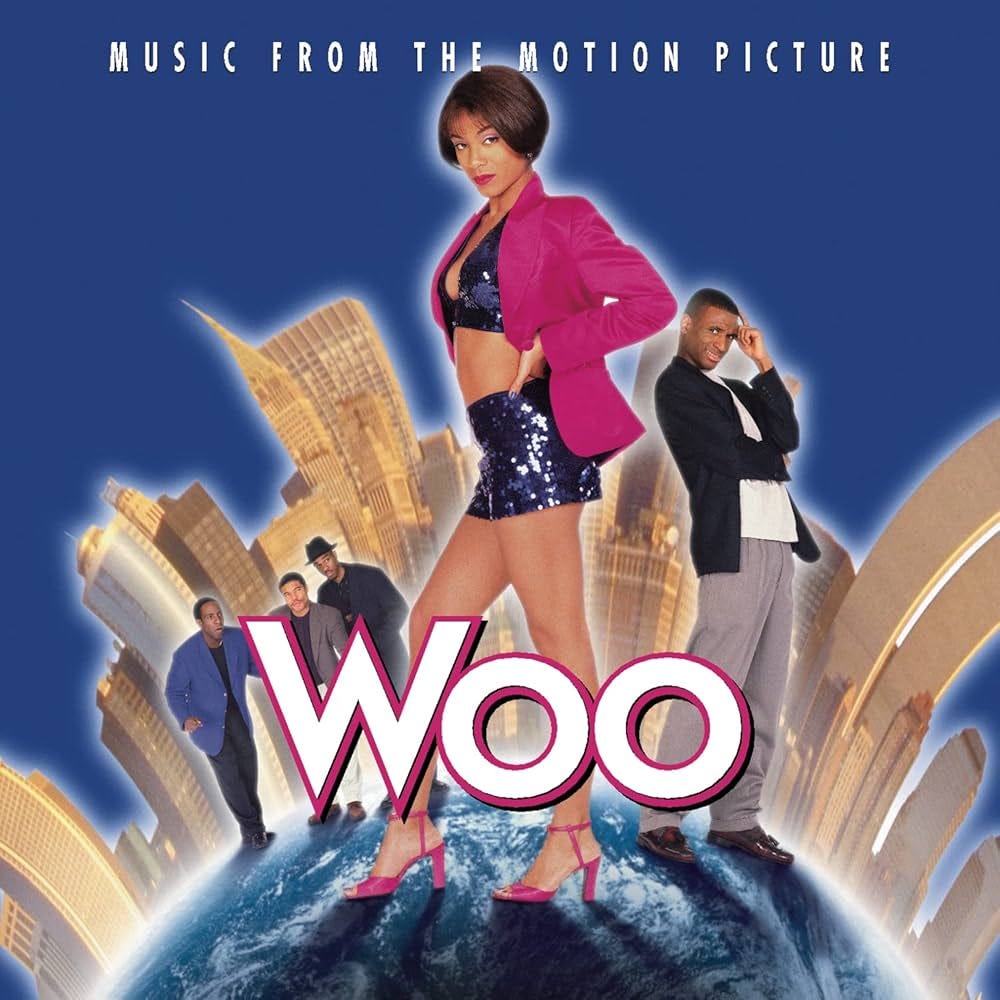
Charli Baltimore had been Lance “Un” Rivera’s answer to Foxy Brown for about a year when Epic put out the Jada Pinkett Smith vehicle’s companion LP, and “Money” is her best-aging cut from that brief Untertainment window. Charli flexes over an O’Jays sample without apologizing for it, rapping in the mid-throat zone where she always sounded most herself and least like a manufactured industry pick. Cam’ron drops “357” twelve months before he would put on a pink mink and start making the records he is actually remembered for, and you can hear him searching for a flow he had not yet settled into. Nate Dogg and Warren G handle the slow-jam slot with “Nobody Does It Better,” because that is what Nate Dogg and Warren G were for in 1998.
For a film whose entire premise has Pinkett Smith’s Woo as a Black rom-com vortex that men keep failing to date, Epic’s tracklist spends a surprising share of its running time with women rappers and singers. Charli and Allure each take a feature, Adriana Evans turns in a Chic-sampling cut, and the men around them mostly play backup. The music reads the assignment in a way the script doesn’t, putting the women up front and treating the men as guests on their record.
Streets Is Watching
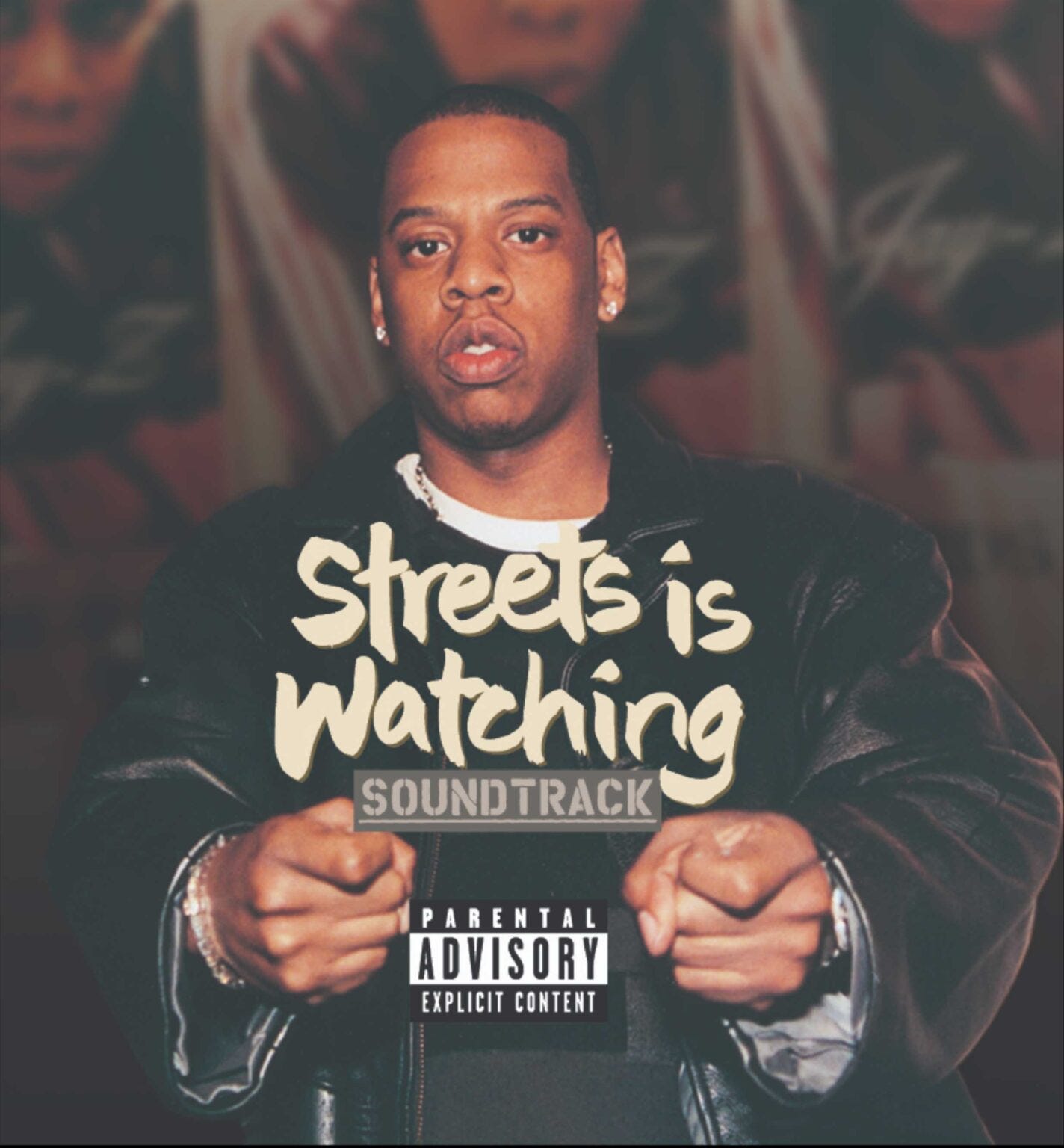
Damon Dash and JAŸ-Z put up three hundred and twenty thousand dollars (less than Bad Boy was spending on a single Mase video that spring) to let Abdul Malik Abbott string a half-dozen unreleased Roc-A-Fella clips into a continuous direct-to-video Brooklyn fable about a kid trying to outrun his corner. The Def Jam tie-in disc dropped the same day as the VHS, and its reason for living was the same as the film’s: roster reveal. Most of these names had nothing else circulating in the spring of 1998. Memphis Bleek had a handful of guest verses to his name and no album. The Diamonds in Da Rough never made another LP. Wais of the Ranjahz disappeared into the same New York rap netherworld that swallowed Sauce Money about a year later, and on this album they all sound like they’re auditioning for a label that hasn’t decided whether to keep them.
The keeper is “Murdergram,” credited to Murder Inc., which on this disc means Ja Rule and DMX and JAŸ-Z trading bars over a Ty Fyffe loop while Def Jam’s A&R department was still figuring out it had inherited three headliners at once. They sound like men sharing a hallway during a meeting that nobody’s going to give them. A year later they would be circling each other across competing platinum records, and the warmth in their voices on “Murdergram” reads now as the last unguarded session those three rappers ever cut in a single booth. The other cut worth queueing twice is “It’s Alright,” which borrows wholesale from Talking Heads’ “Once in a Lifetime,” David Byrne reborn as a man yelling down a Brooklyn block-party stairwell. Bleek’s verse on it is the best he ever sounded sharing a microphone with Jay.
Hav Plenty
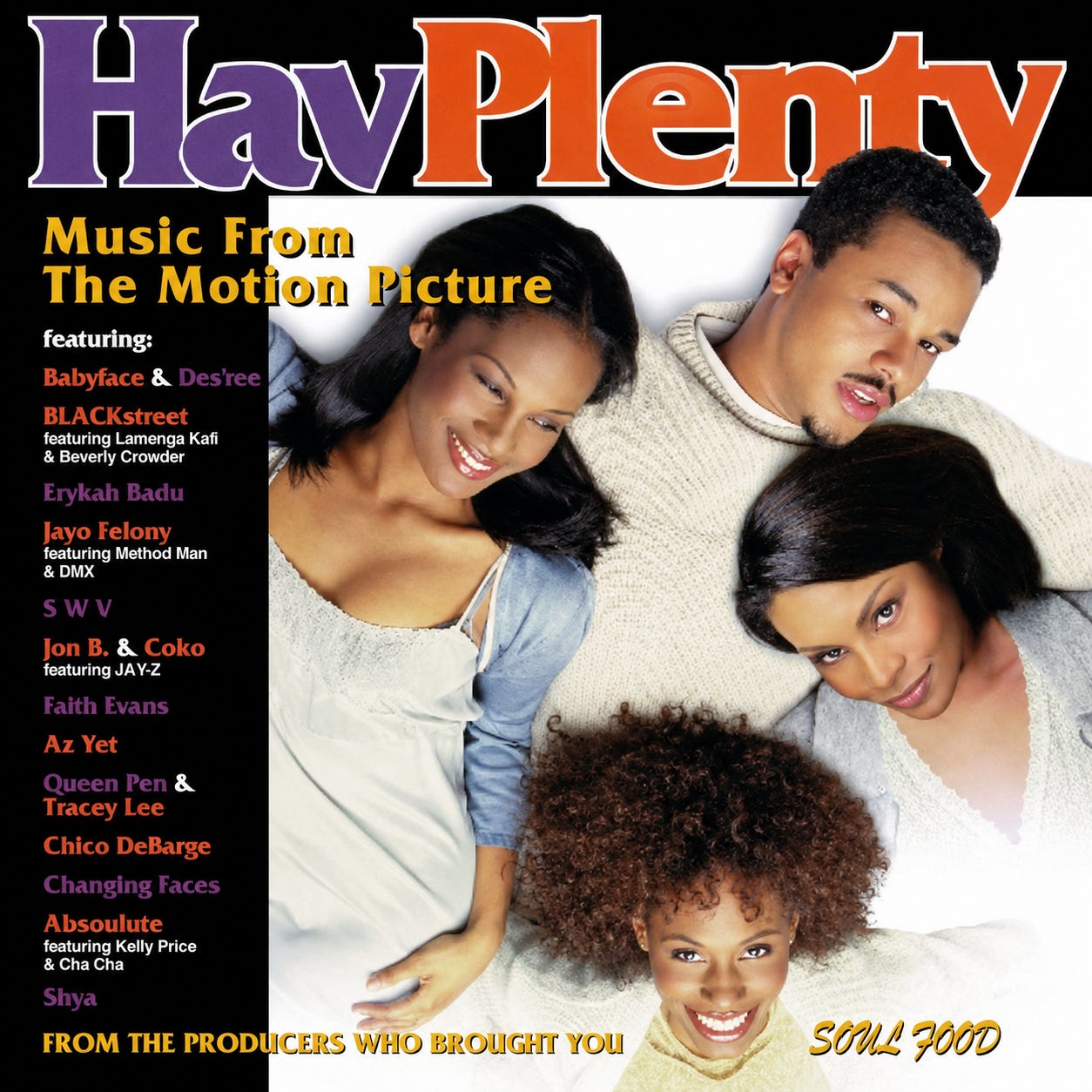
Erykah Badu donated “Ye Yo” to a Christopher Scott Cherot rom-com nobody was going to see, and a quarter century later it remains the strangest licensing decision in the wake of Baduizm. She wrote the song as a lullaby for her son Seven Sirius, born to her and André 3000 in November 1997, and she sings it at conversation volume over a bass figure that pulses behind her at the scale of an air conditioner humming through a wall. There’s no chorus on it, only a circling melody that resolves on her humming the boy’s name to himself, and you can hear her smiling through the take.
Babyface executive produced the rest of the Cherot disc and stocked it almost entirely with grown-up bedroom R&B that the polite indie rom-com Cherot directed barely had room for. Faith Evans turned in “Tears Away” while still mourning Biggie. Jon B and Coko of SWV cut “Keep It Real” with a JAŸ-Z guest verse nobody anticipated. Jayo Felony, of all rappers, pulled in DMX and Method Man for “Whatcha Gonna Do,” which had no business inside a movie about a polite Sarah Lawrence date. Cherot’s film grossed roughly two million dollars on a sixty-five-thousand-dollar budget and still vanished. Badu’s two minutes of humming for her son outlived everything around it.
Dr. Dolittle
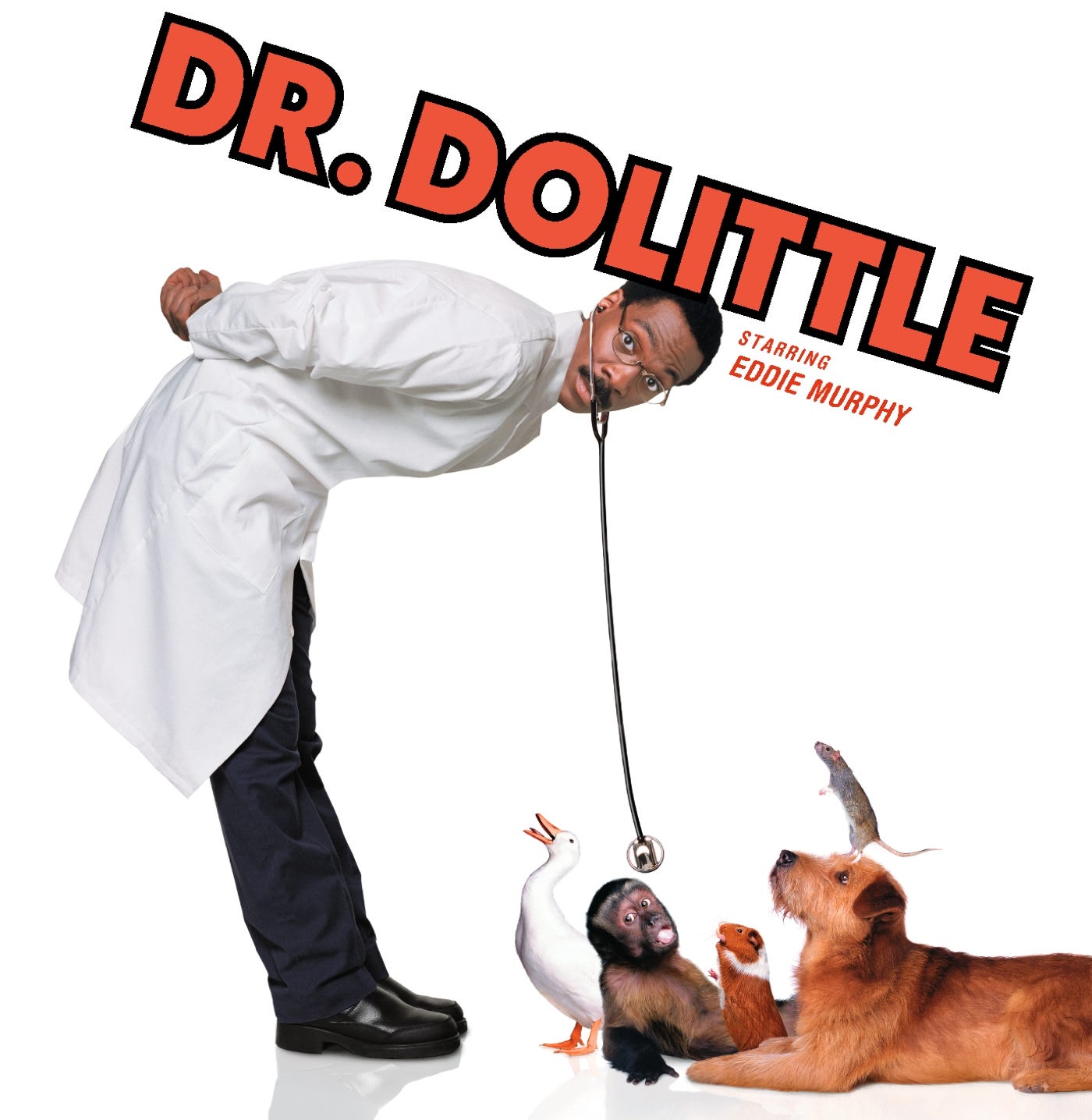
The session for “Are You That Somebody?” started at eleven at night and ran until nine in the morning at Capitol Studios in Los Angeles, with Static Major and Timbaland writing the song on the studio floor while Aaliyah cut her vocal in one continuous take. Jimmy Douglass, who engineered, called it later a soup-to-nuts job: in by midnight, mixed by sunrise, baby coos and Timbaland ad-libs added at the very end as garnish. Static built the song around a secret-relationship conceit, and Aaliyah, eighteen and three years past the annulled R. Kelly marriage nobody at Blackground was supposed to mention, sang it with the brittle precision of someone who knew exactly what kind of confession that was. The drum-and-bass skitter around her was, in 1998, the most adventurous percussion ever committed to a Top 40 R&B hit. The flamenco bridge in the music video came from choreographer Fatima Robinson, not the song.
Around it, the Atlantic disc is the kind of throwaway Eddie Murphy tax-shelter compilation that a Hollywood label puts together if it has eleven days to fill a soundtrack window. The album lists Ray J as the opener and Eddie Murphy, who starred in the picture, nowhere on the credits. Montell Jordan does a remix of “Let’s Ride” that nobody asked for. The Sugarhill Gang re-records something. Twista shares a song with Christopher Williams and the Speedknot Mobstaz that may be the strangest sequencing decision of the year. Aaliyah’s contribution at the center of it all is why the Blackground vault stayed locked for two decades after her death and why every tribute playlist in 2021 had to begin somewhere else.
Small Soldiers
Joe Dante’s forty-million-dollar Amblin movie about commando dolls that develop a bloodlust opened to soft PG-13 box office in July. Nobody at DreamWorks Records seems to have grasped that the soundtrack was the most precise prediction of where commercial radio was headed for the next four years. The whole disc was rappers remaking gritty seventies rock songs they’d grown up on, with the original singers either still in the room or scrubbed from the master. Bone Thugs-N-Harmony harmonize the Edwin Starr Vietnam protest in their queasy West Coast cluster style on “War” while Henry Rollins barks the title at them. Tom Morello plays guitar where the Motown horns used to live, Flea handles bass, and Primus drummer Tim Alexander runs the kit. Over on the Queen rebuild of “Another One Bites the Dust,” Wyclef Jean yanks the Freddie Mercury vocal off the master and drops his own gravelly bars on top alongside Pras and Canibus, with one verse from the future BET host Free squeezed in between them. DJ Kay Gee from Naughty by Nature flips Pat Benatar’s “Love Is a Battlefield” into a smooth-groove platform for Queen Latifah and Lords of the Underground while Benatar handles her own torch melody as she had since 1983.
Most of these collisions landed closer to awkward than inspired. Inspired ones got that way because everyone in the studio had agreed in advance that the joke worked only if everybody took it seriously. Wyclef’s Queen rebuild aged the best, with a Pras verse from a few months ahead of Ghetto Supastar and a Canibus appearance from the brief window when Canibus was the most feared rapper alive. The compilation peaked at 103 on the Billboard 200 in August and was off the chart inside five weeks. Twenty-seven months later, Hybrid Theory sold ten million copies on roughly the same idea, and nobody at DreamWorks ever brought up that they had been there first.
How Stella Got Her Groove Back
Jimmy Jam and Terry Lewis got the assignment for the Terry McMillan adaptation and produced the entire disc themselves, then handed the reggae spots off to Wyclef Jean and Salaam Remi because Wyclef and Salaam were the only producers in Flyte Tyme’s Rolodex who had cut a riddim track on purpose. Stevie Wonder and Wyclef rebuilt “Master Blaster (Jammin’)” into “Mastablasta ‘98” over a Donald Byrd “(Fallin’ Like) Dominoes” loop, with Stevie singing his own twenty-year-old hook in a lower octave he’d grown into rather than out of. He doesn’t sound nostalgic on it. He sounds curious about what the song would be willing to hold up if he leaned on it from a new angle.
The actual sleeper here is “Makes Me Sweat,” which paired Big Pun and Beenie Man on top of an INXS “Need You Tonight” loop and let the Bronx and Kingston meet in the middle without anybody having to apologize for being there. Pun’s verse is one of the loosest, most swaggering on tape from his short career, the kind of bar work he did when nobody was making him prove he could outrap Big Punisher; Beenie’s breathy chorus rides over Michael Hutchence’s guitar as if he wrote the riff himself. Mary J. Blige’s “Beautiful” got the lead-single push and went Top 20 R&B, but it’s the Pun cut that gives the disc its actual reason for existing.
Blade
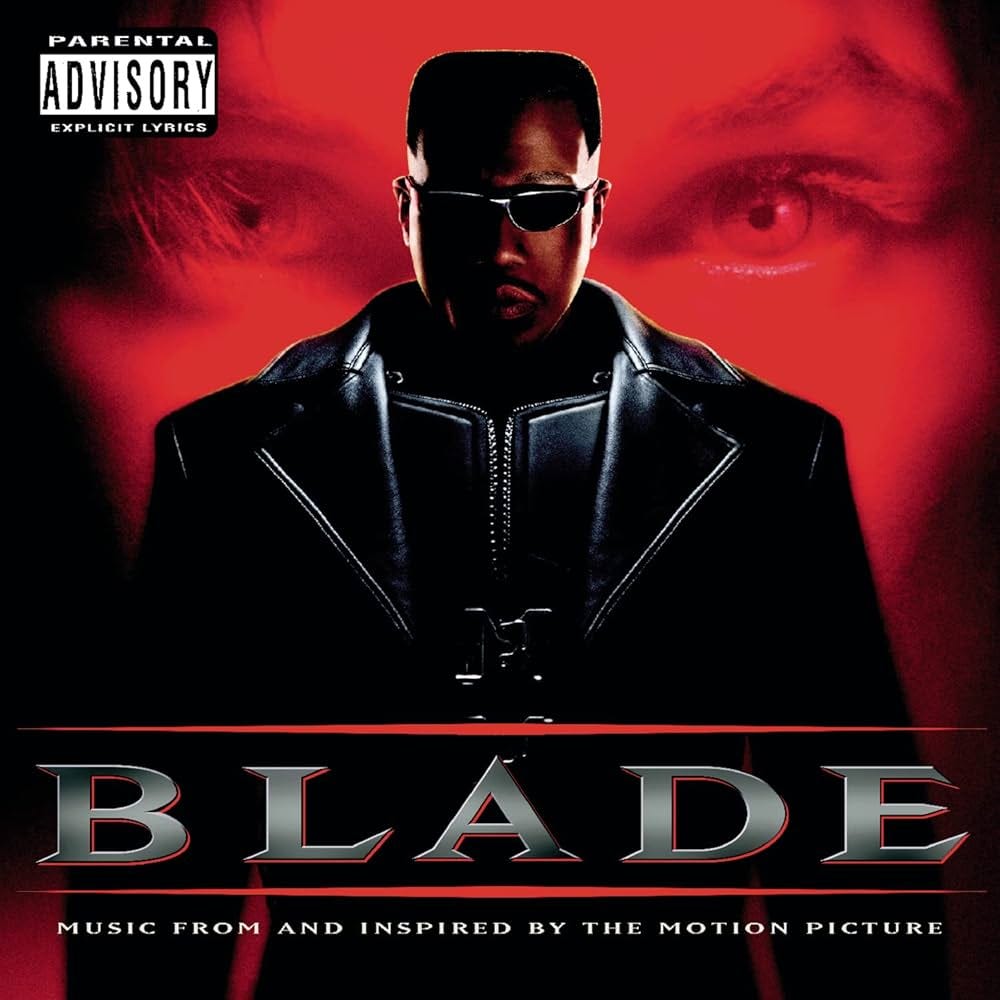
The opening of Stephen Norrington’s vampire movie drops Wesley Snipes into a Los Angeles blood rave scored by a 1995 New Order remix that until that night belonged solely to acid-house DJs and to the techno faithful who knew the names Pump Panel and DJ Rush. Within ten minutes of the credits, every person in the theater wanted to know the title of that song, which is the rarest synchronization win, the one where the soundtrack sells the scene back to the audience already standing in front of it. The Pump Panel Reconstruction Mix of “Confusion” had been sitting in record-store back-room crates for three years. Snipes used four minutes of screen time to hunt fanged extras under it and made it canon overnight.
The TVT Soundtrax compilation around the New Order cut is what a soundtrack album becomes whose executive producer is also its leading man. Mystikal opens, KRS-One and Channel Live show up around the corner, and DJ Premier handed in a Gang Starr and M.O.P. team-up called “One-Half and One-Half” that swings inside the same dusty pocket Premo would bring to the Belly soundtrack two months later. DJ Krush slips a Mo Wax instrumental in toward the close. Bounty Killer pulls Mobb Deep and Big Noyd onto “Deadly Zone,” which nobody on it would mention again. The disc went gold by spring on the back of one club hit and a Wesley Snipes co-sign, and remains the only superhero soundtrack of the late nineties to put DJ Krush on the same tracklist as EPMD.
Rush Hour
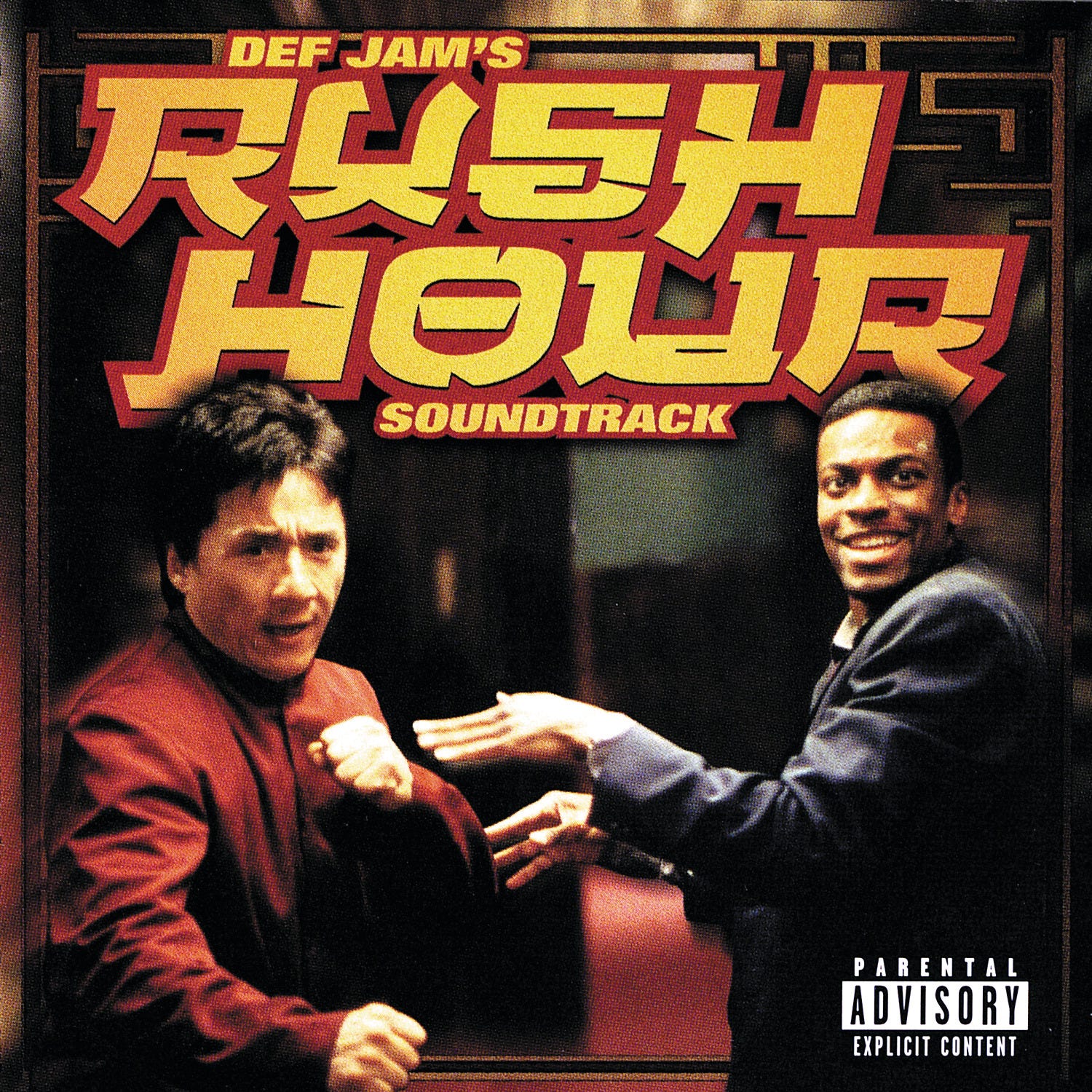
Brett Ratner directed the buddy-cop comedy and Lalo Schifrin scored it; Def Jam handled the soundtrack and made more money off it than anyone associated with the picture made off the picture itself. The lead single was Dru Hill’s “How Deep Is Your Love,” an original Dutch production with the same title as the Bee Gees record and nothing else in common with it. Sisqó and engineer Michael “Fish” Herring wrote the middle eight together in a Hong Kong hotel room during the shoot. A Redman verse got parachuted in afterward for the album version and then cut from the soundtrack edit. The song held number one on the R&B chart through the autumn and topped out at number three on the Hot 100. Sisqó had never sounded more grown on a Dru Hill record; he holds a slow-burn falsetto for whole verses at a time on it and forgets about the runs entirely.
Chris Tucker turns up between every other song doing his Detective Carter routine, riffing about radios and guns and the FBI in 30-second skits Def Jam used as palate cleansers. “Can I Get A...” introduced Amil from Major Coinz onto a Jay record and gave Ja Rule his first JAŸ-Z feature, and a month later the same arrangement of the same song would resurface on Vol. 2... Hard Knock Life and turn into the bigger hit on the LP where it had always wanted to live. Slick Rick’s “Impress the Kid” arrived as part of his post-prison comeback. Wu-Tang submitted “And You Don’t Stop,” a workmanlike compilation cut from a Clan cooking on five other projects that fall. Two singles and Chris Tucker pretending to lose his radio carried the LP to platinum by January.
Why Do Fools Fall in Love
Nine months past Supa Dupa Fly, three Grammy nominations into a career barely eighteen months old, Missy Elliott had also begun running her own Elektra imprint, The Goldmind Inc. The Frankie Lymon biopic was the first major-studio soundtrack assignment a hip-hop woman had ever been handed, and Missy made the easy creative call and the difficult business one in a single move: stock the album with her own people instead of doo-wop revivalists. She told Interview magazine that nobody was running to the store for a Frankie Lymon LP in 1998. Warner Bros., which owned both the picture and one of the two competing soundtracks, agreed enough to push the film up to August 28 and let Rhino issue a separate disc of original Lymon recordings two weeks later.
What Missy turned in for September 8 played like a Goldmind family album in soundtrack clothing. Lil’ Mo introduced herself to a national audience on a Missy production called “Five Minutes.” Mel B of the Spice Girls cut “I Want You Back” with Missy and watched it go to number one in England without help from the other four Spices. Destiny’s Child and Timbaland combined for “Get on the Bus” in the brief window before Beyoncé had ever recorded anything without Kelly and LaTavia. En Vogue handled “No Fool No More,” the only Diane Warren composition Missy didn’t produce, and the only one Cindy Herron didn’t sing lead on. Almost a decade later it remains the closest the late nineties produced to a Missy Elliott curation playlist that happened to ship with a movie-studio barcode.
Slam
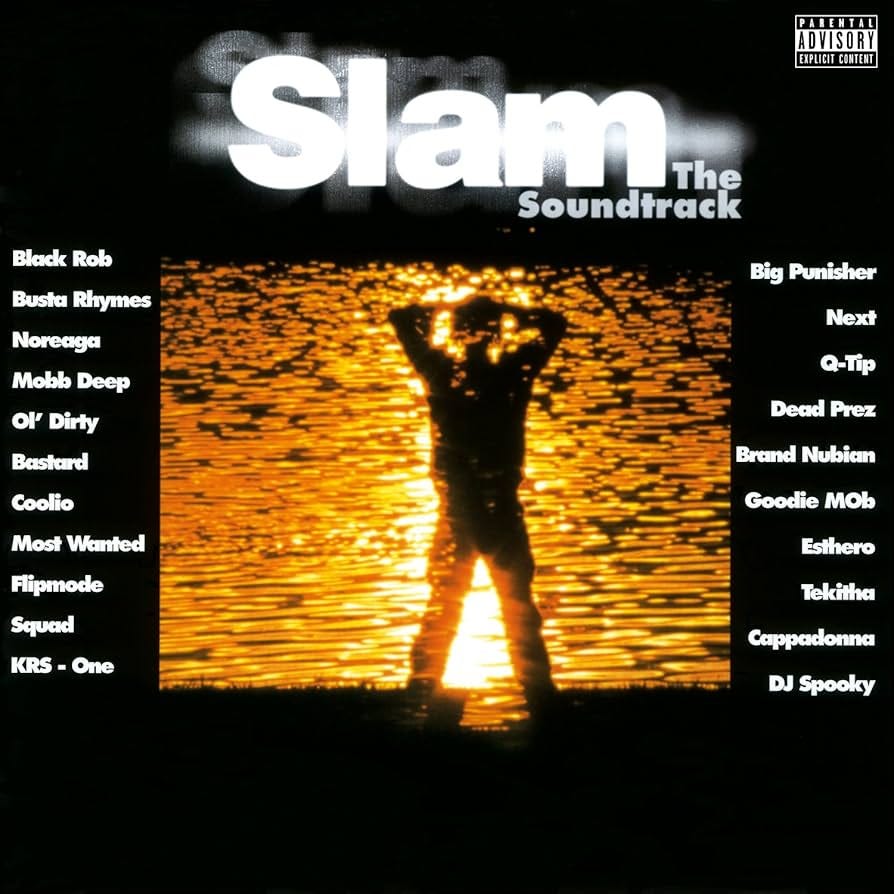
Marc Levin’s prison-poetry feature opens with Saul Williams walking down Pennsylvania Avenue with his back to the Capitol building, where the cops pop him for a chump-charge weed bust within four screen minutes, and drops him inside the D.C. jail to begin recovering himself by writing poems on commissary stationery. Two festival prizes followed: the top jury award at Sundance and the Camera d’Or at Cannes, both in the same calendar year. Saul and Sonja Sohn became stars before either had any business being one. Almost nobody who saw the picture bought the Immortal/Epic soundtrack when it arrived that October, and the reason has something to do with how little Saul Williams there is on it. Four interludes pulled directly from the film (Saul reciting “Sha-Clack-Clack,” Sonja Sohn running through “Run Free,” Bonz Malone reading from the basketball-court scene) are the sequences that made grown men weep at Park City, and they sit stranded between rap songs with no obvious tether to a poetry slam.
Most of those rap songs are very good. Big Pun’s “Sex, Money & Drugs” arrived months before Capital Punishment did and has stayed off most Pun playlists since. Mobb Deep, KRS-One paired with Saul, Brand Nubian doing the conscious cut they hadn’t done since In God We Trust, Dead Prez ten months before they were Dead Prez, Goodie Mob donating a song between Soul Food and Still Standing, ODB and Coolio paired on a song that should not work and almost does. The Q-Tip cut, produced by The Ummah, may be the best loose Q-Tip recording of the year Amplified was being assembled. The Immortal/Epic compilation peaked at 84 on the Billboard 200, which is exactly where a soundtrack album that thinks of itself as a literary tie-in always peaks.
Belly
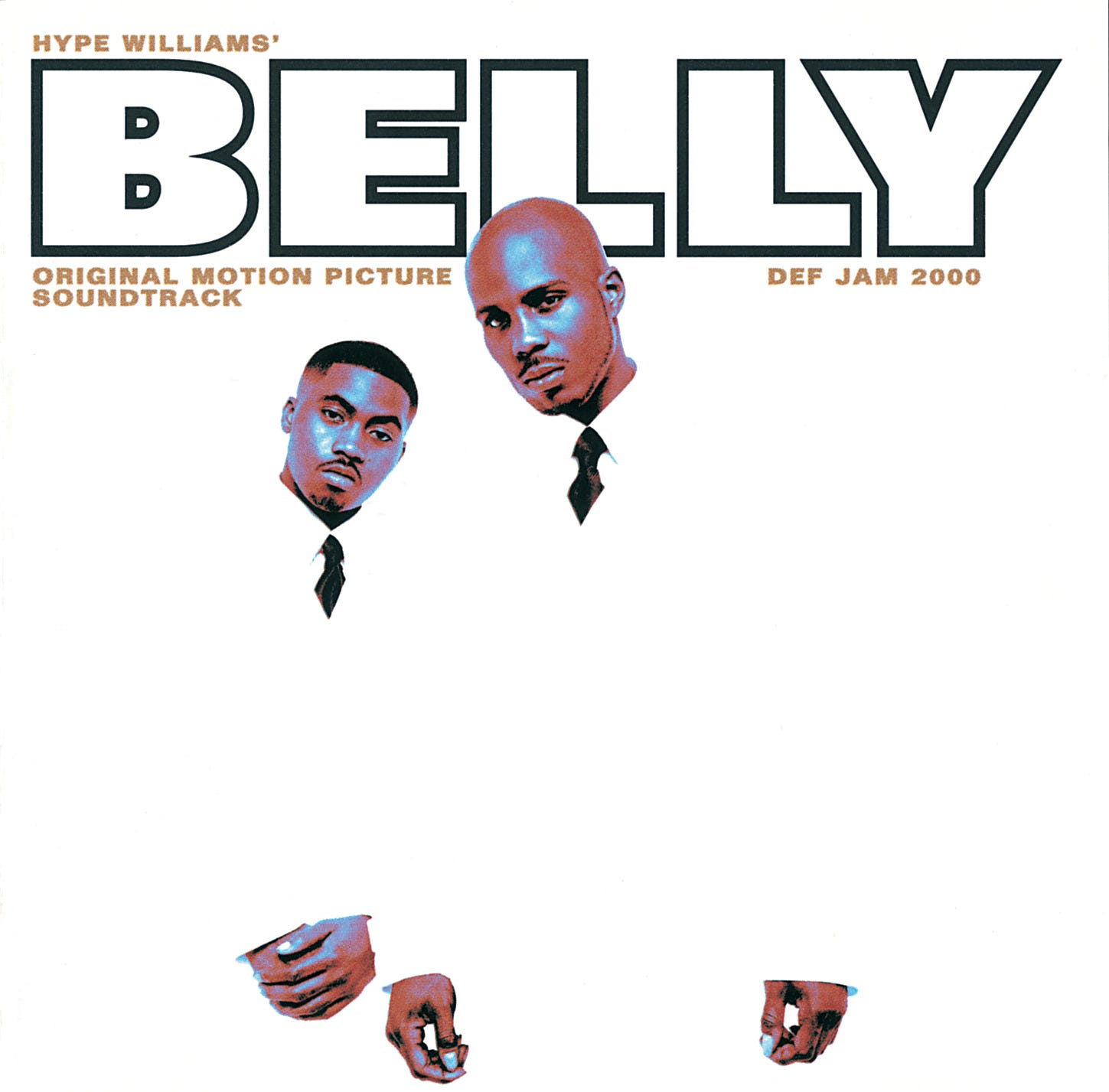
Recorded with DJ Premier the summer between Brown Sugar and Voodoo, “Devil’s Pie” was the only piece of new D’Angelo music to surface anywhere in the long stretch leading up to Voodoo. Hype Williams put the song on his soundtrack and over the closing-credit sequence of his picture, doing the moral accounting nothing else inside Belly tries to do. D’Angelo sings about the same temptations Hype’s camera spends ninety minutes coveting, except his vocal sounds wrung out by what watching friends ruin themselves chasing those temptations has cost him. The “devil’s pie” is the deal at the front door of any career in 1998 hip-hop: women, jewelry, cars, an industry promising sustenance in exchange for the listener’s spirit and the artist’s name on a contract somebody else gets to enforce.
As a Def Jam compilation, Belly is one of the deeper soundtracks anyone released in the nineties and one of the few late-decade comps that still scans as an actual album. Four of Russell Simmons’s biggest assets share a posse cut on the lead single, where DMX, Method Man, Nas and Ja Rule manage what their label boss had stopped trying to organize personally years earlier. From the Wu corner comes “Windpipe,” a rare RZA-Ghost-ODB three-way that nobody had requested and everybody needed. Mya, Raekwon and Noreaga ended up sharing “Movin’ Out” through a sequencing accident that turned into a sleeper hit. Sister Nancy’s “Bam Bam” plays under the Jamaica sequences in the picture and didn’t make the disc, which is a small theft. Hype’s movie was savaged in the New York Times the week it came out and has aged into a cult object on roughly the same timetable the soundtrack has aged into the canon.
Fakin’ da Funk
![Fakin' Da Funk - The Soundtrack – CD (Compilation), 1998 [r3539973] | Discogs](https://substackcdn.com/image/fetch/$s_!z03o!,f_auto,q_auto:good,fl_progressive:steep/https%3A%2F%2Fsubstack-post-media.s3.amazonaws.com%2Fpublic%2Fimages%2Ffc513a29-7d98-484a-8727-b5ccc9098bb0_598x600.jpeg "Fakin' Da Funk - The Soundtrack – CD (Compilation), 1998 [r3539973] | Discogs")
Tim Chey’s comedy about a Chinese baby adopted by a Black family in Atlanta and raised for seventeen years as Julian Lee, all-conference point guard, before the whole family moves to South Central, is a late-nineties identity farce that Pam Grier and Ernie Hudson and Tatyana Ali showed up for and that nobody outside of a Blockbuster new-release shelf ever heard about. The Street Solid Records soundtrack arrived two weeks after the film hit home video and has nothing to do with the movie’s multicultural thesis. Nineteen tracks of West Coast G-funk and gangsta rap, stacked entirely from the Ruthless/Death Row/Def Jam West freelance ecosystem circa 1997, with no concession to the comedy or the cross-cultural premise on the poster.
Shorty, formerly of Ice Cube’s Lench Mob, opens with “Califunk.” Mellow Man Ace, Sen Dog’s older brother and the first Latino rapper to chart a Billboard hit with “Mentirosa” in 1989, handles the title track. Dove Shack, Warren G’s Long Beach trio, drop “Low Low.” RBX, Suge Knight’s cousin and a former Death Row signee, turns in “Heatmizer.” Above the Law, Eazy-E’s old Ruthless Records proteges, bring “Smoke.” Goldie Loc, who would join Snoop’s Eastsidaz inside a year, adds “5 Dubs.” Lifestyle Crew pull Snoop himself onto “Lifestyles of a G,” which is the only reason anyone ever picked the disc up at retail. Father MC, an early-nineties East Coast R&B-rapper who had vanished from the national conversation around 1993, shows up on “Could Care Less” as if somebody at Street Solid owed him a session fee and paid it in tracklist placement. The album never charted anywhere, and it remains the purest document of what the West Coast G-funk diaspora was doing for money between Dr. Dre leaving Death Row and Snoop signing to No Limit.
Down in the Delta
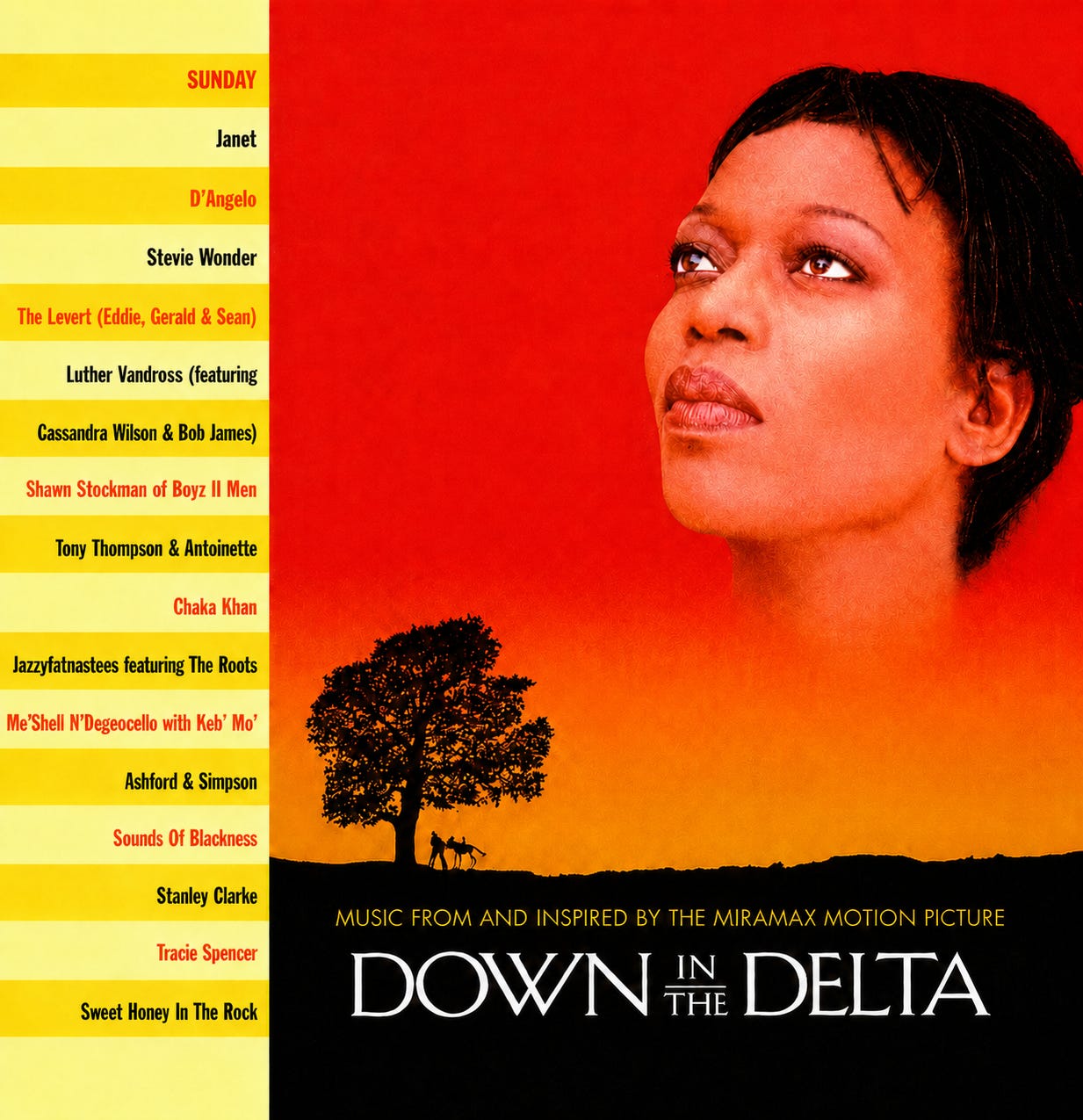
Maya Angelou directed exactly one feature film in her life, and Virgin Records put out the soundtrack for it three weeks before Christmas, after the movie had quietly opened in limited release on Christmas Day to grosses that wouldn’t recoup an Atlanta press junket. Stanley Clarke wrote the orchestral score and isn’t on the song album, which is a shame, since the song album turns out to be the most thoughtful late-1998 R&B compilation almost nobody has heard. Snipes co-produced the film, and the soundtrack producers he and Angelou assembled read accordingly: Prince, Scott Storch, Jimmy Jam and Terry Lewis, Gary Hines of Sounds of Blackness. DJ Quik produced a Tracie Spencer ballad called “The Rain” during the same week he was assembling Rhythm-al-ism.
Janet Jackson contributed “God’s Stepchild,” a Velvet Rope outtake that should have run as a single off that album and instead found its way into a Maya Angelou movie about reverse migration. D’Angelo sent in a smoky, syrupy cover of the Ohio Players’ “Heaven Must Be Like This” recorded in the same window as “Devil’s Pie” but mixed thicker and slower, with the Voodoo sketches starting to take shape inside it. Sweet Honey in the Rock’s “Patchwork Quilt” is the song the movie’s heart turns on, an a cappella benediction the five women sing in close, grainy harmony, no extra notes. Eddie Levert sings on a ballad called “Where Would I Be” alongside his sons (both already on Atlantic by then), and the Levert family sounds like kin rehearsing in a kitchen rather than a crossover act tracking for a movie label. Esther Rolle is on the cover but isn’t on the disc, and watching her rest against a porch column in the film with the Sweet Honey track playing is the most Maya Angelou minute of any soundtrack the late nineties produced.
1999
The Corruptor (The Soundtrack)
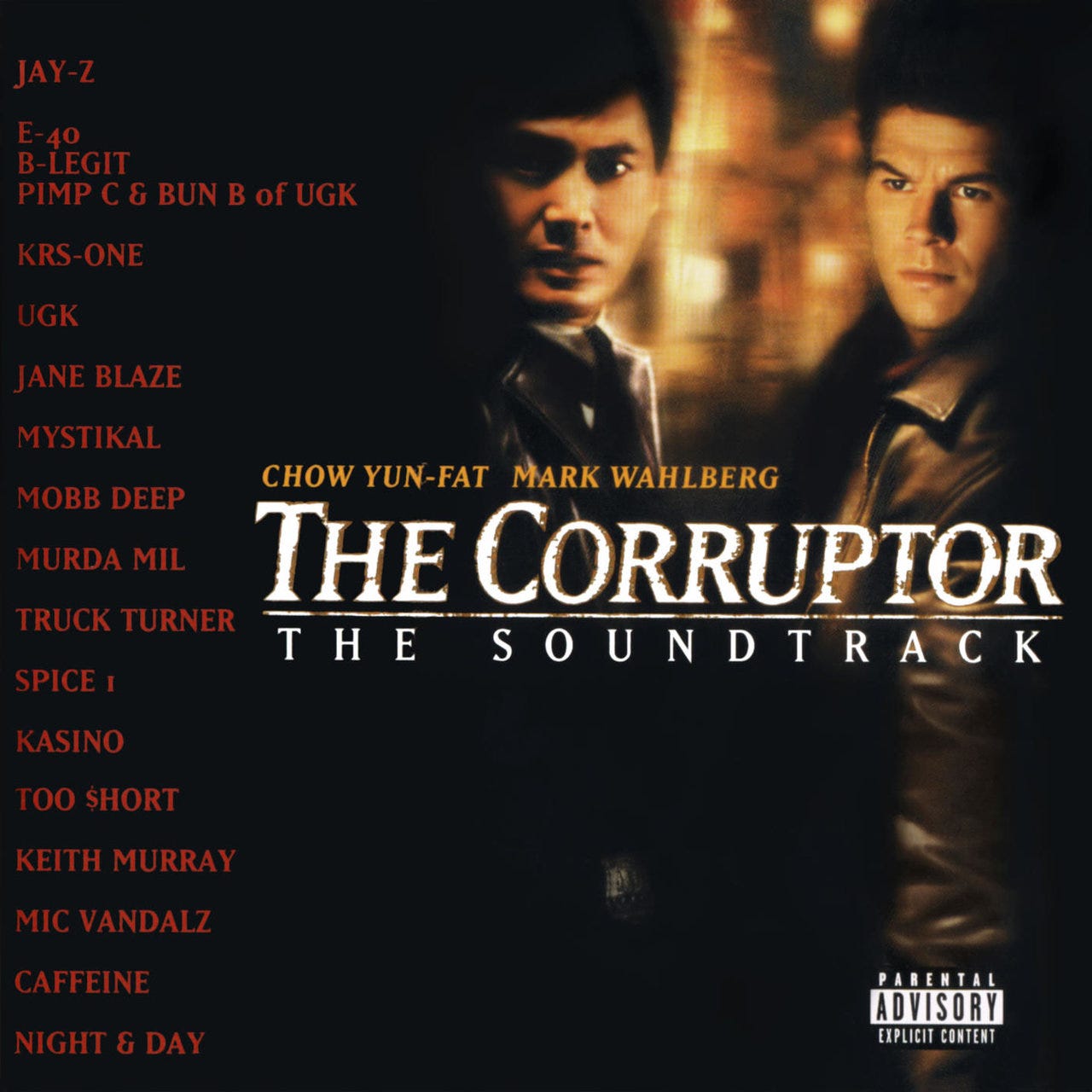
Jive Records had a small problem heading into 1999. Their flagship (R. Kelly) had committed to a different soundtrack across town. Their biggest rapper, KRS-One, was drifting away from radio. Their best young signing, Mystikal, was still finding his footing on a major. The James Foley action film about Chinatown corruption gave them a frame to flex the entire roster anyway, and they pulled one of the strangest favors of the year. KRS hosted a posse cut called “5 Boroughs” that crammed Buckshot, Cam’ron, Killah Priest, Prodigy, Redman, Rev Run, and a handful of others into one room and asked each one to rep his borough on a Marley Marl beat. Redman did Newark on a song titled “5 Boroughs” with no apology, which is the most New York move anyone has ever pulled.
JAŸ-Z’s “More Money, More Cash, More Hoes” is the other anchor here, a remix of the Vol. 2 single that pulls in Beanie Sigel, Memphis Bleek, and DMX over Swizz Beatz drums sharper and more coiled than the original’s. It is harder than the original and a useful early document of how Roc-A-Fella’s bench was already starting to crowd Jay’s frame. UGK turn in a leftover from the Ridin’ Dirty era, Mobb Deep’s “Allustrious,” knottier than anything on Vol. 2, could pass for an offcut from the Murda Muzik sessions next door, and Mystikal screams his way through “I Ain’t Playin’” with Mannie Fresh nowhere in sight. Film barely registered. What you have is a Jive yearbook in disguise.
Dollar (Soundtrack From the Original Motion Picture)
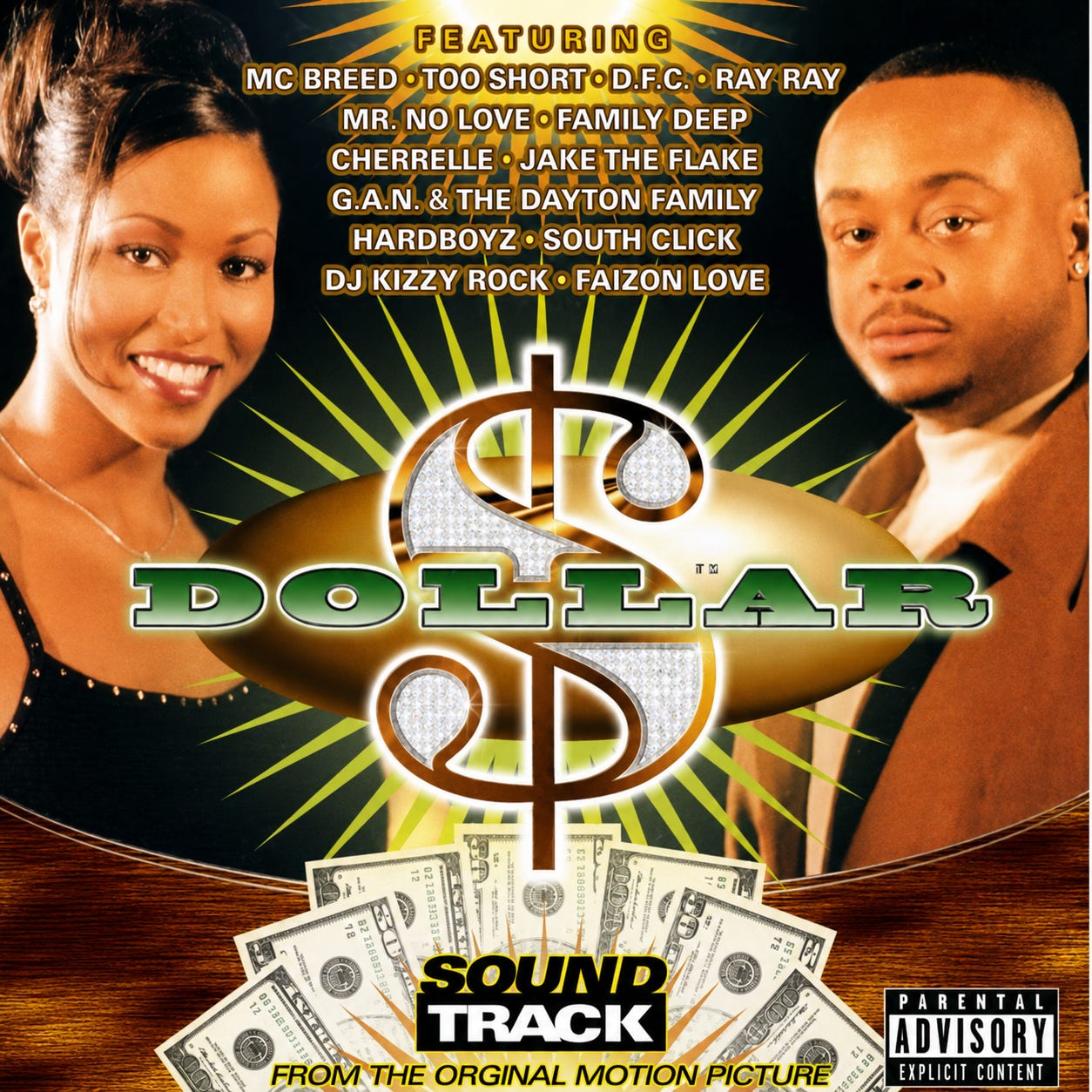
Flint, Michigan’s MC Breed was the first rapper from that area to go national, hitting the #66 spot on the Hot 100 with “Ain’t No Future in Yo’ Frontin’” in 1991, years before anyone else in the Midwest broke onto the pop charts. And then, in 1999, the rapper launched a label (Power Records) and made his own straight-to-video feature. Dollar came out months before that film was released, which speaks to the economics of a project when you need your compilation on shelves more than you need the film on a reel. MC Breed is featured three times on the album, including an updated version of his single, “Ain’t No Future,” as well as a “Conclusion” with Too $hort. The Dayton Family drops by, alongside G.A.N., on the cut “Outsiders,” and Breed’s original crew, DFC, contributes their “Listen (Five Minutes).” Jake the Flake also has a solo track. Four out of the seveteen artists featured are from the hometown, and from there the compilation reaches outward: Spice 1 and Too $hort from the Bay Area, Freaknasty and DJ Kizzy Rock, along with DJ Smurf from Atlanta’s bass music scene, ‘80s R&B sensation Cherrelle, and Friday cast-member Faizon Love, who raps his own track titled “Me Mike!” Family Deep brings an early sighting of Mac The Jacka on “Scrilla,” which is a couple of years before he became a West Coast underground favorite. South Click brings the compilation to Carolinas on the song “Carolina Bounce.” Breed died of kidney failure at 37 in 2008. He was still making music and still self-releasing at the time. Dollar is one of the few places where all of this history is documented in one place.
Life
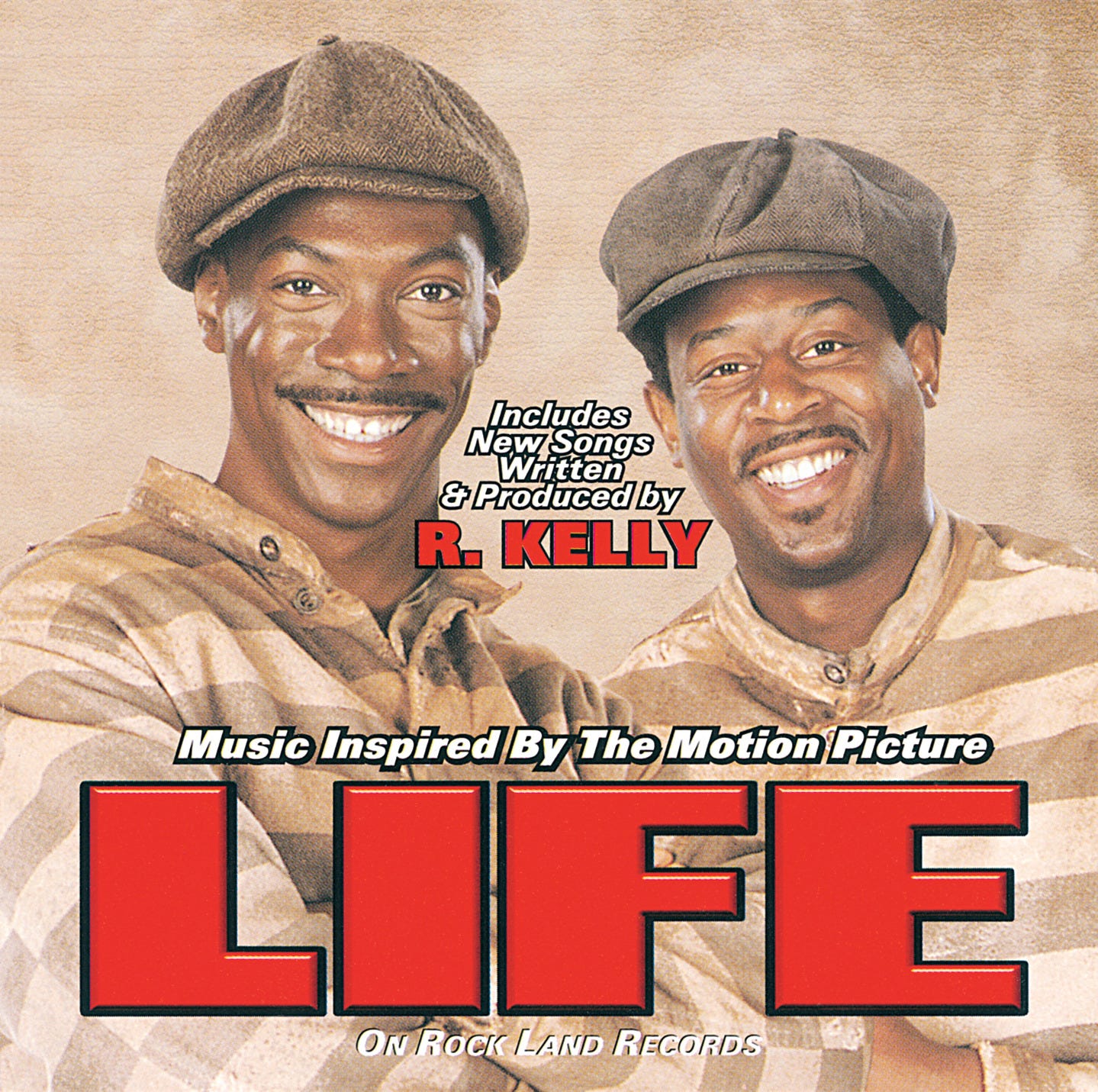
R. Kelly produced or co-produced eleven of fifteen songs, and that fact governs the whole experience. He was at the absolute peak of his abilities as a producer-for-hire, fresh off engineering Sparkle’s debut and about to start work on TP-2.com, and these sessions are where you can hear him test-driving everything he was doing for other people. The Quiet Storm guitar lines for K-Ci & JoJo, the bedroom-funk loops for Sparkle herself, the gospel-balm progressions for Kelly Price, all stitched into one cassette. Maxwell’s “Fortunate” came out of these sessions and went to #4 on the Hot 100, his biggest pop hit, written and produced by Kelly, given away to a soundtrack instead of held for Now. It’s closer to a Kelly slow jam than anything Maxwell would record on his own records, and Maxwell sings it like he knows that.
Wyclef Jean and Jerry “Wonder” Duplessis handle the rest. That split is the soundtrack’s secret math. Kelly’s eleven keep the surface smooth and Wyclef’s quartet keep poking holes in it. His “New Day,” the closing piece, sits around a Kenny G saxophone line that has no business working and somehow does. Months before The Writing’s on the Wall, Destiny’s Child slip in with “Stimulate Me.” Xzibit, Ja Rule, Juvenile, Nature plus Reptile pile onto a Kelly-produced posse cut called “25 to Life” that nobody talks about and probably should. Eddie Murphy and Martin Lawrence are barely audible.
Foolish
You could set your watch by No Limit’s release schedule in the spring of 1999. They were putting out a new record nearly every week. Master P had figured out that owning the master, the label, the publishing, and the distribution deal meant he could undercut any rap operation on the planet. The Foolish soundtrack is what that machinery sounded once applied to a mid-budget Eddie Griffin vehicle nobody asked for. The whole Tank shows up. C-Murder, Silkk the Shocker, Mystikal, Mia X, Fiend, Mr. Serv-On, Kane & Abel, Magic, Ghetto Commission, Lil’ Soldiers. The title cut (Master P with Magic and Mo B. Dick) sands Keith Sweat’s “How Deep Is Your Love” into a hook so flagrant about its source that the credit on Discogs just reads “interpolation.”
Notice how unwilling P is to costume the assembly line as anything else. The features are obligation features, the production credits are split between Beats by the Pound and whichever in-house team had a beat that Tuesday, and a third of the album is licensed Marvin Gaye, Kool & the Gang, and Parliament material from albums No Limit had the rights to slot in. It went gold inside eight weeks, and shamelessness was always the appeal.
The PJs (Music From & Inspired by the Hit Television Series)
A claymation sitcom about a Brooklyn housing tower should not have produced a record with Snoop Dogg, Da Brat, Timbaland, Destiny’s Child, Raekwon, Jermaine Dupri, and Ja Rule on it. But Eddie Murphy was an executive producer, the show was a Fox tentpole, and Hollywood Records’ Mitchell Leib used the leverage to pull an actual rap album out of the deal. Da Brat and Jermaine Dupri open it with a So So Def cut built on a sample of Jerry Butler and Marvin Yancy’s “I’m Your Mechanical Man,” recorded at JD’s KrossWire Studio in Atlanta in late 1998, and that two-minute opening tells you the deal got real money and real attention even though it was tied to a stop-motion comedy with Loretta Devine voicing the wife.
Deeper into the lineup, the choices get stranger. Snoop offers up a Cali-funk loosie that didn’t make No Limit Top Dogg. Raekwon raps a verse that scans as an offcut from Immobilarity about how he doesn’t trust his own lawyers anymore. Destiny’s Child appear here too, on yet another song they’d never get around to performing live. The whole comp is an argument that 1999’s rap business was so flush that even a King of the Hill lead-in could underwrite a real album. Most TV soundtracks of the era are vapor; this one is unaccountably legit.
Black Mask
Tommy Boy Music landed an unusual job. Artisan Entertainment had bought the U.S. rights to Daniel Lee’s 1996 Hong Kong film with Jet Li, recut it for an American teen audience, stripped out the original score, and asked Tommy Boy to commission a brand-new English-language hip-hop soundtrack to play over the top of it. What Tommy Boy delivered, in the spring of 1999, is one of the deepest underground rap compilations of the year. D.I.T.C.’s “Get Yours” gathers O.C., Diamond, Lord Finesse, plus A.G. trading verses; Natural Elements’ “Live It Up,” a cult favorite that had only existed as a 12-inch B-side; Screwball’s “F.A.Y.B.A.N.” over a DJ Premier beat; offerings from Half a Mil, Crooked Lettez, plus Council. Everlast turns up to no real effect, none of it actually appears in the movie, and all of it is sharper than the movie. The comp scans now as a snapshot of New York indie rap right before the bottom fell out of the format, costumed as a Hong Kong action tie-in and forgotten.
Wild Wild West (Music Inspired by the Motion Picture)
Past the Stevie Wonder hook, past the matching cowboy hats and the Salma Hayek cameo and the eventual Razzie sweep, this comp is one of the most quietly stacked talent dumps of the year. Lil’ Bow Wow makes his first major-label appearance on a Jermaine Dupri-produced song called “Stick Up.” Jill Scott sings her first major-label chorus on Common’s “Eight Minutes to Sunrise,” in a voice nobody outside Philadelphia poetry slams had heard yet. Kel Spencer’s first single is buried deep in the lineup (yes, the Richie Sambora guitar cameo is real). MC Lyte’s “Keep It Movin’” is one of her sharpest late-period singles. Dr. Dre and Eminem turn in “Bad Guys Always Die,” recorded during the run-up to The Marshall Mathers LP and never collected on any Aftermath release after. Slick Rick’s “I Sparkle” was produced by Large Professor.
Will Smith’s title song did what title songs were supposed to do. It went #1, sold the album double-platinum in a week, and became Smith’s best-known piece of music for reasons most fans now find embarrassing. The track interpolates “I Wish” so heavily that Stevie Wonder is technically a co-writer, and Kool Moe Dee re-recorded his original “Wild Wild West” chorus from 1988 to make the loop legal. Rap fans relegated the whole movie to camp inside of three years. Almost everything else on here got overshadowed in the process and deserves another listen.
Black Gangster (Original Soundtrack)
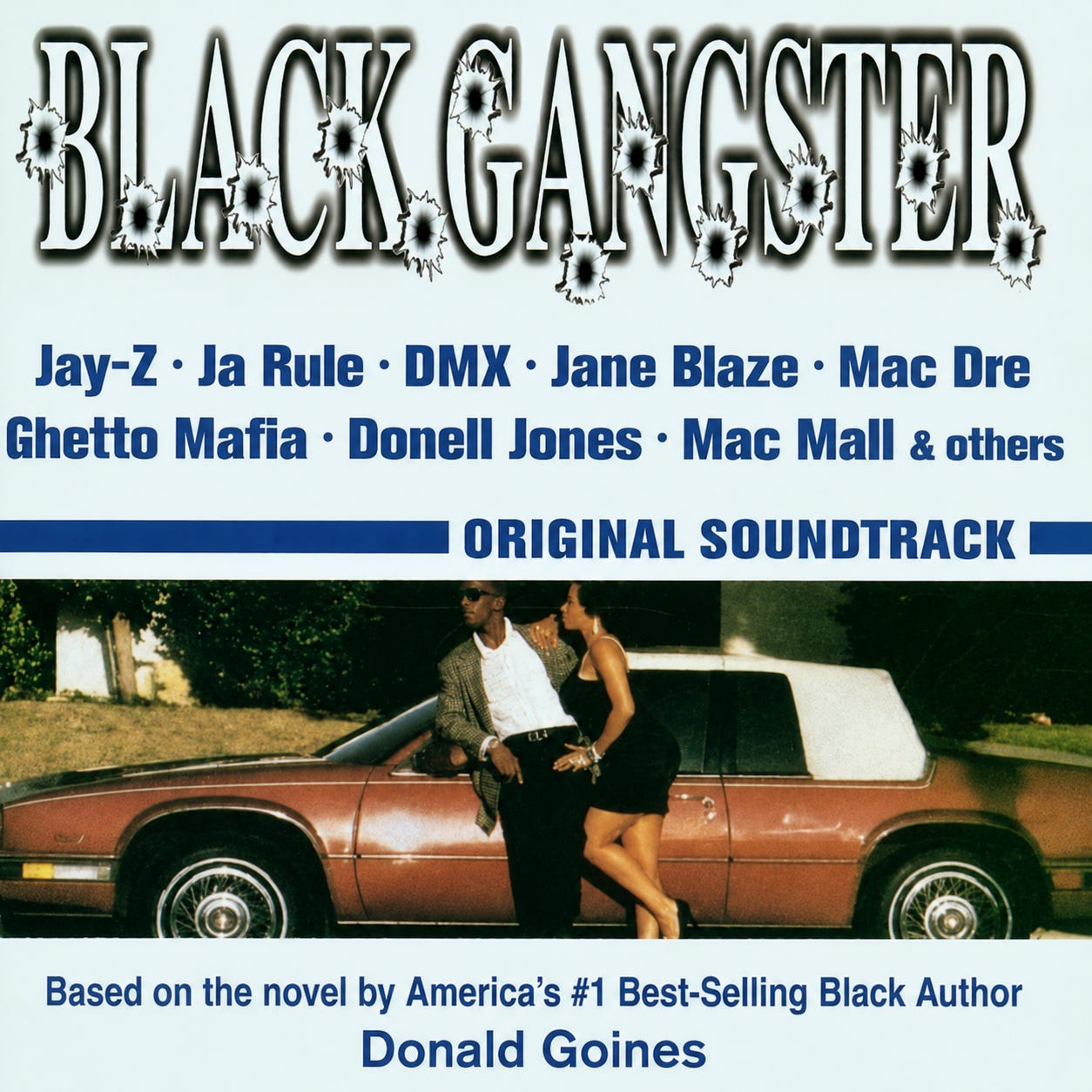
Donald Goines wrote sixteen pulp novels about Detroit hustlers between 1971 and his murder in 1974. No Hollywood studio ever touched them in his lifetime or for decades after; the first film version of a Goines book wouldn’t arrive until 2001. What did arrive in 1999 was the Black Gangster “soundtrack,” assembled by Chaz Williams of Black Hand Entertainment as a rap-album companion to the 1972 novel, commissioned for a movie that never got made. Williams asked the New York rappers he knew to read the book and come back with songs about what they were feeling. JAŸ-Z turned in “This Life Forever,” a Ty Fyffe-produced cut sober enough to slot into The Dynasty. Ja Rule did “Represent.” DMX growled “The Story” over a Dame Grease loop as barbed as anything on Flesh of My Flesh. Mac Mall, Donell Jones, Freddie Foxxx, and Ghetto Mafia filled out the disc.
What makes the comp louder every year is a name at track twelve. Williams, whose street alias was Slim, had a protégé from the 40 Projects in Queens who still had no label deal and no album out. Slim put him on the album anyway. “Fifty-Cent” rapping “You Ain’t No Gangster” is the earliest commercially available 50 Cent performance most listeners will ever hear (outside of the you-knew-what), months before he’d be shot nine times outside his grandmother’s house, four years before Get Rich or Die Tryin’. He comes off as a hungrier, less polished version of the rapper he’d become, same flow, same threats, fewer hooks.
The Wood
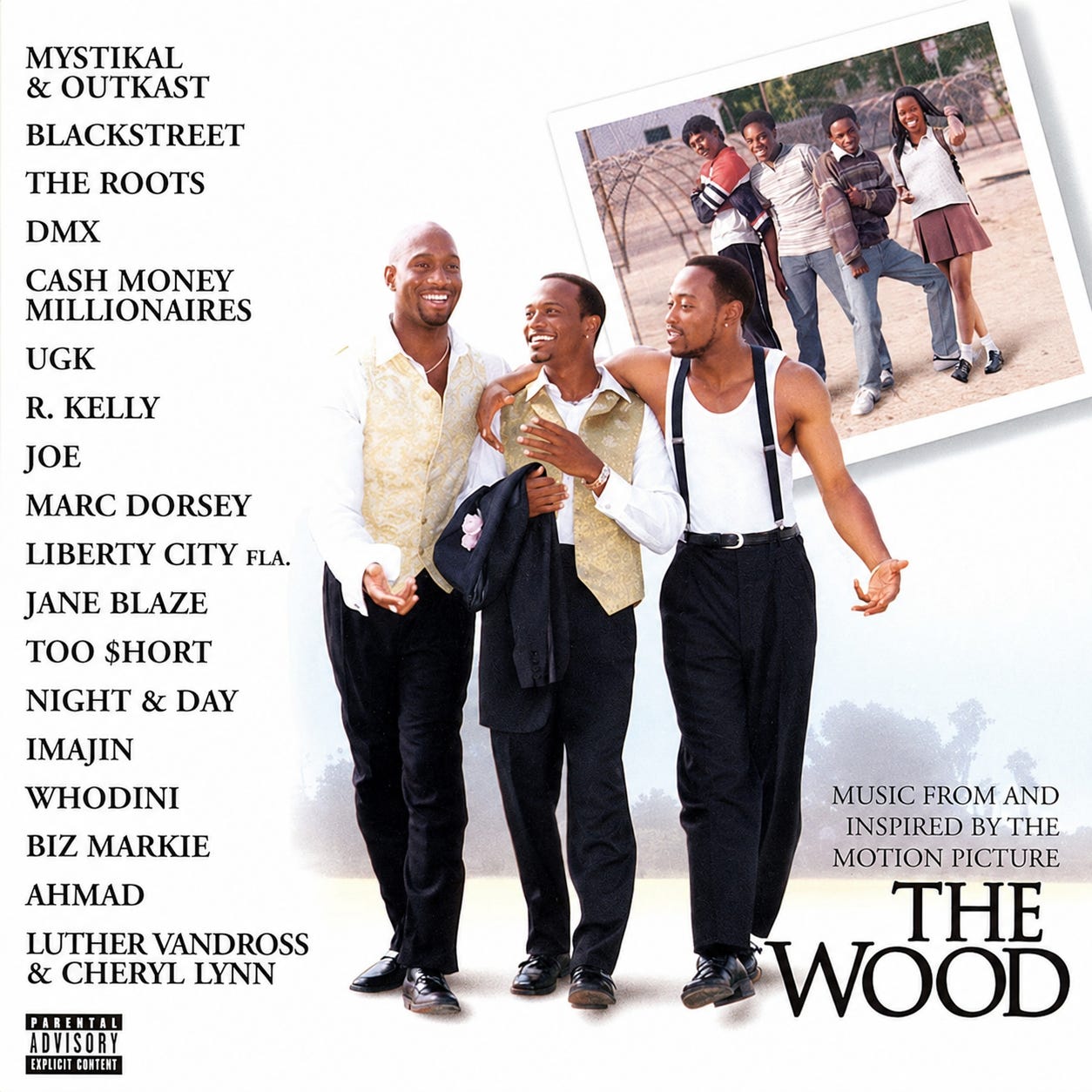
Inglewood doesn’t get coming-of-age films. Rick Famuyiwa’s debut, about three Black friends drifting between 1986 and the present-day ‘90s, sets the city as a place where ordinary kids grew up rather than a site for trauma porn or moralizing. The soundtrack mirrors that bifurcation by stitching together two separate decades of music as if they were one continuous tape. On the 1999 side, you get Mystikal and OutKast’s “Neck Uv Da Woods,” a Southern declaration with Big Boi and André trading bars over Mannie Fresh-adjacent drums; The Roots’ “Ya’ All Know Who!”; DMX’s clipped, jabbing “I Can, I Can”; UGK’s “Belts to Match” with Smitty and Sonji; Joe’s “I Wanna Know,” which would chart for half a year and become the inescapable wedding song of the early 2000s. On the 1986 side, you get Whodini’s “Freaks Come Out at Night,” Biz Markie’s “Make the Music with Your Mouth Biz,” and Luther Vandross and Cheryl Lynn’s “If This World Were Mine.”
Nothing on the soundtrack quite reaches Famuyiwa’s film; the better measurement is whether the music carries itself the same way, with Black kids in Inglewood as the default, the wallpaper, the air of an ordinary American childhood instead of a sociology assignment. Blackstreet’s “Think About You,” Ahmad’s “Back in the Day” remix, R. Kelly’s “It’s All Good,” Marc Dorsey’s “Crave”—these are the songs you’d actually have heard if you were 17 in ‘99 and your parents grew up on Whodini, and that continuity is the comp’s whole reason for being.
Whiteboys
Marc Levin shot a satire about three white kids in Holyoke, Iowa, who decide they’re hip-hop, and the soundtrack TVT released for it is mostly posse-cut adjacent New York and Memphis material. Big Pun, Raekwon, Buckshot, Three 6 Mafia, Common with Slick Rick, Snoop Dogg with T-Bo, Trick Daddy, Smif-N-Wessun, Canibus. Hardly any of the artists on it are the kind of rappers the kids in the movie idolize, which is the joke. The compilation was made by people who know rap, for a film about people who don’t. The song to find is Common and Slick Rick’s “Don’t Come My Way,” where Rick raps from the perspective of a junkie watching Iowa kids show up to buy crack and deciding to set them up to be killed. Common spends his verses ventriloquizing the residents of the projects the kids walk through, watching the visitors get shot at the end. The film barely got released. The song is one of Slick Rick’s most deadpan-vicious performances of the decade, and barely anyone has heard it.
Deep Blue Sea (Music From the Motion Picture)
LL Cool J had a problem on the Deep Blue Sea set. Renny Harlin had cast him as Preacher, the wisecracking cook, and asked him to record a song for the credits. The song he wrote, with help from Trevor Rabin, was “Deepest Bluest (Shark’s Fin).” The chorus repeats one line, “deepest, bluest, my hat is like a shark’s fin,” until you can’t tell whether it’s a threat or a joke. LL has been asked about the song in interviews for twenty-five years and still answers as if writing it had been ordinary professional behavior. The rest of the soundtrack runs Hi-C, Cormega, Bass Odyssey, mostly West Coast rap with a couple of R&B detours, and got buried under the LL track, the movie’s ending, and the Samuel L. Jackson scene everybody quotes.
In Too Deep
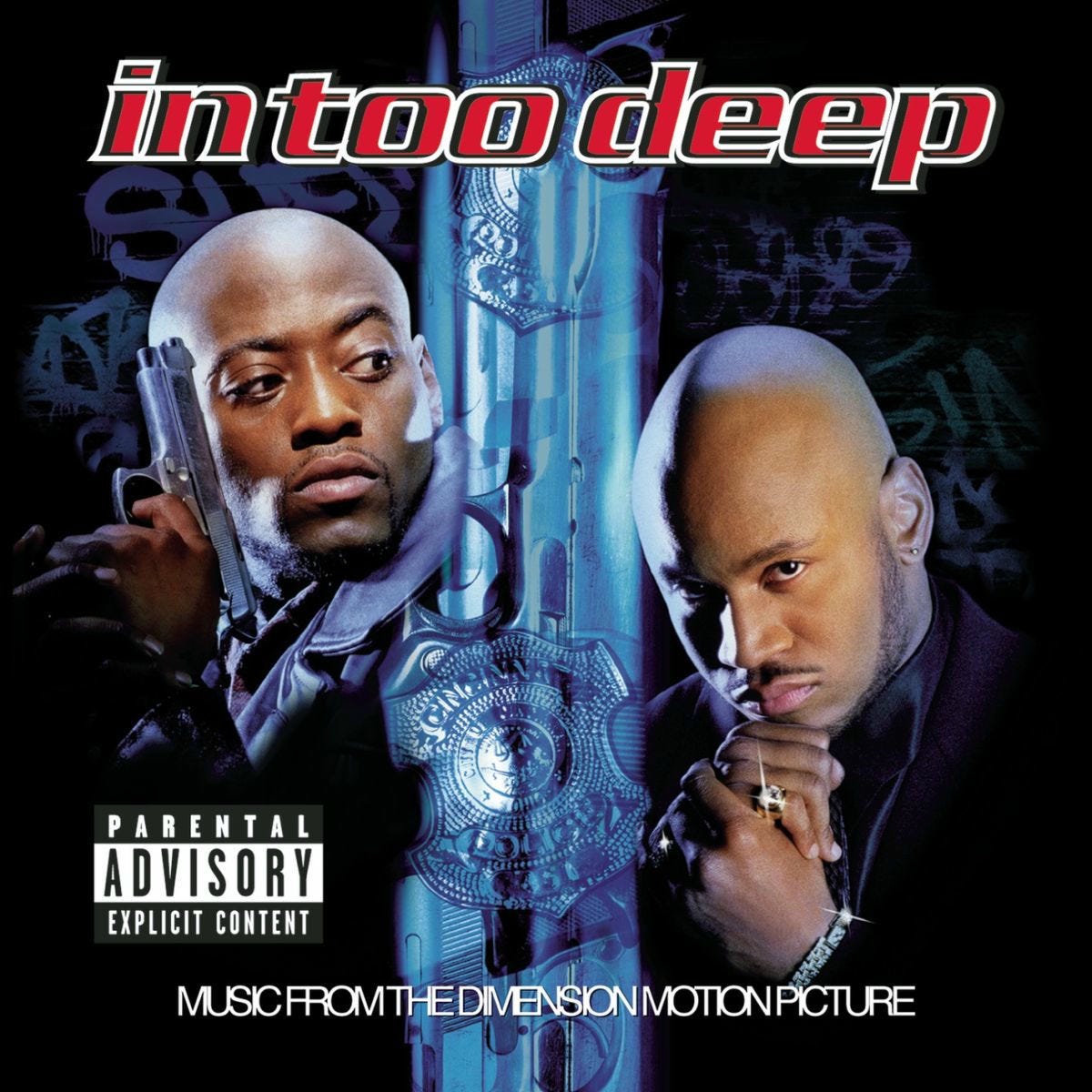
LL Cool J playing a drug lord named God in a Dimension Films undercover-cop thriller should have been the headline. Instead the Trackmasters-supervised soundtrack Columbia assembled for it became the launchpad for 50 Cent’s entire career. “How to Rob,” produced by Poke and Tone, is a fantasy where an unsigned Queens rapper names every star in hip-hop and R&B and describes exactly how he’d rob each one. JAŸ-Z, Jada, Puffy, Busta, Timbaland, Bobby Brown, Wu-Tang—nobody is safe. The song was meant to lead off 50’s debut album Power of the Dollar, but Columbia shelved that record after he was shot the following spring; the In Too Deep comp is the only major-label home “How to Rob” had in 1999. It charted at #24 on the Hot Rap Singles and turned 50 from a Trackmasters protégé into the most talked-about new voice in New York rap overnight. He also shows up on a second cut, “Rowdy Rowdy,” as if to remind Columbia he wasn’t going away.
Nas and Nature share the title song. Method Man and Redman turn in “Tear It Off.” Mobb Deep’s “Quiet Storm” remix with Lil’ Kim, one of 1999’s most played rap singles, landed here before it landed on Murda Muzik. Capone-N-Noreaga bring The LOX for “Bleeding from the Mouth.” Jill Scott, two months removed from singing on the Wild Wild West comp, shows up again with “Dreamin’,” her second major-label placement of the year, still twelve months before Who Is Jill Scott? would make her a household name. Trick Daddy, Jagged Edge with Jermaine Dupri, Ali Vegas from Queensbridge, Dave Hollister, and the Product G&B with Pras from the Fugees fill out the rest. Omar Epps and LL Cool J are barely visible behind it.
Blue Streak (The Album)
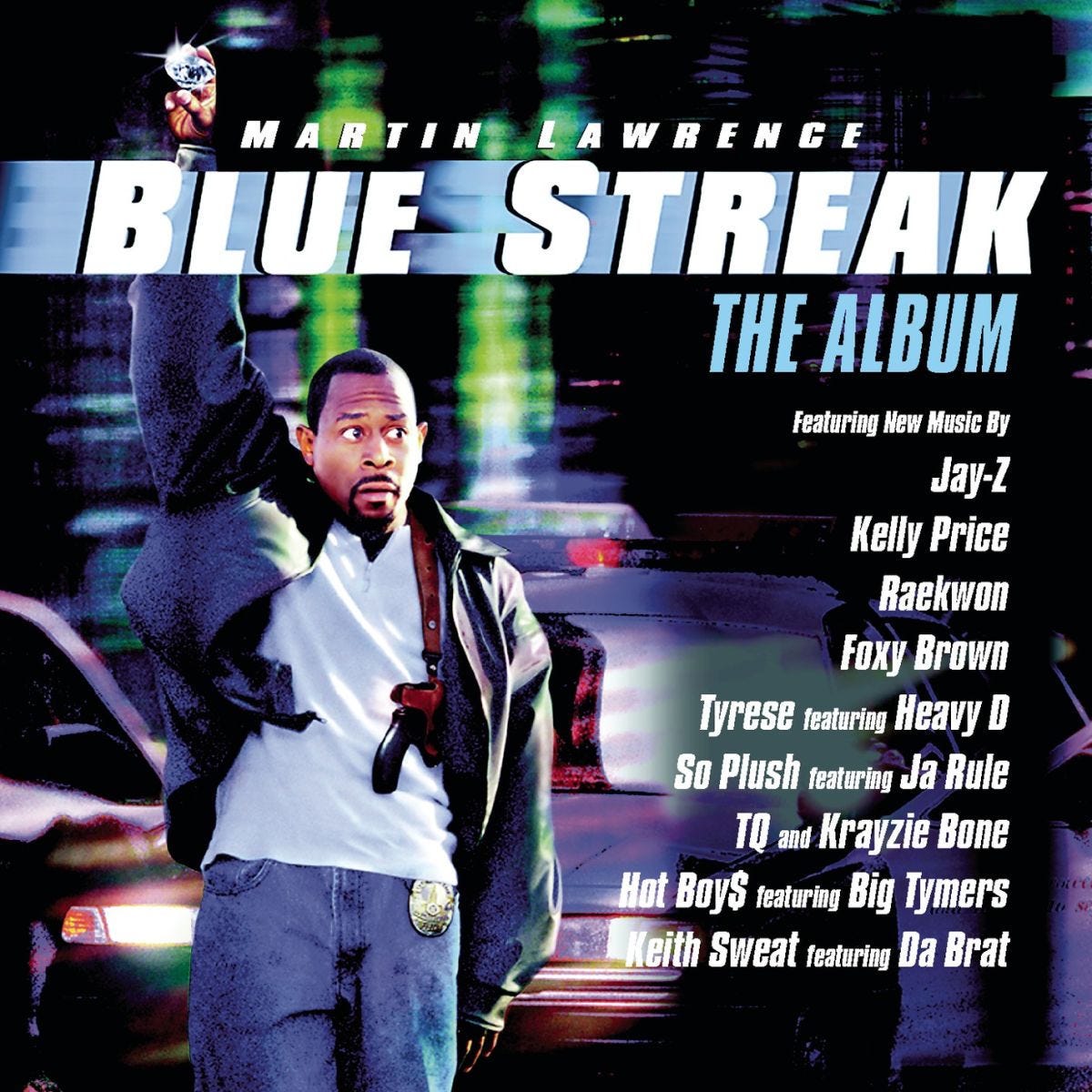
Martin Lawrence cop comedies don’t usually leave behind soundtracks anyone wants to revisit. The Blue Streak tie-in is the rare exception, one of the sharpest themed compilations of 1999. The premise that holds it together, very likely accidental, is a running argument between male and female artists about how gangsta rap has wrecked Black love. JAŸ-Z’s “Girl’s Best Friend” opens with him bragging that diamonds make him welcome anywhere; Kelly Price’s “While You Were Gone” is the answer record, sung from the perspective of the woman left behind while he was bragging. Foxy Brown’s “Na Na Be Like” answers Jay back with her own version of the brag. Tyrese and Heavy D split the difference on “Criminal Mind.” Keith Sweat and Da Brat share “I Put You On.” Raekwon and Chip Banks trade jewelry verses on “Blue Diamond.”
Whether anyone at Sony or Roc-A-Fella sequenced it that way on purpose is anyone’s guess. Play the disc end to end and you can hear late-90s rap and R&B going at each other in the same songs, sometimes inside the same chorus. Rehab’s “Gimme My Money” is the dark horse, a piece of vivid, unsentimental writing about ghetto fabulousness from a New York writer who never made another record anyone remembers. So Plush’s “Damn (Should’ve Treated U Right)” with Ja Rule charts. Lawrence’s cop comedy attached to it is forgettable. What sits on the disc absolutely is not.
The Best Man (Music From the Motion Picture)
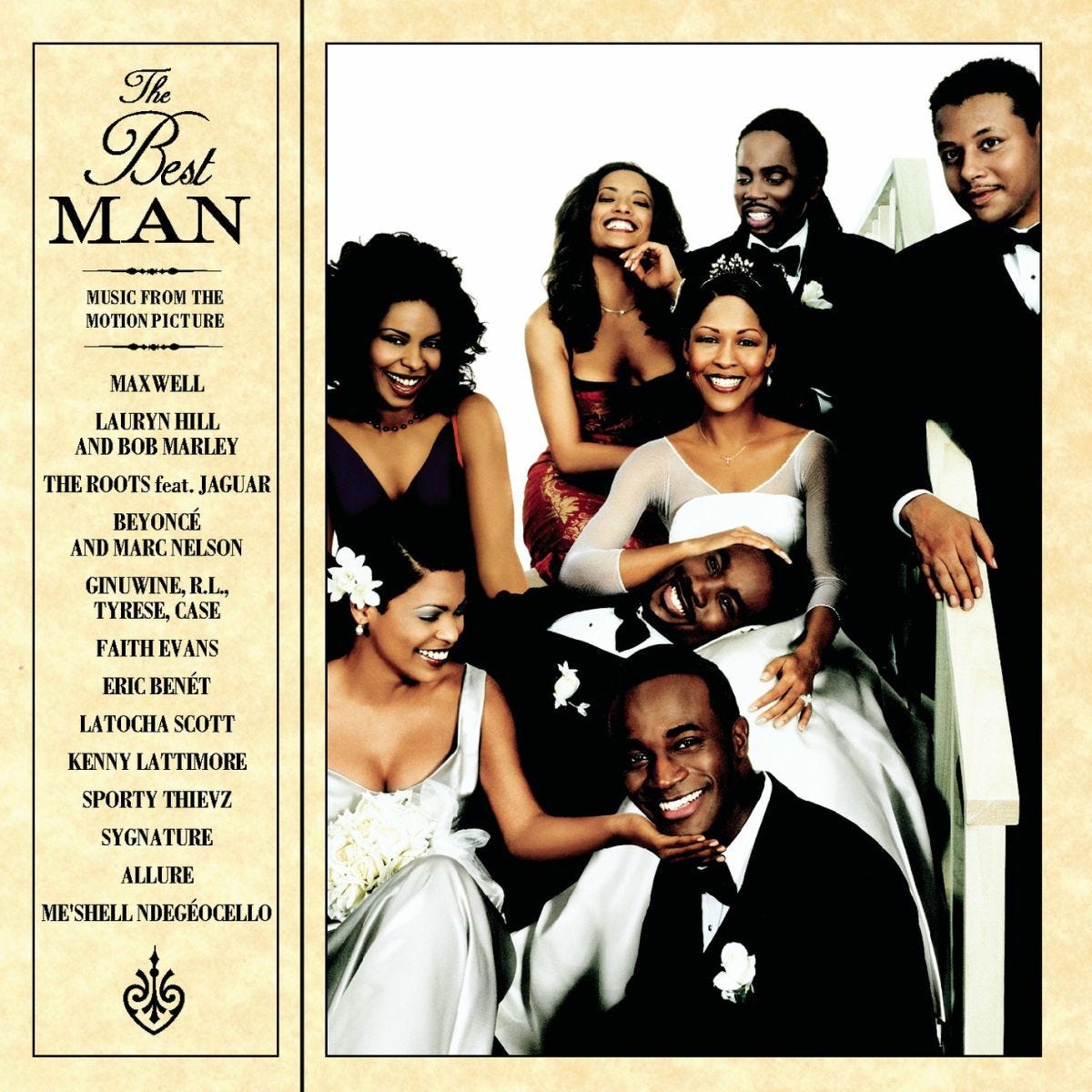
Out of all the Black wedding movies of the ‘90s, Malcolm D. Lee’s directorial debut had the best music supervisor, and probably the best Rolodex. The soundtrack matches the movie’s premise nearly to the letter. This is a record about Black grown-ups in love, sequenced by people who know what kind of music plays at a Black wedding reception. The Roots and Jaguar Wright open with “What You Want.” Maxwell, on a three-year sabbatical between Embrya and Now, contributes both “Let’s Not Play the Game” and “As My Girl,” and they’re sharper than half of Now. Lauryn Hill turns up with a posthumous duet alongside Bob Marley, “Turn Your Lights Down Low,” her vocal grafted onto the Exodus original to sing a love song with the late father of the man she was raising two children with. Faith Evans, Eric Benét, Kenny Lattimore, and Me’Shell Ndegéocello round out the slow-jam side.
The Beyoncé footnote here is the strange one. She and Marc Nelson share the lead on “After All Is Said and Done,” credited as Beyoncé Knowles three years before her actual solo debut, singing in a tone the rest of Destiny’s Child wouldn’t get to hear her use until Dangerously in Love. It is the first piece of music ever released with her name above the title, and barely anyone who bought The Best Man in 1999 noticed. Sporty Thievz pop up on “Hit It Up.” Allure, the Track Masters-signed girl group who’d gone to #4 on the Hot 100 with “All Cried Out” two years earlier, close out the lineup with “When the Shades Go Down,” a bedroom-funk slow jam that should have been a single. The comp is a sleeper R&B classic and one of the most listenable straight-through records anyone released that year.
Thicker Than Water
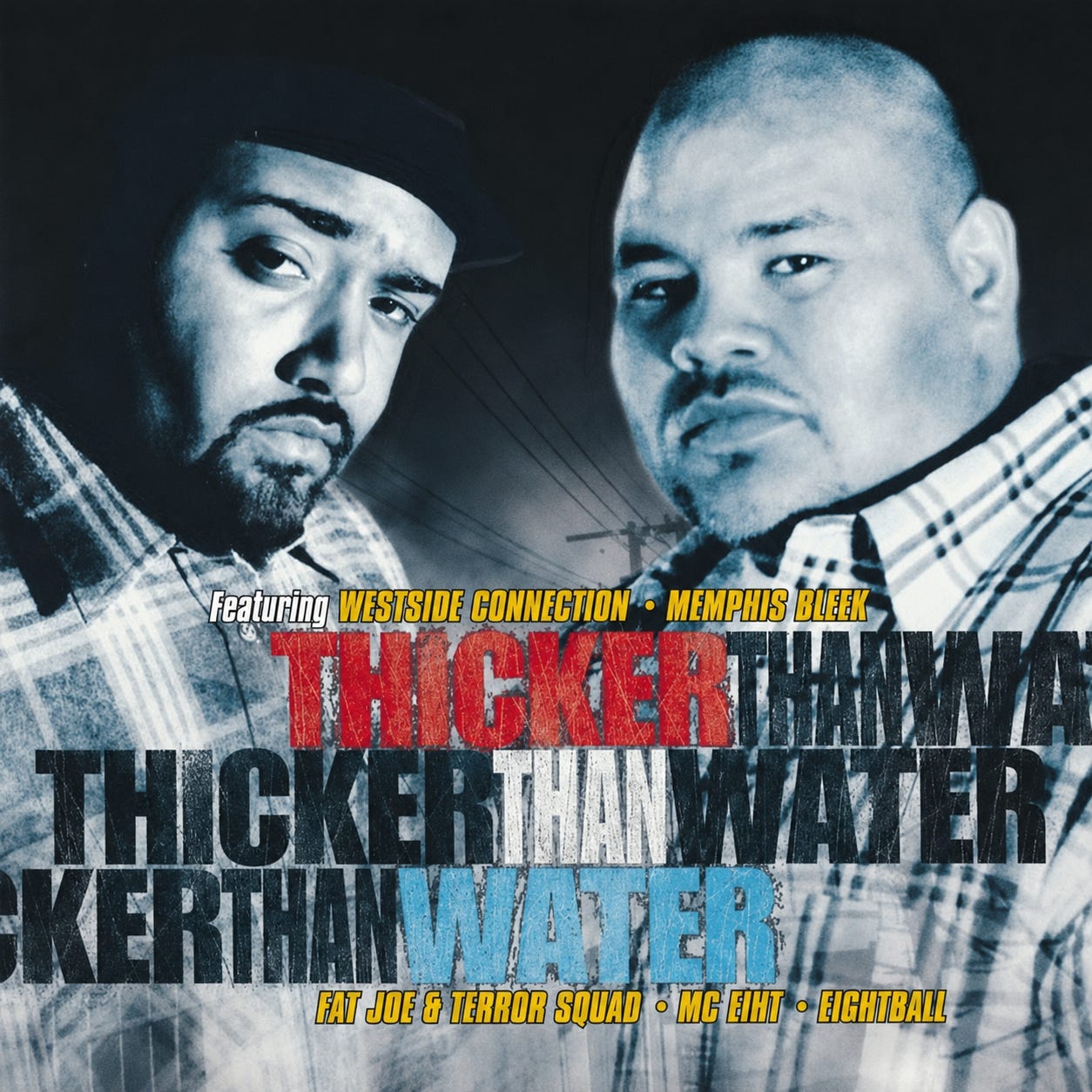
Who in 1999 actually thought a Mack-and-Fat-Joe gang movie nobody would see deserved twenty-eight songs across two discs? Mack 10’s Hoo-Bangin’ label, that’s who. With next to no quality control, you get one of the most accurate documents of where West Coast rap actually was in late 1999, costumed as a tie-in compilation. The doubled layout gave Mack space to cram in the entire Westside Connection extended family alongside East Coast cameos that wouldn’t have fit on a single-disc release. Westside Connection open with “Let It Reign.” Memphis Bleek slides over from Roc-A-Fella for “Live Life 2 Tha Fullest.” Fat Joe and Terror Squad pile onto “Thicker Than Blood.” 8Ball, MC Eiht, King Tee, CJ Mac, Children of Da Ghetto, and a young Tech N9ne all get songs. The bench is wide and the production values are 1999 indie-rap-budget rough.
What stays with you across both discs is the East/West truce visible everywhere, three years after Biggie. Memphis Bleek on the same disc as Fat Joe on the same disc as Mack 10’s whole crew is a sentence that wouldn’t have been possible in 1996. Half the songs are forgettable. Most of the rest got passed around on rap-blog ripped-from-promos lists for the next decade, the kind of rap nerd shit nobody who watched the movie ever heard. Movie went straight-to-video. Comp belongs in the year’s top tier of unintentional time capsules.
Music From and Inspired by Light It Up the Movie
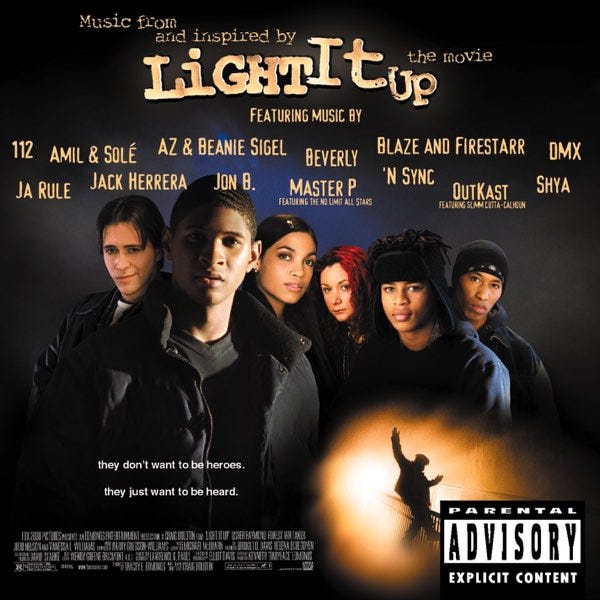
Of all the things Kenneth “Babyface” Edmonds and his then-wife Tracey Edmonds got up to at Yab Yum Entertainment, the LaFace-distributed boutique they ran together through the late ‘90s, the Light It Up tie-in is probably the most ambitious. A teen-hostage drama starring a 21-year-old Usher Raymond, soundtracked by Babyface and Edmonds across hip-hop, R&B, and one extremely strange slot for *NSYNC. Ja Rule’s “How Many Wanna” is the lead single and the only song that charted, but the curiosities are everywhere. AZ and Beanie Sigel team up on “That’s Real,” a pairing so unexpected it scans as a writing prompt; Amil and Solé collaborate on “First One Hit”; OutKast offer “High Schoolin’” with Dungeon Family second-stringer Slimm Cutta-Calhoun, a deeper cut than anything that made Stankonia. DMX’s “Catz Don’t Know” could pass for Flesh of My Flesh leftovers.
Master P shows up halfway through with the title song, a No Limit All-Stars piece that crashes Silkk, C-Murder, and Mystikal into the same hook. *NSYNC sing “If Only in Heaven’s Eyes,” for some reason. Jon B., 112, and a singer named Beverly Crowder turn in the slow jams. The whole thing is held together by nothing except the Edmondses’ Rolodex, and that’s enough. It went gold inside a month, made noise on the R&B chart, and gave Usher a soundtrack platform he wouldn’t actually need until 8701 a year and a half later.
Next Friday (Original Motion Picture Soundtrack)
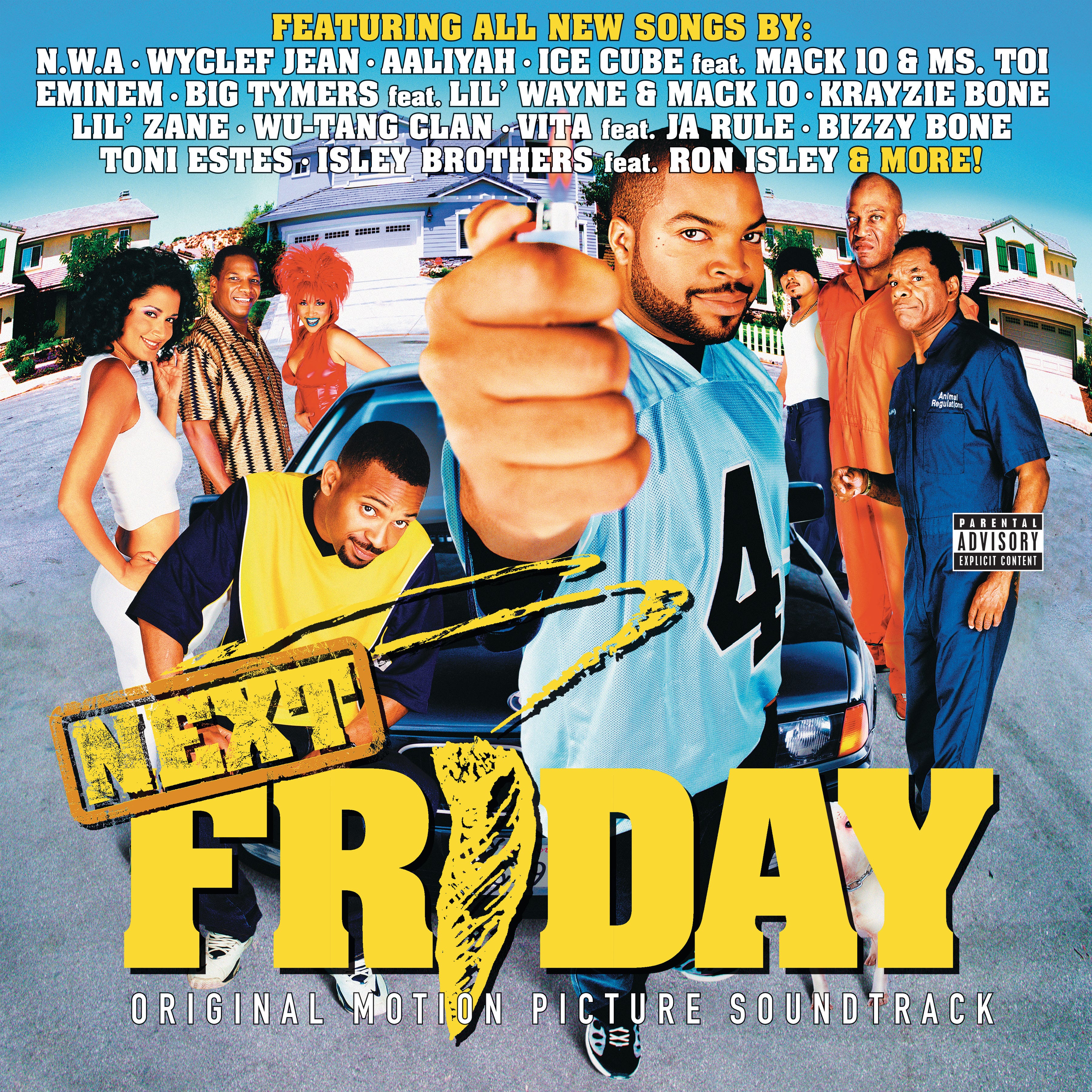
Three years before Detox was even being seriously discussed, before any official reunion announcement, the closest thing the world got to a working N.W.A. came out on a Friday-sequel soundtrack. “Chin Check,” produced by Dr. Dre, brought MC Ren and Ice Cube into a studio together for the first time since 1991, with Snoop Dogg standing in for the late Eazy-E on a verse that nobody in the group has ever talked about with much enthusiasm. The song moves the way a Dre beat from any of the years on either side of it does, all handclaps and talkbox bass and unhurried tempo, the same rolling West Coast confidence Dre had been refining since The Chronic. As of this writing, it remains the only N.W.A. studio reunion that was ever finished, and it lives on a comedy soundtrack instead of an album.
What Cube assembled around it is one of his better compilations. Cube produced the whole thing himself, and the choices are funnier and weirder than they had to be. Aaliyah’s “I Don’t Wanna,” a leftover from her Romeo Must Die sessions; Wu-Tang Clan’s “Shaolin Worldwide” produced by Mathematics; Pharoahe Monch’s “Livin’ It Up”; Big Tymers, Lil Wayne, and Mack 10 reprising the Cash-Money-meets-Westside-Connection axis on “Good Friday”; Eminem’s “Murder Murder,” which Cube licensed off The Slim Shady EP; Wyclef Jean’s reggae-leaning “Low Income”; Krayzie Bone’s title cut. Ice Cube’s “You Can Do It” with Mack 10 and Ms. Toi got a second life as a club staple eight years later. Vita and Charli Baltimore turn up with their own songs.
Six weeks separated the album from the film’s January 2000 theatrical run. That gap is part of what makes the comp the year’s best argument for the rap-soundtrack model. By the spring, when Napster started rerouting the industry’s money, every label that had been quietly making real records out of these comps would lose the budget to keep doing it. Next Friday is the last of the great ones, the form goes into slow-motion collapse after this, and nobody really noticed at the time.
Brings back memories 🫶🏿
What an amazing post.
Made me go back and listen to these, some which I have, others that I saw in the stores and passed on.