

The Woman She Armed Was Sold As a Kitchen Object
In 1972, she took the pencil out of a mammy notepad holder and gave it a rifle. Saar spent 54 years arguing that pictures of Black people are not decoration, and the institutions were wrong.
Its original purpose had involved actual labor. The figurine Betye Saar bought had been nailed to a tabletop in a Los Angeles flea market, designed for ease of work. One hand gripped a broom. The other held a pencil, and there was space at its side for a notepad, so a woman standing in her kitchen could store her grocery list on a Black woman reformatted as domestic utility. Saar bought that thing and removed the pencil.
She installed a toy rifle in its free hand and then set to on the environment around it. The Liberation of Aunt Jemima is not quite a foot tall, a shadow box with a glass front and sides about two inches deep, and inside it that figure balances on a bed of cotton. Where the notepad nestles beside her hand, Saar placed a vintage postcard, another mammy holding a white baby who weeps from her bosom, which Saar painted a Black power fist diagonally across. She tiled the back wall from side to side and top to bottom with Aunt Jemima pancake labels, so the brand’s face lines the box behind her in rows. Descriptions of her other accessories vary. The Berkeley museum that owns it says there is a grenade clip tucked between her body and right arm; Jonathan Griffin saw a pistol beneath her other arm; others placed a grenade in her unperturbed hand. No one questions the rifle or the broom.
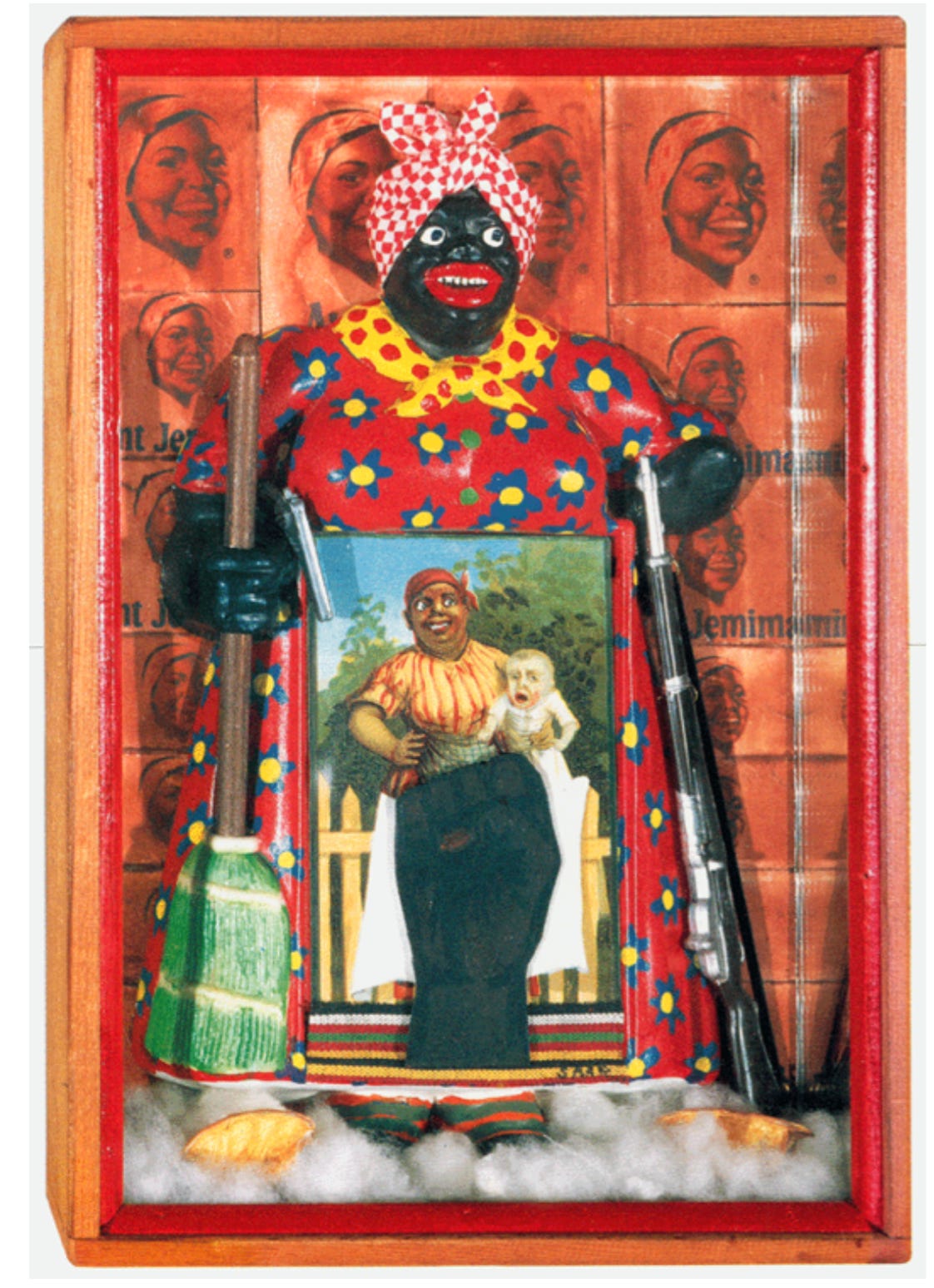
The Berkeley Rainbow Sign had asked for Black heroes, and Saar gave them one. King had been assassinated four years before. She lived then in Laurel Canyon with three small children and could not get out of the house and into the streets, and Angela Robinson Witherspoon, who interviewed her for a documentary filmed in 2023, has stated outright that Liberating Aunt Jemima was Saar’s response to his death and her means of participation in activism that her domestic duties prevented her from joining in person.
She’d had qualms about dealing with that iconography at all. Saar wanted to make images that transformed how Black people were seen “from victims into warriors,” and building that transformation required returning powerful negative images to circulation. Saar thought about white people looking at Black people whenever she worked, and what did or didn’t follow from that into how Black people looked at one another. It was deciding to make the figure a revolutionary instead of a soldier that settled her mind right. She never removed the broom from its other hand. Forty-eight years later, outraged Americans gathered in the street once George Floyd died because Minneapolis police had murdered him, and Quaker Oats eliminated the brand and admitted aloud that the name referred to a racist caricature.
Attacking Aunt Jemima meant attacking no one in particular, which was different from the atmosphere in 1997. Kara Walker had just received a MacArthur Genius Grant, and Saar drafted, distributed, and organized mailing for a letter that targeted elected officials, museums, and any big-name people working in the arts who agreed to read it. The letter objected to bad depictions of Black Americans on display inside institutions that featured almost no Black artists. It asked recipients to pull out their local museum catalog and look at the artwork included there, to call their museum to complain, and cautioned that she was shipping hers to their town next month. She called Walker’s contributions to the field “revolting and negative and a form of betrayal to the slaves, mostly women and children,” forthright interviews while Walker was working, enjoyed by white collectors. Walker responded in kind and never apologized. She’d hoped, she said, her projects would raise questions that could be argued over in Black community instead of sparking op-ed essays. It seemed ludicrous to Walker that anyone got to decide whether art should be seen at all. You either look or you don’t. She had no intention of stopping making it. Howardena Pindell made the same point through prints that year and wrote about the consequences later.
Seeing Joseph Cornell’s work at the Pasadena Museum of Art in 1967 sent Saar to the markets herself. When she began scouring them, she looked for objects that showed signs of previous existence, anything that had lived another life before moving through her hands. She called it mother- wit. Saar had been making prints longer than she made boxes. She worked etching and intaglio from early in her career and turned to soft-ground plates as early as 1965, inking them and stamping and stenciling on top; whatever else could hold an image was usually newsprint by then but sometimes made its way into that process too. Discarded things by other people entered Saar’s art long before it ever occurred to her to stand them up behind glass. Next, Saar went to Chicago. Museum of African Art wasn’t its name yet but something else. She spent most of her visit in its basement poring over African objects staff had put away until they could figure out what to do with them. African artworks resided in the basement of a natural history museum in 1970 because that’s where the country had chosen to park them. Chicago proved so fruitful that Saar referenced African motifs and figures throughout her work from then on.
Two years after her museum trip, the NEA gave her a grant, and Saar told interviewer after interviewer that year that it was the first time someone had made her feel like an artist. Before then she just made stuff. The Whitney gave her a solo in 1975, and her work represented the U.S. in São Paulo the year_before Obama got elected. Countless solo museum shows fell between those dates and after, more than seventy by Smithsonian count. Fondazione Prada did “Uneasy Dancer” in 2016; the following year Tate Modern included her in “Soul of a Nation”. Both major Los Angeles institutions hosted hers simultaneously that same day three years later, LACMA’s survey the first museum in California to attempt her entire career and the first anywhere to center her sketchbooks, MoMA’s built around Black Girl’s Window and forty-two drawings the museum had very recently acquired (she turned 93 that year and kept going).
That house in Laurel Canyon had been the studio from the start, and before there was a studio. There was the kitchen table. The studio was wherever she was able to make stuff, which had been the kitchen when she lived wherever they lived. Richard Saar married her while she studied art at UCLA in 1952. He worked ceramics and painted custom furniture; they divorced in 1968, and she took the top of their dining table with her when she left. Tracye Saar-Cavanaugh writes art. Alison Saar sculpts, and Lezley Saar makes photographs. Between them are six grandchildren.
Saar convened nine curators last summer to put in place what becomes of everything else now. Her archive will travel across town to the Getty Research Institute, and she and Julie Roberts are cooking up a catalogue raisonné, which also began last year. An upcoming biography by Zoé Whitley is in the works. Roberts says Saar still wants to make art, and garden, and see her grandchildren. The exhibition currently on view at her LA gallery features costume design. It hangs in the space she positioned it and will remain until further notice because it was meant to exist on a human body.
We will miss you, Betye Saar.