

Too Smart for the Room
The belief that rap audiences run from intelligence gets the defendant wrong; the case belongs to the industry, and to a country that once wrote Black literacy into its criminal code.
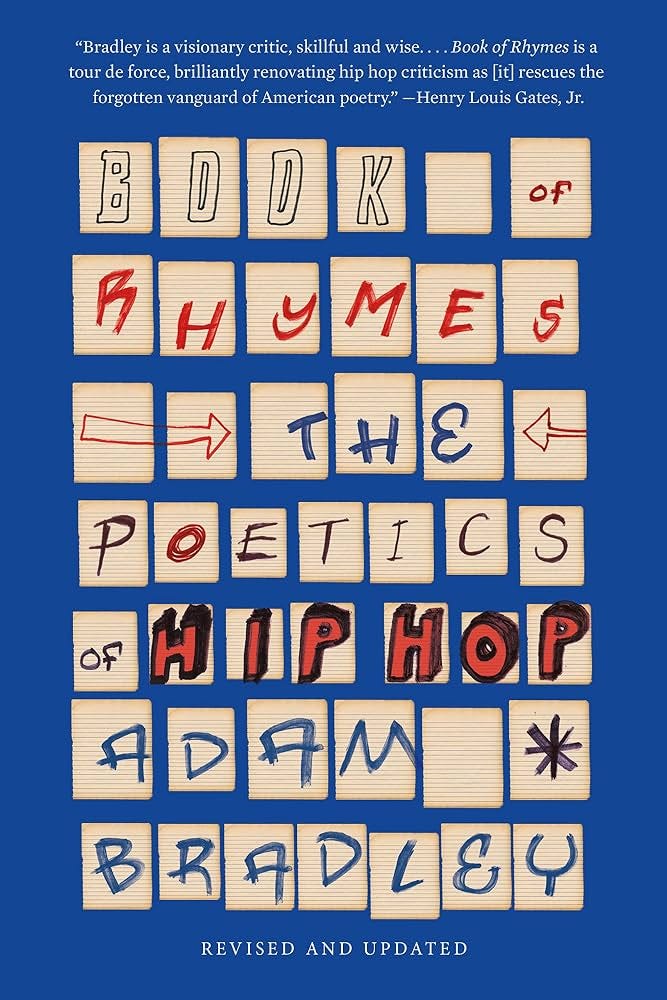
In the prologue to the Book of Rhymes, an interruption happens in a club show. The beat relinquishes, the MC leaves the stage, and the lyrics being performed flash up in bold print on the screen behind the crowd, rolling smoothly in clean lines. Some in the audience boo. Some leave the premises. The remaining start figuring out what they’ve been missing all along—rhymes hidden inside the lyrics, metaphors upon metaphors, rhythm generated by the language itself—and pretty soon their heads start nodding to a beat you can’t even hear. Adam Bradley, the critic responsible for staging this scene, went on to examine rap lyrics as thoroughly as an English seminar analyzes Yeats and Frost. His little fantasy also stages a charge that has hovered around hip-hop for decades and gained momentum in the last few years—the assertion that the crowd leaves when the lyrics become too challenging, and the rapper who seems to be too intelligent for the room ends up performing for the remaining nodders.
Lupe Fiasco voiced the charge in “Dumb It Down” in 2007—the song based on the industry executives’ advice that the double meanings cost him the market, while his lyrics are overloaded with abstractions in apparent revenge. MF DOOM stacked layers of triple entendre beneath his metal mask and remained a cult rapper while far less accomplished writers hit the platinum sales. And Black Thought is mentioned among the best living rappers every time peers and critics evaluate the skill, but the largest audience the Roots has ever attracted happened because they performed as the house band for a late-night talk show.
Then Kendrick Lamar continues to challenge the charge. DAMN. won the 2018 Pulitzer Prize in Music, becoming the first rap album outside classical and jazz ever to win it, a feat that the award committee described as a portrayal of “the complexity of modern African-American life,” and also made the smash single, “HUMBLE.” Then seven years later, the battle track “Not Like Us,” loaded with allusions, double meanings, and minute details, topped the charts and swept the Grammys before headlining the Super Bowl halftime stage. JAŸ-Z has been successfully selling complex, allusive writing for decades while no minimalist writer has managed to approach his sales figures. Ms. Lauryn Hill’s The Miseducation of Lauryn Hill—the dense, scripture—and literary-reference-filled first album to win the Grammy in the Album of the Year category in the hip-hop genre. OutKast rapped coded in the dialect of Georgia and spoke about apocalypse and elections and made diamonds.
Richard Hofstadter drew a convenient distinction in 1963 in his Anti-Intellectualism in American Life between intelligence, a quality valued highly by Americans whenever encountered, and intellect, the activity of the mind done for its own sake, which, as Hofstadter notes, elicits “resentment and suspicion”. The rap criticism also works along this dichotomy: the verse becomes intelligent if it is as complicated as an English paper, multisyllabic, full of allusions, worthy of quoting—anything else does not belong in the category of intelligent lyrics. By such a criterion, the South has been considered unsophisticated for decades, hence the booing in the room of New York tastemakers during the 1995 Source Awards, when André 3000 got hold of the microphone and announced that “the South has something to say.” The intelligence of the Pimp C verse is the timing, the economy, and the mastery of the dialect. The intelligence of the drill lyrics is the compression, the menace contained in the absence of information. Declaring that all of these forms of lyrics are not intelligent is not a verdict of the lyrics but a class statement with literary clothing.
The streaming service requires the listening time of thirty seconds to qualify the song as a stream. Hence, the lyrics that work are those grabbing the attention within twenty-nine seconds, and the payout in fractions of a cent per stream favors the material replayed out of reflex rather than the material replayed for studying. It is the playlist editors, the radio programmers, and the marketing budget that determine whether the songs will be available for listening at all. No listener can punish the verse that wasn’t even presented to them. When the label hears sixteen bars of dense lyrics and requests a catchy hook, as Lupe Fiasco captured the request on tape, the request is the commercial plumbing. Complexity delays the flow. Whatever gets narrated afterwards as the audience tastes is primarily the byproduct of ten thousand decisions about distribution made upstream, by the people paid to avoid skips.
Hugh Auld saw his wife teaching the letters to the enslaved boy in Baltimore in the 1820s and ordered her to stop, warning that learning to read would make the boy unmanageable and unfit for slavery. The boy was Frederick Douglass, and he remembered that the prohibition had taught him more than the lessons themselves. It was obvious from the panic in the order itself.
The panic was already statutory at the time. In 1740, South Carolina made teaching an enslaved person to write a crime in the amendment to its Negro Act, passed right after the Stono Rebellion. After David Walker’s Appeal spread in the Southern ports in 1829, Virginia amended its code in April 1831, prohibiting any gathering of free Black people for reading lessons, and after the Nat Turner rebellion in August, statutes proliferated and became tougher. In 1833, Alabama fined the teaching of any Black person, slave or free, how to spell, read or write. In North Carolina, they differentiated the penalties on racial grounds: whipping for a Black teacher, fines or imprisonment for a white one. Perhaps five to ten percent of the enslaved population could read in the country that made fear of literacy a statutory matter.
After emancipation, the policing switched locations. Disfranchisement was rebuilt around the literacy tests, with the exception for white men through the grandfather clause; reading, prohibited for a century, became the condition of the voting right at the very moment when much of the liberated population couldn’t afford it. Around 1900, approximately half of the voting-age Black men couldn’t read, compared to about twelve percent of white men—a disparity the tests were designed to exploit.
According to the 2023 PIAAC survey, a part of the OECD’s adult skills study, twenty-eight percent of American adults tested at or below the lowest literacy level, a share nine points higher than in 2017. On the 2024 NAEP, four out of ten fourth-graders failed to read above the basic level, the worst result since the introduction of the test in 1992, and about three in ten reached the proficient level. Decades of standardized testing of schoolchildren under No Child Left Behind and its successor resulted in classes being loaded with the test-preparation. The public that reads less is easier to serve, to advertise to and to poll. The same corporations that consider a rap listener in thirty-second increments don’t voice objections.
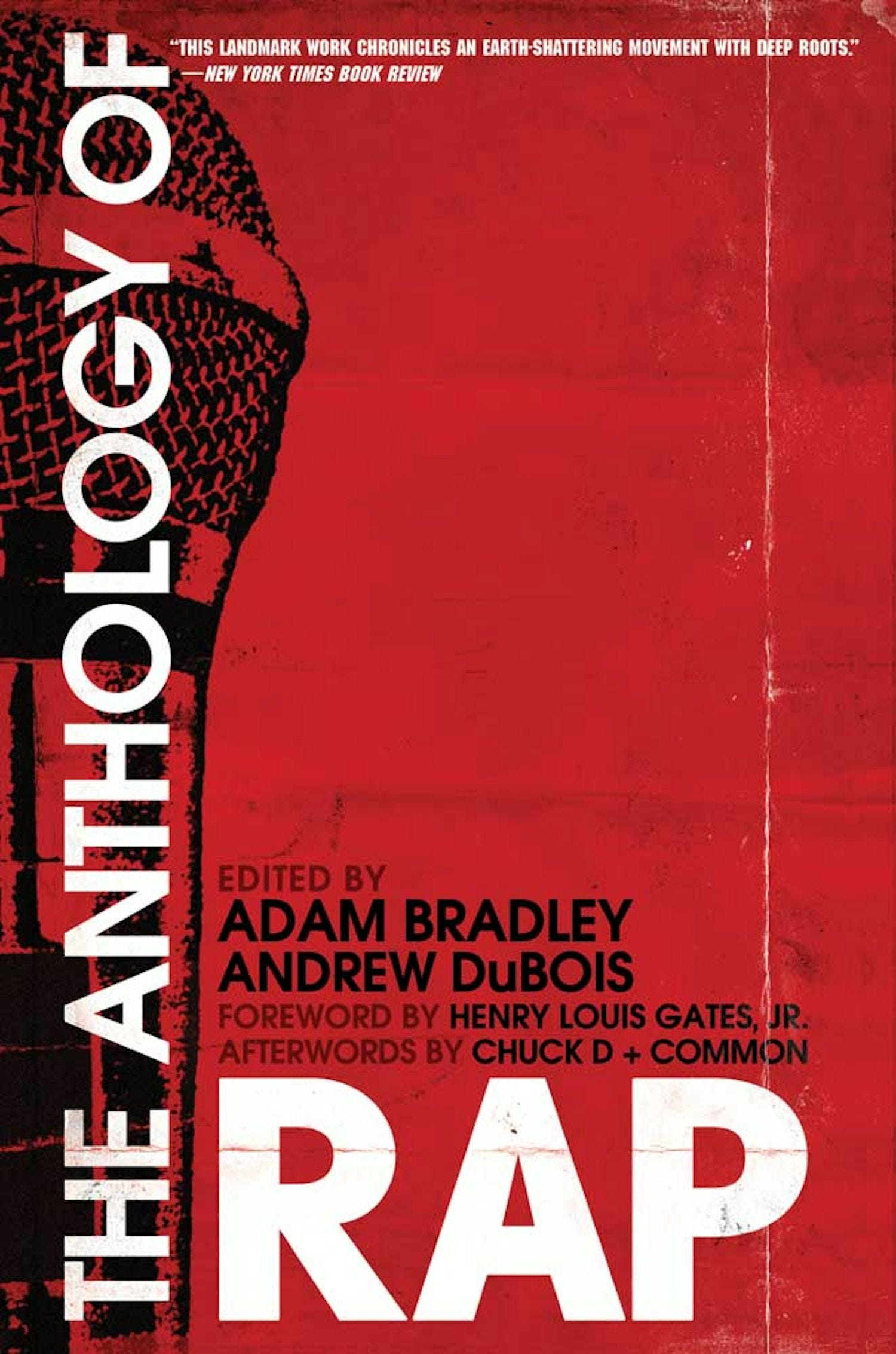
Eight hundred pages of transcribed rap verses appeared as The Anthology of Rap in 2010, published by Yale University Press and edited by Bradley and Andrew DuBois, with afterwords from Chuck D and Common. Henry Louis Gates Jr. has started the foreword with his father, born in 1913, reciting the Signifying Monkey toasts in rhyme, and tracing the evolution of the art form from the Dozens through toasts to MCs; twenty years earlier he testified in a Florida obscenity case that the rowdiest 2 Live Crew’s record was a parody in venerable tradition. The anthology immediately ran into a public correction after the Slate reporter compiled the list of mistranscribed bars, hearing errors printed in Yale typeface; the flap told as much as the book did about the ownership of the vernacular transcription and care. Bradley’s claim that rap lyrics are poems of which the mass popularity partially hinges upon the refusal to call them poetry rested comfortably in the midst of the entire affair.
The appetite is evident everywhere where the charge doesn’t expect to find it—on the syllabuses, in an anthology, on Genius, where the millions of listeners transcribe the verses line by line free of charge, just for the fun of catching the reference. Against this backdrop, the assertion that the crowd runs away from the difficulty looks misaddressed. The people telling Lupe Fiasco to dumb it down were the people who worked in the label. The programmers kept MF DOOM off the daytime radio airwaves without polling a listener in the Bronx. Any argument ending with the indictment of Black listeners for lack of sophistication repeats the oldest slander in the American file, the one stated in the 1740 statute—the problem with Black people and books lay with Black people. Douglass has answered the charge himself, teaching his hands to write by copying letters off the fence posts and pavement in the city where the lesson was contraband.
The text becomes instantly available, fluent and inexhaustible, practically free, and this flood reveals what the price of a sentence used to cover. Hugh Auld reads differently in this perspective. His fear went beyond the alphabet, aiming at the activities of a reading mind, and nothing about that fear has become irrelevant. A verse that requires several listens to be deciphered, a Rakim lyric, where rhymes occur inside the verse rather than at its end, a Black Thought freestyle lasting ten uninterrupted minutes on the live radio broadcast -all these are the testimonies of the activity of the human mind functioning at full capacity, and this value grows with the flood of generated filler covering all feeds.
Every statute, literacy test, playlist algorithm, and label’s request of simplicity worked to shrink the number of those who stick to the words on the wall. Yet the number kept increasing all the way through 1740, 1831, 1900, test-prep decades and up until February 2025, when the Pulitzer winner played a diss record constructed like the court document in front of the packed stadium in New Orleans.