

We Saw Michael, The Anticipated Biopic About Michael Jackson
Before discovering Michael in theaters tomorrow (on Wednesday, April 22), Shatter the Standards shares its advance impressions of this highly anticipated biopic.
It’s an understatement to say that this biopic, devoted to the man who remains perhaps the most publicized artist of all time, was under intense scrutiny. Let’s be honest: the few images and the trailer that circulated ahead of the film’s release didn’t exactly inspire optimism, and we feared a result that would fall short of the vast potential of a film about the King of Pop, especially since the soundtrack hinted at a story that wouldn’t go beyond Michael Jackson’s third solo album, Bad. Coming out of the top-secret screening we attended, the film directed by Antoine Fuqua left a far more positive impression. Fuqua, already known for Training Day, also directed music videos for Stevie Wonder (“For Your Love”), Prince (“The Most Beautiful Girl In the World”), and Coolio’s iconic “Gangsta’s Paradise” featuring Michelle Pfeiffer. Let’s not keep you in suspense.
Michael is a genuine success in ONLY without trying to match the level of detail of a documentary, the film remains precise enough to faithfully reconstruct the beginning of MJ’s career and the Jackson 5 (later the Jacksons) adventure without losing an audience that may be less versed in the lore than the mega-fans. Those die-hards won’t always find every last detail of the countless stories they know by heart, but they’ll likely appreciate the excellent performances, particularly Coleman Domingo’s striking portrayal of the fearsome patriarch Joe Jackson, young Juliano Krue Valdi’s highly convincing turn as the young Michael, and above all Jaafar Jackson, Jermaine Jackson’s son and therefore the star’s nephew, who acquits himself admirably in an incredibly difficult role, both onstage and off. At a time when the King of Pop is so often reduced to caricatures, not always in good taste, this role brings a welcome renewal of warmth and genuine passion for those getting enamored with his biography.
We also appreciated the film’s references to, and appearances by, figures like producer Bruce Swedien, guitarist Jennifer Batten, director John Landis, James Brown (glimpsed on a television screen in the Jackson living room without being named), Eddie Van Halen, Quincy Jones of course, and even, yes, you read that right, Prince! (We’ll let you discover that delicious reference for yourself.)
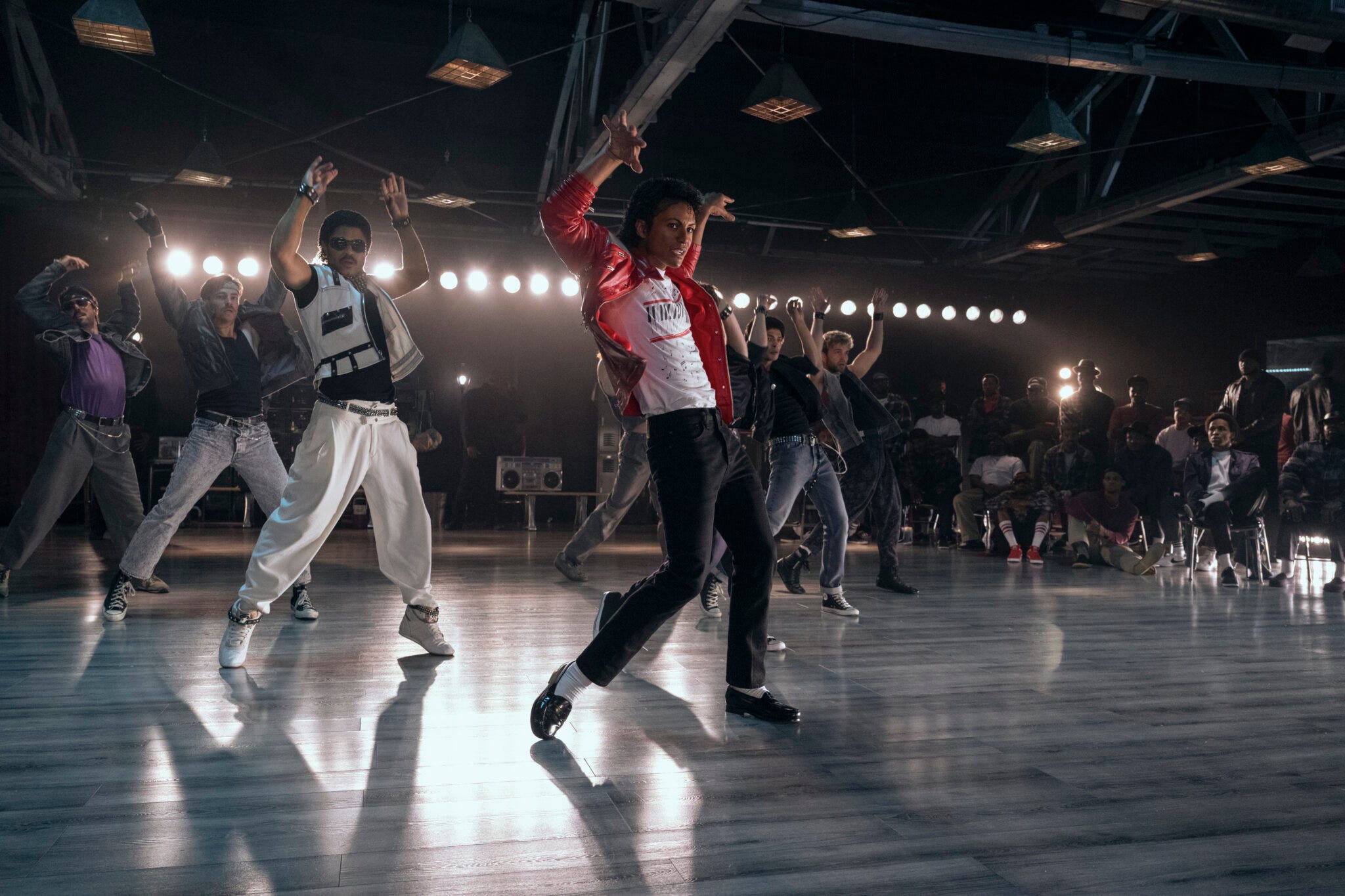
The emotion and the pleasure are immense in reliving key moments (often performance-based) of Michael Jackson’s career, faithfully reproduced but benefiting from a more cinematic treatment than you’ve seen before. You’ve never experienced the iconic first moonwalk at Motown’s 25th anniversary, or the 1984 Victory Tour (more on those later), quite like this. Elsewhere, there are passages that seem more fictionalized but are no less welcome, like the behind-the-scenes staging of the “Beat It” choreography, with a few hip-hop dancers embodying MJ’s debt to street dance. Without falling into the trap we feared of becoming a giant music video that could never replace the originals, Antoine Fuqua makes smart use of this magical repertoire to push the story further.
The film’s other great strength lies beyond its spectacular side. Even if Fuqua doesn’t take the same critical distance a documentarian might have, he delivers a portrait more nuanced than it first appears, and not entirely a celebration of Jackson. The film dwells heavily on his eccentricity, proportional to his talent, which set him apart from his brothers: his passion for games, toys, and video games, his pets (his rat Ben, the chimpanzee Bubbles, the snake Muscles, his llama, his giraffe), and above all an artistic and media ambition (the two were inseparable in his worldview) that far exceeded that of his siblings and possibly all of his contemporaries.
It would have been difficult to do otherwise, but the film addresses his harsh childhood and violent father fairly directly. Joe Jackson was driven by an ambiguous ambition, torn between a desire for social mobility to spare his children from “ending up in the factory” like him, in the working-class city of Gary, Indiana, and purely commercial impulses. The thorny question of what we owe Joe Jackson, the catalyst and architect of his sons’ career, is therefore tackled head-on. Michael Jackson himself once said that his father made him what he became, a statement heavier with meaning than it appears.
This explains Michael Jackson’s fierce will for independence, but also his unhealthy relationship with his own image from very early on: the mockery about his looks starting in childhood, the repeated surgeries as a way of forging his own image within a strange ideal of perfection and breaking free from his father’s likeness. In one striking scene, he justifies his changed appearance to his father with purely medical reasons, as the star continued to do in real life until the very end. But the unspoken need for a family rupture comes through clearly in the film, which goes as far as Joe Jackson’s firing by fax and Michael’s avoidance of a confrontation with his father that persisted well into his career.
Running beneath the surface is the question of the price of genius and entertainment, from a childhood sacrificed in the name of performance to the terrible burns Jackson suffered in 1984 during the filming of a Pepsi commercial (shown spectacularly in Michael), the beginning of a long, dark history with painkillers that would ultimately claim his life, as they did Prince’s. And you can’t help but think that this question extends far beyond MJ’s career alone, connecting in its own way to the stories of D’Angelo, Whitney Houston, and Prince, to name just a few, whose demons, sometimes very different from Michael Jackson’s but not always, weighed heavily on their trajectories.
Paris Jackson read an early version of the script, flagged inaccuracies, and got ignored. She eventually told the press the picture panders to a specific section of the fandom still living in the fantasy, which is a brutal thing for a daughter to say about a film depicting her father. Janet Jackson was reportedly unhappy after a family screening; neither woman attended the L.A. premiere. Enough journalists walked out of that premiere reaching for the same word, “sanitized,” that it stopped sounding like opinion and started sounding like consensus. But when the subject’s own daughter calls a biographical picture inaccurate, and the production doesn’t alter a frame, you already know more about who the movie was made for than any review can tell you. The estate and the family are not the same people.
The film’s entire original third act got cut during reshoots after producers reportedly discovered (late, apparently, which raises its own questions) that the script violated a legal clause in the Jordan Chandler settlement prohibiting any dramatization of Chandler’s story. In its place: a concert-finale victory lap ending at the 1987 Bad tour and a title card reading “His story continues.” Two hours of buildup: Joe Jackson’s abuse, Michael’s fixation on controlling his own image, the Pepsi burns cracking open a door to painkiller dependency. And the picture drops every thread at the threshold. You’re asked to applaud a Bad tour recreation while three unresolved storylines sit bleeding in the wings.
Miles Teller shows up early and keeps showing up. He plays John Branca as a steady, principled advisor who materializes at every crisis, the one adult in the room who always says the right thing. A warm performance that’s also, as it turns out, the performance of Jackson’s longtime attorney, co-executor of the estate, and a producer on this very film. How does that work, exactly? The person bankrolling the biopic is also a character being flattered inside it, and the picture handles this arrangement with the confidence of someone who’s never heard the phrase “conflict of interest”—the kind of move that would sink a documentary on contact and wouldn’t even be attempted.
Juliano Krue Valdi, the kid playing young Michael, is the cast member who sneaks up on you. All instinct, zero child-actor affectation. Domingo turns Joe Jackson into something genuinely unsettling: you watch his self-justification form in real time, which is harder to pull off than it sounds and far more interesting than any scene the script gives him after the first hour. Jaafar Jackson doesn’t impersonate his uncle so much as relocate himself inside his uncle’s body language, down to the head tilts, the hand movements during interviews, a physical specificity that’s (honestly) a little eerie to watch. These three deserved a script that followed the threads they were pulling. They got a concert movie with a dramatic intermission.
The picture spends real screen time on Michael’s relationship to his own face, his retreat into a childlike interior world, a perfectionism so consuming it visibly scares the people around him. Each of those threads could anchor a film by itself. Fuqua introduces all of them and then buries each one under the next set piece that needs recreating. The Motown 25 performance, the Thriller video shoot, the Bad tour. It’s the biopic treadmill at full speed: childhood hardship, breakthrough, interpersonal conflict, triumphant performance, repeat. The genre has been doing this since La Bamba, and Michael rides it as though the formula were contractually obligated, which (given the estate’s involvement) it very possibly was.
This may leave tons of viewers (and reviewers) unsatisfied, though in practice, Jackson’s more mixed artistic ventures from that period onward (despite their undeniable qualities) were arguably less suited to this “best of” film designed for the widest possible audience. Michael, while it doesn’t tell the whole story, may be the best way today to introduce MJ to a new generation: an entry point to the work and the life, including some of its darker chapters, of a star who continues to fascinate, to raise questions, and sometimes to unsettle. A sign that his music still belongs to our time.
Honestly very curious to see where they go from here, but the movie was enjoyable, albeit short.