

Who Told Spotify Hip-Hop Needed New Leaders
Spotify placed billboards in eight cities naming the artists it believes should lead hip-hop forward. The genre’s health was never the concern—the company’s bottom line was.
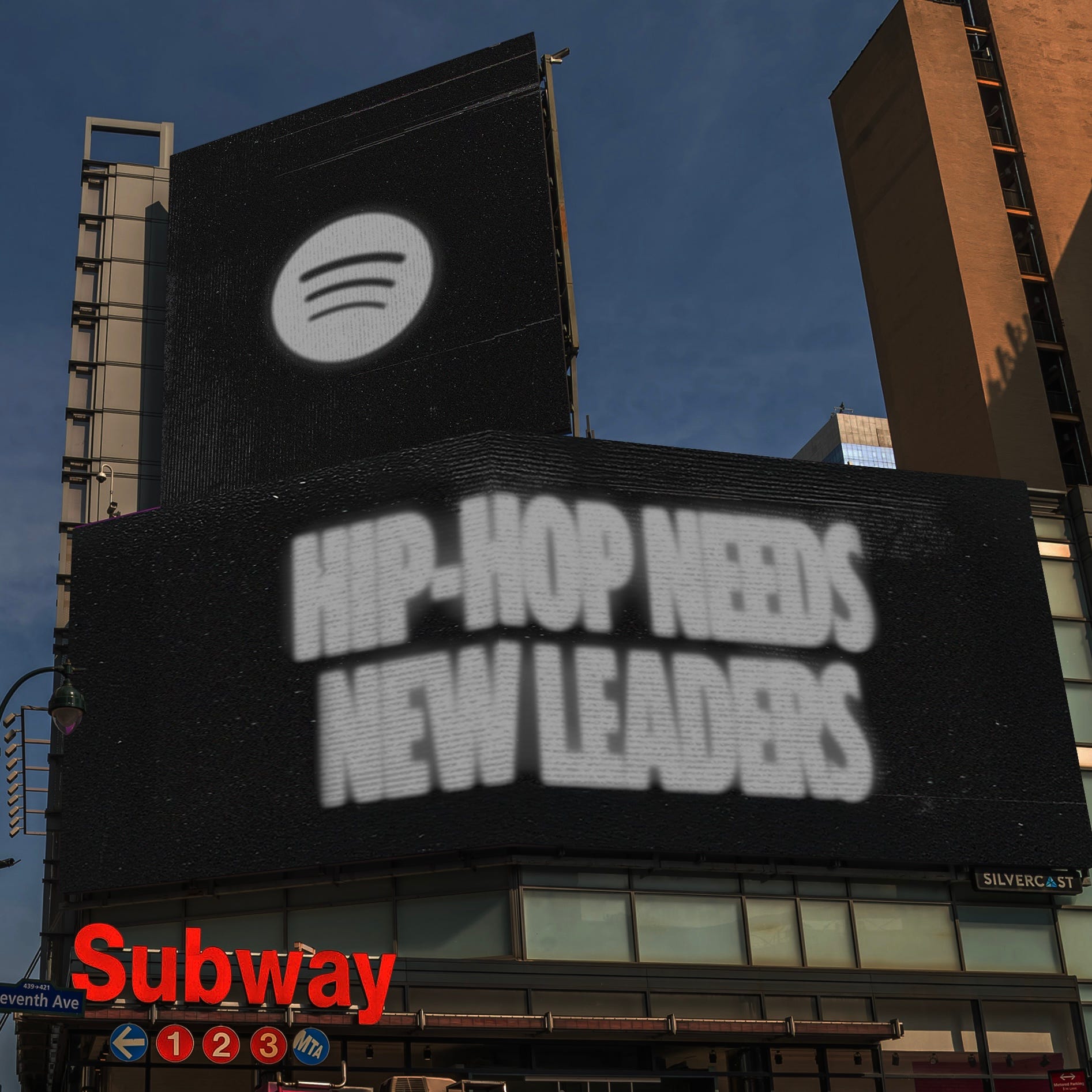
Last Monday, Spotify’s RapCaviar account posted a declaration on Twitter. “New superstars are essential to the health of the genre,” it announced, alongside billboards planted in major U.S. and international cities bearing the phrase “Hip-Hop Needs New Leaders.” The campaign named eight artists—Baby Keem, GloRilla, Doechii, Central Cee, Sexyy Redd, Rod Wave, Lil Tecca, BigXthaPlug—and invited fans to vote inside the Spotify app on which of them would carry hip-hop’s next generation. The accompanying copy cited Drake, Nicki Minaj, Kendrick Lamar, and J. Cole as the dominant stars of the 2010s and argued that a decade later, fresh faces needed to step forward. An $18 billion company diagnosed a vacancy in a genre that has never stopped producing talent and offered its own handpicked roster as the cure.
Look at that list of eight. Baby Keem records through pgLang and Interscope. GloRilla is on CMG and Interscope. Doechii signed to Top Dawg Entertainment. Central Cee records through Since 93 and Columbia. Rod Wave has Alamo and Geffen behind him. Lil Tecca operates through Galactic and Republic. Sexyy Redd distributes through Gamma, Larry Jackson’s billion-dollar venture backed by Eldridge Industries, Apple, and A24. BigXthaPlug runs with UnitedMasters. Six of the eight have traditional major-label deals. The remaining two have distribution partnerships with heavily capitalized companies that function like labels in all but contract structure. Spotify did not scour open mics in Baton Rouge or comb through SoundCloud uploads from the Southside. Spotify looked at its own data, cross-referenced it with existing commercial infrastructure, and printed what it found on vinyl banners above traffic.
Hip-hop generates roughly 30 to 32 percent of all streams on Spotify—the single largest genre share on the platform. When Spotify says the genre “needs” new leaders, the company is talking about its own supply chain. The word “health” does a lot of heavy lifting in that sentence. A healthy hip-hop, by Spotify’s accounting, means a handful of artists consolidating enough listener attention to drive playlist engagement, keep subscribers locked in through album cycles, and give advertisers a short, legible roster of faces to buy space around. A fragmented hip-hop, where dozens of regional stars pull modest but loyal audiences and no single name commands Drake-level stream counts, works fine for listeners. It does not work for a company that reported over $18 billion in trailing twelve-month revenue by mid-2025 and posted its first profitable year in 2024. Consolidated attention is the product. The eight billboards are the pitch deck.
RapCaviar carries 15.8 million followers. A placement on that playlist can spike an artist’s stream count overnight, and removal can quietly flatten momentum just as fast. The playlist has been called “the new Hot 97” for good reason—it inherited the gatekeeper function that once belonged to terrestrial radio programmers, MTV’s video selectors, and magazine cover editors. The difference is that Hot 97 never also owned the record stores. Spotify runs the distribution channel, manages the editorial playlists that determine visibility inside that channel, and now, with this campaign, produces the billboard advertisements declaring which artists matter most. The old gatekeepers were compromised in familiar ways: payola, personal relationships, regional bias. Spotify’s gatekeeping carries a corporate efficiency those older systems lacked, because the data that identifies who to promote and the platform that does the promoting are the same company.
In 2025, Spotify paid out $11 billion to the music industry—the largest annual disbursement from any single retailer. That figure earns the company goodwill and enormous leverage. When the entity writing the checks also curates the playlists that dictate which artists earn royalties at scale, the relationship between patron and beneficiary gets tangled. Spotify benefits from framing itself as a neutral distributor that simply gives fans what they want. The “New Leaders” campaign punctures that framing by making the promotional machinery visible. You cannot name eight artists on a billboard, place them on hometown posters, build an in-app voting mechanism around them, and then claim you’re just observing a cultural shift. You are manufacturing one.
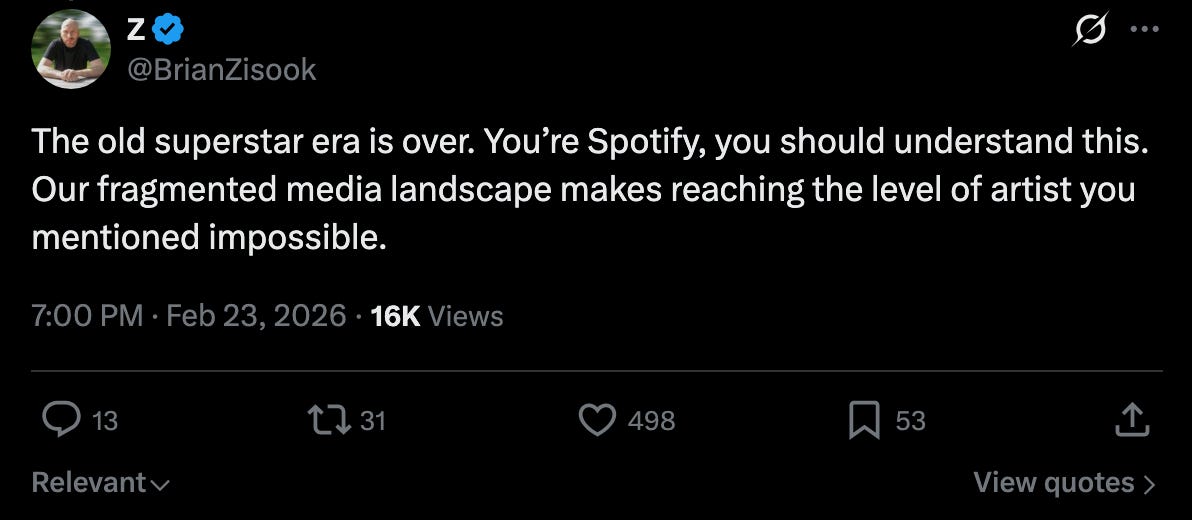
Audiomack cofounder Brian “Z” Zisook pushed back against the campaign’s premise directly. “The old superstar era is over,” he posted. “You’re Spotify, you should understand this. Our fragmented media landscape makes reaching the level of artist you mentioned impossible.” Trapital’s Dan Runcie drew a parallel to basketball’s perennial “face of the league” conversation, noting that the 2000s and 2010s stars remain the biggest names not because of talent gaps but because media fragmentation made that kind of consolidation harder to reproduce. Both responses pointed to the same problem. Spotify cast fragmentation as a crisis. Fragmentation is actually the natural outcome of a streaming economy Spotify helped build, where niche audiences sustain careers that never need to cross over. The company created the conditions, then complained about the weather.
The voting mechanism deserves its own scrutiny. Fans choose from eight candidates Spotify pre-selected, inside an app Spotify owns, with results Spotify tallies and presumably deploys in future marketing and advertiser conversations. The ballot is fixed before the first vote. Write-in candidates and independents were excluded by design, because artists without significant corporate backing don’t serve the campaign’s commercial purpose. The vote gives fans the feeling of participation while Spotify retains every meaningful decision: who gets nominated, where the billboards go, which playlists amplify the winners. Strip the fan-engagement language away and the structure is a promotional focus group.
GloRilla moved 69,000 units first week with Glorious in 2024. Doechii won two Grammy awards. Central Cee commands massive European streaming numbers. Rod Wave fills arenas. Nobody disputes their ability. So why did a Swedish technology corporation with 696 million monthly users and 276 million premium subscribers appoint itself the body that decides when hip-hop’s leadership has gone stale and who ought to step in? Hip-hop picked its own leaders for decades without a billboard budget from Stockholm. It selected them through mixtape runs, radio spins, club play, regional word of mouth, battle circuits, and the slow accumulation of respect that no algorithm can replicate or accelerate. Spotify’s campaign skipped all of that and went straight to the coronation.
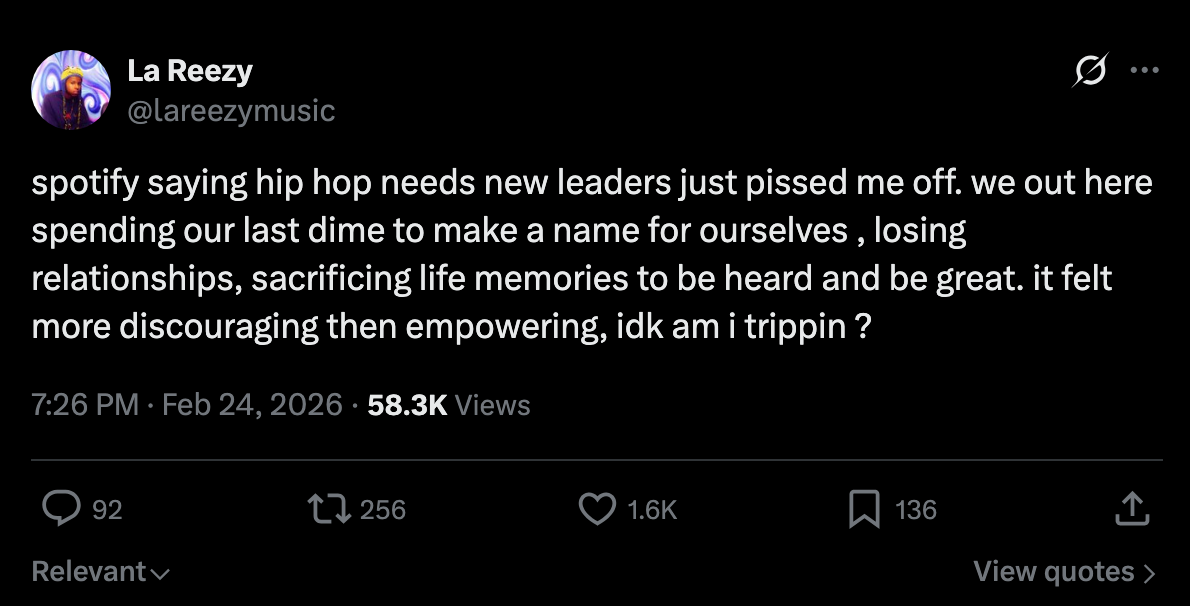
The sharpest response to the campaign didn’t come from an industry executive or a media analyst. It came from La Reezy, an independent rapper, who posted on Twitter the day the billboards went up: “spotify saying hip hop needs new leaders just pissed me off. we out here spending our last dime to make a name for ourselves, losing relationships, sacrificing life memories to be heard and be great. it felt more discouraging then empowering, idk am i trippin?” The post pulled 38,000 views and over a thousand reposts. La Reezy wasn’t trippin. When a corporation worth $18 billion announces that the genre needs saving, the artists grinding without corporate infrastructure hear something specific: you don’t count.
Spotify could spend its billboard money on something the genre actually needs instead of launching ICE ads and funding drones. Restructure a pay-per-stream model that still compensates most rappers in fractions of a penny. Stop bundling hip-hop into genre-agnostic playlists that flatten regional distinctions into one undifferentiated feed. Fund the kind of A&R work that requires leaving the dashboard and going to actual cities where artists perform for 200 people in rooms that don’t have Spotify logos on the wall. The company cleared $18 billion and paid artists $11 billion, a number it trumpets in press releases while individual rappers with millions of streams still struggle to cover rent. If Spotify wants to talk about the health of the genre, the conversation starts at the pay window, not on a billboard.
And Spotify is not the only party milking this. Hip-hop media has chewed on the “who’s next” conversation for years now, recycling the same four or five names that already feed algorithms and generate reliable traffic, running the same debate in slightly different packaging every quarter. Outlets that should be digging through local scenes in Milwaukee and Shreveport and Albuquerque, finding the artists who haven’t been pre-approved by a playlist editor, instead keep serving up the same consensus picks because consensus picks guarantee clicks. The question was never whether hip-hop has new talent. Talent is everywhere, in every city, recording on laptops and performing at open mics that no editorial playlist will ever surface. The question is whether anyone with a platform (Spotify, media, labels) is willing to do the tedious, unprofitable work of actually finding it, or whether they’d rather keep debating which already-famous artist deserves a bigger crown.
Somewhere in Dallas or St. Petersburg or Tampa, one of those eight artists woke up on a Monday and saw their face on a poster they didn’t commission, above a slogan they didn’t write, promoting a contest they didn’t design, for a company that will collect the ad revenue. Spotify called it leadership. The artist called it Tuesday. And somewhere else entirely, in a city with no billboard, no hometown poster, no in-app voting mechanism, somebody recorded a verse that nobody with purchasing power bothered to hear. So before you comment on which rappers should lead the next generation, the answer is down below.
Rappers to Watch in 2026

The center has not held, and the genre is better for it. Where previous years chased the mono-culture—a single sound, a single silhouette, a single city—the incoming class of 2026 thrives on fragmentation. These artists do not seek to flatten their regions or their references into a digestible paste. Instead, they double down on the idiosyncrasies of th…
Great read. It is ironic that Spotify is a gatekeeper now, when DSPs were supposed to democratize access and give all artistes a level playground to operate on.